









Topic Overview
Climate-Smart Agriculture Statistics: Climate-Smart Agriculture is an approach that helps farmers increase productivity while adapting to climate change and reducing greenhouse gas emissions. It focuses on improving food security sustainably through efficient farming practices, improved water management, and climate-resilient crops.
As climate conditions become more unpredictable, this method helps farmers protect their livelihoods while conserving natural resources for future generations.
Spotlight Article
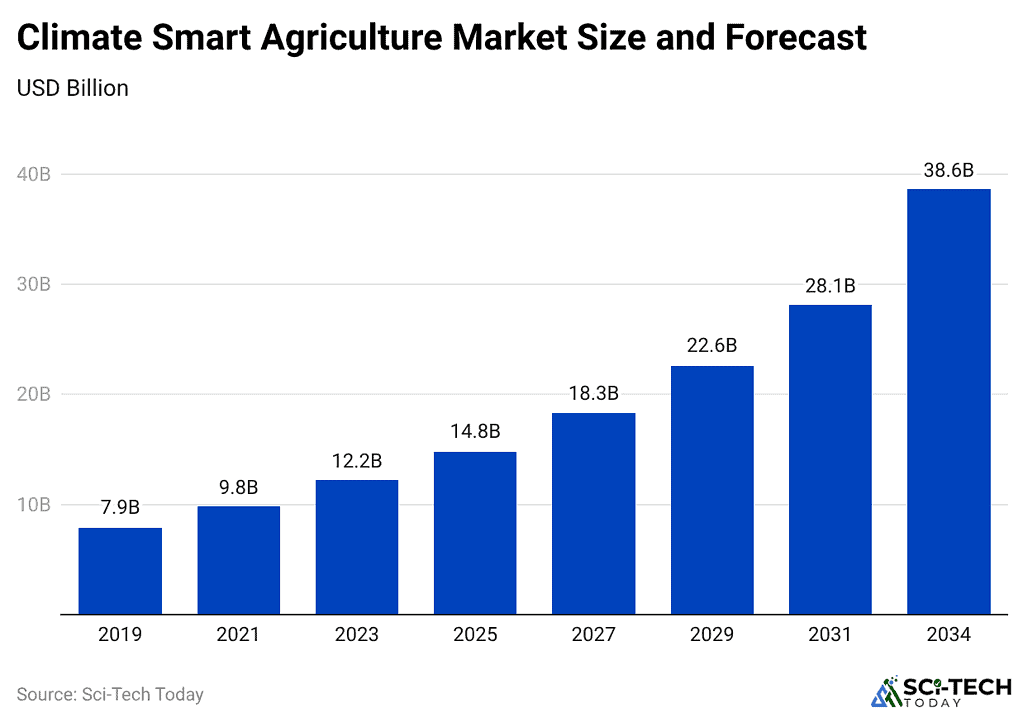
- The climate-smart agriculture market is valued at USD 14.8 billion in 2025 and is projected to reach USD 18.3 billion by 2027.
- The Asia-Pacific region led the climate-smart agriculture market in 2025, with USD 5.05 billion in revenue, accounting for 34.1% of global revenue.
- The Hardware segment led the market with 42.3% revenue share, worth around USD 6.3 billion.
- Precision Farming led the market in 2025, accounting for 38.7% of application revenue.
- The global agrifood system produces about one-third of global emissions, while food demand is expected to support a population of 9.7 billion by 2050.
- The World Bank increased CSA financing 8 times to nearly USD 3 billion annually under its 2021-2025 Climate Change Action Plan.
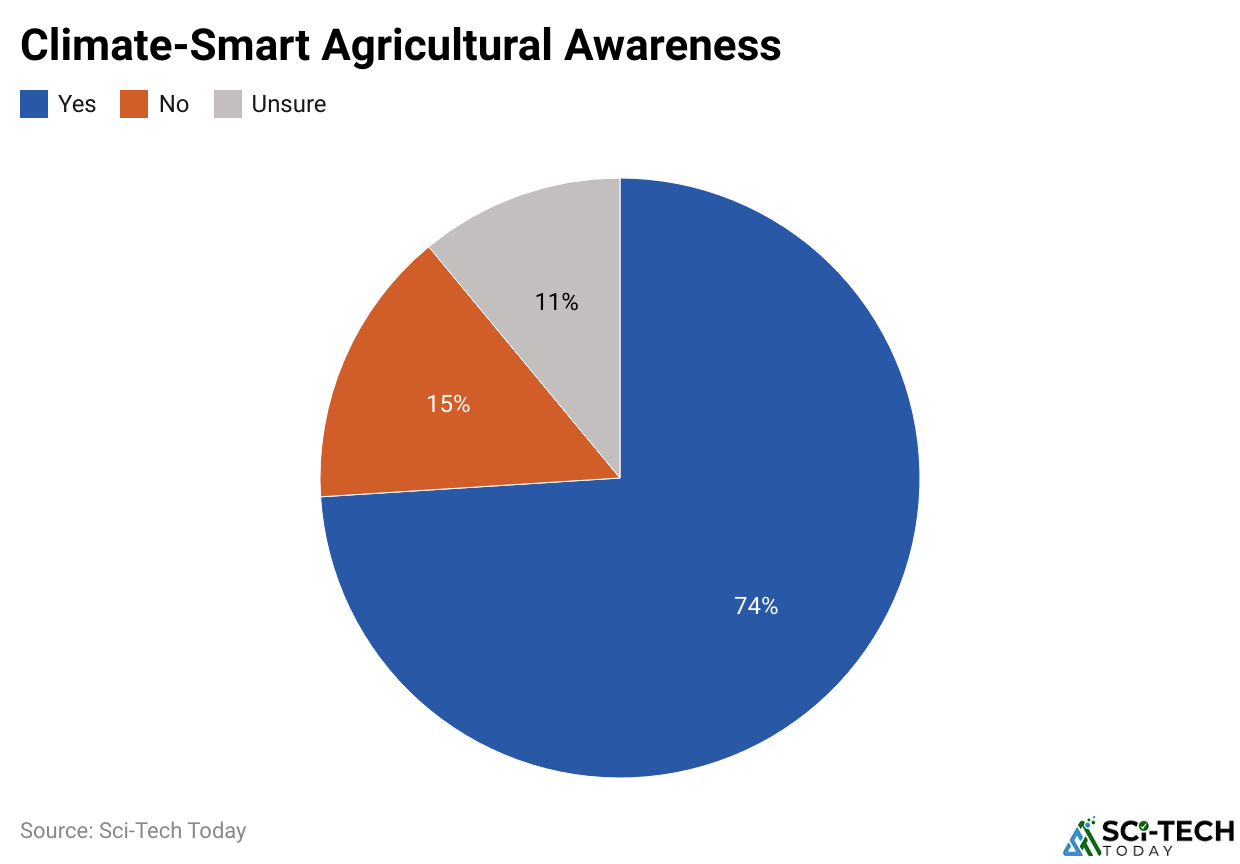
- The majority (73.79%) of SSUC farmers have heard of CSA practices, 15.53% are unaware, and 10.68% are unsure.
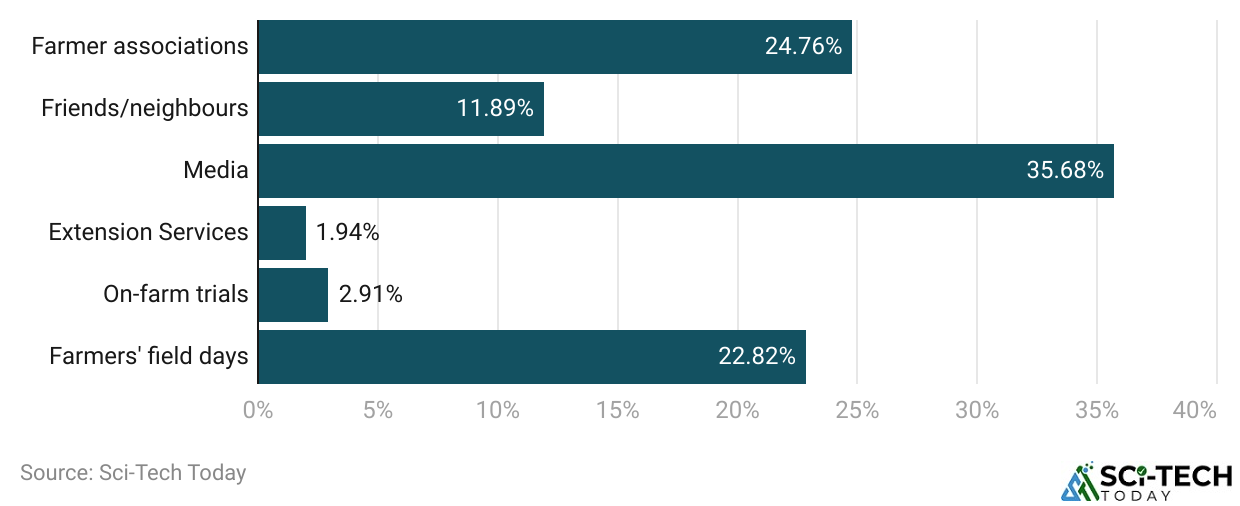
- About 36% of the sampled SSUC farmers referred to media sources, including radio, television, newspapers, and online platforms.
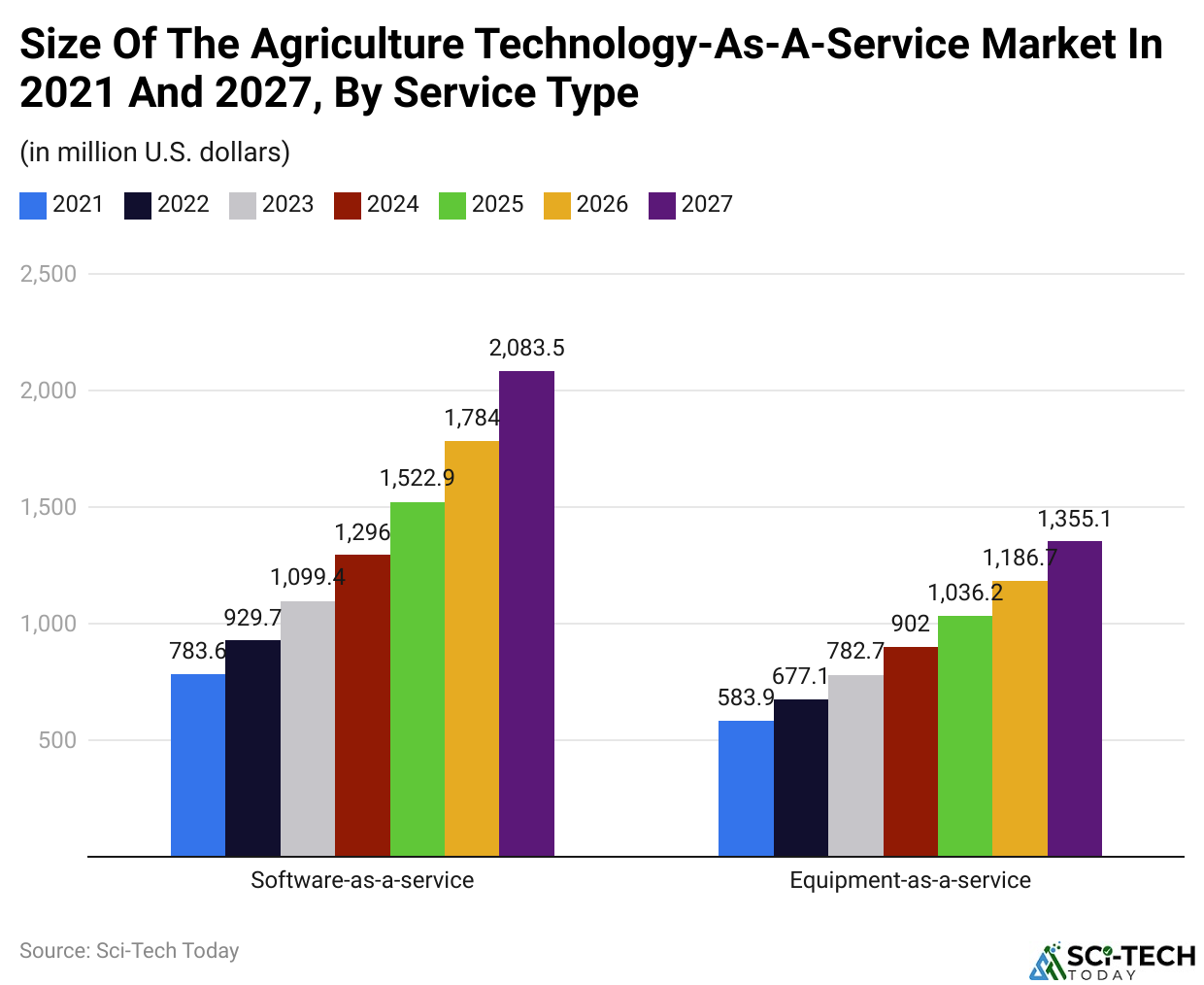
- In 2026, software‑as‑a‑service reaches USD 1,522.9 million, while equipment‑as‑a‑service hits USD 1,186.2 million.
- The smart agriculture market is expected to grow from USD 26.27 billion in 2025 to USD 29.48 billion in 2026 and USD 81.49 billion by 2035.
Climate Smart Agriculture Market Size
(Reference: dataintelo.com)
- The climate-smart agriculture market is valued at USD 14.8 billion in 2025 and is projected to reach USD 18.3 billion in 2027.
- By 2034, the market is forecast to reach USD 38.6 billion, more than double its 2025 value.
- An 11.2% CAGR supports this trajectory.
Regional Climate-Smart Agriculture Market Insights
- According to Data Intelo, the Asia Pacific led the climate-smart agriculture market in 2025 with USD 5.05 billion, accounting for 34.1% of global revenue.
- The region is expected to grow at a 12.8% CAGR through 2034, supported by CNY 12 billion (USD 1.65 billion) in China’s digital agriculture investments and India’s programs benefiting over 3.5 million farmers.
- North America held 27.6% of global revenue in 2025 and is projected to grow at a 10.4% CAGR through 2034, supported by the USD 3.1 billion U.S. Climate-Smart Commodities initiative.
- Europe accounted for 23.2% of revenue, backed by goals to reduce pesticide use by 50% and fertilizer use by 20% by 2030.
- Latin America and the Middle East & Africa together contributed 15.1% of global revenue in 2025. Latin America is expected to grow at 11.9% CAGR, while the Middle East & Africa is forecast to expand at 10.7% CAGR through 2034.
By Components
- The Hardware segment led the market with 42.3% revenue share, worth around USD 6.3 billion, and is expected to grow at a 9.8% CAGR through 2034.
- Drone prices fell by 31% between 2021 and 2025, while about 2.4 million multi-spectral camera kits were shipped in 2025.
- The Software segment accounted for 31.4% of market revenue in 2025 and is projected to grow at the fastest CAGR, at 13.1%, through 2034.
- More than 180 million acres were digitally managed using leading software platforms in 2025.
- The Services segment accounted for 26.3% of revenue in 2025 and is forecast to expand at an 11.8% CAGR through 2034.
By Application
- Precision Farming led the market in 2025, accounting for 38.7% of application revenue, and is expected to grow at a 12.3% CAGR through 2034.
- It helps farmers improve efficiency and reduce input use by 15% to 30% through smart technologies.
- Livestock Monitoring accounted for 21.4% of revenue in 2025 and supports better animal health, feeding, and emission management.
- Livestock contributes about 14.5% of global greenhouse gas emissions, making digital monitoring increasingly important.
- Aquaculture accounted for 14.2% of revenue in 2025 and is projected to grow at the fastest CAGR, 13.7%, through 2034.
- Forestry represented 12.8% of revenue, while Other applications, including greenhouse automation and urban agriculture, accounted for 12.9% in 2025.
Climate-Smart Agriculture Trends and Key Findings
- Global agricultural production must increase by 70% by 2050 to meet rising food demand driven by population growth and changing consumption patterns.
- Climate change is expected to reduce farm productivity and create greater production risks, especially in regions already facing food insecurity and environmental challenges.
- Agriculture accounts for 14% of global greenhouse gas emissions, while deforestation and land degradation account for another 17%, making sustainable farming essential for climate action.
- Climate-smart agriculture promotes better management of land, water, soil, and biodiversity through practices such as conservation agriculture, agroforestry, improved livestock management, integrated pest management, and sustainable fisheries, building resilient and productive farming systems.
Global Progress and Investment Highlights
- The global agrifood system produces about one-third of global emissions, while food demand is expected to support a population of 9.7 billion by 2050.
- Climate-Smart Agriculture improves productivity, strengthens climate resilience, and reduces greenhouse gas emissions through improved farming practices and technologies.
- Around 75% of the world’s poor depend on agriculture for their livelihoods, making CSA critical for rural development.
- Although agrifood systems generate one-third of emissions, they receive only 4% of global climate finance, and just one-fifth of that funding reaches smallholder farmers.
- The World Bank increased CSA financing 8 times to nearly USD 3 billion annually under its 2021-2025 Climate Change Action Plan.
- Major investments include USD 345 million in China, USD 621 million in Eastern and Southern Africa, USD 200 million in Pakistan, USD 125 million in Jordan, and USD 4.1 billion from the Government of China. Jordan’s program will support 30,000 farming households, create about 12,000 jobs, and run over the next 5 years.
Climate-Smart Agricultural Awareness
(Reference: mdpi.com)
- The data regarding climate-saving agriculture statistics gave insight into the awareness level of SSUC farmers regarding climate-saving agriculture (CSA) practices.
- It was revealed that the majority (73.79%) of SSUC farmers have heard about CSA practices, 15.53% do not know about them, and 10.68% are unsure.
- Such a high level of awareness indicates that most farmers in the province have heard about CSA practices and are likely to adopt them.
- On the other hand, informed farmers are more likely to adopt such CSA practices, transforming their skills and knowledge.
- However, a portion of eThekwini SSUC farmers did not know about CSA practices, which may have emanated from poor outreach and education programs.
- Awareness, therefore, becomes a major barrier to the successful adoption of CSA.
- Interestingly, some farmers probably even use CSA practices.
- So, addressing these communication and awareness barriers in improved ways should be of utmost priority.
Information Sources For Climate-Smart Agricultural Practices Among Small-Scale Urban Crop Farmers
(Reference: mdpi.com)
- Climate-smart agriculture statistics depict how different SSUC farmers access different information sources to raise awareness about CSA practices.
- About 36% of the sampled SSUC farmers referred to media sources, including radio, television, newspapers, and online platforms.
- While the media is said to play an important role in spreading CSA practices, it often does not provide sufficient detail for successfully implementing the methodologies of specific CSA practices.
- The second source of information was farmer associations (indicated by about 25%), followed by farmer field days (about 23%). Other information sources are farmer associations, field days linked to research institutions, and first-time experience.
- Other sources of information include friends and neighbours (12%) of the sampled SSUC farmers, on-farm trials (3%), and extension services (2%).
- Friends and neighbours, on-farm trials, and extension services are critical sources of information for CSA practices.
- However, without SSUC farmers fully exploiting these sources, this may hinder the large-scale adoption of CSA practices.
Efforts To Enhance Sustainable And Climate-Smart Agriculture
- According to Climate-Smart agriculture statistics, as a loan supporting green agriculture and rural development in Hubei and Hunan provinces in China, the US$345 million Program aims to reduce greenhouse gas (GHG) emissions resulting from crop and livestock production activities as well as improve carbon sequestration within farmlands and conserve biodiversity within agricultural ecosystems; it seeks to increase the capacity of local governments to accommodate environmental and decarbonisation targets into rural revitalisation strategy.
- Besides, the program will be complemented by an additional US$4.1 billion commitment from the government of China.
- This program, funded by the U.S. International Development Agency with US$621 million, is expected to enhance the resilience of food systems and preparedness to mitigate food insecurity in countries such as Kenya, Comoros, Malawi, and Somalia.
- Climate-smart agriculture statistics show that there are six components aimed at boosting agricultural production capacity, promoting climate-smart and gender-sensitive farming technologies, and strengthening productivity among crops, livestock, and fisheries sectors to withstand shocks and stressors.
- US$200 million will support Pakistan in its endeavours to enhance agricultural water access and productivity and to improve farmers’ incomes.
- The project will address mismatches in water use among users, enhance per-unit water output for specific crops, increase the area under high-value crop cultivation, and provide other important climate adaptation and mitigation benefits.
- This program, with US$125 million in assistance, will bolster Jordan’s agri-food sector in terms of climate resilience, competitiveness, and inclusion.
- Over five years, it will help 30,000 farming households adopt climate-smart and water-efficient practices, impart customised training, create almost 12,000 jobs, and advance the value chain and export promotion.
- In this respect, the program also happens to be relevant to the National Sustainable Agriculture Plan of Jordan in enhancing the livelihoods of women, youth, and refugees.
Agriculture Technology-as-a-Service Market Size
(Reference: statista.com)
- The software-as-a-service market is expected to grow strongly, increasing from USD 1,784.0 million in 2025 to USD 2,083.5 million in 2027.
- Equipment‑as‑a‑service also expands from USD 1,036.2 million in 2025 to USD 1,355.1 million in 2027.
- In 2026, software‑as‑a‑service reaches USD 1,522.9 million, while equipment‑as‑a‑service hits USD 1,186.2 million.
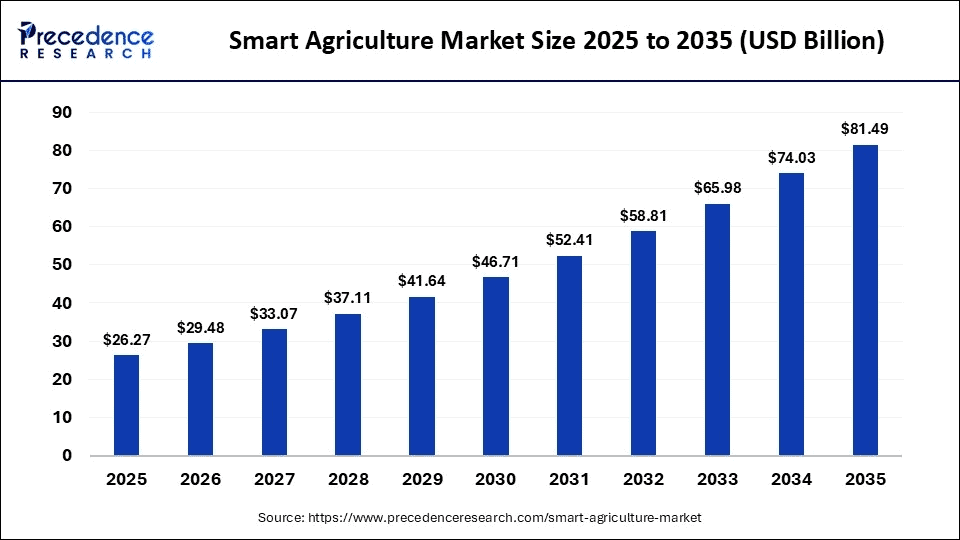
Smart Agriculture and Agritech Market Insights
(Source: precedenceresearch.com)
- The smart agriculture market is expected to grow from USD 26.27 billion in 2025 to USD 29.48 billion in 2026 and USD 81.49 billion by 2035.
- Advanced connectivity could generate USD 500 billion in global agricultural GDP by 2030 and improve farm productivity by up to 9%.
- According to Coherent Market Insights, smart agriculture solutions are projected to reach USD 20.90 billion in 2026 and USD 44.50 billion by 2033.
- AI, IoT, drones, sensors, robotics, and cloud platforms help improve yields, save water, reduce input waste, and support climate-smart farming.
- Autonomous harvesting equipment is forecast to reach USD 7.7 billion, while agricultural automation and robotics are expected to exceed USD 1.1 billion by 2027.
Challenges In Climate-Smart Agriculture
- Although food security is inseparably tied to water security, the availability of water for agricultural purposes has become the main challenge to food security and the sustainable development of climate-smart agriculture on a global scale.
- Climate-Smart agriculture statistics estimate that global water demand will increase by 55%, and the current status of water scarcity is being aggravated, affecting agricultural water users worldwide.
- It is proven that agriculture has a greater negative effect on yield and quality owing to a shortage of water; for example, in Turkey, less availability of water led to reduced yields and protein content in sweet corn, ear yields, and marketable ear numbers, and essential micronutrients like Fe, Zn, and Cu in kernels decreased leaf area index.
- In Northwest China, medium to low risks of agricultural water shortage were recorded for 2010; however, these risks were projected to range between medium and high levels in 2030.
- Reduced rainfall corresponded with decreased grain yield and water-use efficiency for the key dryland agricultural region of the Loess Plateau.
- Similar to coal mining areas, areas generally facing severe environmental conditions face a significant shortage of both water and nutrients, which hampers plant growth.
- Climate-smart agriculture statistics have shown that the application of water along with nitrogen and phosphorus could be beneficial for ecological restoration in arid regions.
- Agricultural water resource assessment is of utmost importance in long-term planning and management.
- For example, South Korea’s irrigation-dependent agriculture is susceptible to seasonal changes in rainfall and the quality of the available water.
- In addition, climate variability-exacerbated droughts and heat waves have worsened water resource shortages and the temporal and spatial unevenness of supply.
- Climate-Smart Agriculture statistics indicate that supply and demand estimation regarding agricultural water resources will increasingly be a priority for further advancing CSA initiatives in the wake of climate warming.
Closing Remarks
Climate-smart agriculture is important for growing food safely and sustainably. It helps farmers adapt to climate change, use resources more efficiently, and reduce environmental harm. Improved farming methods, better water use, and stronger crop choices increase productivity and stability.
Overall, it supports long-term farming success and helps build a more secure and resilient food system for the future.
FAQ
The concept of Climate-Smart Agriculture (CSA) was introduced by the Food and Agriculture Organization (FAO) in 2010 to promote sustainable, resilient, and climate-friendly farming practices.
The “Triple Win” concept improves productivity, strengthens climate resilience, and reduces greenhouse gas emissions through sustainable farming practices.
How does Climate-Smart Agriculture differ from traditional sustainable agriculture?
Climate-smart agriculture emphasizes climate adaptation and emissions reduction beyond traditional sustainability practices.


