









Introduction
Ridesharing Industry Statistics: The year 2025 has seen a rise in the use of ridesharing services, thanks to the growth of the on-demand economy. Ridesharing activities have disrupted local commuting patterns and mobility as a whole. Entrepreneurs and companies such as Uber, Lyft, and Didi have also adapted to the contemporary demand by reinvesting in their services, among other things, driving the focus further on ease, cost, and availability.
This paper discusses the ridesharing industry statistics in 2025 based on the key issues of the year, industry dynamics, and highlights of customer structure in detail.
The Editor’s Ultimate Picks
- In 2023, global ride‑hailing and taxi services counted around 1.69 billion users, with forecasts indicating about 1.89 billion users in 2025 and nearly 2.0 billion by 2026.
- Ridesharing has become so popular that in cities in the U.S., 60% of people use the services daily or once a week.
- Rideshare companies’ fleets currently consist of 15% of electric cars all around the world, which is 5% more than in 2023.
- Uber and Lyft have a combined market share of 65% in ridesharing in the United States. Hinge’s average price increased by 7% due to surging fuel expenses and inflationary pressures as of 2024.
- Also, 90% of the ridesharing consumers are opposed to calling or waving for taxis, as they all prefer hailing the cabs via the app, and by the year 2024, it is expected that 50% of the ridesharing trips will be pooled.
- On top of that, many enhanced driver’s rights policies were implemented in 20 countries, creating a ripple effect on the whole economy.
- Ridesharing industry statistics anticipate that the market will expand considerably, in direct correlation to the users of the particular system, with the number of users expected to reach 2.31 billion in 2029.
- The user penetration rate is likely to stand at 23.1% in the year 2024 and increase to 28.6% in 2029. The average revenue per user is USD 93.59.
- The entirety of the ride-hailing market is based on the internet. China is expected to be the largest market for ride-hailing services, with expected revenues of USD 59.56 billion by the year 2024.
- Pew’s latest widely cited survey, roughly 36% of Americans took part in the activity known as ridesharing. The main players in this segment are ridesharing companies such as Uber and Lyft.
- The North American ride‑hailing market is estimated at roughly USD 65.8 billion in 2024, and is expected to grow to about USD 92 billion by 2030, CAGR 5.8%, making it one of the largest regional markets globally.
- As for the US, Uber led the market share of ridesharing services with 71%, whilst Lyft had 29%. It is expected, however, that the ridesharing market will hit USD 185.1 billion by the year 2026.
- The revenue of the rideshare industry in America is projected to be USD 71.78 billion in the year 2023. However, it will grow by an annual growth rate of 1.07%.
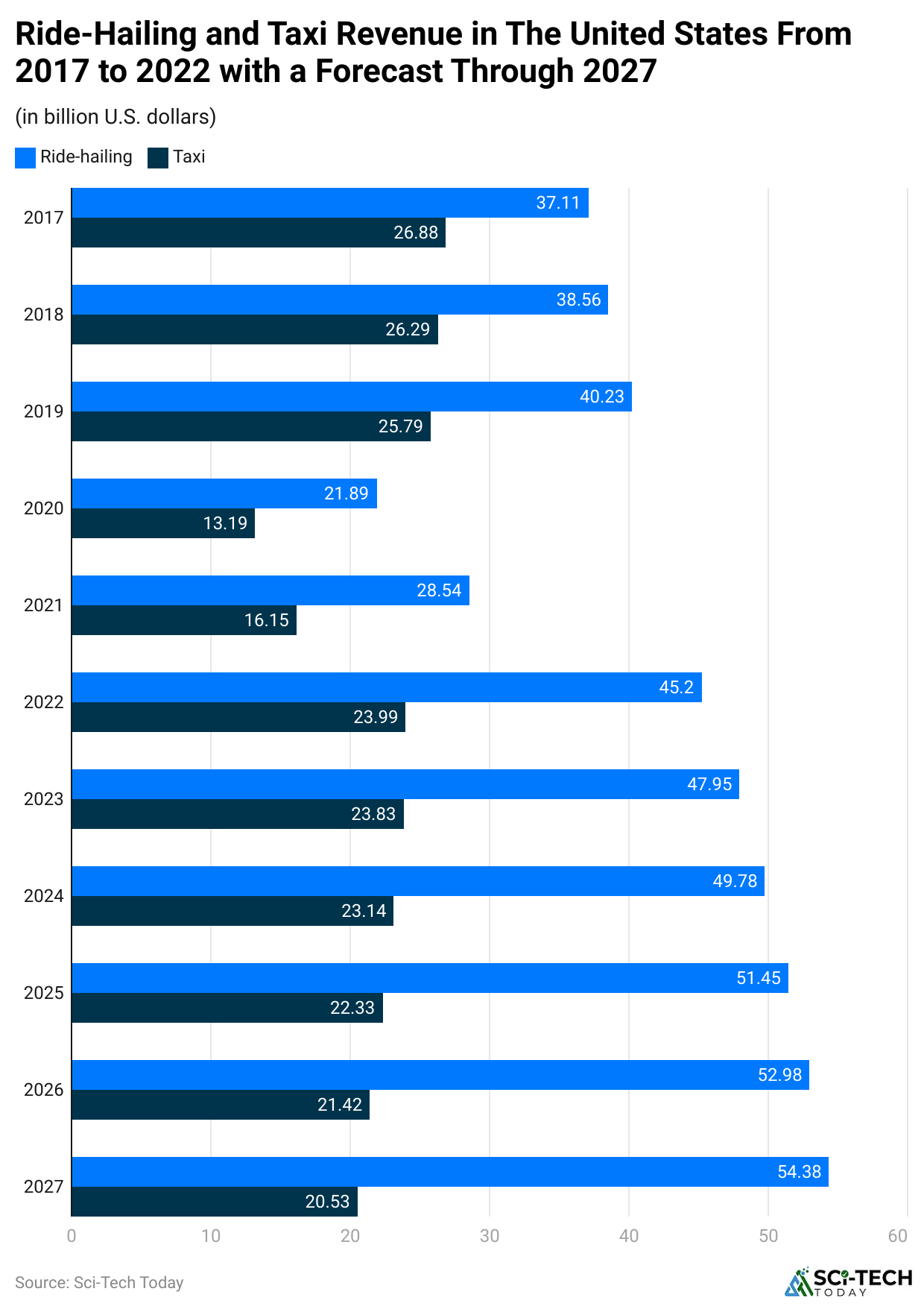
- In the same year, the ride-hailing industry in the United States is expected to bring in USD 49.78 billion, while taxi services will make USD 23.14 billion.
Ride Sharing Market Size

(Reference: statista.com)
- Ridesharing industry statistics project that the global market for ride-sharing services will increase progressively over the next five years, reaching over 40%.
- By 2028, the market value for the ride-sharing services will be approximately USD 216 billion. Uber, Lyft, and DiDi are some of the prominent players in the market.
- There are many basic elements that play a role in the expansion of the market.
- The young generation has specifically resorted to bearing the expenses of traveling by public transport instead of purchasing their own vehicles.
- But on the other side, owing to the high expenses of owning cars most of the time, the ride-sharing application is expected to succeed in areas where the expense of car ownership is very high and there is heavy traffic congestion.
- Another factor that has enhanced the growth of the ride-sharing industry is the high penetration of smartphones, where mobility apps have been more popular in developing countries such as India and China.
- This shows that these regions, mostly located in China, are going to have an important role to play in the growth of the mobility services company.
- However, some geographical regions could present challenges to the business world as these are the regions having an advanced public transport network in which individuals use trains and buses etc.
- For instance, the most promising geographical regions for Europe can be those regions that provide integrated solutions of public and private transportations.
- Most simply, shared mobility is car sharing and ride sharing, which are components of the wider transport ecosystem. The social interaction with anyone while using a car due to ride-sharing services is minimal compared to that if one were to hire out the same vehicle to drive themselves.
- The predicted size of the ride-hailing sector’s future value is over 14 times higher than car-sharing’s future value by the year 2030.
Global Ride-Hailing Revenue
- There will be considerable growth in the Ride-hailing market on a global scale.
- Based on the estimates, the income generated in this market is expected to amount to USD 188.60bn by the year 2026.
- Additionally, the 5.08% CAGR 2026-2030 will contribute to achieving a market value of USD 229.98bn by the year 2030 on a worldwide basis.
- Concerning the number of users, there will be a significant increase in the Ride-hailing market, with the number of users reaching up to 2.34bn by the year 2030.
- The penetration of users is estimated at 24.6% for the year 2026 and is expected to rise to 28.7% by the year 2030.
- The average income per user (ARPU) will amount to about USD 96.95.
- The Ride-hailing market is an online-only market.
- Finally, China is expected to generate the highest income in the Ride-hailing market, which is USD 66bn in 2026.
Ride Sharing and Taxi Revenue
(Reference: coolest-gadgets.com)
- In 2023, the ridesharing revenue industry surged in the United States.
- Ridesharing industry statistics show that Ride-hailing services alone accounted for about 47.95 billion U.S. dollars, and traditional taxi services approximately 23.83 billion U.S. dollars.
- These numbers show the power of both ride-hailing and taxi services in the U.S.; the popularity of ride-hailing services is, however, higher because of their easier access via mobile applications.
- Looking ahead to the year 2024, revenues in these segments are expected to grow mildly in the case of ride-hailing, which is projected to grow up to 49.78 billion U.S. dollars, while taxi services are predicted to slightly decrease in revenue, projected at 23.14 billion U.S. dollars.
- This small drop in the revenue from taxi services might signal the increasing popularity of app-based services that are not only easier to access but also require less strict fares and other factors compared to taxi services.
- The revenue disparity evidenced in the above segments reflects the impact of technology and changing consumer behavior on the transport sector in the U.S.
Ridesharing Industry Statistics by Region
United States
- The ridesharing market in the United States is expected to undergo astronomical changes, with the estimated revenue expected to reach 53.88 billion U.S. dollars by the year 2024.
- It is projected that there will be a compound annual growth rate (CAGR) of 2.37% between the years 2024 and 2029, leading to a market volume of 60.56 billion U.S. dollars by the year 2029.
- It is further estimated that the number of users will increase to 99.94 million by 2029, whilst the user penetration rate slightly grows from 26.7% in 2024 to 28.5% in 2029. The average revenue per user (ARPU) stands at USD 590.
- This specific market, which can only be accessed online, has enjoyed an increase in demand as people now prefer using private means of transport as opposed to public transport, which has made its business patronage out of bounds.
- The American Market is vast, but it is reported that China will dominate the market, with revenue estimates of 59.56 billion U.S. dollars for the year 2024.
United Kingdom
- On the same note, even the ride-hailing sector in the UK is set to register further growth as well. This is because, according to projections, its revenue will hit USD 4.79 billion by 2024.
- A compound annual growth rate (CAGR) of 5.40% from the years 2024 to 2029 is expected to grow the market volume to 6.23 billion dollars by the year 2029.
- The increasing number of users is expected to reach 22.26 million by 2029, while the user penetration rate is also set to improve from 27.4% in the year 2024 to 32.3% in 2019.
- The average revenue earned from each user (ARPU) is expected to stand at USD 257.50.
- There is, however, no doubt that this is a 100% online business, and it is highly competitive because many international and local players are active in the market.
- It is the same case with China in terms of revenue market share, as it doesn’t disappoint.
France
- According to a ridesharing industry statistics report, ride-hailing services in France are anticipated to grow over the forthcoming years, notably by achieving market revenue of USD 1.65 billion in 2024 and a CAGR of 2.86% through 2029, culminating in an estimated market volume of USD 1.90 billion by 2029.
- The number of users is expected to grow to 11.39 million by the year 2029, where the user penetration is forecast to stand at 15.9% in the year 2024 and 17.4% by the year 2029. ARPU is expected to be about USD 159.80.
- Although the growth of the market has been robust, conventional taxis, which are also beginning to provide some services over the Internet, remain the market leaders.
India
- The ride-hailing industry in India is growing, with an expected market size of USD 7.53 billion by the year 2024 and USD 11.64 billion by the year 2029, at a compound annual growth rate (CAGR) of 9.10%.
- As of 2029, the market is forecasted to have a total of 380.60 million users, with the user penetration rate increasing from 18.6% in 2024 to 25.3% in 2029.
- The average revenue per user for this market is expected to USD 28.09.
- The market, which is purely online in nature, is very free and competitive; not only does Uber dominate the global market, but local competitors like Ola also command a good share of the market.
Russia
- According to ridesharing industry statistics, Russia’s ride-hailing industry is likely to earn USD 5.39 billion by 2024, with an annual growth rate of 4.32% until 2029, when the revenue is expected to grow to USD 6.66 billion.
- The number of users in this market is expected to grow to 45.26 million by 2029, while user penetration is expected to grow from 28.4% in 2024 to 31.9% in 2029.
- ARPU is anticipated to be at USD 132. Yandex. Taxi is likely to dominate the Russian ride-hailing system. The global revenue leader remains China, where the revenue is expected to touch USD 59.56 billion by 2024.
Ridesharing Digital Service Apps
(Reference: statista.com)
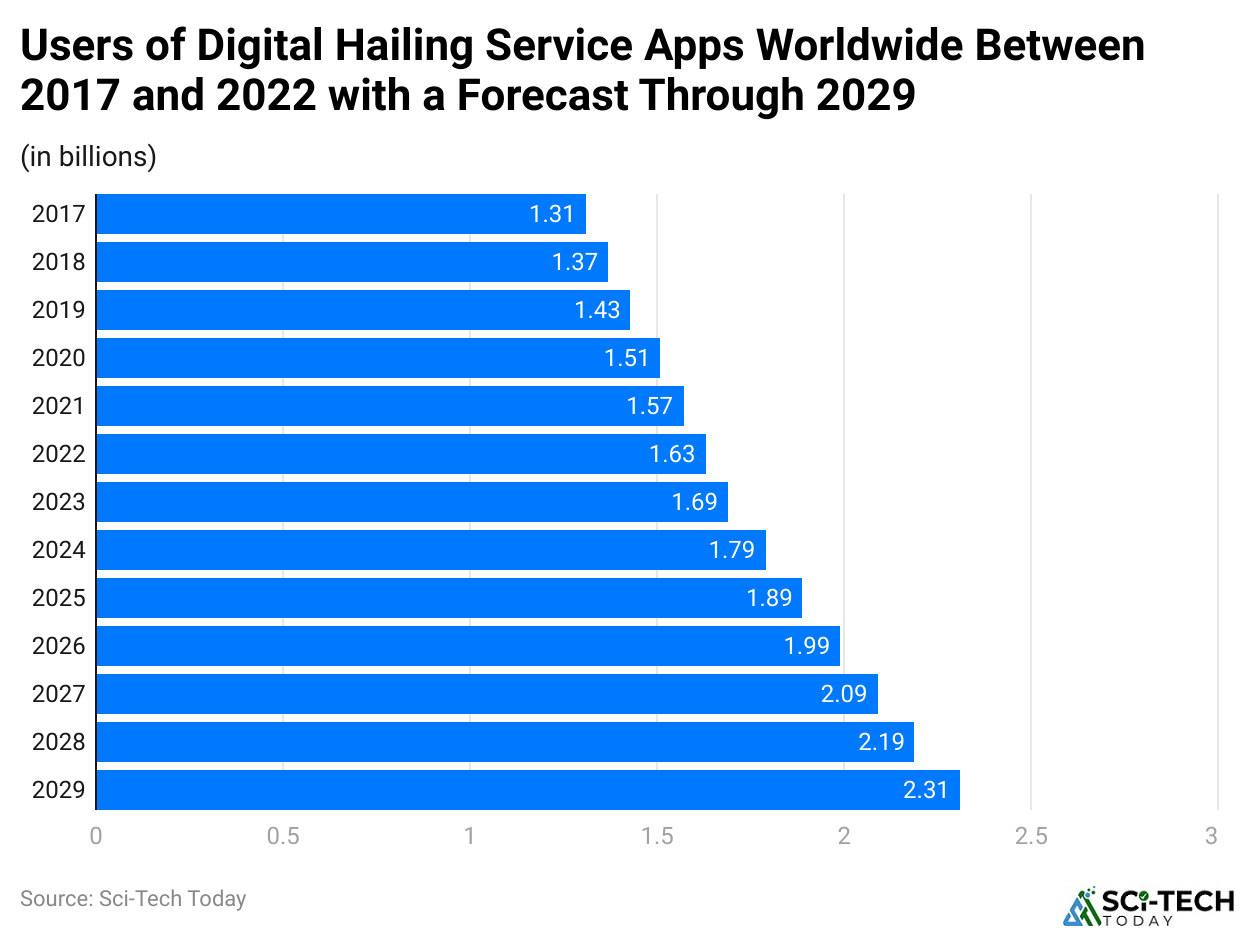
- Ridesharing industry statistics state that approximately 1.69 billion users actively use an app to hail a taxi. This number exceeded 1.79 billion users in 2024 for worldwide digital taxi-hailing services.
- The user base continues to grow as a forecast is made about the coming years, after which it is predicted that almost 1.89 billion will be reached by 2025, 1.99 billion by 2026, 2.09 billion by 2027, 2.19 billion by 2028, and eventually 2.31 billion in 2029.
Leading Mobility Services
(Reference: statista.com)
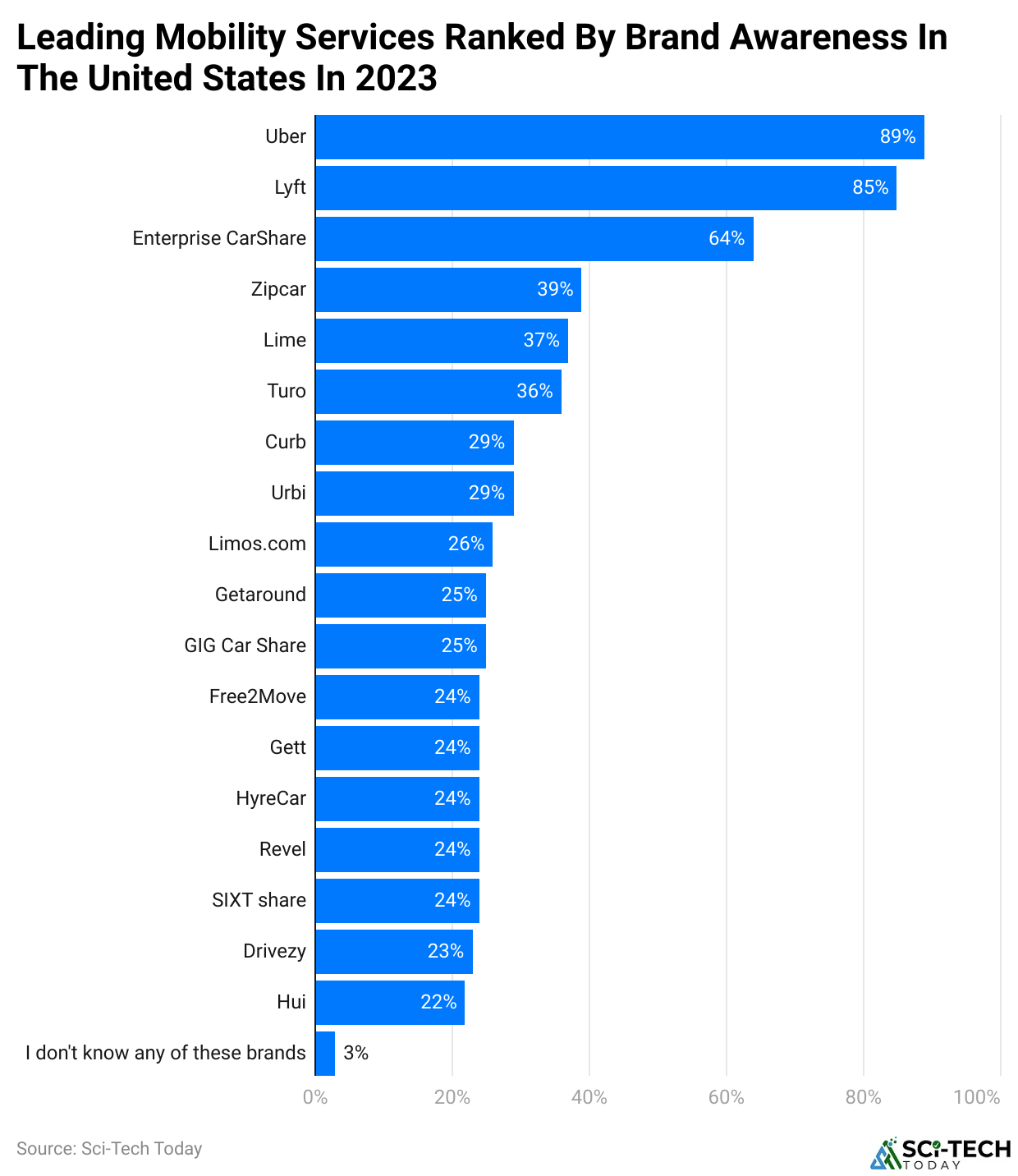
- In 2023, Ridesharing Industry Statistics revealed that Uber, a mobility service that started in 2009 in San Francisco, was still the most Uberane mobility service in the United States, with an 89% awareness rate.
- Next in line of the services ranked by their brand recognition is Lyft (85%), Enterprise CarShare (64%), Zipcar (39%), Lime (37%), Turo (36%), Curb (29%), Limos.com (26%), Getaround (25%), GIG Car Share (25%), Free2Move (24%), Gett (24%), HyreCar (24%), Revel (24%), SIXT share (24%), Drivezy (23%), Hui (22).
Rates of Violence Experienced by U.S. Ride-Share Drivers
(Reference: statista.com)
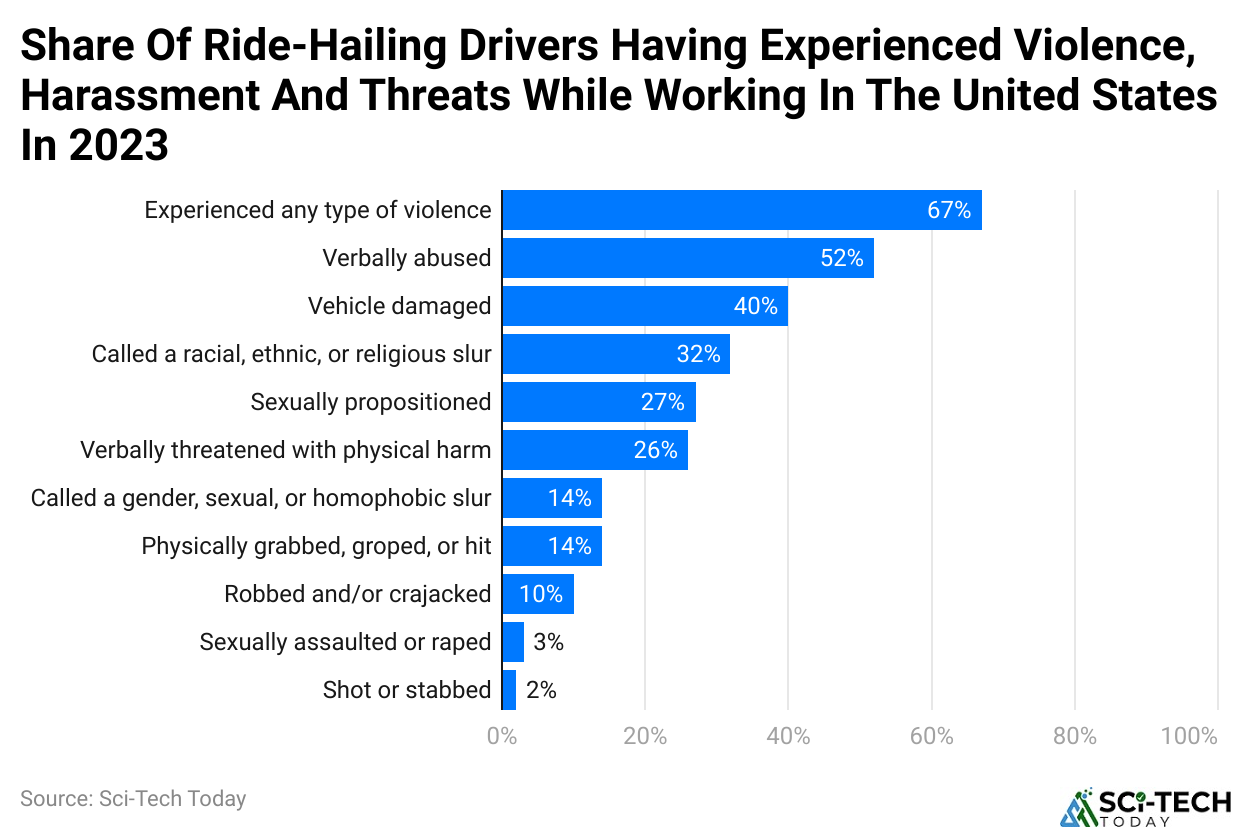
- As of 2023, around two-thirds of drivers providing ride-hailing services in the US have claimed that they were assaulted in some form or other.
- In these cases, around 52% involved prolonged verbal abuse, 40% had their vehicles damaged, and 32% of them were victims of verbal abuse due to race, ethnicity, or religion.
- In addition, 27% were harassed, 26% were threatened with actual violence, 14% were the target of offensive slurs based on gender, sexual orientation, or homophobia, 10% were mugged or had their cars stolen, 3% suffered sexual assault or rape, and 2% of them were either stabbed or shot.
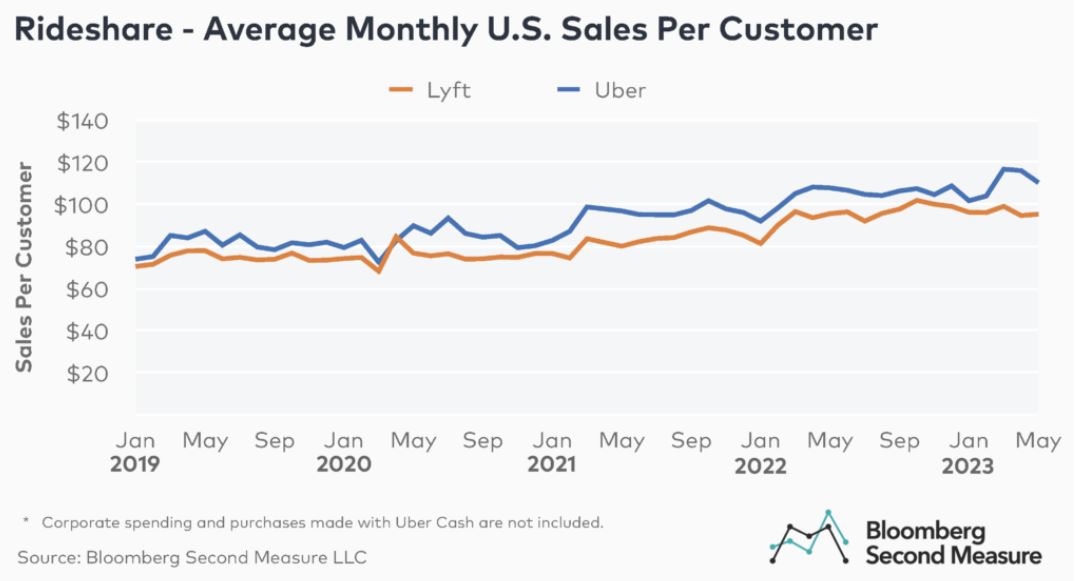
Rideshare Monthly Sales Per Customer
(Source: enterpriseappstoday.com)
- Ridesharing industry statistics represent the number of rideshared sales per month per capita in the United States. Uber increased its total revenue from USD 31.9 billion in 2022 to USD 43.9 billion in 2024, with about 156 million people using Uber or Uber Eats at least once a month in 2024.
- Lyft’s average revenue per active rider was USD 57.72 in Q4 2022 and about USD 55.85 for full‑year 2024, alongside 23.7 million active riders and USD 5.7 billion in revenue.
Challenges And Opportunities
- The number of active drivers in the sector will decrease by 10% in 2024 because of high operating costs and the implementation of stringent rules.
- Nations all around the globe are establishing even more strict requirements concerning the provision of the mentioned service, and they have already collected USD 2 billion in penalties.
- The investment in the development of technologies for the production of self-driving vehicles is rather high, and such vehicles may appear in 5 years – that is, in 2028. The operating cost of the mentioned system will be decreased by 15-20% once the autonomous ridesharing system is implemented.
- As for the other factors of its further development, one can mention expansion to rural and suburban territories, along with environmental initiatives, which will be relevant for many years ahead.
- Ridesharing belongs to the urban transport system and attracts passengers of all ages, valuing comfort, safety, and environmentally friendly conditions during the transportation process.
Summary
Statistics regarding the ridesharing industry in 2025 show that the industry has been resilient and has promising future ahead except for issues like regulatory compliance and lack of drivers.
The ridesharing industry will definitely grow and cater to the rapidly urbanizing world due to technological advances and shifts in management strategies.
FAQ
Uber’s primary competitor varies heavily by region and vertical, but its largest rivals globally are Lyft for North American ridesharing, DoorDash for US food delivery, and Rapido in the rapidly expanding Indian mobility market.
Uber is an American company. Headquartered in San Francisco, California, it operates as a publicly traded corporation whose ownership is divided among millions of global investors and institutional shareholders.
Uber was co-founded by Travis Kalanick and Garrett Camp in 2009. Garrett Camp originally conceived the idea after struggling to find a taxi in Paris, while Travis Kalanick came on board as the mega-advisor and founding CEO to scale the Uber business globally.

Sources


