








Prelude
Job Interview Statistics: A job interview is a strategic conversation between a job seeker and an employer. Its main purpose is to check if the candidate is right for the job. In an interview, employers look at skills, knowledge, confidence, and communication skills.
It is not just about your resume; it is about how you present yourself and answer questions. For candidates, it is a chance to show their strengths and explain why they are the best fit.
In short, a job interview is the key step that connects talent with opportunity and helps both sides make the right choice.
Top Pick
- Enterprise companies conduct 65-75 interviews per hire, while SMBs conduct only 9-11.
- Job seekers take about 24 weeks on average to get a job through the hiring process.
- Each job posting receives about 250 resumes, but only 4-6 candidates are interviewed.
- Around 70% of employers review candidates’ social media profiles during the hiring process.
- Among respondents who apply to one to ten jobs, 38.3% report no interviews, 47.3% report 1 to 2 interviews, 12.6% report 3 to 7, and 1.8% have eight or more interviews.
- Face-to-face interviews average 40 minutes; most last 30-90 minutes, with feedback in 24 hours to 2 weeks.
- Around 52% of companies have interview cycles lasting 4-6 weeks.
- Phone interviews can extend the hiring process by about 8 days, making the overall timeline longer than 1 month.
- Applicants aged 55+ are 3 times less likely to receive interview invitations than younger candidates.
- Around 93% of 1,500 job seekers admitted to exaggerating or lying during the hiring process.
- 83% of respondents in America have participated in an in-person interview, and 62% have had a phone interview.
- 74% of recruiters say video interviews make the hiring process easier and more efficient.
- 44% of companies now use AI in recruiting, showing that automation has become a common hiring practice.
- Candidates unemployed for less than 5 weeks have a 30.94% chance of being hired, compared with 18.44% for those unemployed for 27+ weeks.
Latest Job Interview and Hiring Statistics
- A report published by Yomly states that only 2% of applicants reach the interview stage.
- The U.S. job market still has around 8 million open positions.
- Average time to hire has fallen from 48 days to 41 days as employers speed up recruitment.
- Enterprise companies conduct 65-75 interviews per hire, while SMBs conduct only 9-11.
- Around 25% of candidates leave the hiring process during the interview stage.
- 61% of job seekers accept the first offer they receive.
- Nearly 52% of companies believe their interview process is still too long.
- 44% of employers now use AI to support recruitment and hiring.
- Employee referrals generate 11% of hires from only 2% of applicants, making them highly effective.
- About 72% of talent acquisition leaders expected hiring to increase in 2025, which supported continued demand for interviews into 2026.
Hiring and Job Search Insights
- According to Zippia, job seekers take about 24 weeks on average to get a job through the hiring process.
(Source: zippia.com)
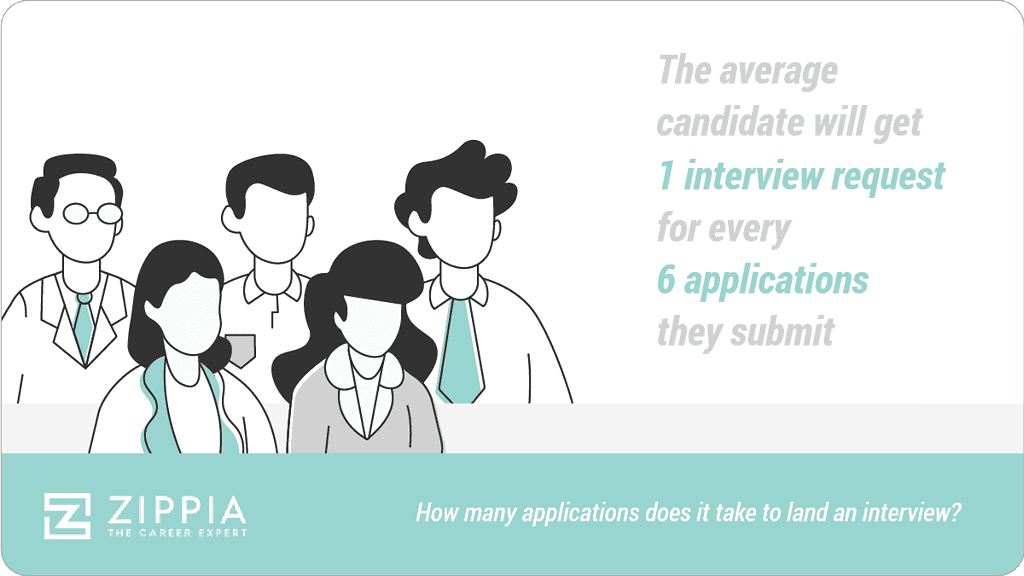
- Candidates get 1 interview for every 6 applications submitted.
- Women are 30% less likely to be invited for interviews than equally qualified men.
- Each job posting receives about 250 resumes, but only 4-6 candidates are interviewed.
- The interview process duration is around 23 days.
- On average, 27 applications are needed to get an interview.
Interview Preparation and Candidate Research Statistics
- Novoresume report further stated that around 70% of employers review candidates’ social media profiles during the hiring process.
- 47% of candidates fail interviews because they do not research the company well enough.
- 90.6% of employers prefer candidates with relevant work experience. About 71% of employers consider professional dress an important part of interview success.
- Nearly 39% of candidates make a poor impression due to low confidence, poor voice quality, or not smiling.
- 60% of hiring managers say candidate screening is the most time-consuming hiring task.
- 92% of companies use social media to evaluate candidates before interviews.
- Around 62% of job seekers prefer automated hiring updates over lengthy email exchanges.
- Employee referrals improve the chance of a successful job match from 2.6% to 6.6%.
Job Interview By Application Sent
(Reference: zippia.com)
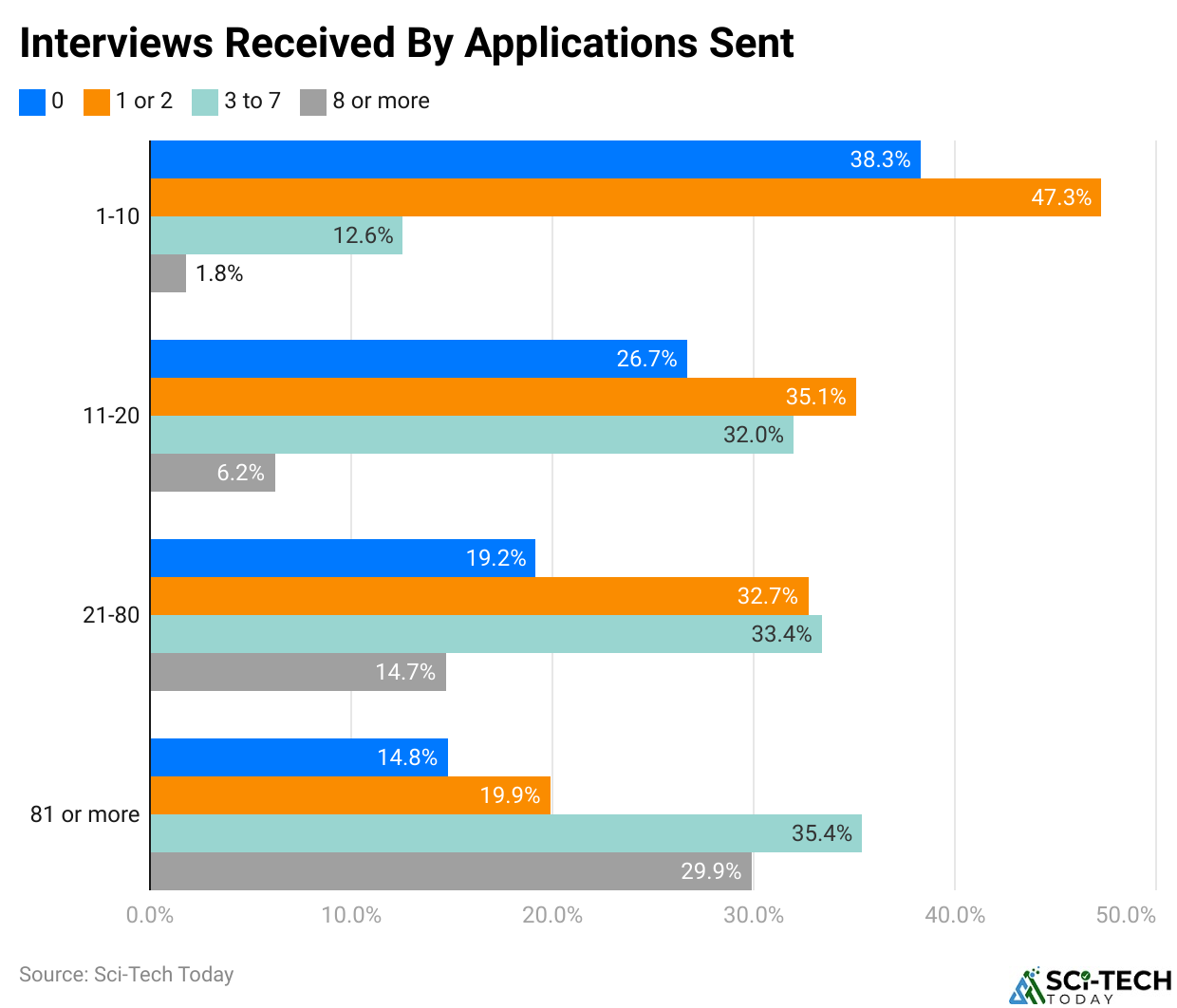
- Among respondents who apply to one to ten jobs, 38.3% report no interviews, 47.3% report 1 to 2 interviews, 12.6% report 3 to 7, and 1.8% have eight or more interviews.
- There, 26.7% of respondents who applied 11 and 20 reported no interviews, while 35.1% got 1 or 2 interviews, 32.0% landed 3 to 7 interviews, and 6.2% scored eight or more.
- Job interview statistics state that for respondents who sent 21-80 applications, the incidence of no interviews stood at 19.2%, while those who reported 1-2 interviews stood at 32.7%, 33.4% at 3-7 interviews, and 1.47% at eight or more interviews.
- Few among 81 or more applications did not get interviewed, such as 14.8%. At the same time, some received 1 or 2 interviews, about 19.9% of applicants, 35.4% who were noted as interviewed anywhere between 3 to 7, and 29.9% at eight or more interviews.
Application-to-Interview Conversion Statistics
- Around 4% of applicants at SMBs receive an interview, equal to 1 in 25 candidates.
- Enterprise companies interview only 2% of applicants, or about 1 in 50, because they receive more applications.
- Across all companies, only 2% of applicants reach the interview stage.
Interview Duration Timeline Overview
- Face-to-face interviews average 40 minutes; most last 30-90 minutes, with feedback in 24 hours to 2 weeks.
- About 33% of interviewers decide within the first 90 seconds, making an early impression critical.
- The full process averages 27.5 days, typically just under 1 month from application to offer.
Time-to-Hire and Recruitment Speed Statistics
- According to Yomly, the average time to fill a position has dropped from 48 days to 41 days as companies speed up hiring.
- Enterprise hiring time improved from 46 days to 35 days through faster interviews and approvals.
- SMB hiring time decreased from 49 days to 46 days.
Interviews Required per Successful Hire
- SMBs conduct an average of 9-11 interviews for each successful hire.
- Enterprise companies conduct about 65-75 interviews per hire because they receive more applicants and follow more extensive hiring processes.
- More than 50% of employers use 4 or more interview rounds before making a final hiring decision.
(Source: yomly.com)
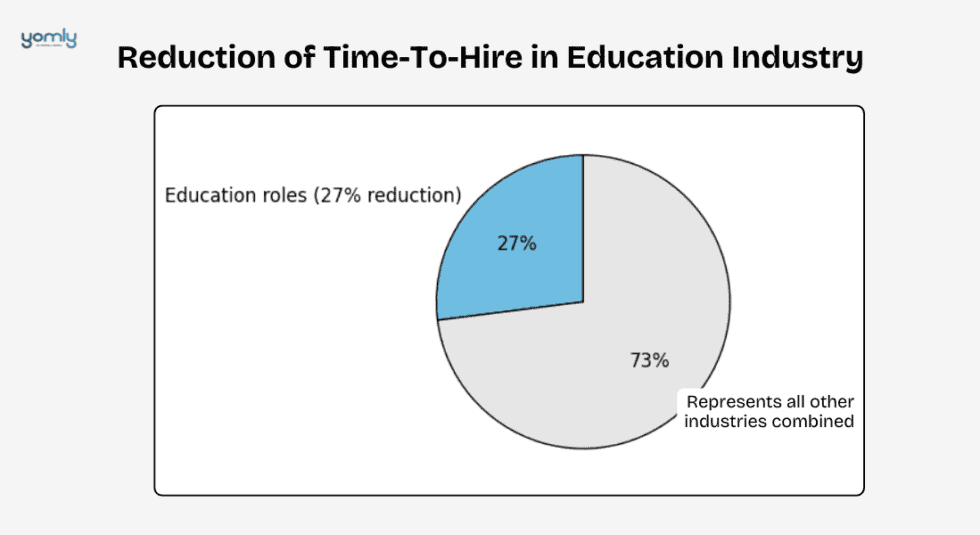
- The education sector reduced hiring time by 27%, followed by 73% represents all other industries combined.
- About 31% of companies shortened the time between interviews and job offers to secure candidates more quickly.
- 36% of employers reduced the number of interview rounds to simplify the hiring process.
- Nearly 52% of companies still believe interviews take too long and delay hiring decisions.
- 47% of employers made faster hiring their top workplace flexibility initiative.
- 48% of companies are redesigning their hiring process to improve efficiency and support growth.
Interview Process Length and Effectiveness Statistics
- Around 52% of companies have interview cycles lasting 4-6 weeks.
- 39% of companies say candidates go through too many interviews.
- Structured interviews improve hiring quality by 52%, hiring manager experience by 57%, interview consistency by 55%, and candidate experience by 40%.
- Nearly 52% of employers believe their interview process is still too long.
Video and Phone Interview Statistics
- Phone interviews can extend the hiring process by about 8 days, making the overall timeline longer than 1 month.
- Around 60% of recruiters use video interviews for remote hiring, and 81% expect virtual recruitment to continue beyond the pandemic.
- About 74% of recruiters believe video interviews improve the hiring process.
- Initial phone interviews usually last around 15 minutes and are mainly used to screen candidates.
- 74% of HR professionals use structured interviews, while 73% also rely on behavioral interview methods.
Job Interview Demographic Statistics by Age
- Applicants aged 55+ are 3 times less likely to receive interview invitations than younger candidates.
- Around 95% of older applicants try to appear younger, while 75% report experiencing age discrimination.
By Race
- Young white men are 1.8 times more likely to receive interviews than older white men, 2.3 times more likely than white women in their 50s, 2.6 times more likely than black men in their 50s, and 3 times more likely than black women in their 50s.
- About 77% of hiring managers consider diversity an important part of recruitment.
By Gender
- Men report 33% higher interview confidence than women.
- Women without children are 23.5% less likely, while mothers are 35.9% less likely, to receive interview invitations than comparable men.
By Education
- Around 35% of job postings require a bachelor’s degree.
- 30% require an associate’s degree or some college education.
- 25% of employers use pre-employment assessments before inviting candidates to interviews.
Job Interviews By Country
- Also, in real-world recruitment, job interviews vary from country to country in terms of cultural differences, industry standards, and recruitment practices.
- In the United States, face-to-face and telephone interviews are among the most widely accepted formats. A poll from job interview statistics Glassdoor disclosed that 83% of respondents in America have taken part in an in-person interview and that 62% have had a phone interview.
- In England, video interviews have gained growing popularity over the past few years. According to research from Totaljobs, 76% of businesses in Britain have already incorporated video interviews as part of their recruitment process.
- In two of Australia’s major sectors-commercial and hospitality- group interviews are frequently used. According to job interview statistics, 47% of them say they have experienced at least one group interview as part of the Australian workplace.
- In Canada, it is increasingly common for behavioral interview questions to be used. According to a Robert Half poll, 72% of hiring managers use these types of questions regularly to assess job candidates.
- A detailed CV and a cover letter are more or less standard requirements in Germany. As many as 96% of employers consider cover letters necessary in hiring processes, according to a poll conducted by Hays.
- Recruitment processes in Japan are highly formalized. According to a survey by Hays, 55% of the companies conduct panel interviews, while 73% structure interview questions.
- In India, questions are often asked regarding the personal lives of job interview candidates. Data from CareerBuilder India revealed that 19% of applicants were asked about their marital status, while 9% were asked about potential family expansion plans during one or more interviews.
Job Interview Statistics Across Top Industries, 2026
- Business Insider’s report shows that only 2%-3% of applicants reach the interview stage, while the average job posting receives 242 applications.
- According to Job Intel report analyses, healthcare has the longest hiring time at 49 days, with RN roles taking up to 109 days, a projected shortage of 86,000 physicians by 2036, and an RN turnover cost of USD 60,090 per nurse.
- Finance and business roles require an average of 8 interview rounds before an offer is extended.
- Manufacturing recorded 257% YoY growth in tech hiring and has more than 600,000 open jobs.
- Around 53% of job seekers experienced employer ghosting in 2026.
- Meanwhile, AI supports 87% of hiring processes, but only 26% of candidates trust AI evaluations. Ghost jobs represent 18%-22% of active listings.
Job Interview Lying Statistics, 2026
How Common Is Lying in Interviews?
- Around 93% of 1,500 job seekers admitted to exaggerating or lying during the hiring process.
- Meanwhile, 36% admitted lying during interviews. Men were nearly 2 times more likely to lie than women.
- About 85% of candidates embellished resume details, 80% admitted to lying in interviews at least once.
- 64% of hiring managers rejected candidates caught lying.
Most Common Interview Lies
- Around 60% exaggerated their skills, 52% inflated job titles.
- 32% overstated responsibilities.
- 50% changed employment dates.
- 37% misrepresented job duration.
- 21% hid their employment status.
- 33% overstated education.
- 11% exaggerated AI skills.
Reason Behind Candidates’ Lies
- The main reasons include 54% needing a job quickly.
- 42% feeling pressure to meet qualifications.
- 32% wanting to stand out.
- Around 78% admitted they would misrepresent themselves to improve their chances of being hired.
- Besides, 45% exaggerated their team size or leadership experience.
Job Interview Discrimination Statistics
- Around 24% of workers report experiencing discrimination during hiring or at work.
- The most common concerns are age discrimination (32%), gender discrimination (25%), and racial or ethnic discrimination (17%).
- White candidates are 2.1% more likely to receive interview callbacks than Black candidates with similar qualifications.
- Around 20%-40% of employers are influenced by hiring bias, with age and gender being the most common factors.
- A study conducted by HR University found that, among 83,000 applications, callback rates were lower for candidates with Black-sounding names despite identical resumes.
- About 57% of Black Americans report experiencing discrimination in pay, promotions, or hiring.
- Under the 80% (four-fifths) rule, a hiring process may show an adverse impact if one group’s selection rate falls below 80% of the highest-performing group’s rate.
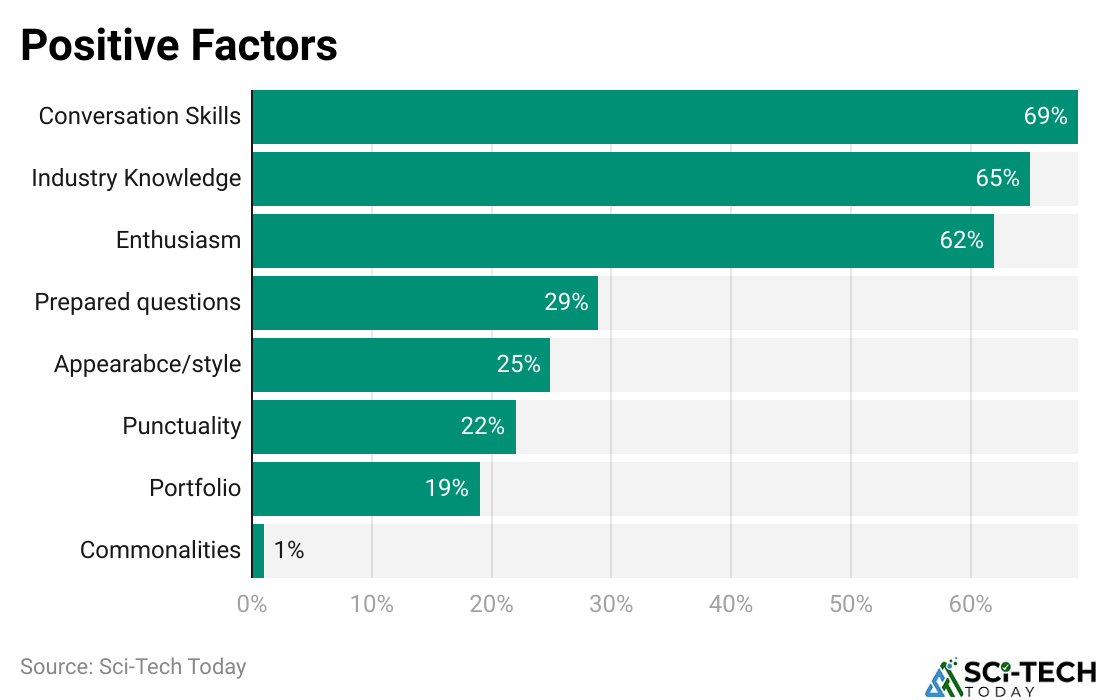
Positive Factors Considered During an In-Person Job Interview
(Reference: enterpriseappstoday.com)
- Interviewers consider different positive aspects of face-to-face job interviews. Conversational skills are the best option, with 69% of interviewers emphasizing them.
- Knowledge of the industry’s incomparably next factor appeared in the appreciation of 65% of interviewers; the enthusiasm attached to the candidate was highly weighted at 62%.
- Pre-prepared questions tend to play a part in 29% of interviewers’ minds, judging by the sight of this quality.
- Appearance and personal style account for 25%, whereas being punctual has been recorded by 22% as a sign of professionalism.
- Portfolios portraying previous works have thus been pointed out by 19% as an asset, while shared commonalities between the interviewer and candidate are also acknowledged by 1% as a positive factor.
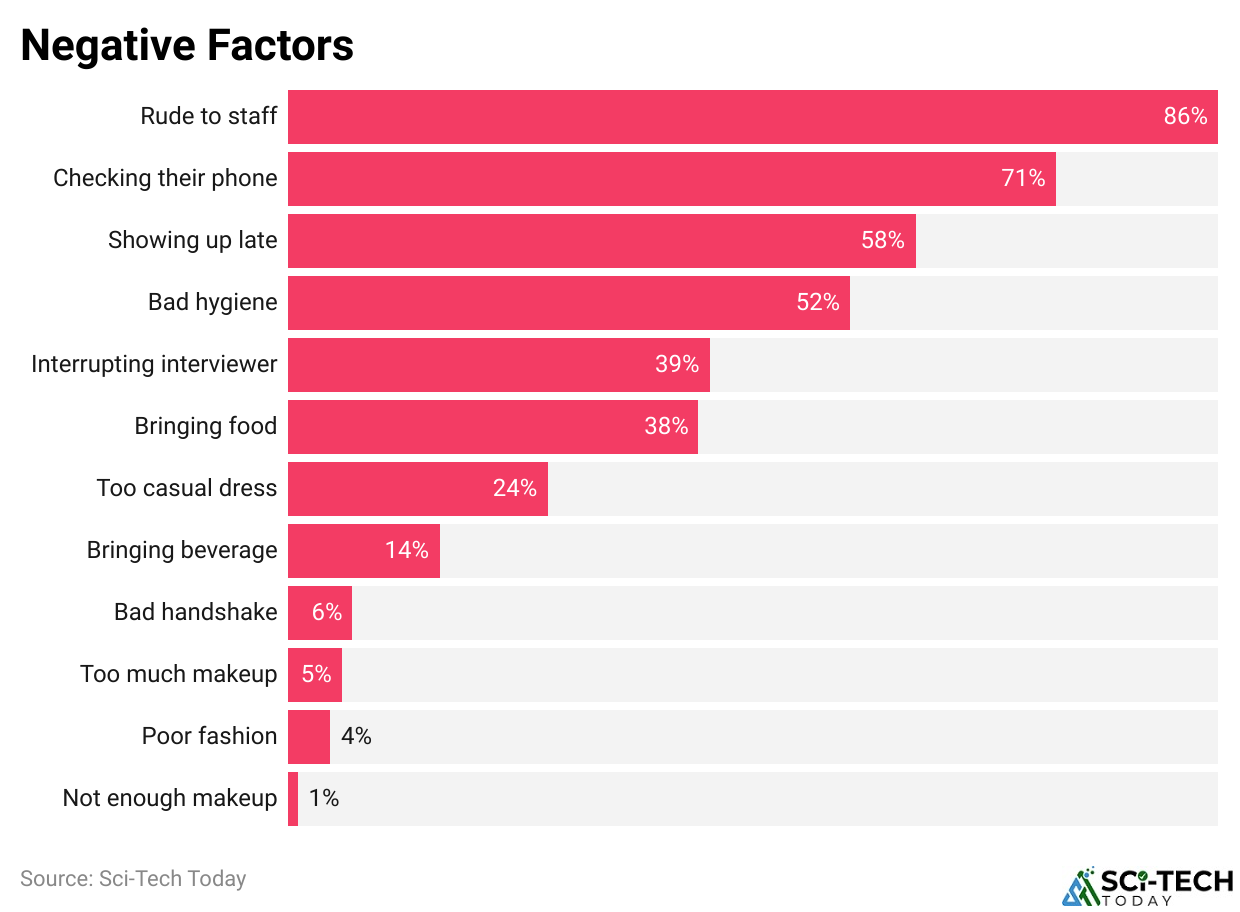
Negative Factors Showing The Person NIs ot Fit For The Interview
(Reference: enterpriseappstoday.com)
- There are specific elements of behavior in an interview that have adversely affected a candidate’s assessment as a suitable fit for the position.
- The most critical red flag was considered by 86% of the respondents to be rude staff behavior.
- Checking one’s cellular device during the interview was also highly viewed as negative by 71% of respondents.
- The following principle is punctuality. Being late was regarded as detrimental by 58%.
- Personal Presentation also matters, as 52% indicated that poor hygiene leads to negative judgment. Interruption of the interviewer while he or she is talking is also reported among those troublesome acts (39%).
- Bringing food to an interview is seen as unprofessional by 38%, while 24% see overly casual dressing as inappropriate.
- Bringing a drink to the interview has received disapproval from 14%, and 6% give credence to the idea that an impression is left that is not so encouraging about a bad handshake.
- The appearance aspects are minor but still counted. 5% of respondents see too much makeup as a negative, 4% have poor fashion choices, and 1% think that little makeup can be a problem.
JVirtual Interview Statistics
- According to Novoresume, around 74% of recruiters say video interviews make the hiring process easier and more efficient.
- 86% of organizations now use virtual interview technology as a regular part of recruitment.
- Nearly 88% of recruiters consider internet lag their biggest frustration during virtual interviews.
- Around 95% of recruiters prefer that candidates use cool lighting rather than warm lighting during video interviews.
- 97% of interviewers prefer an office-themed virtual background.
Recruiter Workload and Candidate Interview Experience
- 1 in 3 companies has fewer recruiters than last year, despite ongoing hiring demand.
- 33% of companies cannot fill open positions due to skill shortages.
- About 26% receive too many applications, while 37% compete for the same qualified candidates.
- 25% of candidates leave during the interview stage, the largest hiring drop-off point.
- 61% accept the first job offer, and 1 in 2 companies lose strong candidates because of slow or ineffective interviews.
- Around 40% wait more than 2 weeks for interview feedback, while only 24% are satisfied with the process.
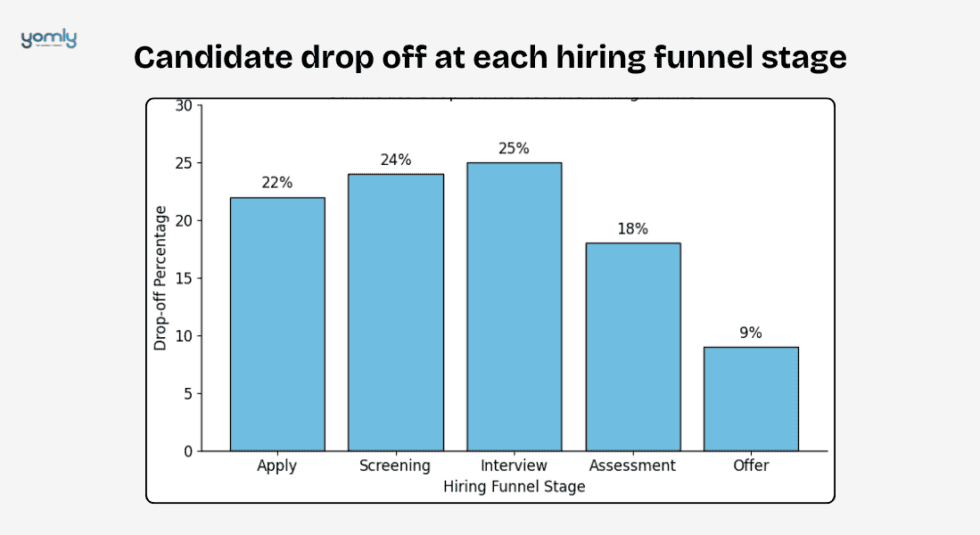
Candidate Drop-Off Rates Across the Hiring Funnel
(Source: yomly.com)
- The interview stage has the highest drop-off rate at 25%.
- About 24% drop out during screening due to delays or role mismatches.
- Around 22% of candidates leave during the application stage because of lengthy forms or unclear job descriptions.
- 18% of candidates leave during assessments due to time-consuming tasks.
- Only 9% drop out after receiving an offer.
AI Adoption in Recruiting and Interviewing
- According to Yomly, 44% of companies now use AI in recruiting, showing that automation has become a common hiring practice.
- 63% of recruiters use AI for tasks such as candidate screening, sourcing, and interview scheduling.
- Approximately 89% of recruiters who use AI rely on it regularly in their daily hiring process.
- 32% of companies use AI during interviews for screening, assessments, and candidate evaluation.
- 39% of employers report that AI improves interview quality by making evaluations more consistent and accurate.
- 63% of companies are investing or planning to invest in AI.
Interview Technology and Scheduling Statistics
- 52% of companies are increasing investment in interview technology to improve hiring speed and coordination.
- Spending on interview tools has increased by 47%, while 46% of companies have reduced spending and 7% kept budgets unchanged.
- 54% of employers use dedicated interview scheduling tools to improve efficiency.
- 34% rely on interview management platforms to centralize hiring workflows.
- 21% use bots to automate interview scheduling, reducing manual work.
- Nearly 25% of companies still lack a standardized interview-scheduling process, leading to delays and operational inefficiencies.
Common Reasons Candidates Fail Job Interviews
- According to Zippia, candidates unemployed for less than 5 weeks have a 30.94% chance of being hired, compared with 18.44% for those unemployed for 27+ weeks.
- About 50% of hiring managers consider a professional presentation an important factor in hiring.
- 20% of managers reject candidates who sit with crossed arms during interviews.
- Nearly 65% of hiring managers value strong eye contact as a positive interview trait.
- Around 40% of recruiters prefer confident candidates, while almost 50% may reject applicants who do not smile.
- 40% of recruiters assess vocal quality, and 47% of HR managers say candidates fail because they lack company knowledge.
Conclusion
In conclusion, a job interview is an important step for both the company and the candidate. It helps the employer understand your skills, confidence, and personality, while you also learn about the job and workplace.
Good preparation, simple communication, and confidence can improve your chances of success. Being honest and calm leaves a positive impression. In the end, a job interview helps both sides decide whether they are a good match.
FAQ
Interviewers often ask about your background, strengths, weaknesses, career goals, motivation, and why you are the right candidate.
Study the job role, research the company, and practice 5-7 STAR-based examples
Aim to arrive 10–15 minutes early for a smooth check-in

Sources