








Overview
Roscosmos Statistics: Russian Federal Space Agency, Roscosmos, is also one of the world’s most important bodies for space exploration and technology development. It was founded in 1992 and covers a range of activities, from satellite launching to human spaceflight, interplanetary missions, and international partnerships.
In 2026, Roscosmos put all its energy into the continuation of its programs in the space environment, notwithstanding the various world challenges. In this article, we will discuss some of the most significant numbers and events of Roscosmos statistics from the past year under the agency’s roof.
The Best In Class
- According to Roscosmos statistics, the budget for Russia’s space program for the year 2025 is around 3.0 billion U.S. dollars, quite far behind the U.S. government’s figure.
- Roscosmos carried out about 20–22 successful launches in 2024, a slight decrease over that of last year; it maintains three active cosmodromes for orbital launches, namely Baikonur, Plesetsk, and Vostochny.
- There has been a downsizing in the workforce employed in the industry owing to the asset sales and optimisation efforts, and Roscosmos has around 175,000 staff working with it in 2025.
- The Ukraine conflict has also soured relations between Russia, NASA, and ESA; while taking this measure, Russia also put a stop to launches from the Kourou cosmodrome in French Guiana, incurring a drawdown now approaching around 200 billion rubles as Western countries from agreements.
- Roscosmos statistics reveal that the planning cost is about 609 billion rubles by 2030 to build the new Russian Orbital Service Station, with construction expected to start around 2025.
- GLONASS now has its program budget revised to around 484 billion rubles for 2021–2030, instead of the earlier capped 158 billion rubles figure, reflecting updated funding needs for the navigation system
- During 2023–2024, the realized funding reached around 65 billion rubles, while cumulative net losses in the broader program surfaced to more than 50 billion rubles.
- Over the coming 10 years, Roscosmos was poised to turn around about 1.5 trillion rubles as government funding, which has not computed even around half of the former estimate at 3.4 trillion rubles.
- Roscosmos statistics show that only 1.4 trillion rubles are secured at the outset, with the balance of 115 billion rubles dependent on the execution of future projects.
Facts About Roscosmos
- In 2025, it is estimated that Russia’s spending in the space arena will be around 3.2 billion U.S. dollars per year, still roughly an order of magnitude lower than U.S. government space spending U.S. budgets remain well above 65 billion dollars annually for civil and defense-related space.
- According to Roscosmos statistics, space research remains a defined priority in Russia’s national programs. Total revenues of Russian firms under Roscosmos are expected to rise from about 413 billion rubles in 2023 to roughly 440 billion rubles for the 2025 calendar year, in parallel with a planned government space-program spend of about 942 billion rubles over 2025–2027.
- Passing on the Soviet legacy, the significant achievements during the USSR’s years in space are being kept alive by Russia’s launching of Sputnik 1 in 1957 as an orbiting satellite, 1961 first human spaceflight by Yuri Gagarin, the first woman to space in 1963, and the first cosmonaut with a spacewalk in 1965.
- Between 1961 and 1991, the number of human-crewed space missions undertaken by the Soviet Union stood at 71.
- Roscosmos statistics state that there are currently three operational cosmodromes in Russia, namely, Baikonur in Kazakhstan, Plesetsk not far from Arkhangelsk, and Vostochny in the Amur Oblast.
- In February last year, Russia stopped space launches in the Kourou Cosmodrome in French Guiana as a result of conflict with its partners.
- It further declared a loss of 180 billion rubles due to the effect of Western countries’ withdrawal from their agreements.
- Along with it comes the announcement that Russia will withdraw from the International Space Station as a contract that runs until 2028.
- The current deterioration of the diplomatic relationship with the West has created several obstacles to Russia’s space program in the coming years.
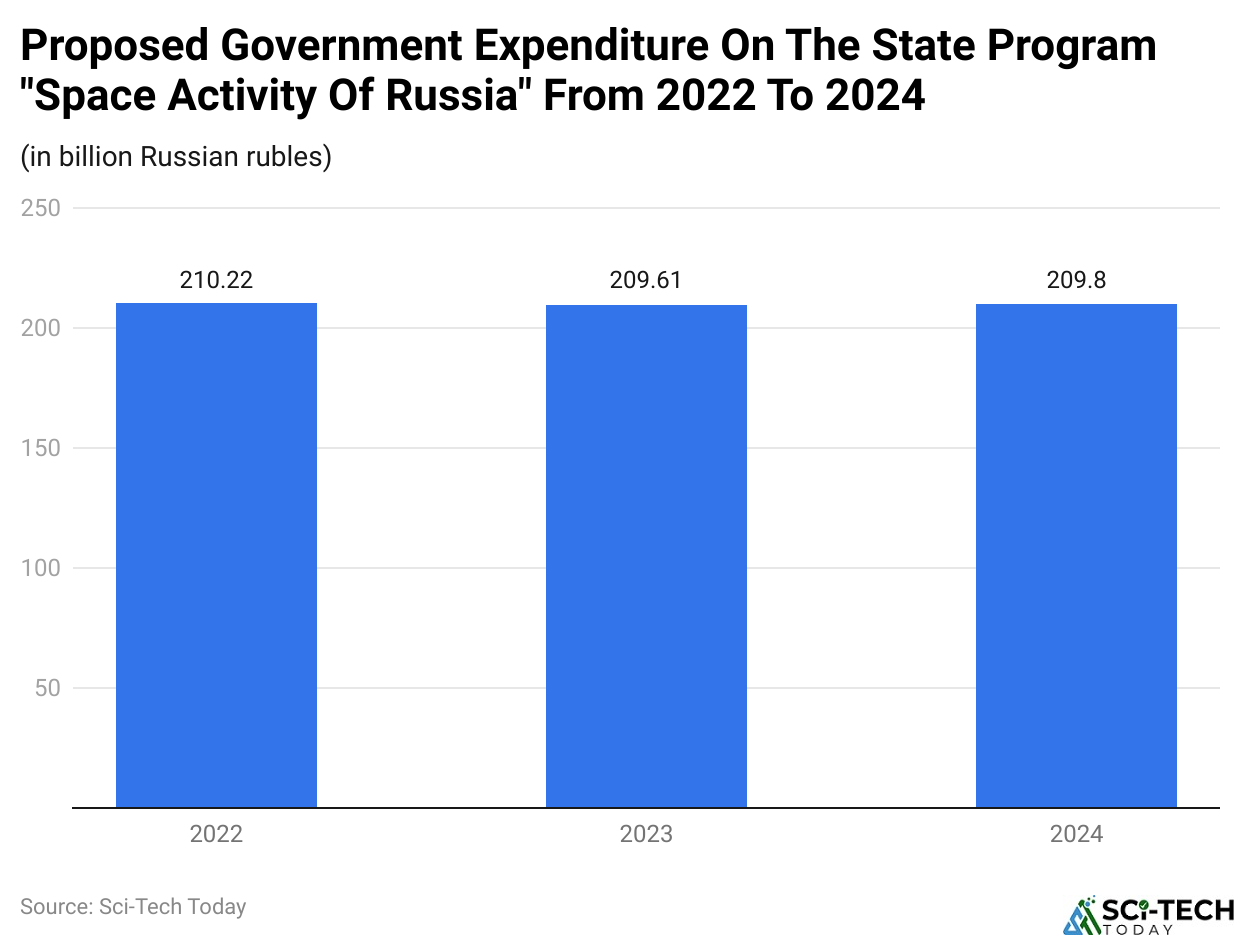
Roscosmos Proposed Government Space Program Spending
(Reference: statista.com)
- Government spending in 2021 for space activities by Russia shall be more or less constant in the next three years.
- Roscosmos statistics reveal that a slight decrease is expected to occur in spending during 2023, but an increase is likely again in 2024, up to 209.8 billion rubles.
- For 2025, planned government expenditure on space activities is projected at around 258 billion rubbles, forming part of a broader roughly 942.3 billion rubble allocation for space programs over the 2025–2027 period.
- Russia ranked as the fifth-largest government spender in space programs around the world, confirming its strong investment in advancing its space technologies.
Roscosmos Revenue Statistics
(Reference: statista.com)
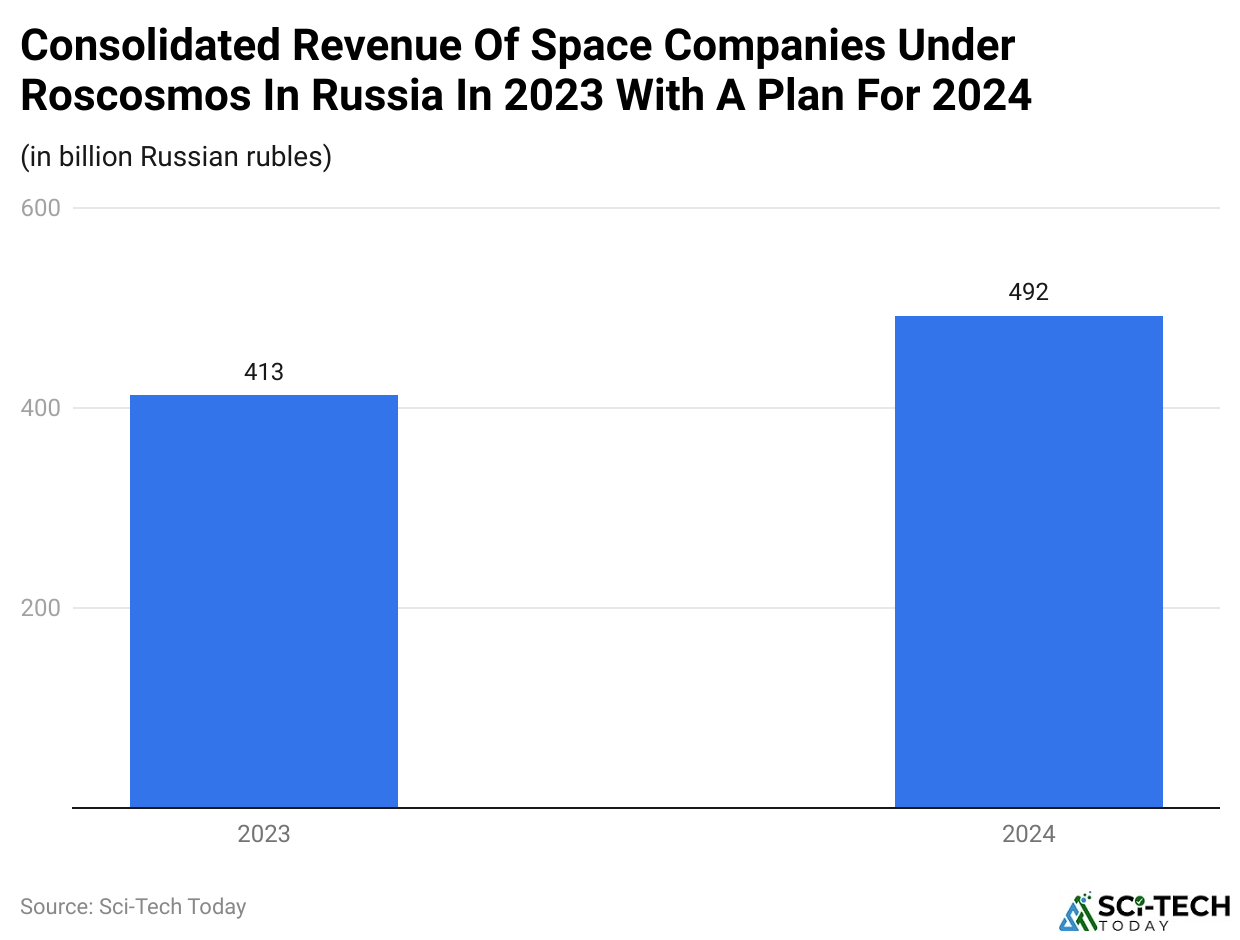
- Roscosmos statistics show that under the State Corporation for Space Activities Roscosmos, Russian space companies have generated revenues amounting to 413 billion Russian rubles in the year 2023.
- The impressive results were indicative of the great potential of the sector.
- Projections for 2024 suggested a 19% increase in revenue, and for 2025, forecasts point to further growth toward roughly 510 billion rubles in annual revenue, cementing the notion that Russia’s space industry remains on an upward curve supported by ongoing federal space programs through 2025.
Roscosmos Launches by Outcome
(Reference: statista.com)
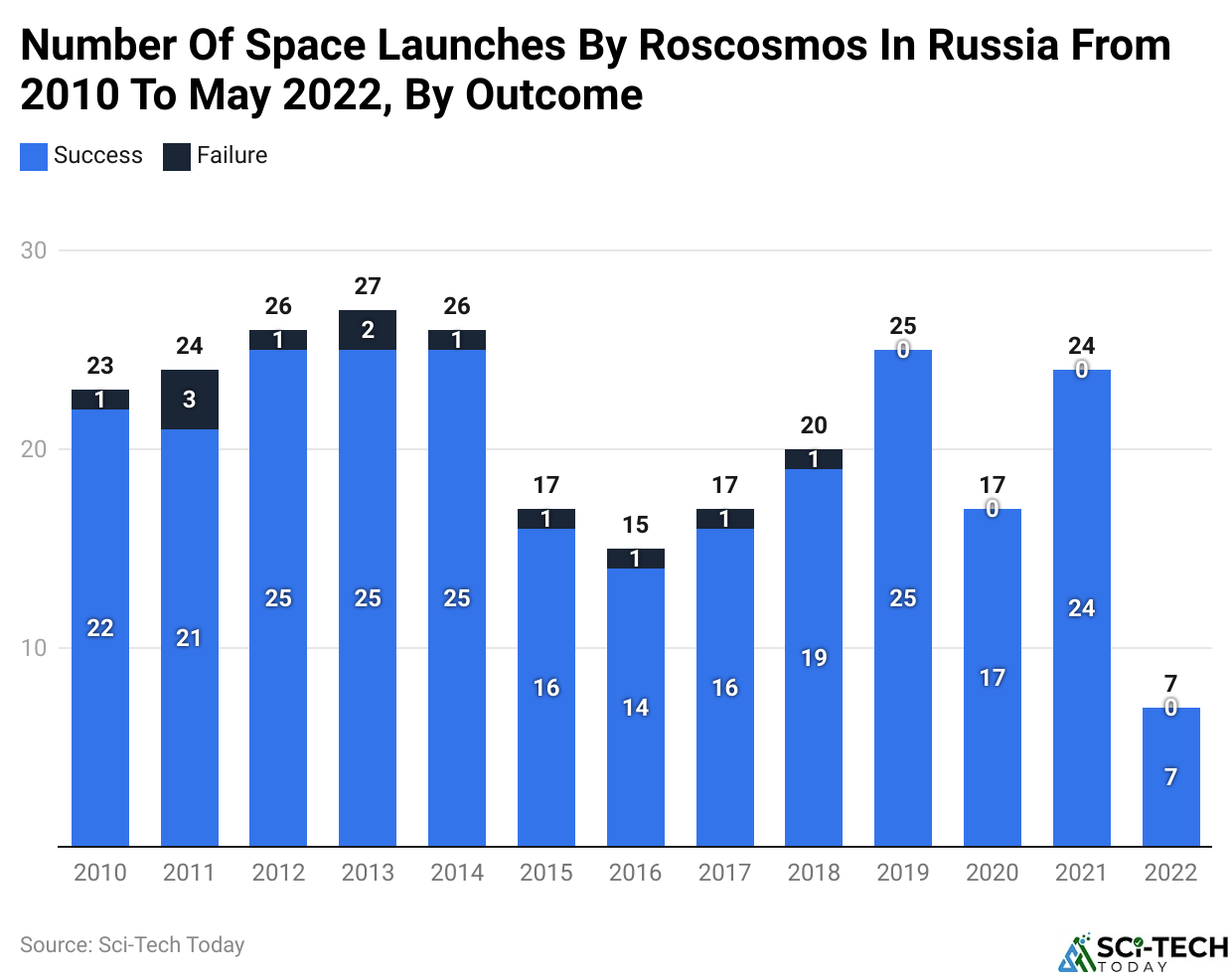
- Throughout the first five months of 2022, Roscosmos undertook seven outer space missions, therefore, continuing its stable engagement with global space operations.
- By 2025, the situation has evolved: the aerospace corporation is planning and executing more than 20 orbital launch attempts over the year, aiming to reverse the decline in launch rates seen in the previous three years and strengthen its presence in spaceflight.
- Roscosmos statistics now reveal an unbroken streak of launch successes over the past four years, with no recorded launch accidents from 2022 through 2025, underlining the agency’s safe and sound mission performance, precision, and operational excellence.
Number of Carrier Rockets Launched by Roscosmos
(Reference: statista.com)
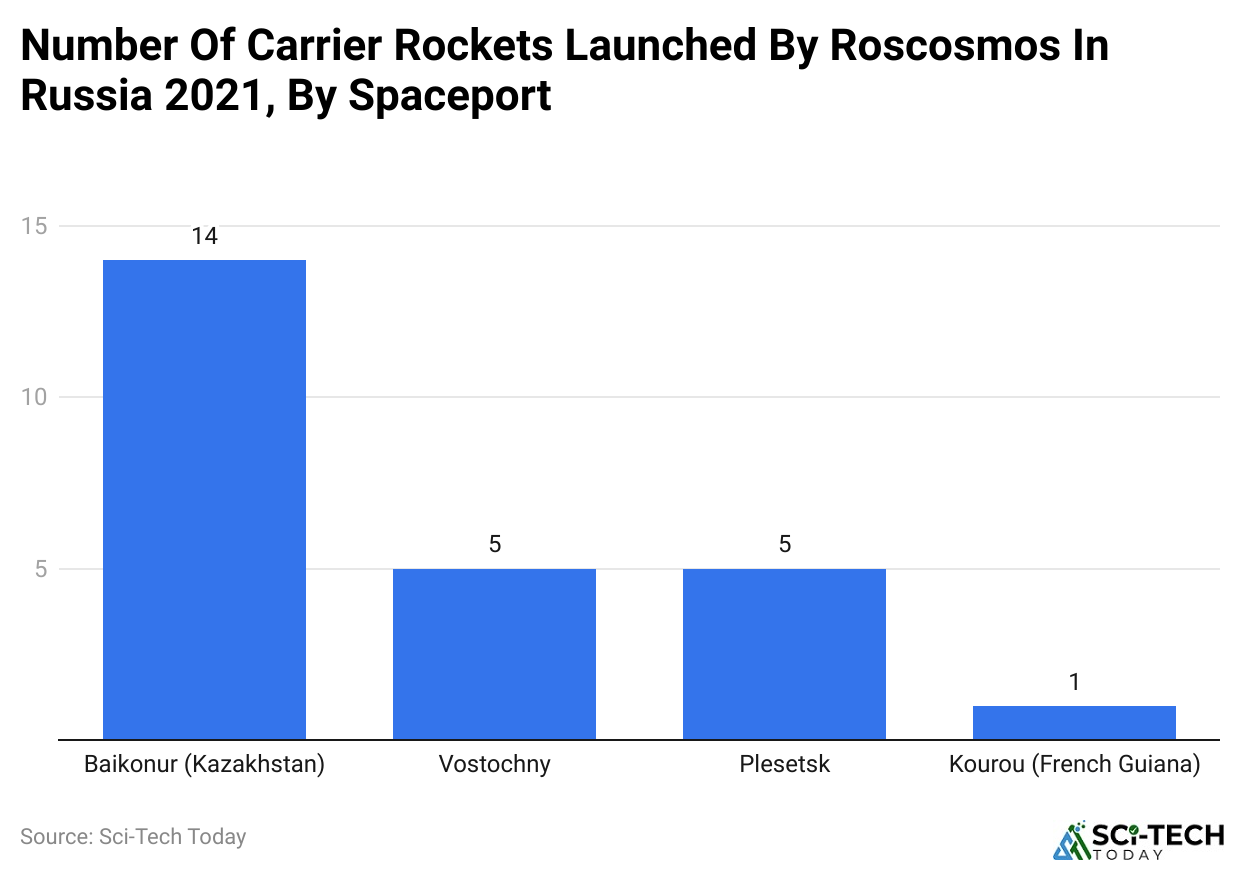
- Roscosmos, one of the Russian aerospace corporations, carried out six rocket launches from the Baikonur Cosmodrome in 2025, making it one of the most active sites that year, while Plesetsk recorded five launches and Vostochny four launches, reflecting a more balanced distribution of activity across Russia’s launch infrastructure.
- There was also one launch from French Guiana’s Kourou Spaceport.
- There were no launches from French Guiana’s Kourou Spaceport in 2025 under Russian vehicles, as cooperation on Soyuz launches from Kourou remained suspended due to geopolitical tensions.
- The historical record from 1957 to the end of 2025 shows that Plesetsk Cosmodrome used by Russia and previously by the Soviet Union has performed about 1,680 orbital launches, mostly ground‑based to orbit, while Baikonur over the same period has surpassed 1,700 orbital launches.
- The term “cosmodrome” is usually used to refer to spaceports in Russia and other post-Soviet states.
Roscosmos Launches By Purpose
(Reference: statista.com)
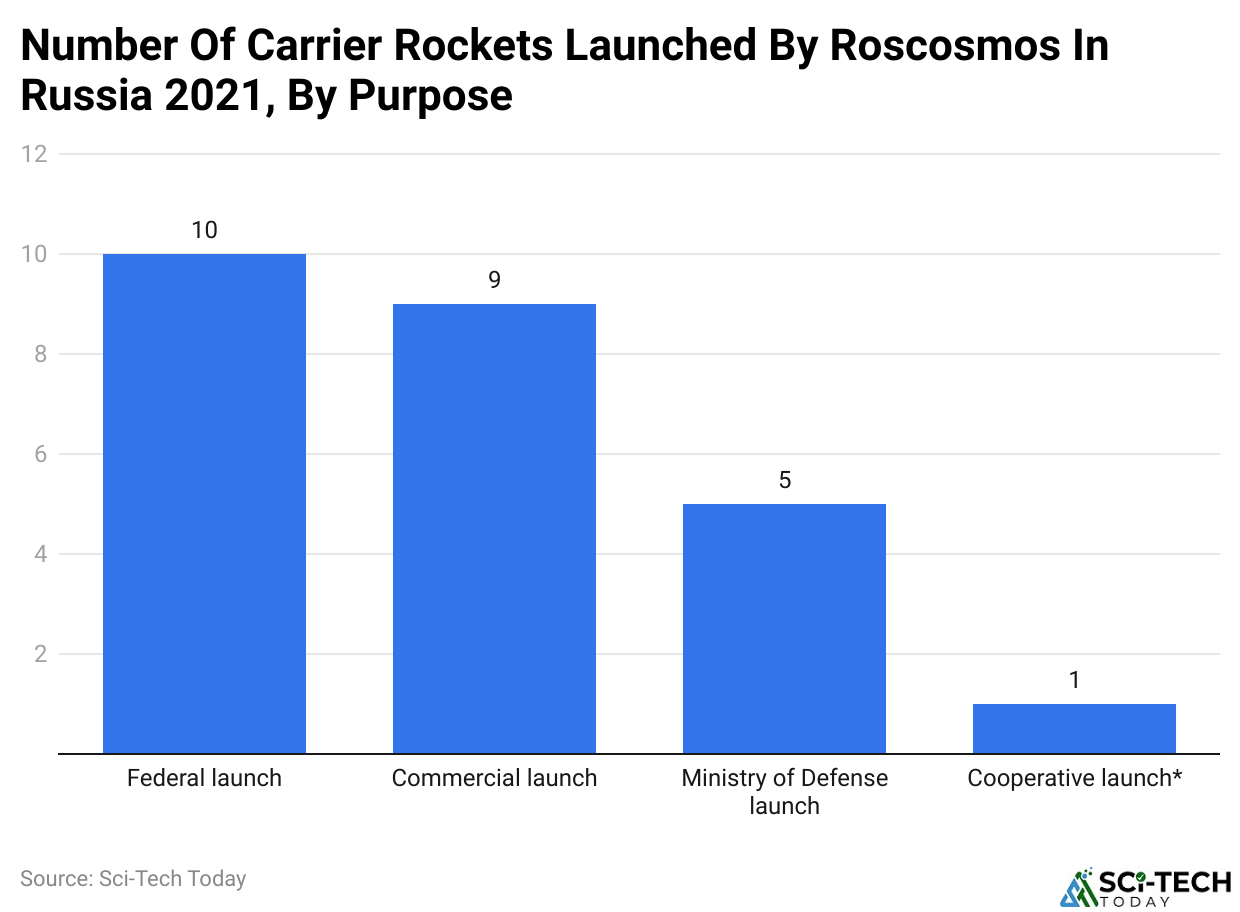
- In Roscosmos, a total of 17 launches were noted in 2025, most of which were federal missions, while commercial launches came second in the tally, accounting for five of the total carrier rockets launches and helping grow Russia’s orbital constellation from 288 to 300 satellites.
- More than half of these launches were performed from the Baikonur Cosmodrome, again pointing to the importance of this launch site as a key point for further Russian space operations.
Funding Challenges for the Roscosmos GLONASS Navigation System
- The planned Russian expenditures concerning the federal space program, the GLONASS navigation system, and the development of launch sites remain open to deliberate inspection.
- With its strategic significance, however, GLONASS seems to suffer huge underfunding, even in ruble terms alone.
- Roscosmos statistics reveal that official plans allocated ₽484 billion (USD 6.7 billion) for GLONASS development in the period between 2021 and 2030.
- This funding was intended to support the development and deployment of the next-generation GLONASS-K (GLONASS-K2) satellites, which will replace the ageing GLONASS-M satellites that are nearing the end of their service or have already exceeded it.
- Forecasts indicate that, by the end of 2026, Russia will have spent no more than ₽158 billion (USD 1.9 billion) in the implementation of development activities for GLONASS.
- Funding from 2027 to 2030 may not reach adequate volumes; rather, current projections reduce the chance.
- For comparison, GLONASS funding from 2002 to 2011 represented close to ₽114 billion (USD 3.9 billion), while the value for actual expenditures is represented by ₽268 billion (USD 5.1 billion) for the 2012–2020 period.
- Thus, the current funding plans can hardly be said to be sufficient for continued maintenance and modernisation of the architecture of GLONASS.
- At least 18 satellites in medium earth orbit (20,000-22,000 km) are necessary to guarantee the provision of services over Russian territory, together with a minimum of 24 satellites for global coverage.
Financial Struggles and Budget Trends in Russia’s Space Programs
- As of 2025, Russia’s funding strategy for civilian and military space programs remains heavily reshaped by ruptured cooperation with the United States and Europe (outside of the ISS), sanctions, and economic pressure on Roscosmos; the corporation reports cumulative losses of around 180 billion rubbles (about USD 2.1 billion) from canceled contracts and withdrawn Western agreements.
- Roscosmos statistics indicate that while the agency received 31 billion rubbles (about USD 421 million) in 2021–2022, its total losses over 2020–2024 exceeded roughly USD 1.2 billion, and key enterprises such as Energia posted a net loss of about 458 million rubbles in the first half of 2025
- This sharply contrasts the mixed but modest results from 2019 and 2020, 1.8 billion rubles in net losses and 500 million rubles in net profit, respectively, and since Roscosmos was established in 2015, its accumulated net losses now exceed about 90 billion rubbles and, counting export and contract losses, approach the USD 1.8 billion range.
- Since its establishment in 2015, it has accumulated net loss amounts exceeding 90 billion rubles (USD 1.3 billion)-not a little money, by the way, compared to Russia’s annual civil space exploration budget.
- The recent years have been dire for Roscosmos because the war has amplified its financial woes. Yet, minor changes have happened in the actual Russian space budget allocations.
- In 2018, 212.4 billion rubles (USD 3.4 billion); in 2019, 251.7 billion rubles (USD 3.9 billion); in 2020, 258.2 billion rubles (USD 3.6 billion); in 2021, 250.6 billion rubles (USD 3.4 billion), and in 2022, 264.2 billion rubles (USD 3.9 billion) were the annual expenditures over the past five years on space programs.
- Roscosmos statistics indicate that the allocations planned for the next years are 257.5 billion rubles (USD 3.8 billion) for 2023, 254.5 billion rubles (USD 3.7 billion) for 2024, and 253.8 billion rubles (USD 3.7 billion) for 2025 (according to the average of the 2022 exchange rates).
- However, these forecasts are subject to changes during 2023, with very few of the final numbers available until the end of the year.
Reduced Funding of Roscosmos Under the Federal Space Program
- Roscosmos, the federal space agency of Russia, expected government payment in the next decade to amount only to 1.5 trillion rubles (US$22.5 billion)-that would be less than half of the initial projections of 3.4 trillion rubles, as the space officials declared earlier this year. This announcement was obtained in a statement from Roscosmos on Monday evening.
- Originally, the agency estimated 3.4 trillion rubles as part of the Federal Space Program 2016-2025 (FSP), a strategic document that defines the goals of space development for Russia and its associated financial needs.
- The problem was simply that the country’s economic crisis and the continuously adjusting government budgets across sectors forced Roscosmos to alter its requests for budgetary provisions on several occasions during the year.
- In March, that amount was reduced to 41%, setting the budget at 2 trillion rubles (US$30 billion). Ultimately, the approved amount paid was settled at 1.521 trillion rubles, according to Roscosmos director Igor Komarov.
- The program was optimised to prioritise key projects that are essential for advancing the industry despite the budget cuts.
- Roscosmos statistics reveal that of the 1.5 trillion rubles, only 1.4 trillion rubles (US$21 billion) are secured upfront. The remaining 115 billion rubles will depend on the execution of an unspecified project after 2021, subject to economic conditions.
Closing
As per Roscosmos statistics, it has achieved further milestones in the completion of important missions and the enhancement of its technological capabilities. Looking forward to lunar exploration and international cooperation, the agency remains an important player in the ever-changing space industry.
Such statistics show its contributions to scientific research and practical applications, thereby firming up its position as a leader in the exploration of outer space.
FAQ
Roscosmos stands for Rossiysky kosmos, which means Russian Space in English.
Yes, NASA still works with Roscosmos mainly to run and staff the International Space Station (ISS).
Dmitry Vladimirovich Bakanov (Russian: Дми́трий Влади́мирович Бака́нов, 7 October 1985) is a Russian economist who has been the General Director of Roscosmos, the Russian space agency, since 2025.


