









Introduction
Cost of Space Missions Statistics: Space exploration is such a field that it has always fascinated human beings and the quest for new inventions. Space flight is, however, not only about marvels in technology but also about a burden, a financially expensive venture in and of itself. The costs for different space missions depend on the objective of the mission, the technology brought to bear to reach that mission, and its scale.
In the year 2026, as space agencies and privatised commercial organisations across the globe plough ahead in their efforts to explore the Moon and Mars, the numbers become both eye-opening and astounding. This article narrows itself down to the figures behind the cost of space missions statistics.
Editor’s Hand Picked
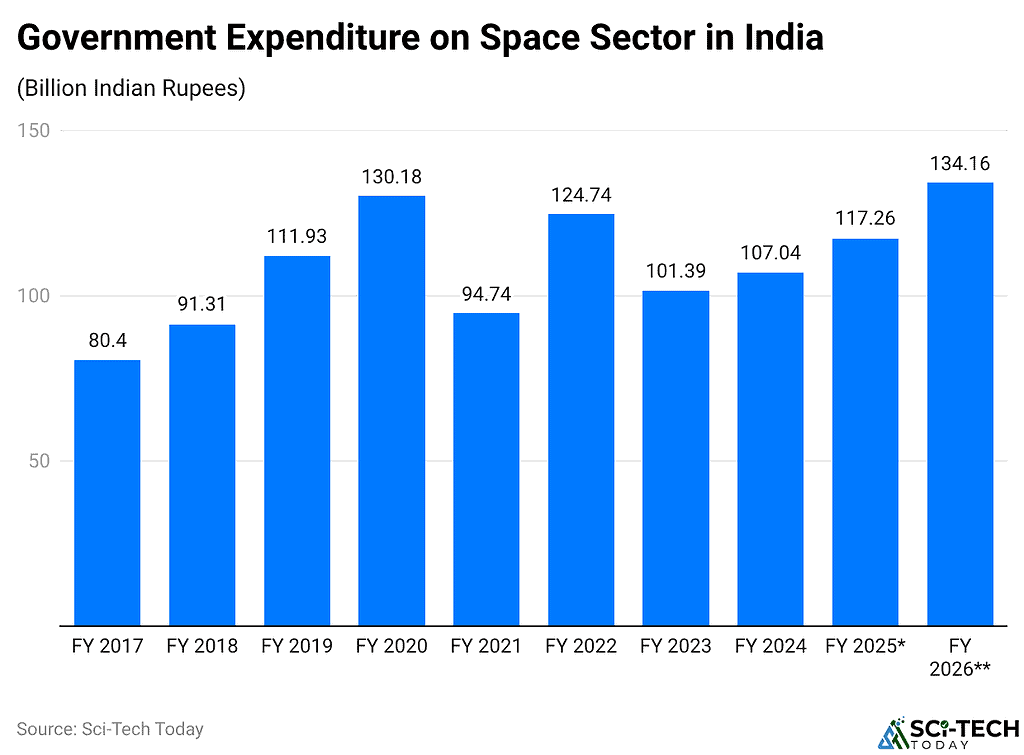
- India’s space sector expenditure has grown significantly from Rs 80.4 billion in FY 2017 to Rs 134.16 billion in FY 2026, reflecting the country’s increasing commitment to advancing its space exploration and technology capabilities.
- In 2025, global government space investment rose further to USD 137.4 billion across 60+ nations.
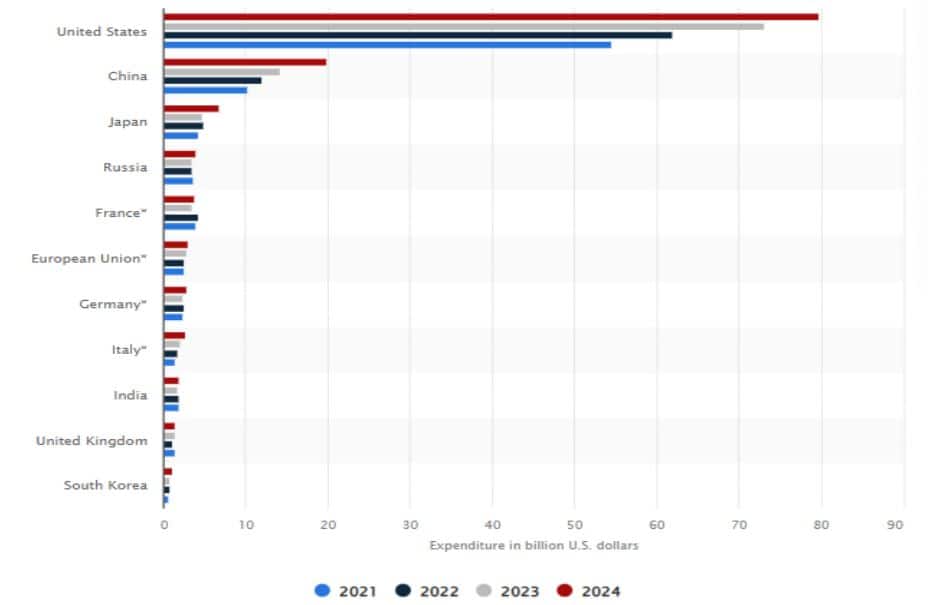
- China is ranked as the world’s second-biggest investor in space programs, with over US$14 billion.
- NASA made requests of US$27.2 billion in FY 2024 for activities related to science and exploration.
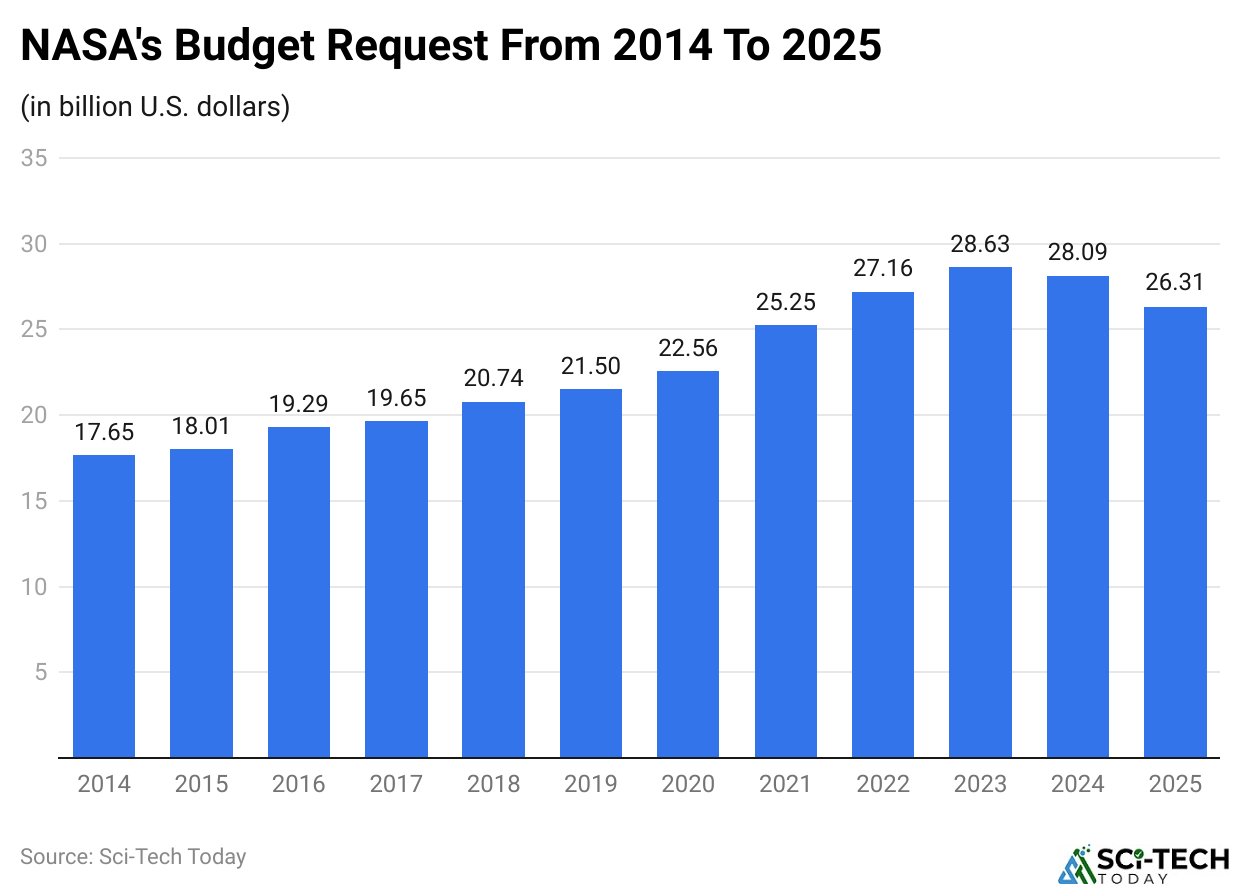
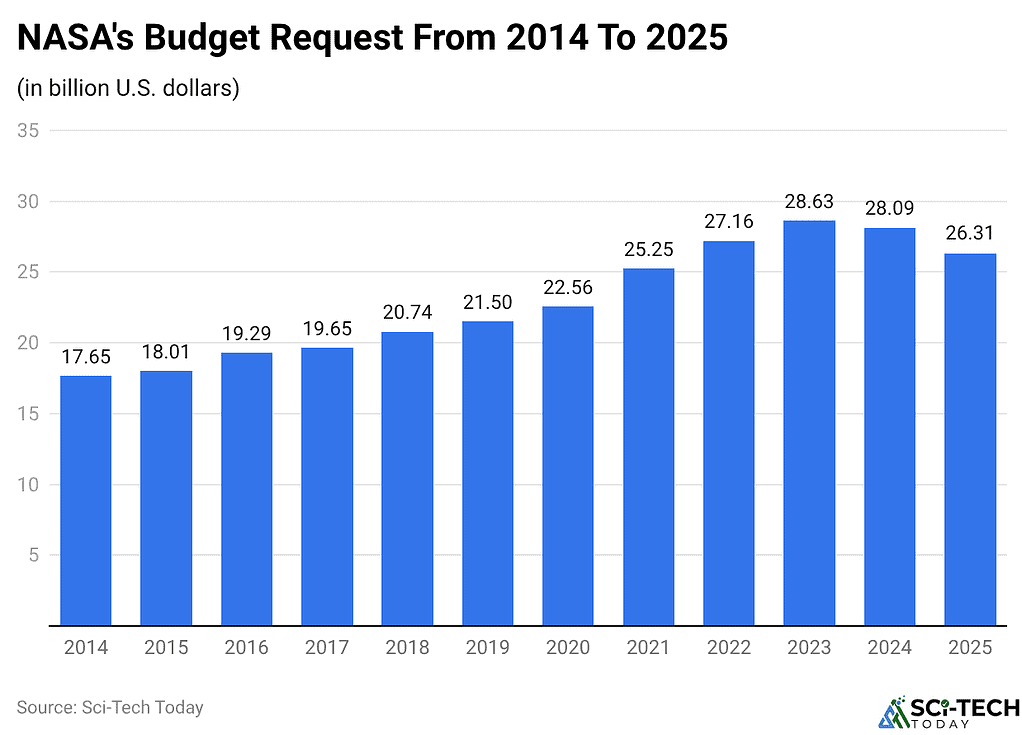
- NASA’s funding increased differentially every year starting from 2014 until 2025, reaching USD 25.25 billion in 2021.
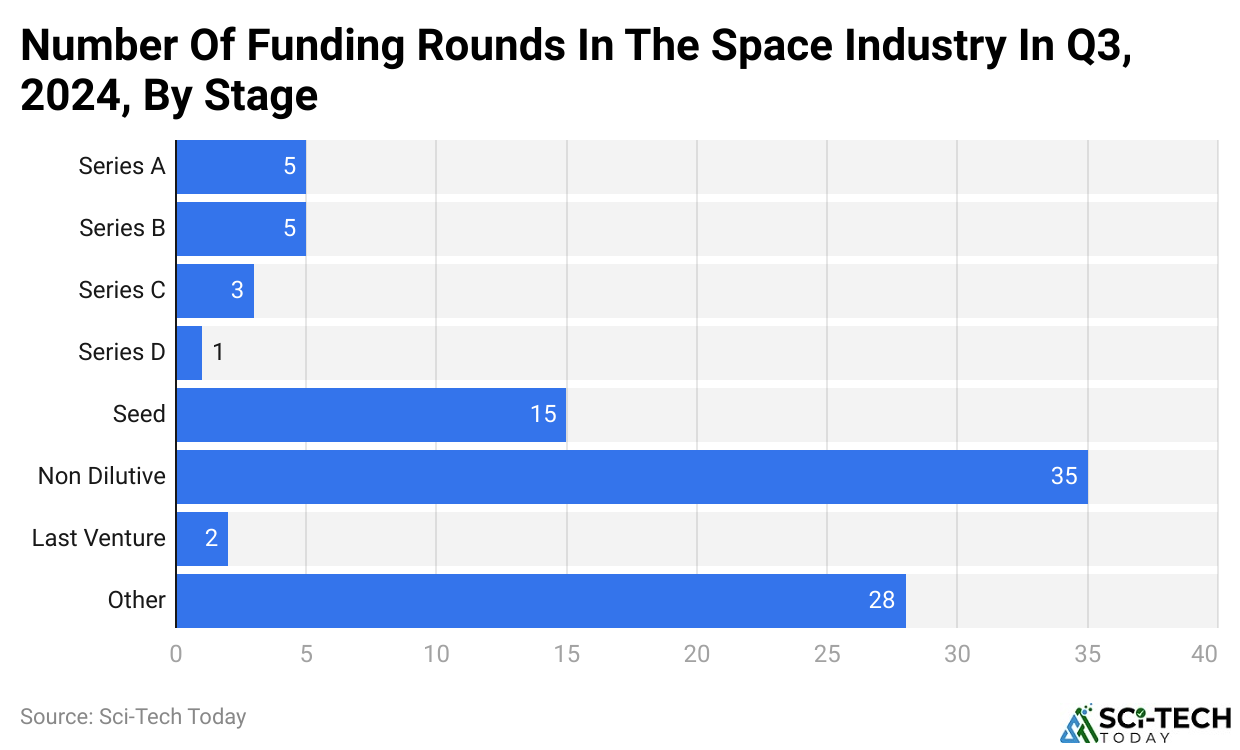
- In Q3 2024, the space technology sector recorded 94 funding rounds, out of which 35 were classified as non-dilutive.
- ESA’s 2024 budget increased by EUR800 million (US$870 million) compared to the previous year under the new budget, as it plans to spend a total of EUR7.8 billion that year.
- Germany (EUR1.17 billion), France (EUR1.05 billion), and Italy (EUR881 million) are the leading countries contributing to ESA in 2024.
- ESA will bring five imaging satellites to orbit in 2024, including two Copernicus Earth Observation satellites.
- Statistics on the cost of space missions indicate that the cost of launching spacecraft has decreased by tenfold in the last ten years, requiring between USD 500,000 and USD 50 million for each human to travel into space.
- SpaceX’s cost-cutting reusable boosters provide a great advantage that others do not have.
- The Vega-C rocket from ESA has been postponed since late 2022, but after November 15, 2024, it is expected to regain its flight status, while the Ariane 6 rocket eyes a launch in June/July 2024.
- The debris of space is a growing concern, as much finds its way to NASA’s ‘graveyard orbit or the orbit of Earth.
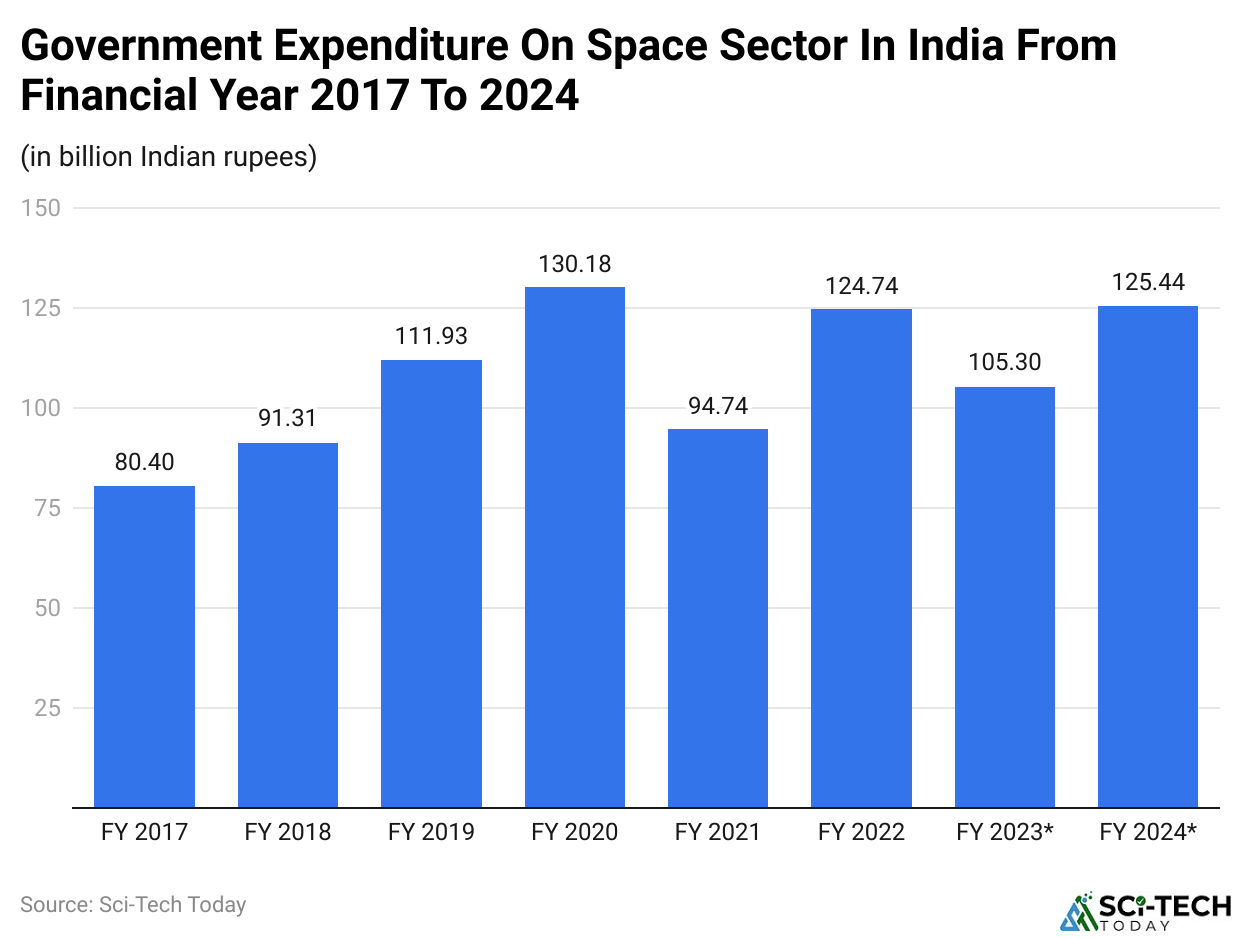
Government Expenditure On Space Sector In India
(Reference: statista.com)
- India’s space sector expenditure has grown significantly from Rs 80.4 billion in FY 2017 to Rs 134.16 billion in FY 2026, reflecting the country’s increasing commitment to advancing its space exploration and technology capabilities.
- From FY 2022 onwards, government spending has shown a consistent upward trajectory, rising from Rs 124.74 billion in FY 2022 to Rs 117.26 billion in FY 2025, before climbing to a record Rs 134.16 billion in FY 2026.
- The FY 2026 budget of Rs 134.16 billion represents the highest-ever government allocation to India’s space sector, signalling strong support for upcoming missions, private sector collaborations, and India’s growing ambitions in the global space industry.
Government Expenditures On Space Mission Programmes By Countries
(Source: statista.com)
- In 2025, global government space investment rose further to USD 137.4 billion across 60+ nations.
- Government budgets represent 22% of the total USD 613 billion global space economy in 2024.
- The US alone accounts for approximately 79.68% of all global government space spending in 2024.
- Space agencies that are more focused on civilian activities in space and major research and exploratory efforts have compounded their assignments over the years.
- Currently, six governmental space agencies- NASA (U.S.), CNSA (China), ROSCOSMOS (Russia), ESA (Europe), ISRO (India), and JAXA (Japan)-have considerable capabilities in launching missions and achieving extraterrestrial landings.
- Among them, the National Aeronautics and Space Administration (NASA) is known to be the most popular.
- Since its formation in 1958, NASA has operated jointly with other international partners to improve human exploration beyond the solar system and use the fruits of such efforts to improve life on Earth.
- Therefore, it is not surprising that a big chunk of NASA’s budget goes to science and exploration.
- Statistics on the cost of space missions reveal that, for FY 2024, NASA is asking for USD 27.2 billion in its overall budget to fund its various programs and objectives.
(Reference: statista.com)
NASA Budget For Space Missions
(Reference: statista.com)
- The graph of the cost of space missions statistics shows that NASA’s budget is expected to increase year by year from 2014 to 2025. In 2025, it had a budgetary provision of around 26.31 billion U.S. dollars.
- This decimal figure indicates the continuing commitment of the United States government to aeronautics and aerospace research.
- NASA is the primary agency of the nation in all things related to space exploration and innovative sciences. Its activities as a government organisation are concerned with technology advancement, research, and exploration beyond the Earth’s atmosphere.
Number of Funding Rounds In the Space Sector For Space Mission By Stage
(Reference: statista.com)
- In the third quarter of 2024, there were 94 funding rounds in the space technology sector, 35 of which involved non-dilutive funding, meaning grantee companies do not reduce their equity or have not been given additional ownership stakes, such as grants or contracts.
NASA’s Biggest Budget Beneficiaries
(Reference: statista.com)
- SpaceX is gearing up for the first full orbital test flight of its Starship system, which is slated for March 2023. It’s being administered by Tesla’s chief executive, Mr. Elon Musk.
- This future rocket model is supposed to carry people and cargo from Earth to the Moon and will be considered by Musk to be the first important step toward colonising Mars.
- However, the flight’s authorisation is pending before the Federal Aviation Administration (FAA), the U.S. agency that regulates rocket launches.
- The same FAA, although generally supporting SpaceX, has delayed previous official licensing dates and the planned launch dates.
- NASA’s FY2025 total contract obligations track at USD 27.2 billion (including carry-over awards) but actual disbursements are lower due to Congressional budget freezes and DOGE-related spending cuts.
- SpaceX remains NASA’s #2 contractor (behind Caltech), and NASA remains SpaceX’s single largest customer. SpaceX also secured USD 5.9 billion of the Pentagon’s USD 13.5 billion Space Force NSSL launch contracts in April 2025.
- A 2025 Open the Books investigation found NASA paid USD 60 billion in contracts between FY2021–2024 while recovering only USD 7.7 million in civil fines.
- Such funding is mostly tied to Caltech in the operation of NASA’s Jet Propulsion Laboratory (JPL).
- Other leading contractors, such as Boeing, Lockheed Martin, and SAIC, reported sharp decreases in their funding compared to previous years. The budget of the European Space Agency (ESA) was much smaller by those standards.
- The new Ariane 6 rocket finally made its maiden flight in July 2024, and with 7 launches in 2025.
- However, 2025 marked a strong recovery with 7 launches, the most since 2021, as the new Ariane 6 performed 4 missions and Vega flew 3 times.
- Science and Technology Corporation taking the top three slots.
Cost Of Space Flights
(Source: brinknews.com)
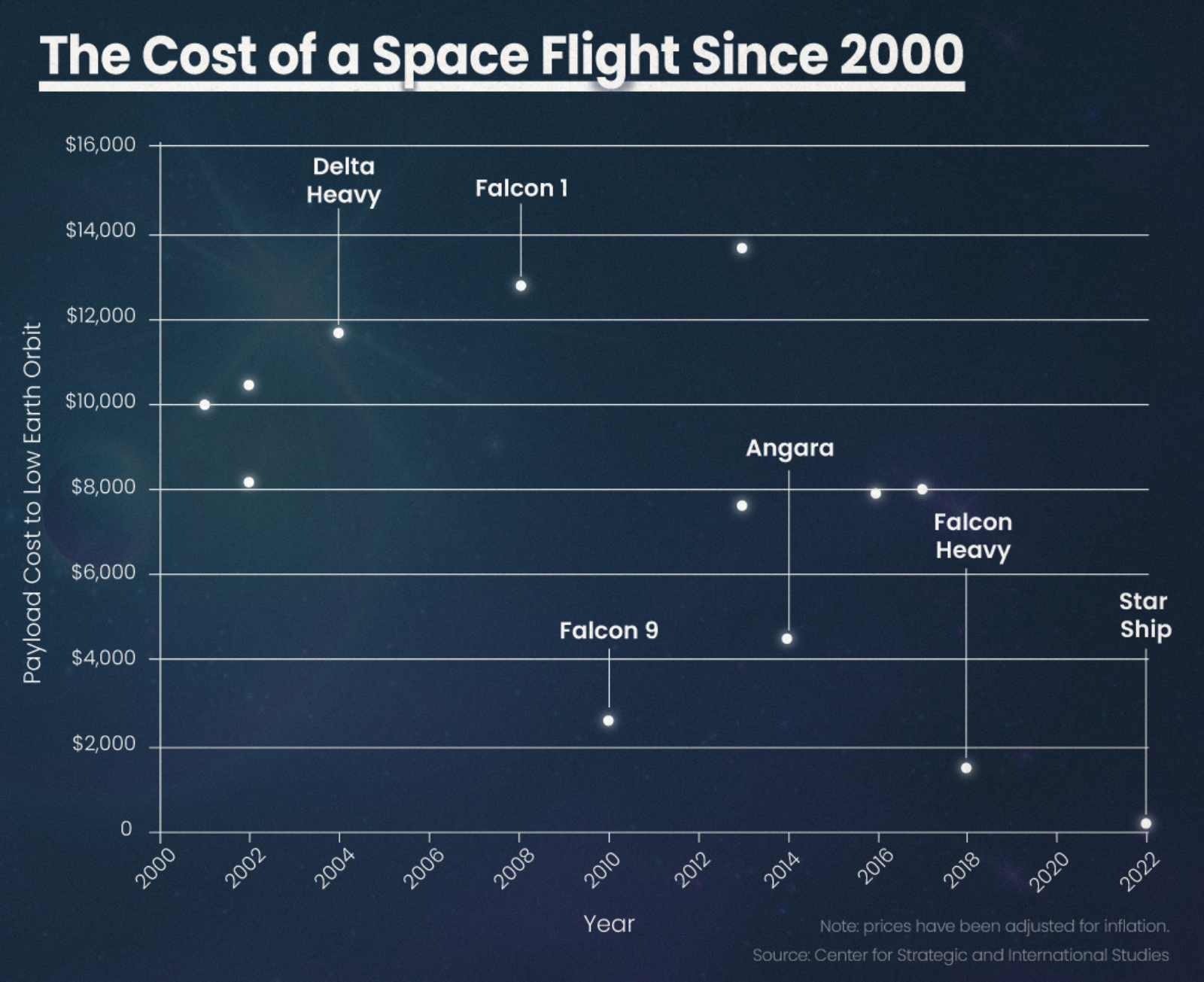
- According to Bruno Venditti and the figures from the Center for Strategic and International Studies, it is about 10 times cheaper today to launch a spacecraft than it cost a decade ago.
- By using a cost-per-kilogram metric and surveying all world launches since 1960, Venditti can draw attention to the reduction of expense.
- Statistics on the cost of space missions indicate that space travel for humans is a very expensive business, from USD 500000 to USD 50 million per seat, yet going to space is getting cheaper.
- Many private companies have significantly aided it, and SpaceX is one of them, competing in the market. SpaceX cleverly sends both crews and cargo into space: “The boosters land near the but are refurbished,” Venditti notes.
- Because of this innovative strategy, costs go down, and SpaceX can charge lower prices than its competitors.
- All these advances come against an increasing backdrop of concern about space debris, much of which ends up in what NASA calls the “spacecraft cemetery” or floats around in the vicinity of Earth, posing potential hazards to future missions.
ESA Budget For Space Missions
(Source: payloadspace.com)
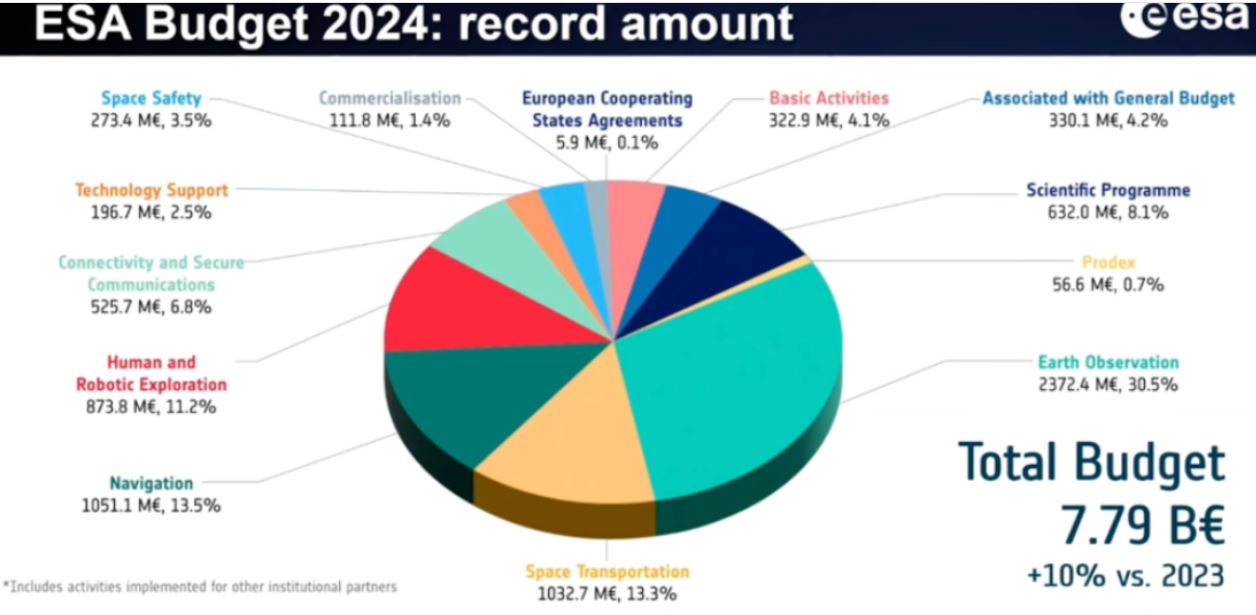
- During annual press briefings, the European Space Agency (ESA) announced a 10% budget increase for 2024, bringing the budget to EUR7.8 billion (around USD 8.5 billion).
- The largest budgeted portions are for Earth Observation (30.5%), navigation (13.5%), and space transportation (13.3%).
- ESA plans to launch five imaging satellites within the year, two of which will be Copernicus Earth observation satellites by 2024.
- Statistics on the cost of space missions show that the budget is funded by ESA member states (64.5%), the EU (23.4%), third-party agreements (10.5%), and Eumetsat (1.5%).
- The top contributors among member states are Germany, which contributed EUR1.17 billion (US$1.3 billion), France, which contributed EUR1.05 billion (US$1.15 billion), Italy, which contributed EUR881 million (US$965 million), and the United Kingdom, which contributed EUR449 million (US$492 million).
- While the overall allocation to ESA would earn less than a double-digit funding boost, NASA’s funding is projected to remain flat or fall slightly.
- Last year, ESA Director General Josef Aschbacher characterised European launch capabilities as being in a “crisis,” pointing to the postponements and worries stemming from the Ariane 6 and Vega-C rockets endangering independent access to space by Europe.
- ESA’s Director of Space Transportation, Toni Tolker-Nielsen, has also announced a flight date for Vega-C, which is slated for November 15.
Final Analysis
The cost of space missions statistics bring to the fore how both governments and private players are ever more ambitious and capable. Attention to the development and supply of technological advances has also re-envisioned the goal of reaching stars at a far lesser price, but it still needs rather larger investments, justifying the networks, innovations, and openness in making space exploration sustainable and inclusive.
FAQ
Space mission cost greatly depends on the purpose, destination, and the space agency.
Every year, budgetary resources are allocated to federal agencies by Congress. For FY 2026, NASA was allotted USD 43.52 Billion among its 1 sub-components. Budgetary resources allocation is done by obligating finances.
An Administrator of NASA, who is similar to the Chief Operating Officer, has a base salary according to the Executive Schedule Level II, which is between USD 221,000 and USD 230,000 (approximately Rs 1.82 crores and Rs 1.89 crores) per annum in 2026.