









Introductory Section
Communication in the Workplace Statistics: Good communication is the key to every successful workplace. It helps employees share ideas, work together, solve problems, and complete tasks more effectively. When people communicate clearly, they understand their roles, avoid confusion, and build stronger relationships with their teams. Today, communication happens through meetings, emails, phone calls, chat apps, and video conferences, making it easier to stay connected from anywhere. Strong workplace communication also improves employee engagement, increases productivity, and creates a positive work environment.
As businesses continue to grow and adopt hybrid and remote work, effective communication has become more important than ever. Learning how to communicate well helps both employees and organizations achieve better results and long-term success.
Selected Highlights
- 70% of employers worldwide consider strong communication the most important skill when hiring new employees.
- Effective communication can increase team productivity by up to 25% and improve business performance.
- Poor communication costs U.S. businesses around USD 1.2 trillion annually, or approximately USD 12,506 per employee.
- 63% of employees planning to quit say poor internal communication influences their decision to leave.
- Companies with strong communication strategies achieve about 4.5 times higher employee retention than those with weak practices.
- 79% of employees say leadership communication affects their understanding of organizational goals.
- Teams with effective communication experience improvements in productivity (63%), motivation (59%), and job satisfaction (54%).
- Around 80% of employees use or have tested AI tools at work, showing rapid adoption of AI-powered communication.
- 51% of employers prioritize communication skills in job candidates, followed by teamwork (44%) and emotional intelligence (40%).
General Communication In The Workplace Statistics
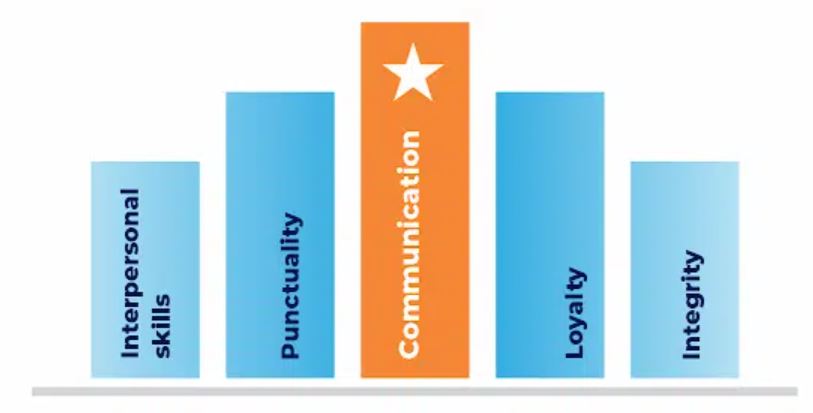
- Around 70% of employers around the world say that good communication is the most important skill they want in new employees.
- Teams that communicate well can boost their productivity by up to 25%.
- Gallup says low engagement costs the world economy USD 8.9 trillion, which is 9% of the global GDP.
- Communication is the main factor that helps enhance workers’ engagement, which leads to improved work engagement, resulting in an increase in productivity (18%) and profitability (23%).
- Engaged employees help reduce turnover by 43% in companies with low turnover rates and by 18% in companies with high turnover rates, making them more likely to stay longer.
- Moreover, 81% of recruiters worldwide think cross-cultural skills are the most important communication ability for job seekers, followed by knowing multiple languages (77%) and good listening (75%).
Employee Preferences for Internal Communication Channels
- Leaders mainly use instant messaging (50%), followed by project management tools (44%) and in-person meetings (38%) for workplace communication.
- Employees prefer instant messaging (64%) and email (63%), while 54% still value face-to-face meetings.
- 75% of employees use enterprise chat tools to communicate with colleagues.
- For important company updates, 67% of employees prefer email or newsletters, while 39% prefer in-person meetings and 24% prefer virtual department meetings.
- Only 18% of employees choose chat or instant messaging for critical updates.
- 85% of internal communication teams consider email their most effective channel.
- Other effective channels include intranets (67%), email (58%), and collaboration tools and direct manager communication (45% each).
Key Barriers to Effective Internal Communication
Major Internal Communication Challenges
- Cross-team communication is the biggest barrier: According to the Global State of Internal Communications 2026 report, 53% of professionals report that poor communication between departments creates challenges in workplace collaboration and information sharing.
- Employee engagement and measurement issues remain common: 46% face low employee responsiveness, while 40% struggle to track and measure communication effectiveness.
- Support and connection challenges continue: 32% report budget and leadership support issues, 30% experience inconsistent feedback, and 29% find it difficult to engage remote or hybrid employees.
Limited Resources and Leadership Issues Impact Communication
- Lack of team capacity is a major challenge: The State of the Sector report highlights that 49% of communication professionals report that limited time and resources make it harder to deliver effective internal communication.
- Workplace changes and management gaps create barriers: 44% face change fatigue, while 41% report weak communication skills among managers as a key issue.
- Leadership support remains critical: 39% highlight a lack of direction from leaders, and 38% identify poor leadership communication as a barrier to successful workplace communication.
Challenges in Improving Communication Quality
- Limited time affects communication efforts: Axios HQ research shows that 29% of leaders report finding enough time to communicate effectively is a major challenge.
- Resource and information issues create barriers: 25% struggle with building well-supported communication teams, while 25% face difficulties managing information overload.
- Measuring and improving communication remains difficult: 22% of leaders highlight challenges with using data and feedback to measure success, while 22% struggle to create clear and engaging messages.
Importance of Communication In The Workplace Statistics
(Source: go.grammarly.com)
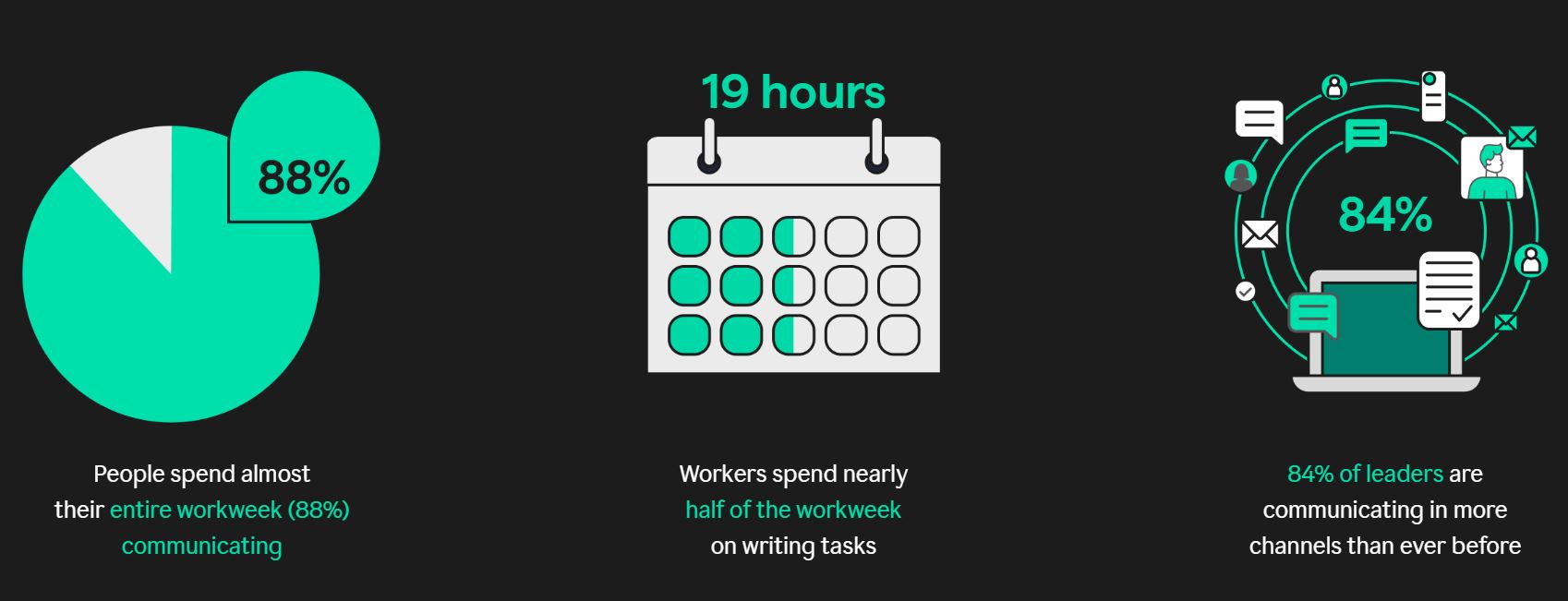
- In 2024, globally, employees will spend about 88% of their workweek communicating with others in various forms, such as meetings and emails.
- Workers spend almost half of their workweek on writing tasks, accounting for 19 hours, using up significant time for emails and reports.
- In workplaces, nearly 84% of leaders are using more communication channels now than before, making it easier to reach people.
(Source: passivesecrets.com)
- Employees expect good communication from their employers, but only 42% say their company communicates well overall to date.
- In 2024, 85% of employees feel more motivated when they regularly receive updates about company news.
- Around 69% of workers agreed that they will work harder when they get positive feedback from bosses.
- Communication in the Workplace Statistics show that 61% of workers feel they receive enough updates about what’s happening in their company, which is possible due to effective communication.
- Companies started using social technologies to improve communication and collaboration in the workplace, which boosted organisations’ productivity by 20% to 25%.
Workplace Communication Impact on Employee Retention
- According to Worktime, Poor workplace communication costs U.S. businesses about USD 1.2 trillion annually, equal to around USD 12,506 per employee, due to disengagement and employee turnover.
- Around 63% of employees planning to quit say weak internal communication influences their decision.
- 76% of employees with excellent internal communication are very likely to stay, while 14% are somewhat likely to remain.
- Sociabble’s report also stated that companies with strong communication strategies achieve about 4.5 times higher retention than companies with poor communication.
- 68% of organizations that increased communication investment reported better retention, compared with 32% that did not increase spending.
- According to axioshq.com, 66% of companies investing more in communication improved net-dollar retention, versus 34% without added investment.
- About 30% of employees believe better communication can improve retention, while 33% of leaders see it as a key priority.
- Only 25% of employees feel appreciated at work, creating a recognition gap.
- 83% of workers stay mainly because of company culture and people.
- 88% of organizations focus on better communication and learning opportunities to improve retention.
Effective Workplace Communication Statistics By Retention
- Effective communication improves retention, while 59% of workers were quietly quitting.
- On the other hand, in 2024, around 23% of workers felt they were doing well at work, while 18% were actively working against their company’s goals (known as loud quitting).
- The 2024 Achievers Workforce Institute report found that 72% of employees prefer staying at a job where they feel valued, even if another job offers 30% more pay but lacks support.
- According to the same report, 41% of employees plan to look for a new job in 2024, while 24% are undecided.
- This means 65% might leave, slightly higher than last year’s 61% who considered finding new jobs.
Effective Communication Facilitates Trust
- Clear communication builds trust, and almost 74% of workers would rather work for an employer they can trust.
- Communication in the Workplace Statistics also state that 68% of people said that low trust made it harder for them to work and be productive each day.
- 68% of people said that low trust made it harder for them to work and be productive each day.
- 24% of employees left their jobs because they didn’t feel trusted by their boss.
- Meanwhile, 22% said they didn’t recommend the company to others because they needed more trust in it.
- As per the Four Factors of Trust, employees who trust their workplace are 260% more motivated, 50% less likely to job hunt, and 41% less likely to take unplanned leave.
The Cost of Poor Workplace Communication
- According to the Zoom Blog, ineffective communication costs U.S. businesses up to USD 12,506 per employee annually.
- Employees spend only 66% of their workday on core responsibilities, while the remaining time is lost to distractions, unnecessary meetings, and communication issues.
- Poor communication reduces productivity for 49% of workers and negatively affects job satisfaction for nearly half of employees.
- 61% of employees who are unlikely to stay with their company say poor internal communication is a major reason.
- 25% of leaders report that poor communication leads to lower customer satisfaction.
- More than 40% of workers say poor communication damages trust, including 54% of remote employees who report lower trust in leadership.
- Poor communication also raises costs for 45% of employees and delays projects for 37% of workers.
- Among leaders, 37% report longer timelines and 32% report higher costs.
(Source: zoom.com)
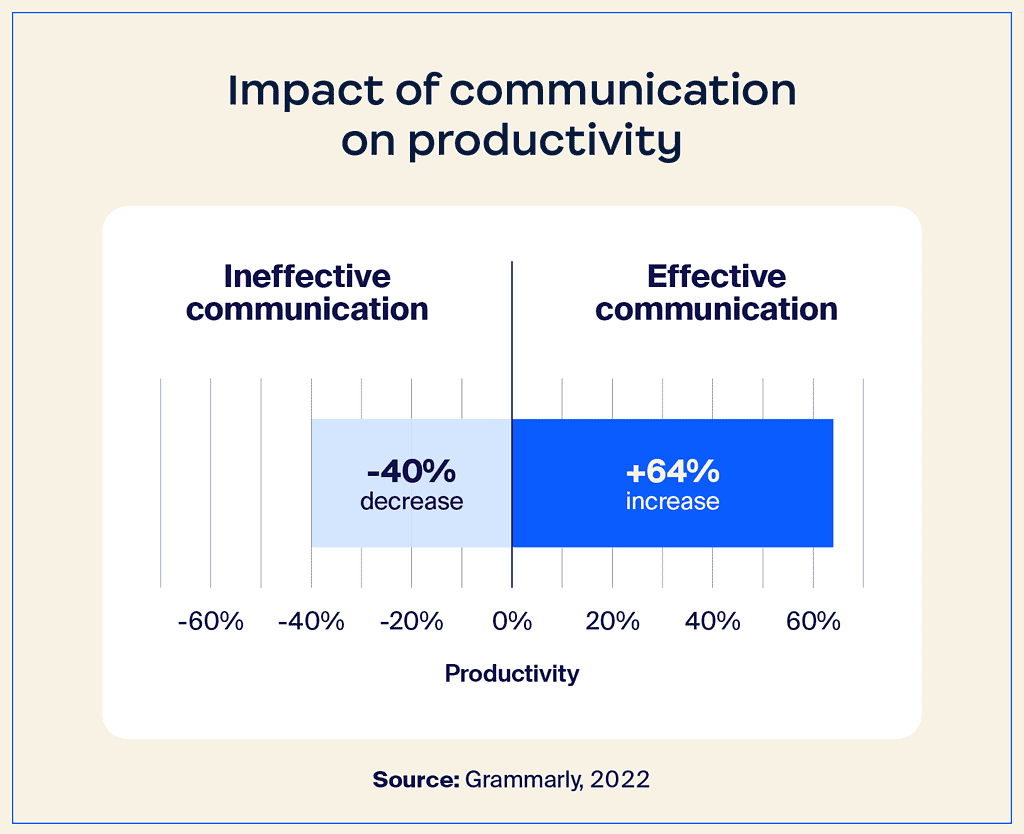
- Effective communication can increase productivity by 64%, while ineffective communication can reduce productivity by 40%.
Key Impact of Poor Workplace Communication
(Source: zoom.com)
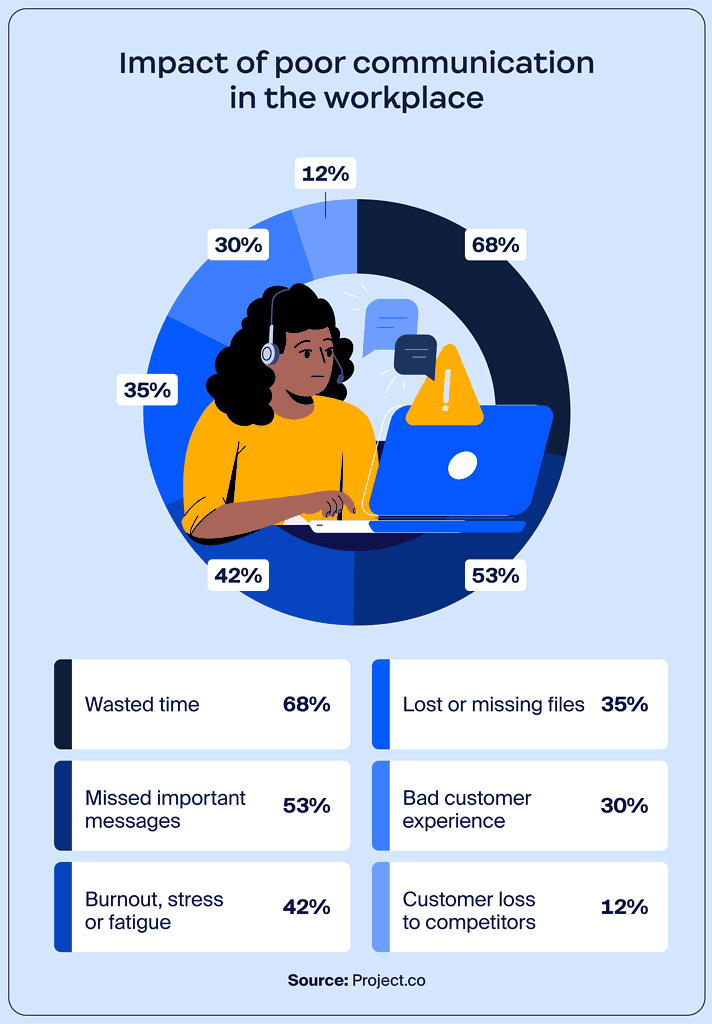
- Wasted time affects 68% of employees, while 53% struggle with missing important messages, which can reduce productivity and delay work.
- Burnout, stress, or fatigue impact 42% of employees, while lost files (35%), poor customer experiences (30%), and losing customers to competitors (12%) create additional operational challenges.
How People Rate Their Businesses In Terms Of Communication
(Reference: s3.eu-west-2.amazonaws.com)
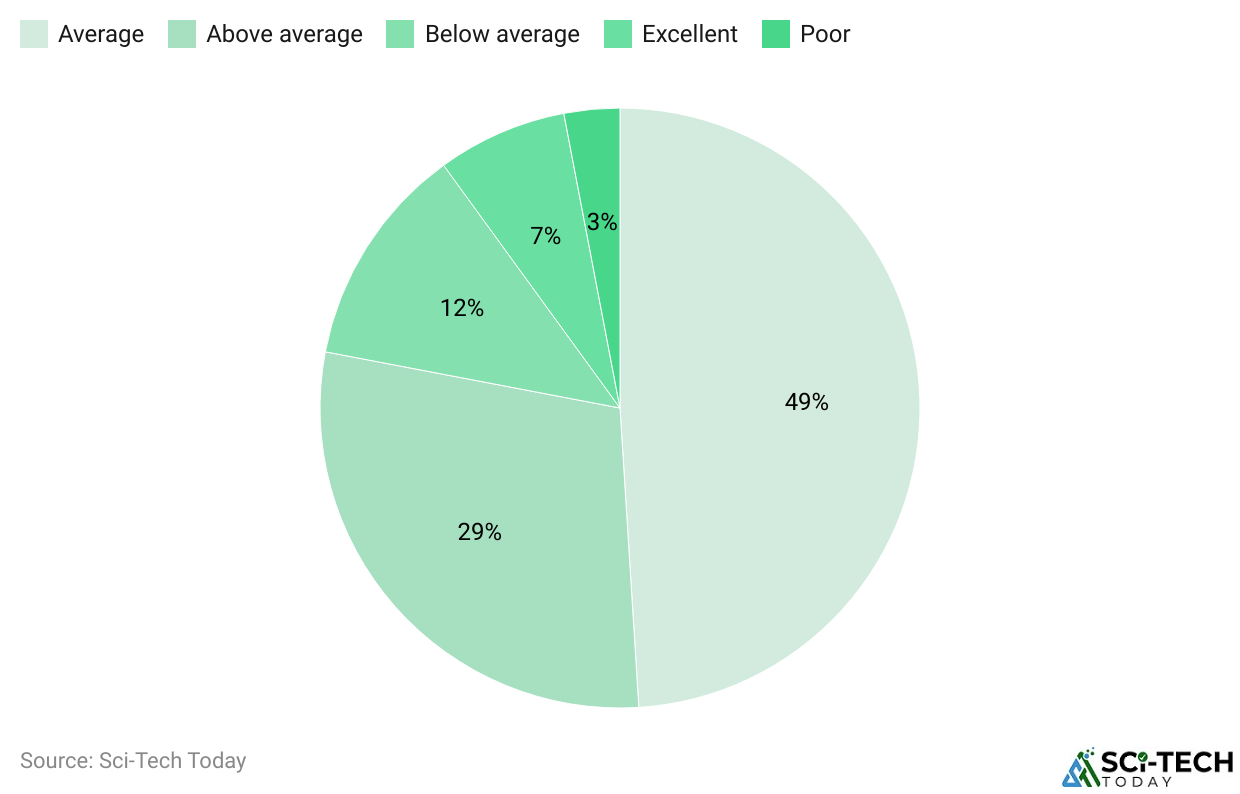
- Communication in the Workplace Statistics state that just more than one-third say their communication is ‘excellent’ (7%) or ‘above average’ (29%), while nearly half rate it ‘average.’
- Furthermore, other people share in terms of business communication, followed by average (49%), below average (12%), and poor (3%).
Communication In The Workplace Statistics By Language
- A Harvard Business School survey shows that 89% of employees work on a global team, and 62% of corporate workers have colleagues from three or more cultures.
| Language | Number of worldwide speakers | Global GDP percentage |
| English | 1.5 billion | 30% |
| Mandarin Chinese | 1 billion | 19% |
| Spanish | 534 million | 6.9% |
| German | 130 million | 4.5% |
| French | 300 million | 4% |
| Arabic | 295 million | 4% |
| Japanese | 127 million | 4% |
| Portuguese | 232 million | 3.2% |
| Hindi | 341 million | 2.6% |
| Russian | 258 million | 2% |
Statistics On Nonverbal Communication In The Workplace

(Source: worldmetrics.org)
- In 2024, nonverbal cues such as body language, facial expressions, and tone of voice will contribute to 93% of overall communication impact, while verbal communication will only make up 7%.
- Communication in the Workplace Statistics show that 55% of communication is body language, including gestures, posture, and eye contact, while 38% comes from tone of voice.
- Meanwhile, up to 90% of people show emotions at work through nonverbal actions.
- On the other hand, 80% of first impressions come from nonverbal signals, which shows how important body language is when meeting people in the workplace for the first time.
- As much as 85% of job success stems from strong communication skills, including nonverbal aspects.
Verbal Communication Statistics
- Verbal communication will be crucial in 2024, as 86% of employees say poor communication leads to workplace failures and affects productivity.
- Nearly 70% of employees report they would be more productive if their organization improved its communication methods.
- 39% of workers feel their companies lack transparency and collaboration, which affects performance and causes mistakes.
- Employees who feel heard are 4.6 times more likely to produce high-quality work.
- In 2024, 96% of workers prefer empathetic communication. Managers who listen and engage openly can keep more employees.
- Also, 89% would recommend their company if communication needs are met.
- In recent years, many companies have switched to video calls for verbal communication, and 45% of employees depend on online tools as their main method.
The Most Used Communication Tools In The Workplace
- Communication in the Workplace Statistics in 2024 show that Slack is one of the most popular communication tools used by 67% of businesses.
- Zoom was widely adopted during the pandemic, and now 45% of remote employees use it regularly for meetings.
- In 2024, 42% of people use Microsoft Teams, a complete communication tool for businesses.
- Google Chat, used by 43% of businesses, integrates with Google Drive and Calendar for easy collaboration.
| Tools | On-site | Remote | Hybrid | Total |
| Mobile phone | 52% | 42% | 51% | 49% |
| Microsoft Teams | 37% | 42% | 45% | 42% |
| Landline | 36% | 36% | 27% | 31% |
| Zoom | 35% | 45% | 51% | 46% |
| Google Chat | 29% | 43% | 44% | 41% |
| Google Meet | 26% | 35% | 47% | 40% |
| VoIP Phone System | 23% | 37% | 24% | 28% |
| Discord | 12% | 38% | 36% | 32% |
| Slack | 12% | 38% | 33% | 30% |
Time Spent On Digital Communication Tools Per Week
(Reference: forbes.com)
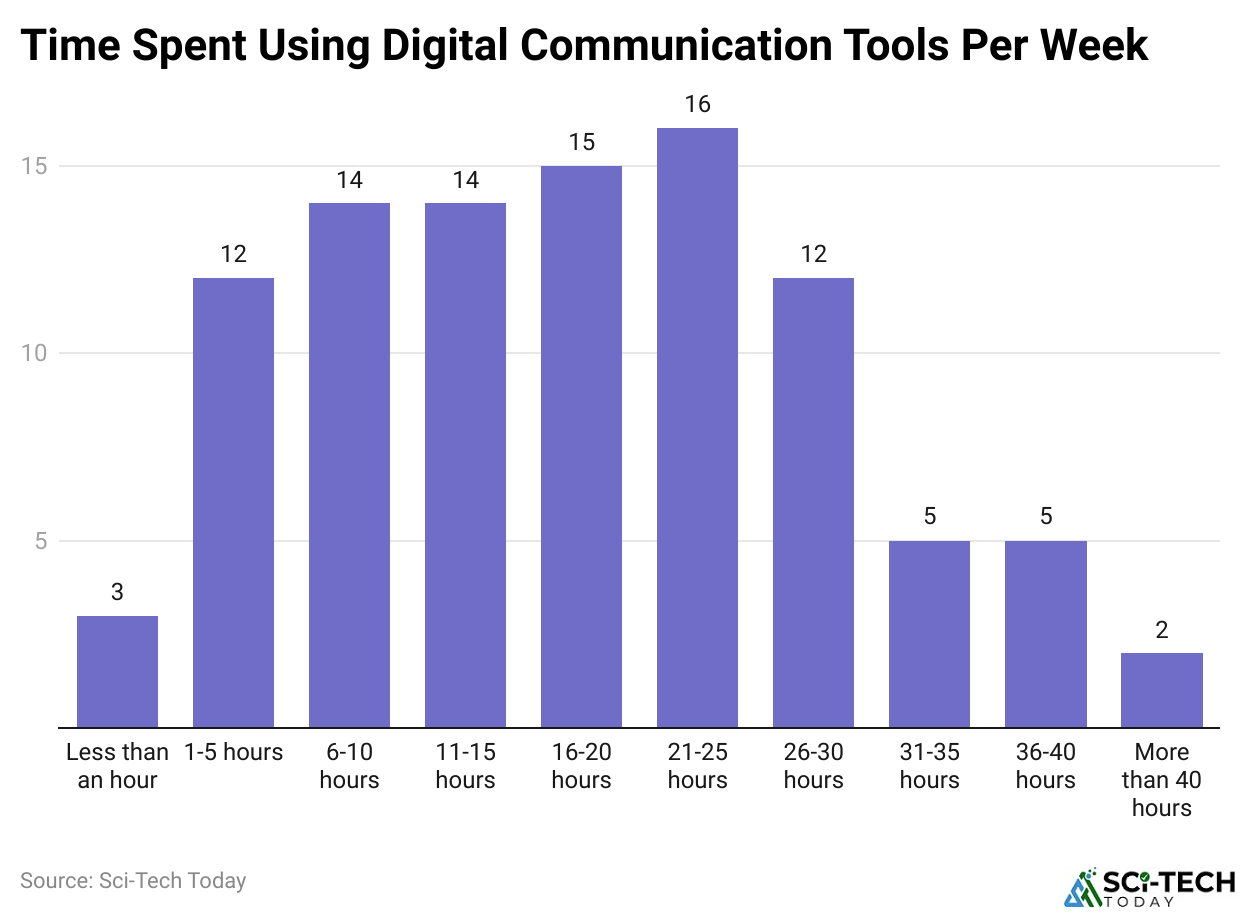
- The largest group of employees (16%) spends 21-25 hours per week using digital communication tools.
- Around 15% spend 16-20 hours, while 14% each spend 6-10 hours and 11-15 hours weekly.
- Another 12% spend 1-5 hours, and 12% use these tools for 26-30 hours per week.
- Heavy usage is less common, with 5% spending 31-35 hours and another 5% spending 36-40 hours weekly.
- Only 3% spend less than 1 hour, while 2% use digital communication tools for more than 40 hours each week.
Impact of Digital Communication on Team Connection
(Reference: forbes.com)
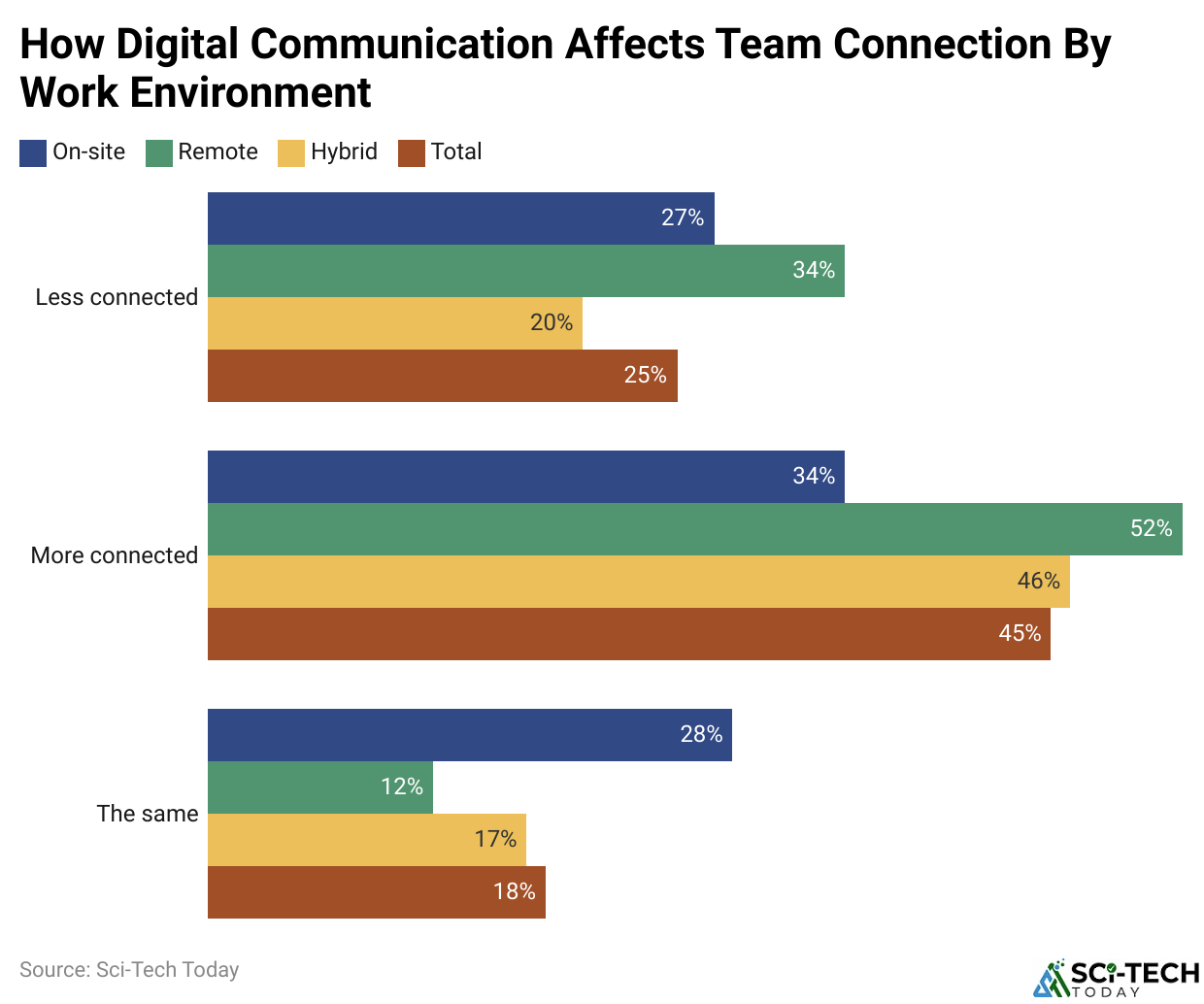
- Among on-site workers, 27% feel less connected due to digital tools.
- For remote workers, 34% report feeling less connected.
- In hybrid settings, 20% feel less connected, indicating a moderate negative impact.
- Overall, 25% of employees across all environments feel less connected when relying on digital communication.
- At the same time, 34% of on-site employees feel more connected through digital channels.
- This share rises to 52% among remote workers.
- In hybrid environments, 46% feel more connected.
- Across all workers, 45% report stronger connection thanks to digital communication.
- Meanwhile, 28% of on-site employees say their sense of connection stays the same.
- For remote, hybrid, and all employees, 12%, 17%, and 18% respectively report no change in connection levels.
Digital Communication In The Workplace Causes Stress Statistics
| Skill category | Importance among employers |
| Communication skills | 51% |
| Interpersonal and teamwork skills | 44% |
| Emotional intelligence | 40% |
| Networking and relationship building | 35% |
| Cross-cultural competence | 26% |
| Verbal communication skills | 54% |
| Presentation skills | 46% |
| Digital communication skills | 35% |
| Active listening | 32% |
| Conflict resolution | 27% |
| Writing skills | 25% |
| Negotiation skills | 25% |
| Cross-cultural communication | 19% |
| Multilingualism | 12% |
| Nonverbal communication skills | 11% |
| Video conferencing skills | 10% |
(Reference: forbes.com)
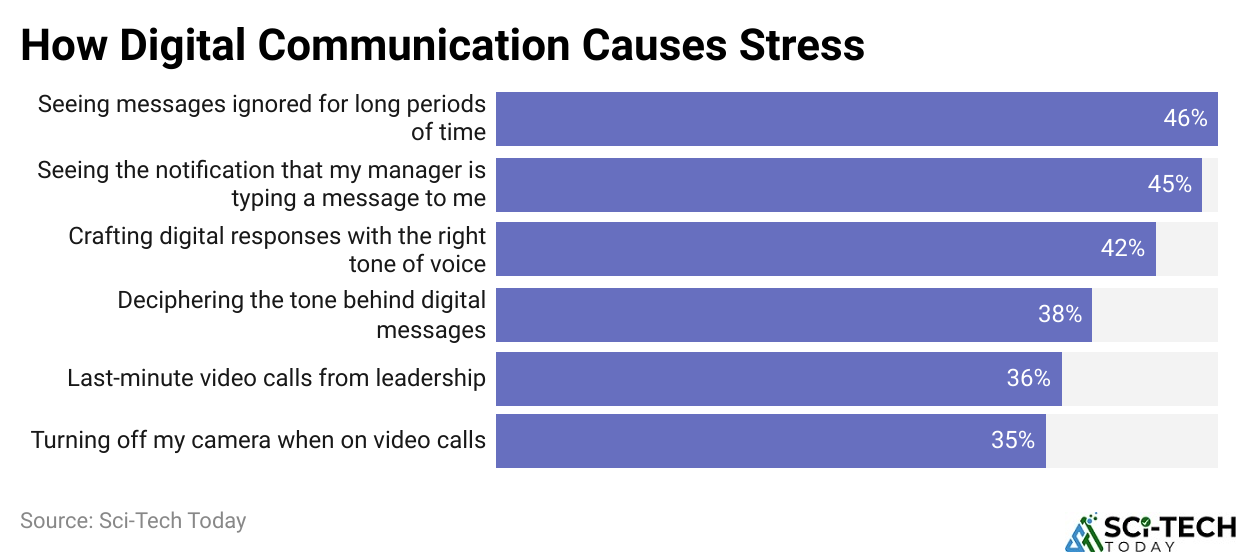
- Communication in the Workplace Statistics report that in 2024, 46% of people experienced long delays in responding to messages at work, which caused them to feel stressed and anxious.
- In addition, digital communication also caused stress for many: 42% struggled with tone in responses, 38% found it hard to understand tone, 36% disliked sudden video calls, and 35% felt awkward turning off their camera.
Most Desired Communication Skills in Job Candidates
Preferred Communication Methods In The Workplace
- Email is the most used tool, with 18% of people preferring it (25% of remote workers and 10% of those working on-site).
The table below shows all other methods of analysis:
| Methods | On-site | Remote | Hybrid |
| Audio call | 9% | 16% | 15% |
| Direct message | 11% | 14% | 16% |
| 10% | 25% | 18% | |
| In-person conversation | 34% | 14% | 12% |
| Text message | 19% | 14% | 11% |
| Video call | 12% | 17% | 17% |
Workplace Communication Methods Statistics By Demographics
- More women preferred personal greetings, accounting for a 47% share, and men with 40%.
- In contrast, male respondents liked audio more than females: 63% compared to 50%, while Video also showed males at 61% and females at 53%.
- As per Communication in the Workplace Statistics, employees aged 43 to 58 liked GIFs the most, with 42% compared to 31% for people aged 18 to 26.
- Similarly, workers aged 18 to 26 were the most likely to prefer video (69%), followed by 60% of those aged 27 to 42, 50% of those aged 43 to 58, and only 23% of people aged 59 to 77.
Remote Workplace Communication Statistics In 2024
- 78% of businesses and workplaces have the tools and systems needed for remote work communication and collaboration.
- In 2024, around 62% of people working from home like to turn on their cameras during meetings to improve communication.
- More than half of remote workers (52%) feel that digital communication helps teams stay more connected and engaged.
- In weekly work meetings, 52% of remote employees spend between 1 and 5 hours.
- However, 31% of remote workers say their tasks involve a mix of scheduled and flexible work hours.
(Reference: jobera.com)
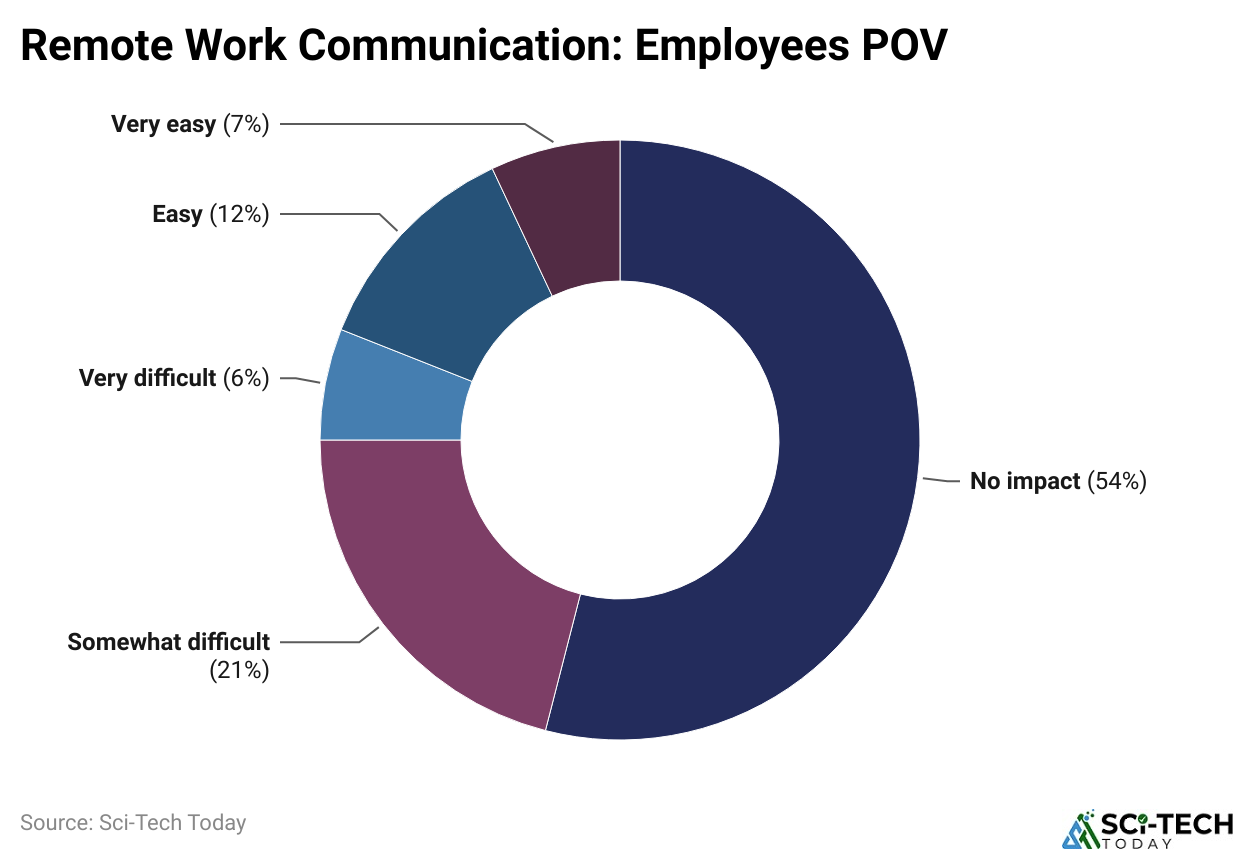
- 54% said remote work didn’t affect communication, while 21% found communication slightly harder with remote work.
- Communicating at work has become harder for them during remote work, as claimed by 6% of employees.
- In contrast, around 12% liked communicating from home better than talking in the office.
Challenges Within Communication In The Workplace Statistics
(Reference: s3.eu-west-2.amazonaws.com)
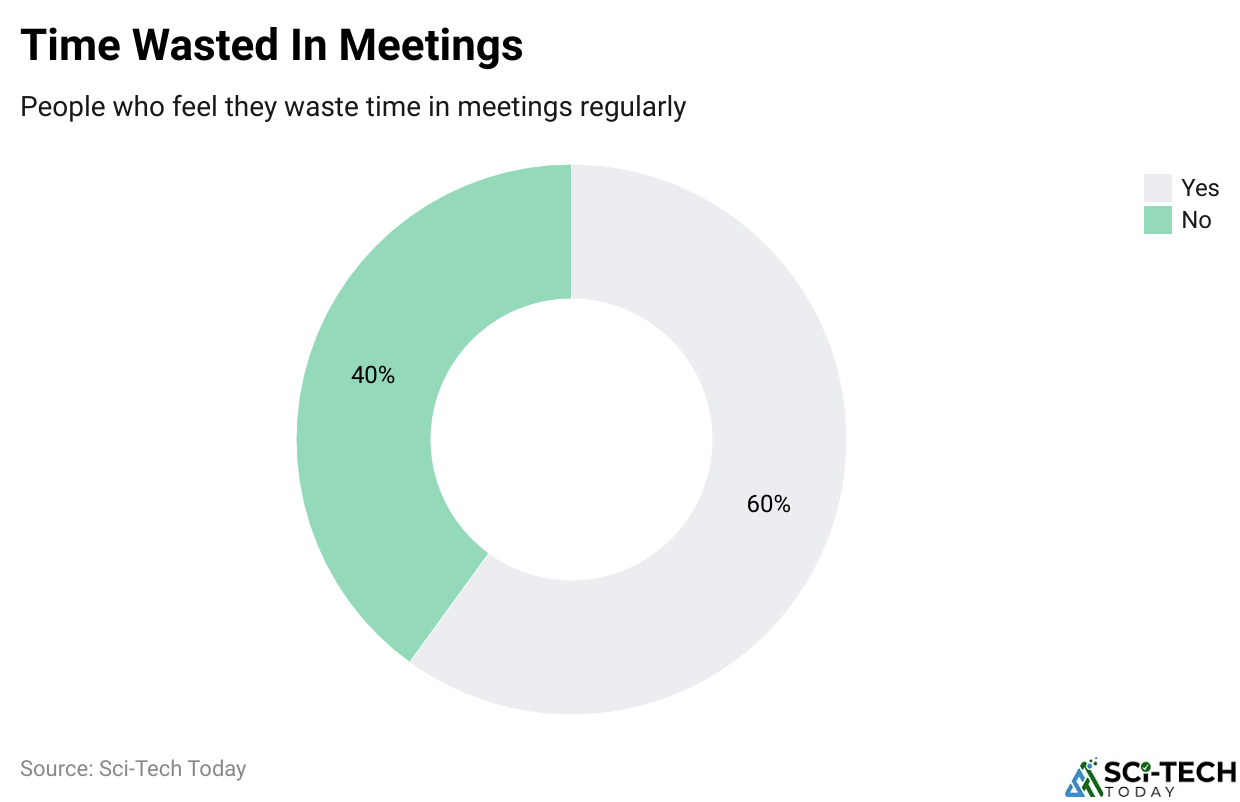
- 60% of employees think they waste time in meetings and aren’t fully involved in them, while 40% of employees claimed they never waste.
(Reference: s3.eu-west-2.amazonaws.com)
 (Reference: s3.eu-west-2.amazonaws.com)
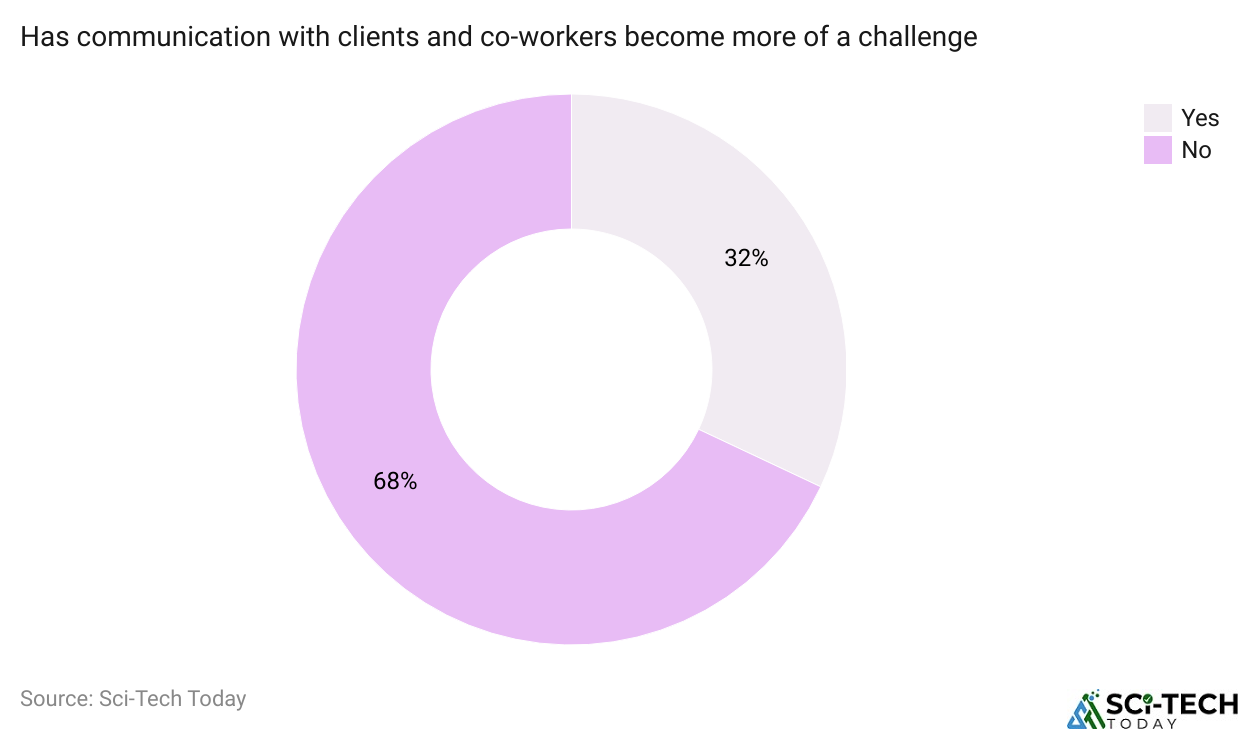
- 32% of people accepted that communicating with clients and co-workers has become harder over the last year, while 68% opposed the statement.
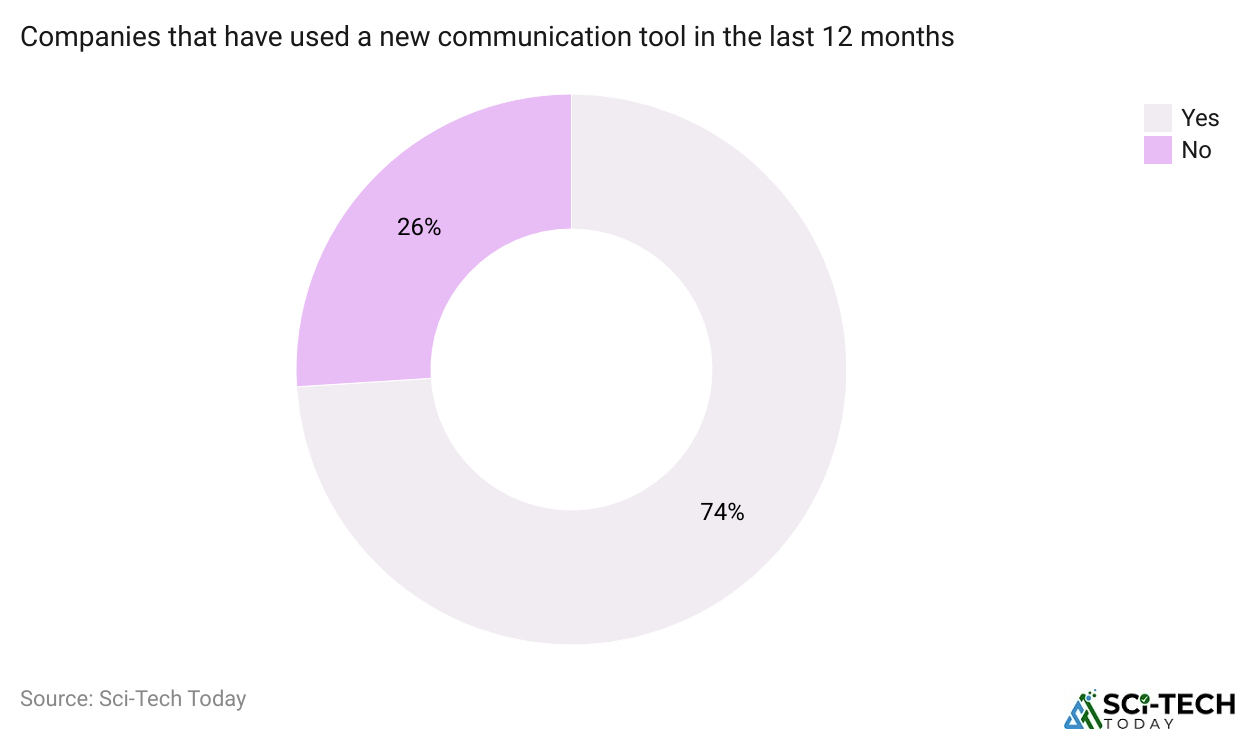
- In the last 12 months, 74% of businesses have started using new tools to organize, communicate, and manage projects effectively, but 26% of businesses still consider them less important.
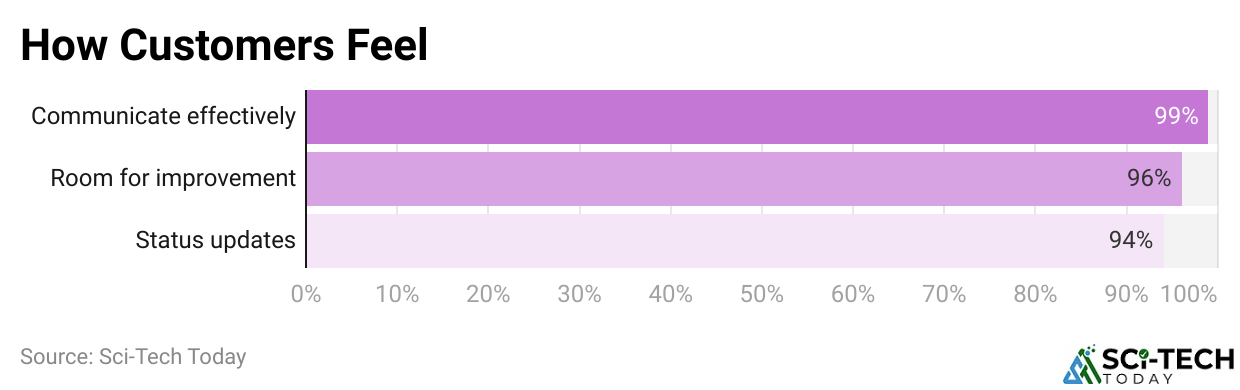
How Customers Feel
(Reference: s3.eu-west-2.amazonaws.com)
- Around 99% of people think it’s important for businesses to communicate clearly and effectively with them as customers.
- Meanwhile, 96% of customers believe businesses need to improve communication and project management to meet their needs.
- In 2024, around 94% of people say it’s important to know the status and next steps for their purchase or project.
Benefits Of Using a Project Management Tool For Co-Worker Communication
| Benefits | The percentage of people who agree |
| Improved Internal Communication | 79% |
| Better Internal Efficiency | 73% |
| Increased Rate of Project Success | 62% |
| Improved Client Communication | 52% |
| Better Customer Experience | 41% |
| Better Employee Wellbeing | 27% |
| Other | 10% |
Generative AI Adoption and Workplace Communication Trends
- AI and machine learning skills are becoming valuable, with 31% of recruiters ranking them as desirable skills in job candidates.
- Around 80% of employees use or have tested AI tools at work, including 90% of managers and 55% of individual contributors.
- Among employees whose companies changed workplace systems in 2025, 31% said those changes involved introducing AI tools.
- AI adoption concerns remain high, especially among low-income workers, with 65% in the U.S. and 71% in the UK fearing AI replacement.
- In comparison, only 47% of high-income U.S. workers and 38% of high-income UK workers share the same concern.
- A report published by Pumble shows AI skills vary among workers, with 13% of knowledge workers and 30% of business leaders being AI fluent.
- Around 26% of knowledge workers and 33% of leaders are AI literate, while 39% of workers and 28% of leaders are AI familiar.
- About 22% of workers and 9% of leaders remain AI avoidant.
- Only 44% of AI-avoidant employees view AI as an assistant rather than a replacement.
- Among AI-fluent workers, 95% say AI reduces workload, while 93% say it creates more time for meaningful work.
- Around 69% of AI power users use AI for workplace communication tasks.
- AI is used for research by 65% of AI-fluent and 42% of AI-familiar workers.
- Editing tasks involve 59% of AI-fluent and 35% of AI-familiar workers.
- Content creation is used by 53% of AI-fluent and 42% of AI-familiar workers.
- Task automation is used by 52% of AI-fluent and 39% of AI-familiar workers, showing AI’s growing role in workplace efficiency.
How Effective Communication Improves Productivity and Work Quality
- According to Pumble, effective communication helps employees better understand company goals, with 79% saying leadership communication directly affects their understanding of organizational objectives.
- Good workplace communication improves productivity (63%), motivation (59%), and job satisfaction (54%) by helping employees stay focused and aligned with business priorities.
- Strong communication also enhances collaboration (45%), problem-solving abilities (44%), creative thinking (37%), and the ability to complete projects on time (35%).
- According to Grammarly’s 2025 report, effective communication can save employees up to 25.2 hours per week by reducing misunderstandings and improving workflow efficiency.
- AI-fluent employees report higher productivity benefits from effective communication (96%) compared with AI-avoidant workers (82%), highlighting the growing role of technology in workplace communication.
Boosts Employee Engagement and Retention
- Poor workplace communication can reduce employee engagement and contribute to global productivity losses of USD 438 billion.
- Only 26% of employees are currently engaged at work, highlighting the need for better communication and stronger employee connections.
- Improved communication from leadership can positively impact engagement levels for 72% of employees.
- Organizations with highly engaged employees experience 51% lower turnover in low-turnover workplaces and 21% lower turnover in high-turnover workplaces.
- Around 63% of employees who plan to leave their jobs say poor internal communication has influenced their decision to quit.
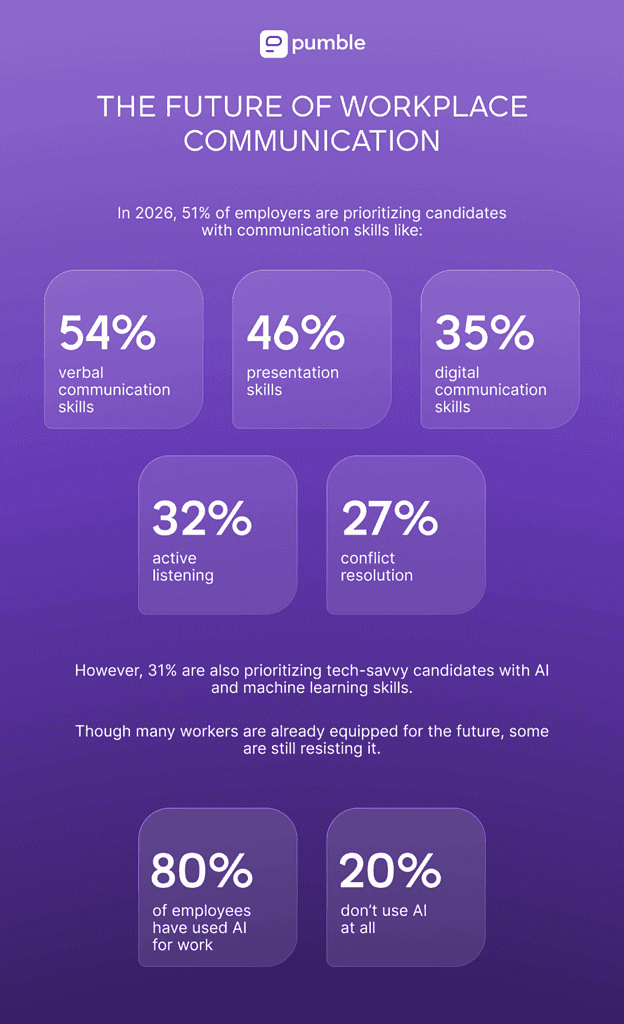
The Future of Workplace Communication
(Source: pumble.com)
- In 2026, 51% of employers focus on candidates with strong communication abilities.
- Verbal communication skills are valued by 54% of employers.
- Presentation skills are important for 46% of employers.
- Digital communication skills matter for 35% of employers.
- Active listening is prioritized by 32% of employers.
- Conflict resolution skills are key for 27% of employers.
- Tech‑savvy talent with AI and machine learning skills is sought by 31% of employers.
- Around 80% of employees have already used AI for work.
Final Thoughts
Good communication is the key to a successful workplace. It helps employees work together, avoid confusion, and complete tasks more efficiently. Clear and honest communication also builds trust, improves teamwork, and increases employee engagement. As more companies adopt remote and hybrid work, using the right communication methods is more important than ever. Businesses that encourage open communication and regular feedback create a positive work environment, improve productivity, and achieve better long-term results.
FAQ
Communication is important because it improves teamwork, reduces misunderstandings, increases productivity, and helps employees achieve shared goals together.
The main types include verbal communication, written communication, nonverbal communication, visual communication, and Digital communication through emails, chats, and video meetings.
Common workplace communication barriers include unclear messages, poor listening, language differences, cultural gaps, limited feedback, and technology problems.