








Overview
Tor Statistics: Tor (The Onion Router) is a free tool that helps people use the internet with more privacy and security. It hides a user’s identity by routing internet traffic through multiple servers around the world, making it difficult for others to track online activity. Many journalists, researchers, activists, and everyday users rely on Tor to protect their personal information and browse the web safely.
It also helps people access information in places where internet use is restricted. While Tor is a powerful privacy tool, it should always be used legally and responsibly. Today, Tor plays an important role in keeping the internet more private, secure, and open for everyone.
Spotlight
- In 2026, approximately 3 million people use the Tor network worldwide on average each day.
- Tor Metrics monitors unique version-3 (.onion) addresses that operate through directory relays.
- Nearly 60% of recorded platform crime in 2025 involved selling posts on Tor-accessible dark web forums.
- Only 1.5% of all Tor traffic ventures into the dark web.
- Tor traffic is estimated to peak at 20 million users in September 2026.
- The United States leads usage with 678,887 users (16.48%).
- Subscription-based Tor marketplaces offered 93 million data logs and 67 million Google logs for about USD 15 per month.
- As of May 2026, monthly website traffic increased by 0.34% compared with the previous month.
- Tor Browser records tens of millions of downloads each year across desktop and Android.
- Mobile users generate around 40% of daily Tor traffic, while Tor Browser for Android has received 65,769 reviews with a 4.4-star rating.
Tor Software Overview
| Attribute | Details |
| Name | Tor |
| Developer | The Tor Project |
| Initial release | 20 September 2002 |
| Stable release | 0.4.9.11 (security release announced on 25 June 2026). |
| Written in | C, Python, Rust (core daemon primarily in C, with components and tooling using Python and Rust). |
| Operating system | Unix-like systems, including Linux and BSD, macOS, Android, iOS (via Tor Browser and related apps), and Microsoft Windows. |
| Size | Approximately 150-231 MB for typical Tor Browser bundles or installed packages. |
| Language | English is the primary project and documentation language, with additional localization in Tor Browser; core Tor daemon messages are primarily in English. |
| Type | Overlay network, mix network, onion routing implementation, and anonymity software used for privacy-preserving communication over TCP-based applications. |
| License | BSD 3‑clause license for Tor (the daemon), consistent with listings of Tor’s open-source licensing. |
| Website | torproject.org |
| Repository | https://gitlab.torproject.org/tpo/core/tor |
Key Facts
- Tor’s network appears to be well-used, as over 2 million people visit it every day, suggesting there’s more to it than simply avoiding the law.
- Only 1.5% of all Tor traffic ventures into the dark web, which means that most of these people are involved with legal online activities.
- Contrary to what most would assume, only 45% of dark web sites exist for illegal purposes, while the other 55% specialise in privacy and freedom from prying eyes.
- Around 26% of dark web users are in India, followed by 22% from Russia and 21% from Brazil. However, it is interesting to note that Russians had the highest daily average number of active Tor users, signifying global usage of it for anonymity and circumvention of orders on information flow.
- It can be inferred that a large proportion (over 40%) of BitTorrent accounts for Tor’s traffic, showing its contribution to peer-to-peer file sharing worldwide and the challenges faced by those utilising this kind of internet communication.
- Tor was developed and financed to secure communication between agents and informants with the support of the American government.
- At its highest point, it had up to 40,000 cryptomarket suppliers due to fears of NSA spying, which shows that it is vital for the online shadow economy.
- The total number of individual .onion URLs on Tor is more than 65,000; a recent study indicates that 10% perform normal Internet activities, thus revealing the network’s double functionality in allowing both lawful and unlawful businesses to transact online.
Dark Web Size Overview
(Source: pandasecurity.com)
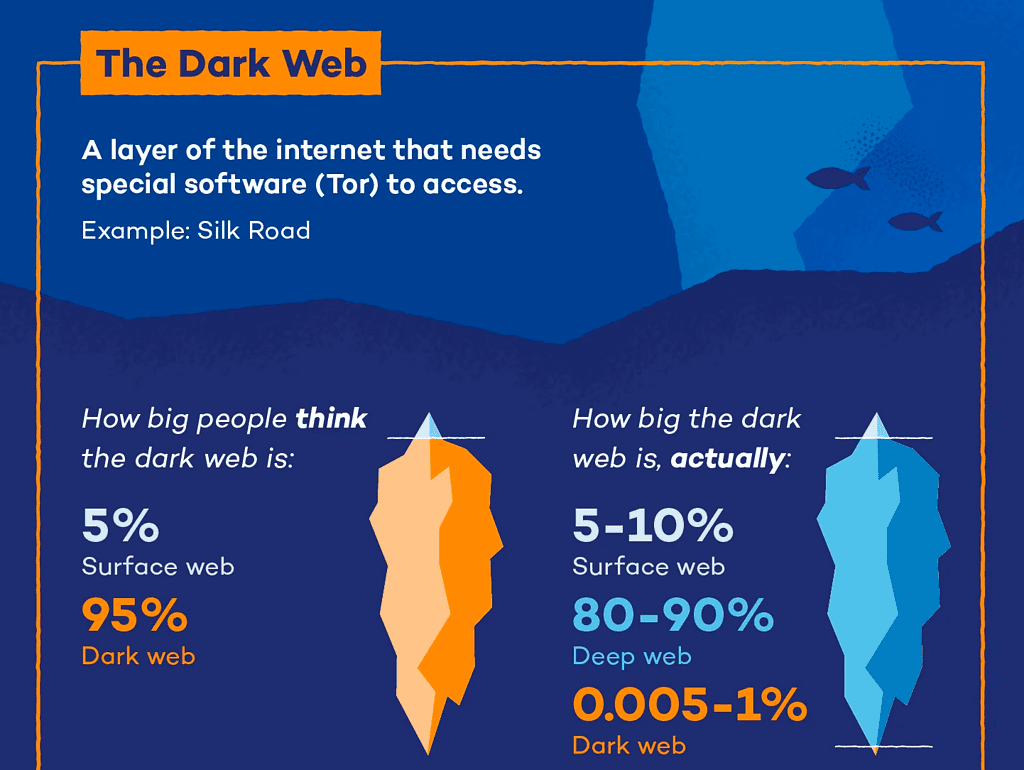
- The dark web is a hidden part of the internet that requires tools such as Tor for access, and Silk Road was one of its best-known websites.
- A common belief is that the internet consists of 5% surface web and 95% dark web.
- However, this estimate greatly overstates the size of the dark web.
- The surface web accounts for about 5%-10% of the internet.
- The deep web accounts for around 80%-90% of the internet, while the dark web makes up only about 0.005%-1%.
Tor-Based Dark Web Marketplace Overview
- Dark web sales are estimated at USD 2.6 billion in 2025, with continued growth in 2026.
- Nearly 60% of recorded platform crime in 2025 involved selling posts on Tor-accessible dark web forums.
- Subscription-based Tor marketplaces offered 93 million data logs and 67 million Google logs for about USD 15 per month.
- Common prices included stolen US Social Security Numbers for USD 1-6, full identity packages for USD 20-100+, and verified crypto-exchange accounts for USD 120-1,170.
- Popular Tor marketplaces included Brian’s Club, Russian Market, STYX Market, WeTheNorth, Torzon Market, and Exodus Marketplace.
Tor Onion Services Overview
- Tor Metrics monitors unique version-3 (.onion) addresses that operate through directory relays.
- Around 54,602 onion addresses, with 38% appearing only once.
- About 42.74% of addresses were advertised 2-5 times, while 16.45% appeared more than 5 times.
- Researchers found 50% of addresses listed only on public websites, 6% only on the dark web, and 44% on both.
- Around 67% of addresses were mainly active, 7% were intermittent, and 26% were mostly inactive.
- HTTP was used by 99.75% of onion services, SSH by 4.95%, and HTTPS by 0.64%.
- Most onion services supported a single protocol, while about 6% supported 2-8 protocols.
Global Tor Network User Report
- In 2026, approximately 3 million people use the Tor network worldwide on average each day.
- The United States leads usage with 678,887 users (16.48%).
| Metric / Country | Mean Daily Users | Global Share Daily Tor Users |
| Germany | 327,937 | 7.96% |
| Brazil | 186,284 | 4.52% |
| India | 169,847 | 4.12% |
| Indonesia | 140,240 | 3.40% |
| France | 126,000 | 3.06% |
| Netherlands | 121,700 | 2.95% |
| Spain | 111,337 | 2.70% |
| Finland | 90,526 | 2.20% |
| United Kingdom | 89,257 | 2.17% |
Usage Patterns
- Only 1.5% of Tor traffic is used to access dark-web (.onion) sites, showing most users rely on Tor for privacy and normal secure browsing.
- According to The Best VPN reports, around 57% of dark web content is associated with illegal activities, like stolen data, drugs, and hacking tools.
- In 2025, dark web marketplaces expanded by 28%, reflecting continued growth in underground online trading.
Tor Network Traffic and Market Insights
- According to Panda Security, Tor traffic is estimated to peak at 20 million users in September 2026, then stabilize at around 5 million by April 2025.
- Tor traffic increased from 2.5 million users during the first third of 2025.
- The dark web intelligence market is projected to reach USD 1.99 billion by 2030, with a CAGR of 21.3%.
- In April 2026, the Tor network hosted more than 1 million active “.onion” URLs.
Tor Project Website Traffic Overview
- The Tor Project website ranked 17,596th globally, 18,242nd in the United States, and 45th in the U.S. Computer Security category, as per Similarweb.
- Between March and May 2026, the Tor Project website’s global ranking changed from 17,107 to 17,596.
- As of May 2026, monthly website traffic increased by 0.34% compared with the previous month.
- The website recorded a 30.22% bounce rate.
- On average, visitors viewed 2.55 pages per session and spent about 1 minute 19 seconds on the website.
Tor Browser Downloads and Funding Overview
- Tor Browser achieves around 10 million downloads annually across desktop and Android platforms, while Android installs have also surpassed 10 million on Google Play.
- The Tor Project generated approximately USD 5.8 million in revenue in its latest annual report.
- Government grants provide most of the funding, while donations, cryptocurrency contributions, and matched-giving programs contribute roughly 25%-40% of the annual budget.
Tor Browser Speed and Performance Statistics
- Tor Browser routes internet traffic through 3 encrypted relay nodes, which improves privacy but increases browsing time.
- On a 1 Gbps fiber connection, average page loading time for the top 100 websites is 4.2 seconds, compared with 1.4 seconds for Mullvad Browser and 1.2 seconds for Firefox.
- Typical Tor download speeds range from 15-80 Mbps, while Mullvad Browser exceeds 800 Mbps and Firefox exceeds 900 Mbps.
- Tor latency is 200-450 ms, compared with 15-40 ms for Mullvad Browser and 5-25 ms for Firefox.
- Tor generally supports 720p video, while 1080p playback may be inconsistent.
Network Performance Metrics
- FlashFlow found that Tor underestimates relay capacity by about 50% under current measurement methods.
- Traffic balancing errors are around 15%-25%, while FlashFlow improves load-balancing accuracy, reducing the median error by 86%.
- FlashFlow also delivers median transfer times 15%-37% faster and reduces timeout rates.
- Exit nodes remained the main performance bottleneck, and longer circuits increase network latency.
Safety, Privacy, and Risk Statistics
- Only 3%-6.7% of Tor traffic accesses .onion websites, while over 93% is used for regular internet access.
- The network supports about 800,000 active v3 onion services each day.
- Tor Browser protects users by routing traffic through 3 encrypted relay nodes, and Mobile users generate around 40% of daily Tor traffic. At the same time, the Tor Browser for Android has received 65,769 reviews with a 4.4-star rating.
- provides 3 security modes: Standard, Safer, and Safest.
- A browser fingerprinting issue found in 2026 was fixed in Tor Browser 15.0.10.
- Around 57% of dark web content involves illegal or high-risk activities, while safe browsing depends on using the latest official Tor Browser version.
Tor Network Product Roadmap and Technology Updates
- The Tor Project is replacing its legacy C-based code with Arti, a Rust-based implementation to improve security, reliability, and long-term maintenance.
- From August 2025 to March 2026, Arti progressed from version 1.4.6 to 2.2.0, adding relay improvements, RPC support, HTTP CONNECT, and onion service enhancements.
- Tor 0.4.8 reached end-of-life on June 1, 2026, with network support ending on September 1, 2026, encouraging migration to newer releases.
- Tor Browser 15.0 became the latest stable version based on Firefox ESR 140.
- Tor Browser 16.0 entered the alpha stage, with 16.0a7 released on June 2, 2026; the stable version is expected in Q3 2026.
- The new release model reduces the number of major browser updates from 2 per year to 1 and increases the minimum Android version to 8.0.
- Counter Galois Onion (CGO) is a new encryption system that replaces the 20+-year-old Tor1 encryption to strengthen network security.
- Planned relay family certificates are expected to reduce bootstrap bandwidth by about 50% and lower compressed microdescriptor size to about 25% of its current level.
- The Tor Project launched its first Android Beta VPN in September 2025, offering exit nodes in 28 countries, a kill switch, and bridge support.
- WebTunnel and Snowflake continue to improve censorship resistance, helping users bypass internet restrictions in multiple regions.
Summary
TOR is a useful tool that helps people stay private and safe while using the internet. It helps to hide any user’s identity and protects personal information from being tracked. Many people use TOR to browse freely and access blocked websites.
Although it may be slower than normal browsers and can sometimes be misused, it is still an important tool for online privacy. Overall, TOR helps create a safer and more secure internet experience for users.
FAQ
The three types of Tor nodes are entry (guard) nodes, middle relays, and exit nodes.
Yes, Tor is legal in most countries, but using it for illegal activities remains unlawful.
Yes, malicious downloads through Tor can infect your device with viruses.
Tor risks include slow speeds, malicious exit nodes, tracking mistakes, and illegal activity.

Sources


