









Market Overview
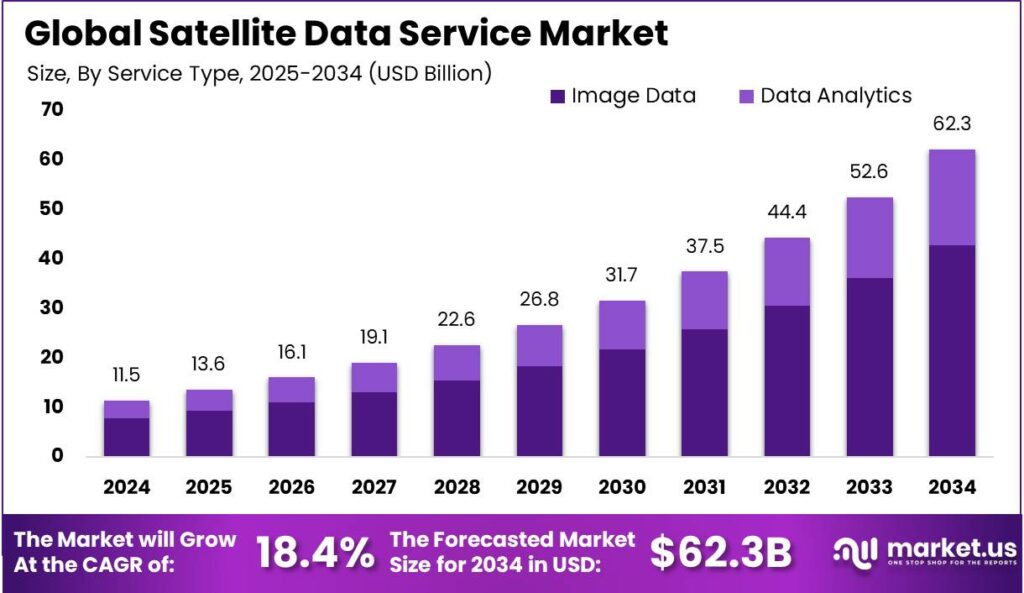
The global satellite data service market continues to expand at a rapid pace. According to Market.us, the market was valued at USD 11.5 billion in 2024. It is projected to reach USD 62.3 billion by 2034, growing at a compound annual growth rate (CAGR) of 18.40% from 2025 to 2034.
Satellite data services cover a wide range of information types collected by Earth-orbiting satellites. These include imagery, weather patterns, communication signals, and sensor data. Consequently, industries such as agriculture, defense, environmental science, and urban planning rely on these services for critical decisions.
Get Your Free Sample and Explore a USD 62.3 Billion Market Opportunity @ https://market.us/report/satellite-data-service-market/free-sample/
The market growth stems from advancing satellite technology that now delivers greater data accuracy and improved imaging resolutions. Moreover, the growing focus on sustainable practices and disaster management increases the demand for real-time global data. Timely information proves especially critical in emergency response and recovery efforts.
A key trend shaping this market is the integration of machine learning and artificial intelligence with satellite data systems. These technologies enhance the analysis of collected data and enable more precise predictions. Additionally, the deployment of small satellite constellations improves data coverage frequency and increases the availability of satellite-derived information.
Planet Labs Germany GmbH secured a three-year contract with the German Space Agency (DLR) in September 2024. This agreement enables Planet to supply advanced Earth observation data and analytics to German researchers. Therefore, this deal highlights how institutional partnerships are accelerating the adoption of satellite data services globally.
Stakeholders including government agencies, private companies, and academic institutions benefit significantly from satellite data services. These services support applications ranging from climate monitoring to resource management planning. However, high deployment costs and regulatory complexities remain challenges that market participants must address as the industry scales.
Explore Bespoke Research Solutions by Emailing Our Team at [email protected]
Key Takeaways
- The Global Satellite Data Service Market is projected to reach USD 62.3 Billion by 2034, up from USD 11.5 Billion in 2024, growing at a CAGR of 18.40% during the forecast period from 2025 to 2034.
- In 2024, the Image Data segment dominated the market, holding more than 68.9% of the market share.
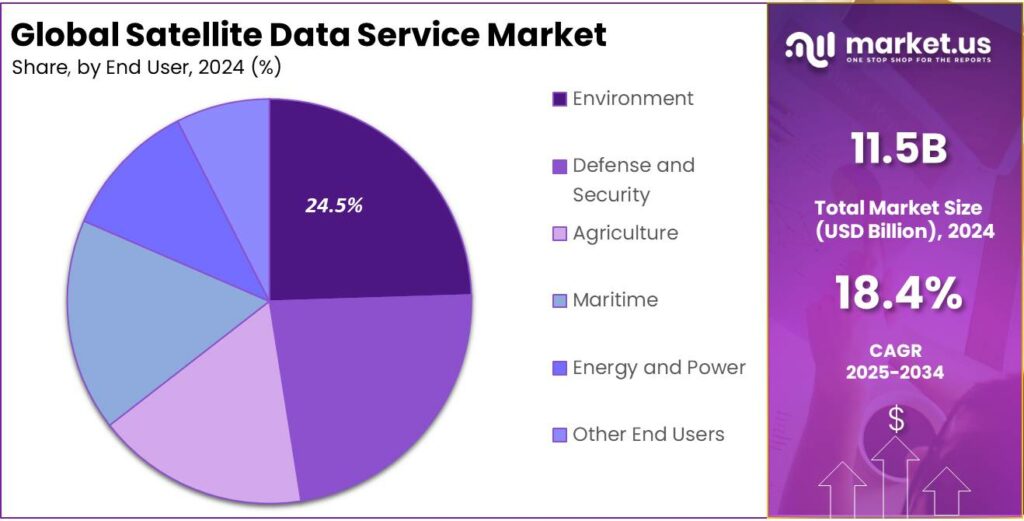
- The Environment segment held a dominant market position in 2024, capturing over 24.5% of the market share.
- North America held the leading regional position in 2024, with more than 39.0% of the market share and approximately USD 4.4 billion in revenue.
- The U.S. satellite data service market was valued at around USD 3.4 billion in 2024 and is expected to grow at a CAGR of 19.1%.
Market Segmentation Overview
By Service Type: Image Data
The Image Data segment held the dominant position in 2024, capturing more than 68.9% of the total market share. This strong leadership reflects the extensive application of satellite imagery across agriculture, defense, environmental monitoring, and urban planning. High-resolution images give industries accurate geographic intelligence for better decisions.
Technological advances such as multispectral and hyperspectral imaging have broadened the utility of image data further. These innovations provide more detailed insights about the Earth’s surface and enable precise environmental analysis. Moreover, the rise of AI-powered image processing has automated workflows and made satellite imagery more accessible across sectors.
By Service Type: Data Analytics
The Data Analytics segment is emerging as the fastest-growing category within the satellite data services market. Companies leverage analytics platforms to extract actionable insights from raw satellite feeds. Additionally, the integration of AI algorithms with satellite analytics enables pattern detection, anomaly identification, and predictive intelligence for sectors such as insurance and logistics.
By End User: Environment
The Environment segment held the largest end-user share in 2024, capturing more than 24.5% of the market. Governments and organizations worldwide use satellite data to track deforestation, monitor climate change, and enforce environmental regulations. This demand reflects growing global awareness and regulatory pressure around sustainability and ecosystem protection.
By End User: Defense and Security
The Defense and Security segment remains a strategic pillar of the satellite data market. Military organizations use satellite data for national security, border surveillance, and intelligence operations. However, the segment holds a smaller share than the Environment segment due to narrower access and more restricted procurement cycles.
By End User: Agriculture
The Agriculture segment uses satellite data for crop monitoring, soil analysis, and resource management. Precision agriculture platforms apply satellite imagery to optimize fertilizer use, predict yields, and detect pest infestations. Nevertheless, its market share remains smaller than the Environment segment due to more localized and region-specific application patterns.
Drivers
Agriculture drives significant demand for Earth observation satellite data worldwide. Farmers and agri-businesses use high-resolution imagery to monitor crop health, assess soil conditions, and predict harvests. This data-driven approach enables precise resource allocation and supports sustainable farming practices. As global food demand rises, satellite data becomes indispensable for modern agricultural productivity.
The growing adoption of AI and machine learning further accelerates market demand. These technologies enable faster and more accurate processing of satellite feeds, unlocking valuable insights across multiple industries. Therefore, businesses in urban planning, disaster management, and environmental monitoring increasingly rely on AI-enhanced satellite intelligence to support strategic decision-making.
Use Cases
Energy companies use satellite data to monitor critical infrastructure such as pipelines, power lines, and offshore platforms. Real-time monitoring enables early detection of damage or malfunction, reducing operational risk and downtime. Consequently, the energy sector benefits from proactive maintenance strategies and improved safety supported by satellite intelligence.
Urban planners and city governments apply satellite data to manage infrastructure development and monitor construction progress. High-resolution images support land-use planning, zoning decisions, and environmental impact assessments. Additionally, satellite data helps cities track urban sprawl and allocate resources efficiently for sustainable development.
Major Challenges
The high cost of satellite deployment and ongoing maintenance presents a major barrier for market participants. Launching satellites requires substantial investment in manufacturing, launch services, and insurance. Moreover, ground control operations and periodic upgrades add recurring costs, making it difficult for new entrants in developing regions to compete effectively.
Regulatory complexity and spectrum allocation issues create further obstacles for the satellite data services industry. Obtaining licenses and approvals involves multiple regulatory bodies across different countries, causing delays. Additionally, growing congestion in available frequency bands results in signal interference, reducing data reliability and limiting the scalability of new satellite programs.
Business Opportunities
The integration of satellite data with AI, IoT, and blockchain technologies creates significant revenue opportunities for market players. AI algorithms detect patterns and anomalies in satellite imagery to serve environmental monitoring and urban planning needs. IoT devices integrated with satellite connectivity enable real-time data collection from remote locations for asset tracking and wildlife monitoring.
The expansion of small satellite constellations in low Earth orbit (LEO) opens cost-effective opportunities for new market participants. These compact satellites deliver frequent coverage at a lower cost compared to traditional systems. Therefore, businesses that invest in LEO-based services can capture growing demand from telecommunications, earth observation, and government sectors.
Regional Analysis
North America led the global satellite data service market in 2024, holding more than 39.0% of the total market share and generating approximately USD 4.4 billion in revenue. The United States market alone was valued at USD 3.4 billion and is expected to grow at a CAGR of 19.1%. Strong R&D investments and strategic government-industry collaborations drive this leadership position.
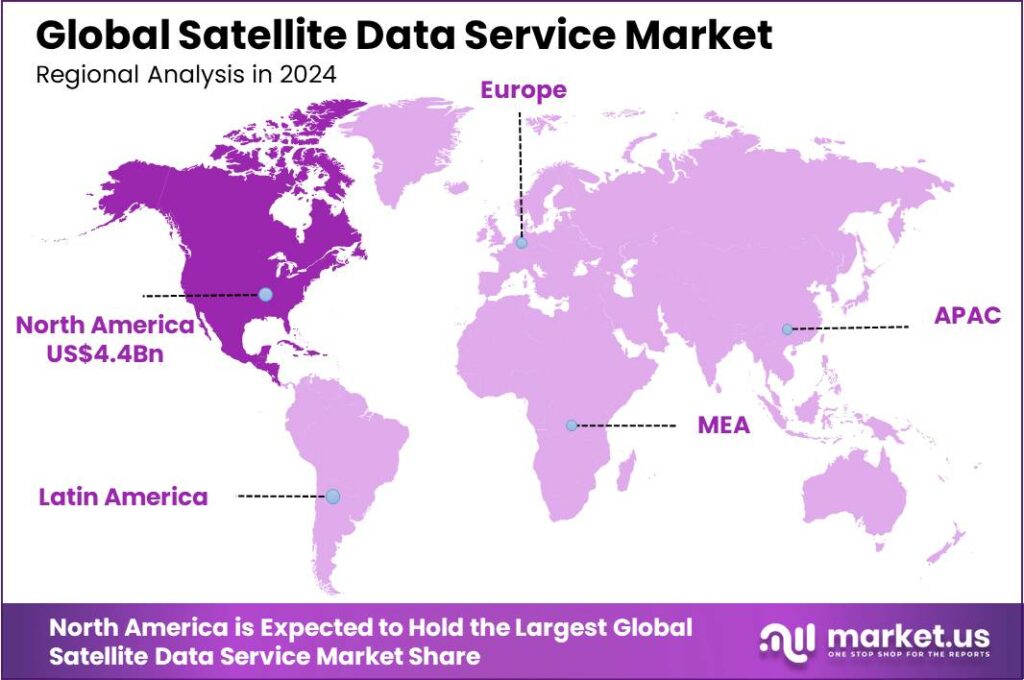
The Asia Pacific region is emerging as a high-growth market for satellite data services. Rapid digitization, rising government investments in space programs, and expanding agricultural and defense applications fuel regional demand. Moreover, countries such as India, China, Japan, and South Korea are scaling satellite infrastructure, making Asia Pacific one of the fastest-growing in-vehicle satellite data markets globally.
Recent Developments
- April 2024: Solidium, a Finnish state-owned investment company, invested €15 million in ICEYE, a Finnish Synthetic Aperture Radar (SAR) satellite imaging company. This followed a convertible debt agreement from earlier in the year, signaling growing institutional confidence in radar-based satellite imaging.
- November 2024: Spire Global agreed to sell its ship-tracking Automatic Identification System (AIS) business to Kpler for USD 241 million. Kpler gains exclusive rights to Spire’s maritime data while Spire retains its satellites and technology, continuing to serve U.S. government clients.
- September 2024: Planet Labs Germany GmbH secured a three-year contract with the German Space Agency (DLR) at the German Aerospace Center, enabling Planet to provide advanced Earth observation data and analytics for R&D initiatives.
Conclusion
The global satellite data service market is on a strong upward trajectory, driven by technological innovation and rising demand across multiple industries. The market is set to grow from USD 11.5 billion in 2024 to USD 62.3 billion by 2034 at a CAGR of 18.40%. Therefore, this growth represents a substantial opportunity for businesses, governments, and investors across the value chain.
Key segments such as Image Data and the Environment end-user category continue to lead the market. Additionally, emerging areas such as data analytics, LEO satellite deployment, and AI integration are reshaping how industries use satellite intelligence. These developments expand market reach and create new service categories for satellite data providers globally.
North America remains the dominant region, but Asia Pacific is gaining ground rapidly. As regulatory frameworks evolve and satellite launch costs decline, more players will enter the market. Consequently, the satellite data services industry is positioned to become a foundational layer of global digital infrastructure over the next decade.
Ready to Go Deeper? Our Data Experts Are Just an Email Away at[email protected]