









At a Glance
mRNA Technology Statistics: mRNA technology is changing the way scientists develop vaccines and medicines. Instead of giving the body a ready-made protein, mRNA delivers simple instructions that tell cells how to make the protein they need. This approach gained worldwide attention after mRNA vaccines helped fight COVID-19. Since then, researchers have started exploring mRNA for more than infectious diseases, including cancer, rare diseases, and other serious health conditions. Its fast development process, flexible design, and ability to target different diseases have made it a major area of biotechnology research. As research and investment grow, mRNA technology could play a bigger role in the future of medicine, offering faster and more personalized treatment options.
Featured Choice
- The global mRNA technology market is projected to reach USD 45.98 billion in 2026 and USD 98.71 billion by 2035, growing at an 8.88% CAGR.
- Infectious diseases accounted for a 71% market share in 2025, driven by demand for COVID-19 vaccines.
- Lipid nanoparticles represented 80% of delivery methods, making them central to mRNA product development.
- Pharmaceutical and biotechnology companies held a 64% end-user share in 2025.
- North America generated about 43% of global revenue, led by the United States.
- Moderna’s RSV vaccine mRNA-1345 demonstrated 83.7% efficacy among adults aged over 60.
- WHO’s mRNA Technology Transfer Programme enters Phase 2.0 during 2026-2030 with 15 partners.
- The programme has identified 8 priority R&D targets and received about USD 89 million from USD 117 million committed funding.
- Global mRNA product revenue is estimated at USD 17 billion in 2026.
- The mRNA synthesis and manufacturing market is valued at USD 56.7 billion in 2026.
Key Facts About mRNA Technology
- mRNA stands for messenger RNA and carries instructions that help cells make specific proteins.
- mRNA technology uses these instructions to guide cells to produce a desired protein.
- COVID-19 vaccines became the first widely used mRNA vaccines, proving the technology’s potential on a global scale.
- mRNA does not change human DNA because it mainly works outside the cell nucleus.
- Cells naturally break down mRNA after using its instructions.
- Lipid nanoparticles protect mRNA and help deliver it into cells.
- Researchers are exploring mRNA for vaccines, cancer treatments, and protein-replacement therapies.
- The technology can be redesigned quickly, supporting faster development of vaccines against emerging diseases.
mRNA Technology Market Overview
(Source: snsinsider.com)
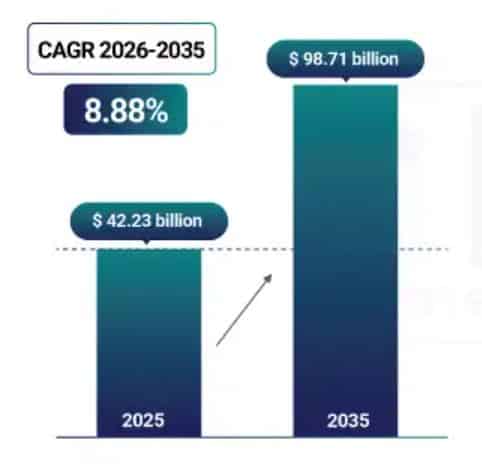
- The global mRNA technology market was valued at USD 42.23 billion in 2025 and is projected to reach USD 98.71 billion by 2035.
- The market is expected to grow at a CAGR of 8.88% from 2026 to 2035.
- By 2026, the market is estimated to reach USD 45.98 billion.
- Pfizer-BioNTech’s BNT162b2 and Moderna’s mRNA-1273 demonstrated the scalability, safety, and effectiveness of mRNA as a pharmaceutical platform.
- Moderna’s mRNA-1345 RSV vaccine reported 83.7% efficacy in 2024 among adults over 60.
- Consequently, mRNA development is expanding into oncology, rare genetic disorders, autoimmune diseases, and cardiovascular conditions.
Market Segmentation, 2025
- By Application: Infectious Diseases led the market with a 71% share, as per a report shared by S&S Insider.
- By Delivery Method: Lipid Nanoparticles held the largest share at 80%.
- By End User: Pharmaceutical & Biotechnology Companies accounted for 64%.
Regional Analysis of the mRNA Technology Market
- North America led the market in 2025, accounting for about 43% of global revenue, with the United States holding 87.4% of the regional share.
- Europe remains a strong market, with Germany accounting for 28.4% of regional revenue.
- Asia Pacific is the fastest-growing region, with China contributing 44.8% of regional revenue through expanding mRNA research and manufacturing.
- In MEA, the UAE held 38.4%, while Brazil led Latin America with 44.2%.
mRNA Technology Transfer Programme Overview
- The WHO-led mRNA Technology Transfer Programme helps low- and middle-income countries (LMICs) develop local mRNA vaccine manufacturing using a technology hub in Cape Town, South Africa.
- In 2026, the programme has 15 partners, including the South African hub and 14 manufacturing partners across 14 countries, according to World Health Organization.
- Phase 2.0 (2026-2030) focuses on achieving GMP-grade, commercially sustainable production of mRNA vaccines, therapeutics, and other biological products.
- WHO has identified 8 priority R&D targets, covering diseases and important mRNA components such as lipids.
- The programme has received about USD 89 million from USD 117 million committed funding, while Canada contributed CAD 45 million.
- The first full technology transfer reached Biovac in September 2024, followed by 3 additional partners that year.
- WHO and the Medicines Patent Pool co-lead the programme, which joined HTAP in 2024.
mRNA Product Revenue Forecast
(Source: market.us)
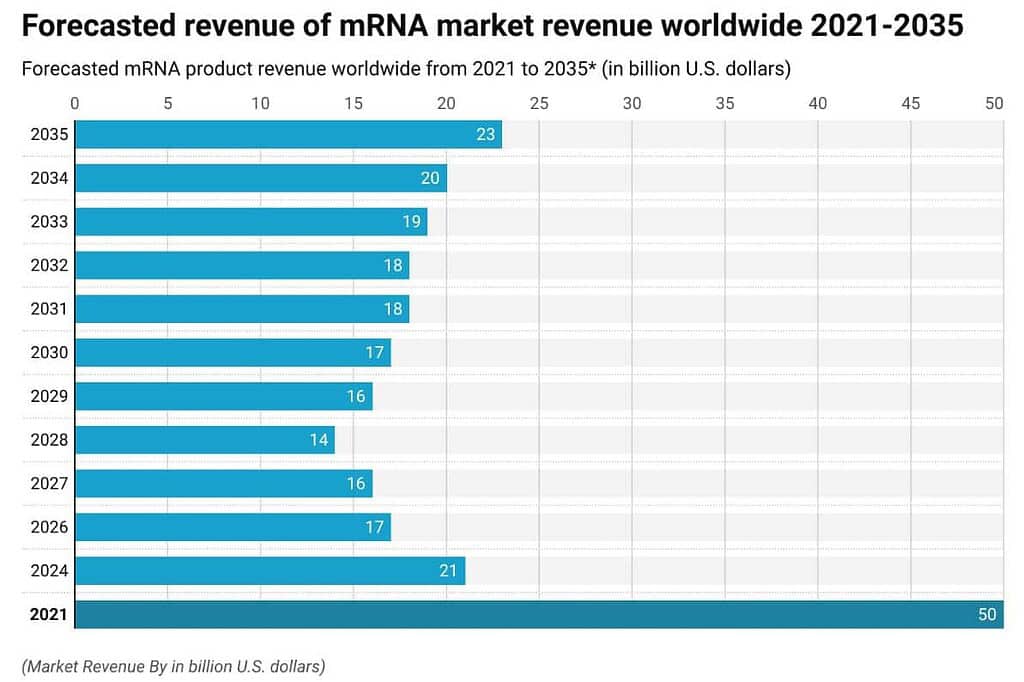
- Worldwide mRNA product revenue was USD 17 billion in 2026.
- Revenue is expected to rise to USD 23 billion by 2035.
mRNA Therapeutics Market Growth Outlook
(Source: market.us)
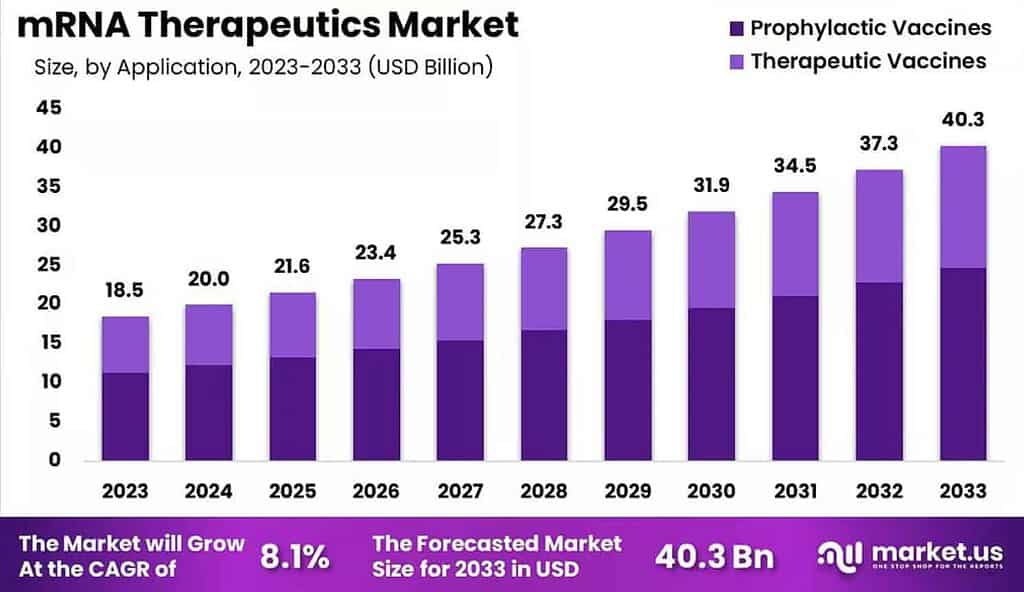
- The global mRNA therapeutics market was valued at USD 21.6 billion in 2025 and is expected to reach USD 23.4 billion in 2026.
- The market is projected to grow further to USD 40.3 billion by 2033, expanding at a CAGR of 8.1%.
Global mRNA Vaccines and Therapeutics Market for COVID-19
(Reference: statista.com)
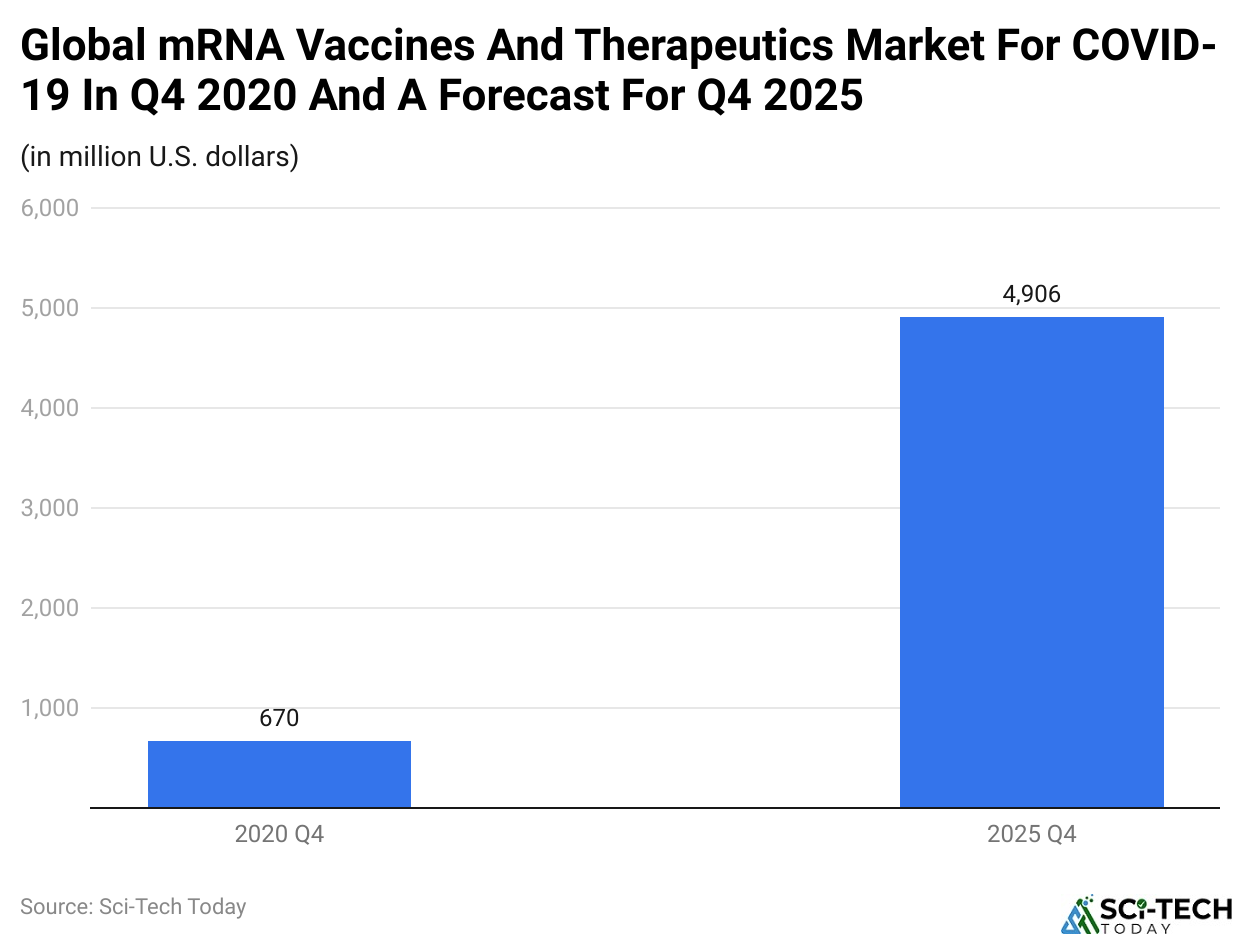
- As per mRNA technology statistics, the mRNA therapeutics and vaccines market for COVID-19 infection in the last quarter of 2020 was set at around USD 670 million, which denotes the inceptive application of mRNA technology in combating the virus.
- The figure could still be considered low owing to production and distribution phases, as the industry was still undergoing transitions within itself with regard to mRNA vaccines.
- Companies were yet to complete their setup of production facilities to supply the already existing demand.
- However, by the end of Q4 2025, it is expected that this particular market will grow considerably and account for roughly USD 4.9 billion.
- This growth signifies the increased confidence and trust in the adoption of mRNA technology to create successful immunisation agents.
- Furthermore, the growth is also driven by the perennially unsated clientele for the COVID-19 booster shots, the worldwide vaccine rollout strategies, and new prospects that mRNA technology brings to healthcare other than COVID-19.
mRNA Synthesis and Manufacturing Market Overview
(Source: persistencemarketresearch.com)
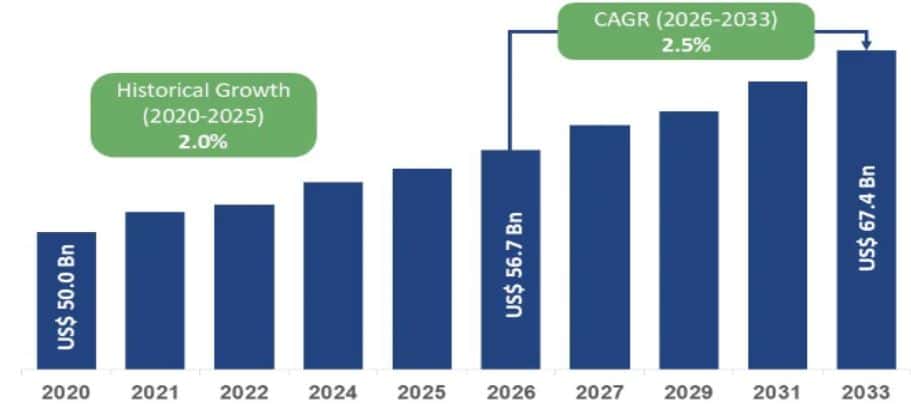
- The market is estimated at USD 56.7 billion in 2026 and is projected to reach USD 67.4 Billion by 2033, growing at a 2.5% CAGR.
- Historically, the market grew at a 2% CAGR from 2020 to 2025, supported by rising mRNA applications.
- mRNA vaccine synthesis held 61.5% of the market in 2025, while commercial-scale operations accounted for over 85%.
- North America led with 42.6% share in 2025.
M-RNA Synthesis Service Market Trends
- Coherent Market Insights stated that the global M-RNA synthesis service market is valued at USD 7,590.4 million in 2026 and is projected to reach USD 11,240.9 million by 2033, growing at a 5.8% CAGR from 2026 to 2033.
- Vaccine production held the largest share at 50.7%, followed by therapeutic development at 21.3% in 2026.
- Drug discovery accounted for 17.2%, while other applications represented 10.8% of the market.
- North America is projected to remain the leading regional market, holding a 33.5% share in the same period.
Market Capitalization of Leading mRNA Biotech Companies
(Source: statista.com)
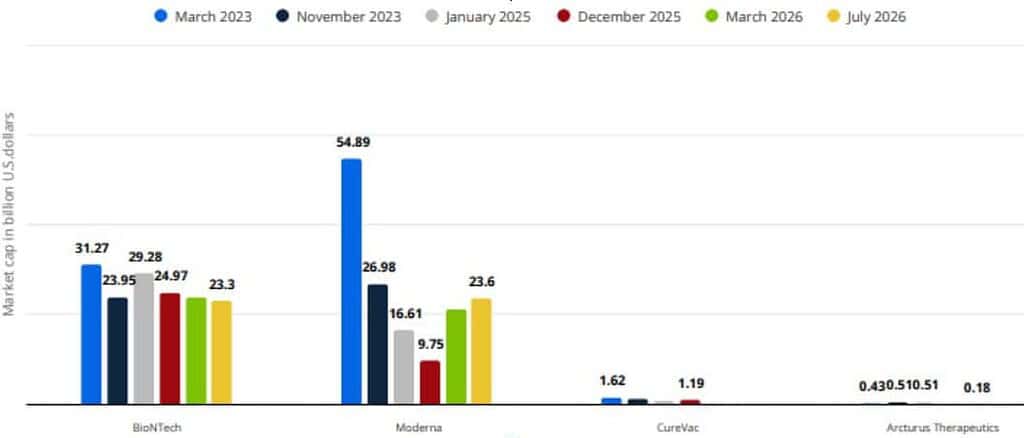
- In December 2025, BioNTech and Moderna recorded market capitalizations of USD 24.97 billion and USD 9.75 billion, respectively, while CureVac stood at USD 1.19 billion.
- By March 2026, BioNTech was valued at USD 23.95 billion and Moderna at USD 21 billion.
- In July 2026, their values reached USD 23.3 billion and USD 23.6 billion, respectively.
mRNA Vaccines Market Overview
- Fortune Business Insights further mentioned that the global mRNA vaccines market was valued at USD 6.01 billion in 2025 and is projected to reach USD 25.64 billion by 2034.
- The market is expected to grow from USD 6.85 billion in 2026 at a 17.94% CAGR from 2026-2034.
- North America held the leading market position with a 39.95% share in 2025.
- COVID-19 vaccine success, AI adoption, faster development, and rising R&D investment are supporting market growth.
- Key players include Moderna, BioNTech, CureVac, and GSK.
mRNA Therapeutics Patent Innovation
- According to KnowMade report, the therapeutic mRNA field recorded 190 new patent applications in Q3 2025, down from 257 in Q1 2025.
- The top 10 assignees accounted for 20% of Q3 publications, showing strong competition for intellectual property.
- Among 14 major contributors, 5 were from China, 4 from the United States, 3 from Europe, 1 from Japan, and 1 from South Korea.
- The University of Pennsylvania led with 7 filings, while BioNTech and Moderna each recorded 5.
- Sanofi and CanSino Biologics remained important contributors to mRNA innovation.
- The quarter also produced 50 granted patents, with Moderna and Translate Bio receiving 4 each, while Ziphius Vaccines secured 3 European patents.
Recent Developments
- To further its mRNA-based drug development efforts, BioPharma Inc. has purchased mRNA Therapeutics for USD 500 million.
- According to mRNA technology statistics, GeneTech Group and mRNA Innovations have completed their merger with the aim of joint mRNA research and development, as well as the effective modulation of gene expression leveraging the hybrid power of both companies.
- CureBio announced the release of an mRNA vaccine designed to tackle infectious diseases and delivered encouraging news regarding preclinical results, stating a 90% efficacy rate against the targeted disease pathogens.
- Therapix also announced an mRNA-based cancer treatment, based on which clinical studies reported a considerable tumour regression, with 70% of patients responding.
- In other news about financing, mRNABio completed a USD 100 million series B funding round led by Biotech Investors and intends to use the proceeds to develop mRNA therapeutics for rare genetic diseases and to start clinical trials in the next year.
- To expand its capabilities with mRNA vaccines and to conduct research on other vaccines that will address emerging infectious diseases, and will be looking to launch in the market within three years, ModernaGen has raised a further USD 50 million in venture capital from Healthcare Investment Group.
- The rise in demand for personalised medicine and targeted therapies among consumers has increased sales of mRNA-based treatments by 70% over the previous year.
- The greater uptake of mRNA vaccines took place during the COVID-19 outbreak when they proved to be safer and more effective than other vaccine platforms that had been in use.
- Authorities have also relaxed the regulatory constraints when it comes to the approval of mRNA therapeutics as well as vaccine products by creating faster timelines and emergency use authorisations to satisfy urgent healthcare needs and public health crises.
Final Assessment
mRNA technology is changing how scientists develop vaccines and new treatments. Its success in COVID-19 vaccines showed how quickly mRNA can support medical innovation. Today, researchers are exploring its use in cancer treatment, infectious diseases, genetic disorders, and other health conditions. However, challenges such as storage, delivery, production costs, and safety still need attention. As research continues, mRNA technology could become a key part of future healthcare and help bring new treatments to patients faster.
FAQ
mRNA delivers genetic instructions to cells, helping them produce specific proteins that trigger a desired biological response.
mRNA technology is mainly used for vaccines, cancer treatments, gene therapies, and protein replacement.
mRNA technology enables rapid development, flexible manufacturing, targeted therapies, and potential applications across vaccines and medicines.

Sources