








Introduction
Branding Statistics: If we see the letter “M” in yellow with a red background, wouldn’t you immediately think of the brand, which is one of the leading quick-service restaurants in the world? Yes, it’s McDonald’s! That’s what branding is all about. Branding is crucial for a business to establish a presence in the market. Regardless of what field you are in, it is essential to have a great brand to be able to establish yourself. Great branding will help distinguish you from other brands, create relationships with your audience, and convert that same audience into loyal customers.
Branding statistics show that consumers are more likely to remember the color of a brand rather than the brand name. Therefore, colors are more important than the name. Let’s explore the recent trends in the branding industry.
Editor’s Choice
- 85% of consumers use social media to research new brands, which can increase brand revenue by up to 20% if presence is consistent across platforms.
- Over 50% of first impressions are visual; using a signature color can increase brand recognition by up to 80%.
- 81% of consumers need to trust a brand to make a purchase, and 86% value authenticity when choosing brands.
- e& leads the ranking with an exceptional brand value growth rate of 701%, far surpassing all other brands.
- 89% of consumers desire online videos from brands; 64% have purchased them after watching a branded social video.
- 68% of organizations note that brand consistency contributes at least 10% to their revenue.
- 86% of job seekers research company reviews before applying; 64% avoid brands with poor employer reputations.
- 33% of top brands use various shades of blue in their logos.
- 13% of consumers are willing to pay between 31% to 50% more for products from brands that impact the world positively.
- Incorporating audio branding can increase consumer preference by 46%.
- 71% of smaller companies, with budgets under USD 500,000, allocate between USD 100 and USD 500 monthly for branding.
- Freelancers or small businesses typically need USD 5,000 to USD 20,000 for branding support.
- Companies generally allocate 10% to 20% of their marketing budget to branding and rebranding efforts.
- 38% of mothers are influenced by other moms on Facebook when choosing products.
- Apple emerges as the most valuable brand with a brand value of USD 607.6 billion in the technology sector.
- One-third of the world’s top 100 brands use the color blue in their logos.
- According to 79% of marketing professionals, Facebook, YouTube, and Instagram are key platforms for brand awareness.
- 76% of top brands use only two colors in their logos.
- Inconsistent brand presentation can lead to a 56% decrease in brand recognition.
General Branding Statistics
- Colors are 80% effective for improving brand recognition.
- 72% of the top brand names are made using acronyms or words.
- Branding Statistics show that brands that post blogs regularly on their website are 67% more likely to generate leads.
- Some experts say that brands with poor branding strategies are 10% more likely to offer the highest salaries.
- Brands with consistency are 3.5 times more likely to gain brand visibility in the market.
- 53% of companies depend on content marketing as their branding strategy.
- One-third of the top 100 brands worldwide have the color blue commonly used in their logos.
- Branding Statistics state that 33% of well-known brands use different shades of blue in their logos.
- When a branding strategy includes audio branding, it is 46% more likely to improve consumers’ preference rate.
- 77% of B2B marketers believe branding is important for company growth.
Branding Statistics By Consumer Behavior
- When reading customized content, 82% of customers said they feel more positive about the brand.
- In addition, 61% of consumers will prefer to buy from those brands that offer unique content.
- Branding Statistics show that 94% of consumers will stay loyal to those brands which has a cent percent transparency.
- Consumers need at least 5 to 7 impressions to remember the brand.
- 73% of customers will love the brand over others if customer service is helpful.
- If the business shows that it is creating a positive impact on the world, then 13% of the consumers said they are ready to pay 31 to 50% more for the products and services offered.
- Branding Statistics by Consumer Behavior report that people will prefer brands that offer a personalized shopping experience over others.
- 68% of men and 64% of women are likely to have an emotional connection with the brand.
- 59% of shoppers will purchase from those brands only if they have trust.
- 38% of mothers will purchase a product or service from a brand that other moms or women “like” on Facebook.
- 44% of Americans give gifts from the brands to which they are loyal.
- Consumers need only 10 seconds to form an opinion about the brands.
- Experience, cost, quality, and brand consistency are the most influential factors in determining whether a consumer will be loyal to a brand.
- 81% of consumers recognize the brand by its color instead of its name.
- 75% of consumers visit the company’s website to learn more about the brand.
- 59% of consumers do not have immediate impressions of the brand after purchasing the product or service for the first time.
Branding Statistics By Spending On Branding
- The majority of companies are likely to spend around 10 to 20% of their marketing budget on branding and rebranding.
- Companies that generate revenue between USD 3 million and USD 5 million spend around USD 501 to USD 1,000 every month on branding.
- Around 14% of small-scale businesses spend more than USD 1,000 on their company logo.
- 71% of companies with annual budgets of less than USD 500,000 have a monthly branding budget between USD 100 and USD 500.
- Branding Statistics state that 18% of companies are likely to pay up to USD 1,000 for a logo, while 57% pay up to USD 500.
- It requires, on average, USD 5,000 to USD 20,000 for a freelancer or small-scale business to support their branding.
- In addition, large-scale businesses are likely to spend USD 30,000 to USD 80,000 on startup branding.
Leading Brands By Industry
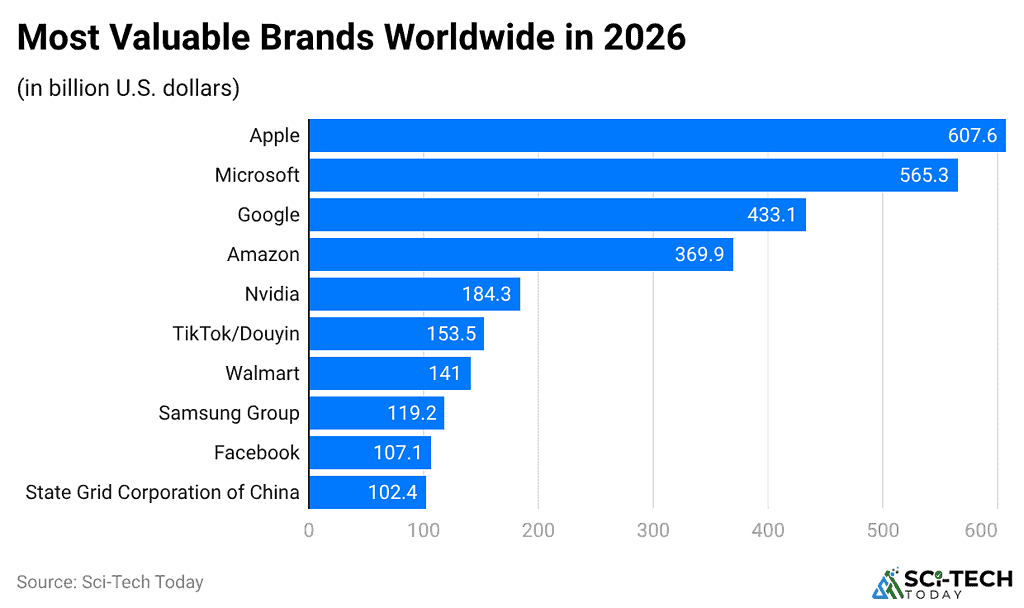
(Reference: Statista.com)
- Apple leads the overall ranking in technology, with a brand value of USD 607.6 billion.
- Microsoft follows closely with USD 565.3 billion, reinforcing the sector’s dominance.
- Technology: Google holds a strong position at USD 433.1 billion.
- E-commerce & Cloud, Amazon stands at USD 369.9 billion, leading retail-based global brands.
- Semiconductors, Nvidia dominates its industry with USD 184.3 billion.
- Social Media & Digital Platforms, TikTok/Douyin leads with USD 153.5 billion.
- Walmart is valued at USD 141 billion, representing traditional large-scale retail.
- Consumer Electronics, Samsung Group holds USD 119.2 billion in brand value.
- Social Media, Facebook maintains USD 107.1 billion in value.
- Energy & Utilities, State Grid Corporation of China leads its sector with USD 102.4 billion.
| Brands | Industry | Brand Value |
|---|---|---|
| Apple | Technology | USD 607.6B |
| Microsoft | Technology | USD 565.3B |
| Technology | USD 433.1B | |
| Amazon | E-Commerce/Cloud | USD 369.9B |
| NVIDIA | Semiconductors | USD 184.3B |
| TikTok | Social Media | USD 153.5B |
| Walmart | Retail | USD 141B |
| Samsung Group | Consumer Electronics | USD 119.2B |
| Social Media | USD 107.1B | |
| State Grid Cor. of China | Energy & Utilities | USD 102.4B |
Top US Brands Worldwide By Brand Value
- Apple emerges as the most valuable brand with a brand value of USD 607.6 billion in the technology sector.
- Following Apple, Microsoft ranks second with a brand value of USD 565.3 billion in technology.
- Google takes third place with a brand value of USD 433.1 billion, further solidifying the domination of tech companies in the top positions.
- Amazon holds a brand value of USD 369.9 billion in the e-commerce and cloud industry.
- NVIDIA, a company in the semiconductor industry, has a brand value of USD 184.3 billion.
- The brand value of TikTok in the social media industry is USD 153.5 billion.
- Walmart has a brand value of USD 141 billion.
- Samsung Group has a brand value of USD 119.2 billion.
- Facebook, under the category of Social media, has a brand value of USD 107.1 billion.
- Finally, State Grid Corporation of China, an energy & utilities company, has a brand value of USD 102.4 billion.
Fastest Growing Brand Worldwide
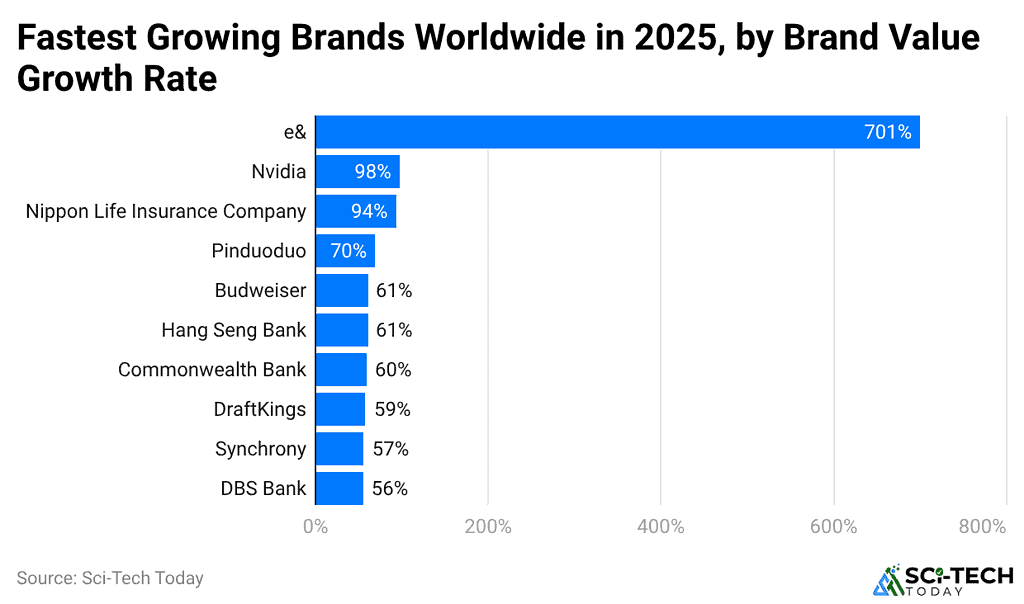
(Reference: statista.com)
- e& leads the ranking with an exceptional brand value growth rate of 701%, far surpassing all other brands.
- NVIDIA comes in second with a strong growth rate of 98%, reflecting the rising influence of semiconductor and AI-driven companies.
- Nippon Life Insurance Company ranks third at 94%, showing significant expansion within the insurance sector.
- Pinduoduo recorded a 70% growth rate, highlighting the rapid rise of e-commerce platforms.
- Budweiser achieved a 61% growth rate, indicating continued strength in the global beverage industry.
- Hang Seng Bank also posted a 61% growth rate, tying with Budweiser and showcasing banking sector momentum.
- Commonwealth Bank follows closely at 60%, reinforcing strong performance among financial institutions.
- DraftKings grew by 59%, reflecting expansion in the sports betting and digital entertainment industries.
- Synchrony reached a 57% growth rate, demonstrating steady progress in consumer financial services.
- DBS Bank rounds out the list with a 56% growth rate, further emphasizing the dominance of banking and financial brands in the top performers.
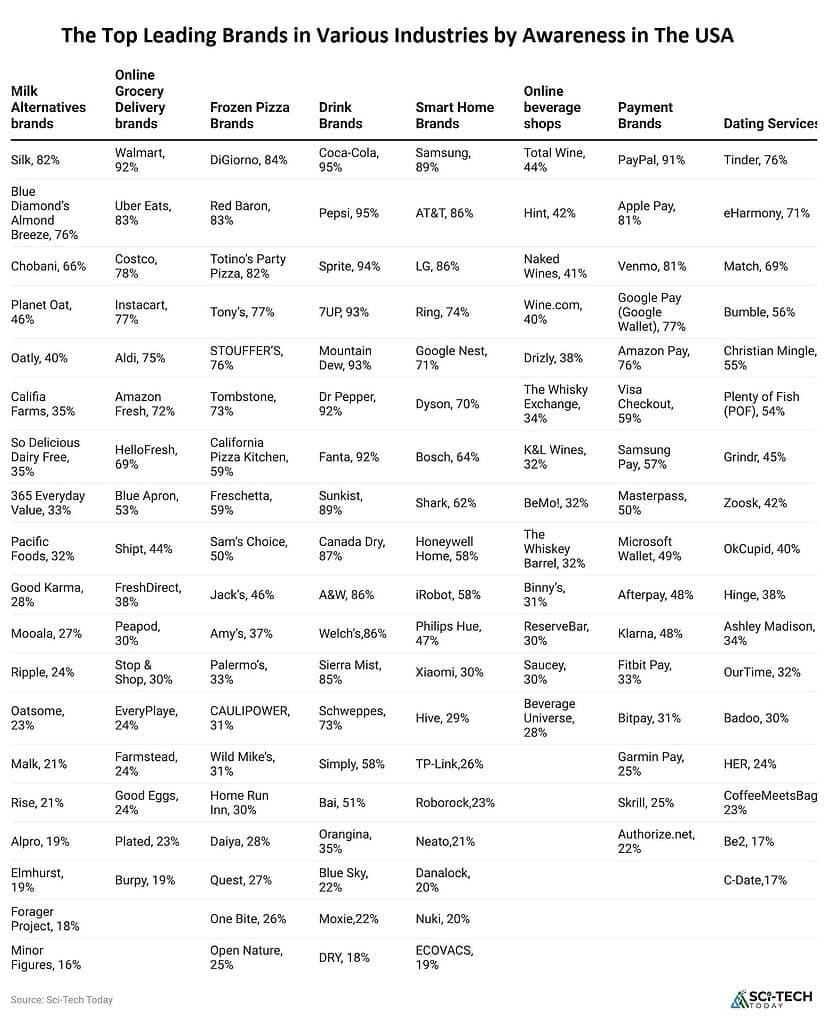
Top Brands In The USA By Brand Awareness By Industries
Based on the survey conducted by Statista, the following were the leading brands in various industries by awareness in the USA.
Employer Branding Statistics
- Given the chance to join a corporation with good reputational standing, almost 90% will likely consider accepting the position.
- One out of five applicants would choose to apply for positions in organizations with one-star ratings on employer review websites.
- A whopping 62% of employees will reconsider how they see the organization when the employer addresses a certain review.
- On Instagram, about 7 out of 10 hashtags have brands attached to them.
- More than half of recruiting experts actively strive to promote their companies as attractive employers and places to work.
- The first three areas where employers should invest resources into developing their employer brands are social media (47%), company career websites (21%), and marketing and advertising (12%).
Brand Awareness Statistics
- Brands require at least 6-7 brand touches for brand awareness.
- As per HubSpot, 34% of brands are using influencer marketing campaigns to create brand awareness.
- Businesses get 67% more leads from blogging.
- 63% of customers prefer purchasing from brands they know.
Understanding Branding: Your Business’s Armor in the Marketplace
Have you ever wondered why you chose one brand of cereal over another, even if they taste similar? Or why are you willing to pay a premium for a pair of shoes with a specific logo? That’s the power of branding! Branding is like your business’s shining armor; it shapes how customers perceive you and sets you apart from the competition.
Different Types Of Branding:
- Product Branding: This focuses on creating a unique identity for a specific product line. For example, Nike and Jordan are both owned by the same company, but they have distinct branding to cater to different customer preferences.
- Corporate Branding: This establishes the overall identity of your entire company, encompassing all its products and services. Think of how Apple’s brand represents innovation and sleek design across its entire product range.
- Personal Branding: This is all about building a strong reputation and image for an individual. It’s particularly important for freelancers, consultants, and anyone who wants to establish themselves as an expert in their field.
Brand Design and Visual Identity
- 60% of the firms utilize non-descriptive logos, whereas 40% use descriptive logos.
- In large corporations, 60% of Fortune 500 firms use combination logos to achieve harmony in branding.
- According to 85% of customers, colors enhance brand recognition and affect purchase decisions.
- 92% of individuals view professionally designed websites as more credible, while 94% find them more appealing.
- 38% of internet users leave websites with poor design, and 65% leave websites that are not mobile responsive.
- According to 42% of online shoppers, the design of a website is their initial point of evaluation, and consumers concentrate 10% more on graphics than words.
Social Media Branding
- Instagram has over 200 million brands and business accounts, and more than 90% of the platform’s users follow at least one brand. In addition, 80% of Pinterest users discover brands on the platform.
- 74% of the total individuals follow brands on social media, whereas 78% of users discuss followed brands with their family and friends.
- Moreover, 73% of TikTok users find themselves connected with companies through their branding.
- The majority of individuals, who constitute 77%, follow brands when these brands create relevant content.
- However, 79% of people unfollow brands because they have mostly promoted posts.
- Similarly, 51% of the followers unfollow brands due to irrelevant content.
- 75% of individuals are more inclined to follow a brand’s social media account if there is video content in their accounts.
- 83% of users love it when the brands answer any question that comes through the social media account.
- 77% of customers like to shop at the brand where they follow, and 50% of them follow brands so that they can be informed about any new offerings by the brand.
- The most preferred brand discovery platform for all ages except Gen Z, who prefer Instagram, and older generations (55+), who prefer Google search, is Facebook.
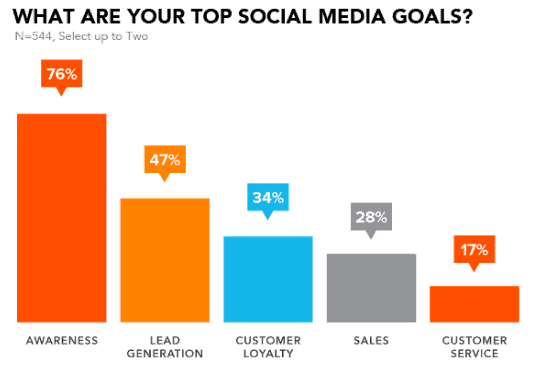
- 76% of small businesses use social media platforms to boost brand awareness, and 79% of marketers consider Facebook as the best experiential marketing platform.
Why Is Branding So Important?
- Customer Loyalty: Strong branding fosters customer loyalty. When customers connect with your brand’s values and personality, they’re more likely to become repeat buyers and advocates for your business. This translates to increased sales and a more stable revenue stream.
- Competitive Advantage: Branding helps you stand out from the competition. It allows you to differentiate yourself and communicate clearly why customers should choose you. A well-defined brand can be a powerful weapon in a competitive market.
- Premium Pricing: Strong brands can command premium prices. Customers are willing to pay more for products or services they trust and identify with.
Who Needs Branding?
- All Businesses: Whether you’re a local coffee shop or a multinational corporation, branding helps you connect with your target audience and build a lasting impression. It’s not a luxury, and it’s a necessity for success.
- Startups: A strong brand is crucial for startups as they establish themselves in the market. It can help attract customers, build trust quickly, and gain a foothold in a competitive landscape.
- Individuals: Personal branding is important for freelancers, consultants, artists, and anyone who wants to build a strong reputation in their field. It allows you to showcase your skills and expertise, making you stand out from the crowd.
Effective Branding Strategies
- Effective brands in 2026 are optimizing for GEO (Generative Engine Optimization) and AEO (Answer Engine Optimization) alongside traditional SEO, ensuring their information is clearly indexed and endorsed by AI systems.
- Consumers in 2026 expect brands to stand for something real, not just polished messaging.
- The most successful brands in 2026 are co-creating with their communities rather than broadcasting to them.
- The most effective brands in 2026 blend paid media, SEO, community, and content into one cohesive growth engine rather than running siloed campaigns.
| Channel | Role in 2026 Brand Strategy |
|---|---|
| Organic SEO/GEO | Long-term authority and AI citation |
| Paid Social & Search | Short-term visibility and demand capture |
| Reddit/Community | Trust-building and pre-purchase research influence |
| Email/Newsletter | Owned audience relationship and retention |
| Influencer/Creator | Social proof via niche-aligned voices |
| Video (Short + Long) | Awareness, education, and humanization |
Popular Branding Trends in 2026
- AI has moved from a back-office tool to a front-facing brand element in 2026.
- ChatGPT’s brand value surged more than 285% in the Kantar BrandZ 2026 rankings.
- Brands displaying authentic sustainability credentials see more than 19% trust lift vs. those without.
- A CEO/founder’s personal branding is now a measurable trust signal for B2B and B2C brands alike.
- Global brands in 2026 are moving from “global uniformity” to “global consistency with local adaptation”.
Conclusion
Branding is an ongoing process. By consistently implementing these strategies and staying on top of evolving trends, you can build a strong brand that resonates with your target audience and propels your business toward success.
As seen in these Branding Statistics, the branding process is extremely important to build the base for business success. Without this, nothing can happen in the world of cutthroat competition.
FAQ
Branding is an endless process aimed at nurturing the uniqueness of a brand in consumers’ minds. Branding includes various efforts to increase brand awareness and market businesses by means of digital and conventional marketing tools.
The goal of branding is to build a unique identification for a brand in order to create trust and distinction against other brands that may compete in the same market. Branding helps turn a company into an image that can be associated with and liked by the consumer, thus simplifying the sales process
Undoubtedly, one of the biggest advantages of branding is recognition. An identifiable brand will stand out much better than an unknown business offering any product or service, regardless of its quality.

Sources