









Overview
Gluten-Free Diet Statistics: Going gluten-free has become more common as people look for diets that fit their health needs and lifestyle. A gluten-free diet avoids gluten, a protein found in wheat, barley, and rye. For people with celiac disease, avoiding gluten is essential because even small amounts can trigger health problems.
Others may choose this diet because they have gluten sensitivity or feel better when they reduce gluten. However, going gluten-free is not as simple as cutting out bread and pasta. Gluten can hide in sauces, snacks, processed foods, and other everyday products.
In this article, we explore key gluten-free diet facts, common foods to eat and avoid, and tips for following the diet safely.
Best of the Best
- Around 3.1 million Americans follow a gluten-free diet, with 72% being people without celiac disease who avoid gluten.
- About 11% of U.S. consumers reported following a gluten-free diet in Q1 2023 and Q1 2024.
- In 2025, only 5% of U.S. adults reported following a gluten-free diet.
- Celiac disease affects about 1% of people in North America, or roughly 1 in 100.
- Nearly 47.9% of gluten-free consumers follow the diet because they have celiac disease.
- The global gluten-free food market is valued at USD 8.32 billion in 2025.
- The global market is projected to reach USD 14 billion by 2032.
- Bakery products lead the global gluten-free market, accounting for 31.4% of sales.
- Asia Pacific is forecast to record the fastest regional growth, with an 11.2% CAGR through 2033.
- India is projected to achieve a 12.4% CAGR, making it one of the fastest-growing gluten-free markets globally.
Rise Of The Gluten-Free Diet
- While more and more Americans are choosing gluten-free diets, the prevalence of celiac disease—an autoimmune condition where the ingestion of gluten leads to damage in the small intestine—has not increased over the last five years.
- At present, gluten-free eating is practiced by 3.1 million Americans, and most (72%) belong to the so-called “PWAGs:”: People Without Celiac Disease Avoiding Gluten.
- This segment has been on the rise since 2009, owing to the fears regarding the health effects of gluten intolerance.
- Many describe these celiac-free gluten consumers as ‘gluten phobic’ or excessively health-conscious, while others claim they jump on the gluten-free bandwagon without proper appreciation of the facts.
- The Mayo Clinic, however, cautions that whether there are clear health advantages of gluten avoidance is still in doubt and warns against such diets, especially because of the danger of deficiencies in iron, calcium, and dietary fiber.
- Nonetheless, many individuals suffering from gluten sensitivity but not celiac disease claim that they have undergone complete symptom relief after abstaining from gluten-containing foods.
- Emerging evidence seems to suggest that gluten intolerance could exist without a celiac diagnosis, though the underlying mechanisms are yet to be fully elucidated.
- Gluten-free diet statistics anticipate that the scientific investigations regarding non-celiac gluten intolerance would sharply increase in the next few years, which, one hopes, will put to rest the question as to whether gluten-free diets are just another fad or are, in fact, beneficial for health.
Types Of Gluten-Free Diet
 (Reference: enterpriseappstoday.com)
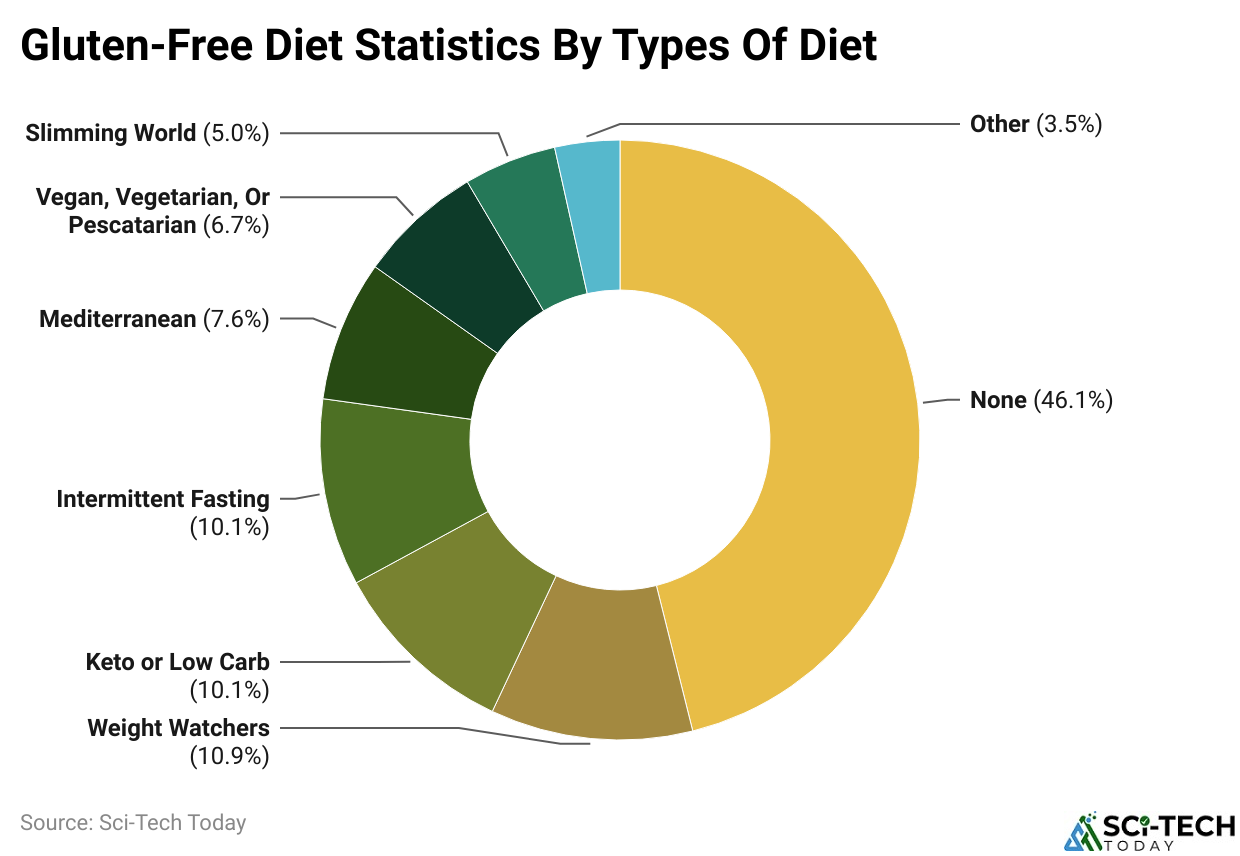
- Gluten-Free Diet Statistics state that around 46.1% of people practice only a gluten-free diet.
- In contrast, only 10.9% of consumers considered following a gluten-free diet alongside weight-loss schedules such as Weight Watchers.
- Moreover, many people also blend gluten-free consumption with other eating systems such as Keto or Low Carb (10.1%), Intermittent Fasting (10.1%), Sun diet (7.6%), Vegan, Vegetarian, and Pescatarian diets (6.7%), Slimming World diet (5%), and many other types of eating regimes (3.5%).
Global Gluten-Free Food Market Outlook
(Reference: statista.com)
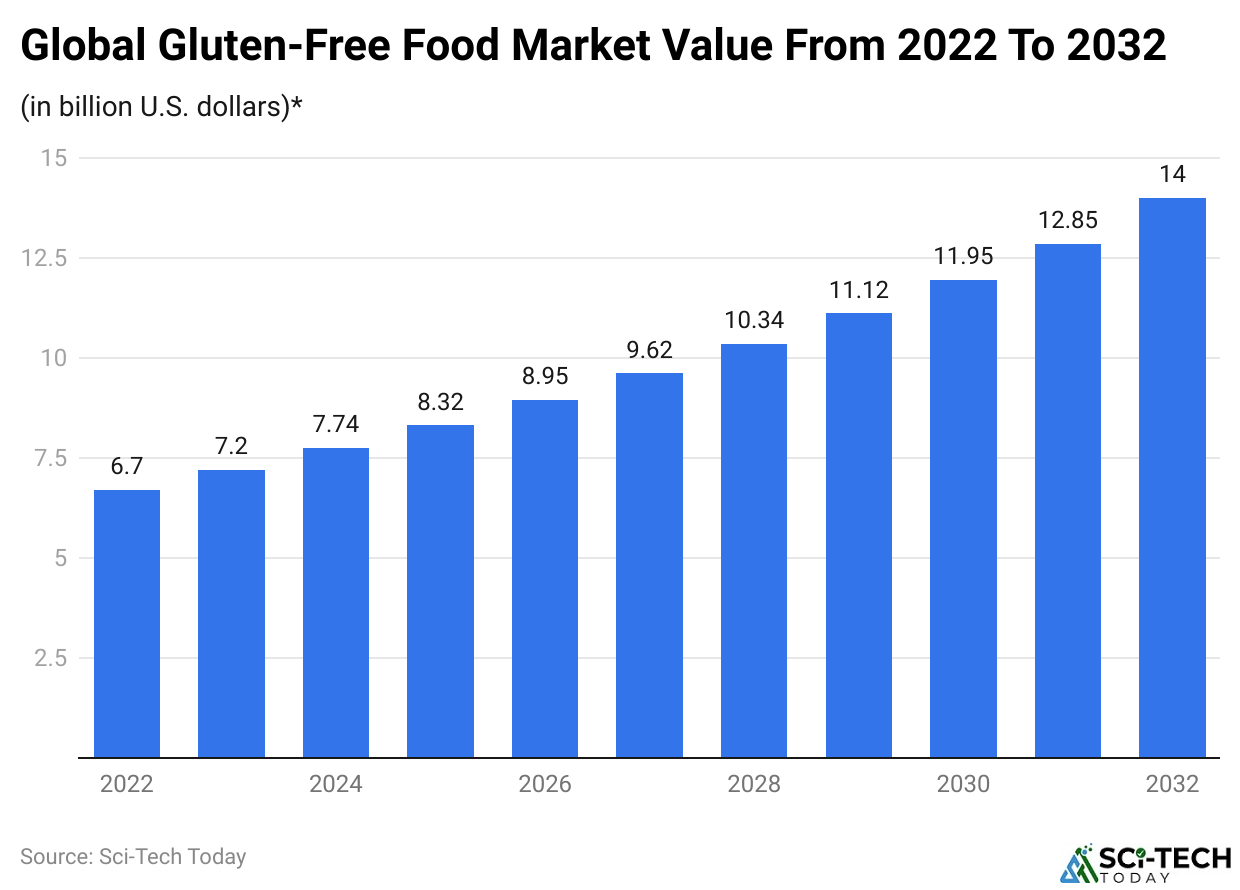
- The global gluten-free food market is valued at USD 8.32 billion in 2025.
- The market is expected to reach USD 8.95 billion in 2026.
- By 2032, the market is projected to grow to USD 14 billion, indicating strong long-term demand for gluten-free products.
Market Value of Gluten-Free Ready Meals Worldwide
- The global market for gluten-free ready meals was valued at approximately USD 1.3 billion in 2020.
- The broader gluten-free food market was projected to exceed USD 17.05 billion by 2027, as per Statista.
Global Gluten-Free Pasta Market Size
- The global gluten-free pasta market was valued at approximately USD 1.08 billion in 2021.
- The market was projected to reach nearly USD 1.16 billion by 2027.
Gluten-Free Food Market Segmentation
- According to Future Market Insights, Bakery products are expected to remain the largest product category, accounting for 31.4% of the global gluten-free food market.
- Solid-format products lead the market by form, representing 58.7% of total category sales.
- Plant-based products are the leading source segment, contributing 63.5% of the market.
- India leads with an 8.4% CAGR for 2026-2036, followed by China at 7.1%, Germany at 6.6%, Japan at 6.4%, and the United States at 5.2%.
Global Gluten-Free Products Market by Product Segment
| Product Segment | Revenue, 2025 | Forecast revenue, 2033 | CAGR (2026-2033) |
| Dairy and dairy alternatives | USD 1,394.4 million | USD 2,745.6 million | 8.90% |
| Bakery products | USD 2,653.1 million | USD 6,231.0 million | 11.30% |
| Meats and meat alternatives | USD 339.4 million | USD 693.9 million | 9.40% |
| Condiments, seasonings, and spreads | USD 316.3 million | USD 664.0 million | 9.70% |
| Desserts and ice creams | USD 1,059.6 million | USD 2,422.3 million | 10.90% |
| Other gluten-free products | USD 1,665.1 million | Not provided | 8.50% |
By Distribution Channel
| Distribution channel | Market size, 2025 | CAGR, (2025-2033) |
| Specialty stores | USD 1,651.3 million | 9.6% |
| Supermarkets and hypermarkets | USD 2,604.2 million | 9.9% |
| Online | USD 1,428.5 million | 11.1% |
| Convenience stores | USD 1,962.5 million | 10.5% |
| Other distribution channels | USD 858.3 million | 8.8% |
Regional Forecast
| Region | Projected revenue(2033) | CAGR (2026-2033) |
| North America | USD 6,348.8 million | 10.0% |
| Latin America | USD 1,155.1 million | 8.9% |
| Middle East & Africa | USD 1,520.9 million | 8.0% |
| Asia Pacific | USD 3,810.4 million | 11.2% |
By Country
| Country | Projected Revenue (2033) | CAGR(2026-2033) |
| Canada | USD 407.7 million | 11.0% |
| Mexico | USD 692.5 million | 10.5% |
| United States | USD 5,248.6 million | 9.8% |
| Germany | USD 1,031.5 million | 11.6% |
| United Kingdom | USD 913.7 million | 11.0% |
| France | USD 550.0 million | 10.1% |
| Italy | USD 1,150.6 million | 10.1% |
| China | USD 810.9 million | 11.3% |
| India | USD 513.8 million | 12.4% |
| Brazil | USD 844.5 million | 8.7% |
| Spain | USD 641.6 million | 9.7% |
| ANZ | USD 854.1 million | 11.0% |
| Japan | USD 713.4 million | 12.2% |
| South Korea | USD 348.5 million | 10.7% |
| South Africa | USD 354.9 million | 8.5% |
United States Gluten-Free Products Market Outlook
(Source: grandviewresearch.com)
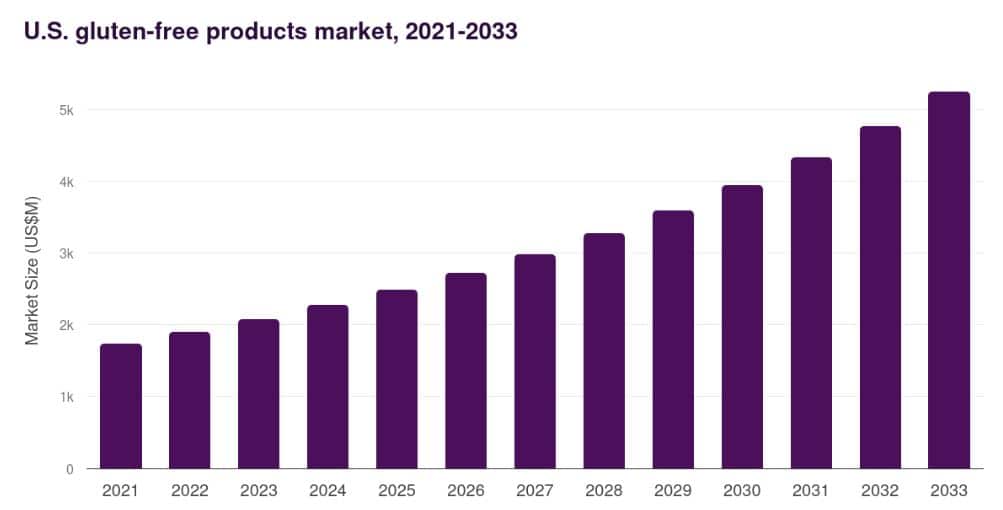
- The U.S. gluten-free products market generated USD 2,489.1 million in revenue in 2025.
- The market is expected to reach USD 2,726.2 million in 2026, reflecting continued consumer demand for gluten-free foods.
- By 2033, the market is projected to reach USD 5,248.6 million, growing at a 9.8% CAGR from 2026 to 2033.
Share Of US Consumers Of Gluten-Free Diet
(Reference: statista.com)
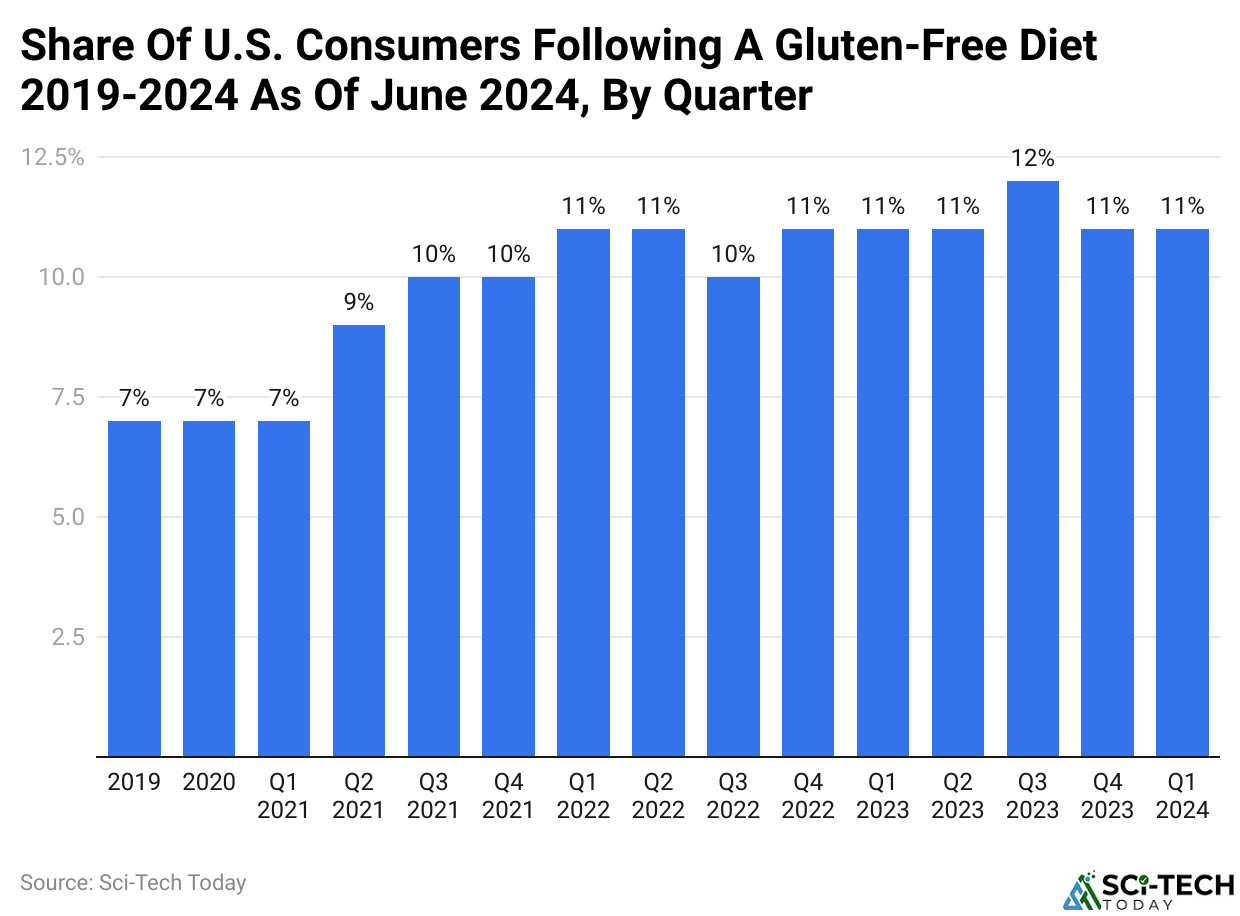
- Gluten-free diet statistics show that in both Q1 2023 and Q1 2024, the percentage of U.S. consumers following gluten-free diets has remained consistently at 11%, even though there are overall varying tendencies.
- The food avoidance behaviors differ greatly and may be due to allergies, ethics, or just a dislike of certain specific foods.
- There is also information that concerns what practices are typical among American consumers in terms of certain dietary patterns and how many adhere to no such requirements at all.
- This survey covers the period of quarters 1-4, 2019-2024, and includes between 4,182 and 10,051 U.S. respondents every quarter, and with its focus on consumers, belongs to Statista Consumer Insights.
- The findings are based on more than 2 million interviews and thus provide unique and rich information about American consumers’ profiles and eating patterns.
U.S. Consumer Diet Trends, 2025-2026
- According to ific.org, only 5% of U.S. adults aged 18-80 reported following a gluten-free diet during the previous year.
- Overall, 57% of U.S. adults followed at least one specific eating pattern in 2025, up from 54% in 2024 and 36% in 2018.
- High-protein diets led at 23%, followed by mindful eating at 19%, calorie counting and intermittent fasting at 15% each.
- Gluten-free ranked 7th, behind clean eating at 13% and Mediterranean-style diets at 8%.
- The survey covered 3,000 U.S. adults aged 18-80 and was conducted from March 13-27, 2025.
Celiac Disease: Key Facts for Consumers
(Source: celiac.org)
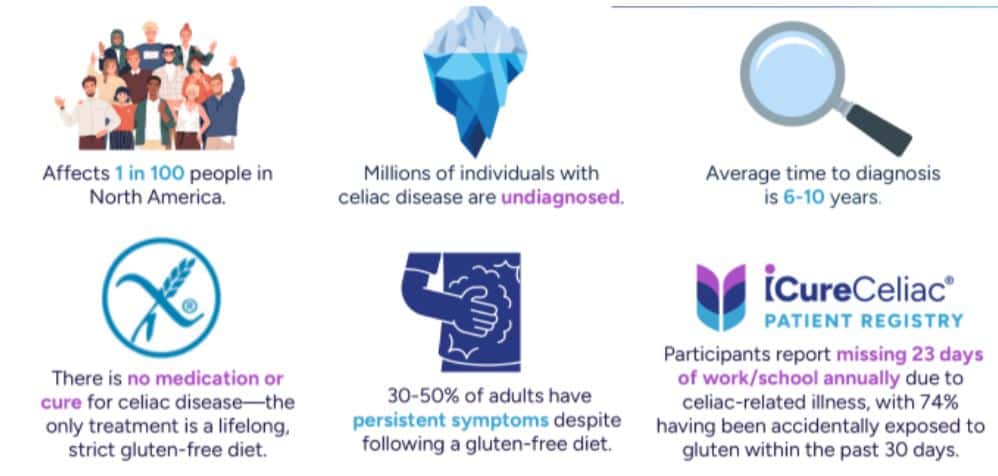
- Celiac disease affects 1 in 100 people, or about 1%, of the population in North America.
- Millions of people with celiac disease remain undiagnosed, and it usually takes 6 to 10 years to get a correct diagnosis.
- There is no medicine or cure for celiac disease; a strict, lifelong gluten-free diet is the only treatment.
- Even after following a gluten-free diet, 30% to 50% of adults still have ongoing symptoms.
- Data from the iCureCeliac Patient Registry shows patients miss 23 days of work or school each year due to celiac-related illness.
- Within the registry, 74% of participants said they were accidentally exposed to gluten in just the past 30 days.
- Celiac disease raises the risk of death from non-Hodgkin’s lymphoma by 6 times.
- It raises the risk of death from liver disease by 3 times and from pneumonia by 2 times.
- The risk of death from small bowel cancer increases by 4 times in people with celiac disease.
Reasons To Follow A Gluten-Free Diet
(Source: enterpriseappstoday.com)
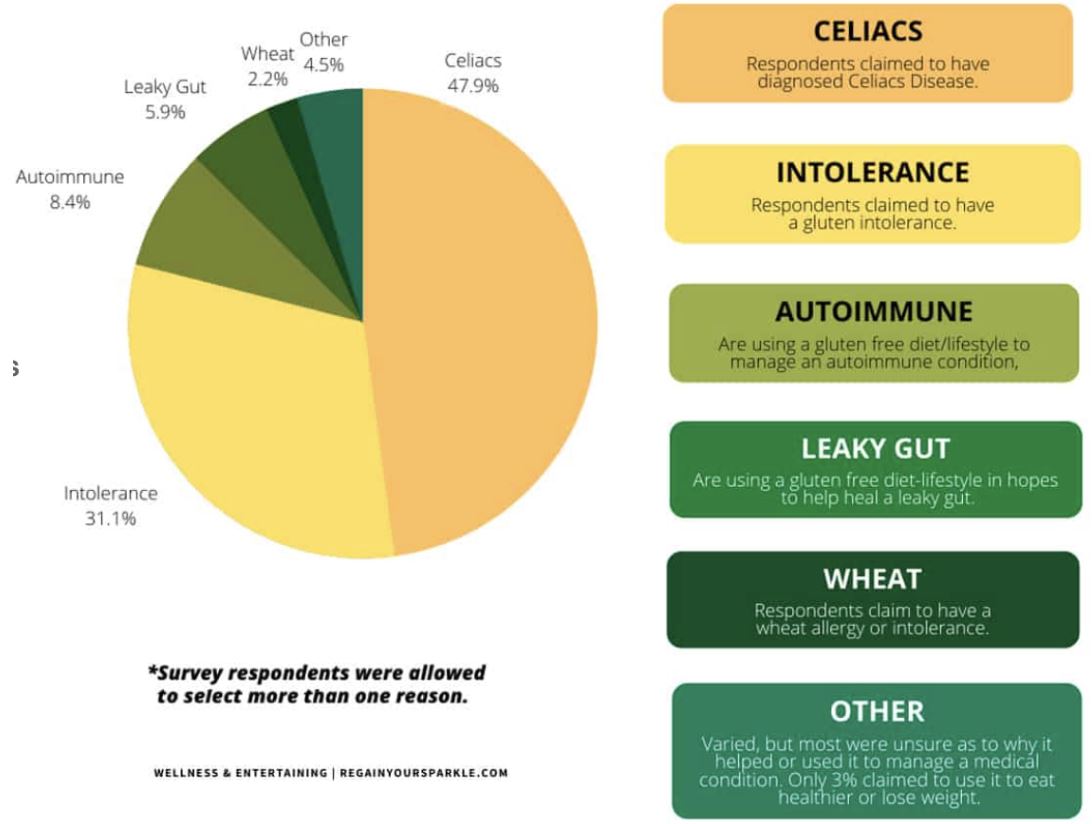
- Among those who adhere to a gluten-free diet, a considerable portion, 47.9%, do so as a result of having celiac disease.
- Furthermore, 31.1% of people consider themselves gluten intolerant. Around 4% are suffering from some form of autoimmune disease, while 5.9% are in the process of recovering from leaky gut syndrome.
- Another 4.5% do not know the exact cause but still live gluten-free. At the same time, 3% of the consumers state that their purpose is to lose weight and eat healthy, and only 2.2% of them are wheat-allergic individuals who are on this diet.
Key Gluten-Free Industry Developments
- In April 2026, Gerber updated its Puffs and Teether Wheels recipes with sorghum, a nutrient-rich gluten-free grain, supporting demand for clean-label and allergen-friendly snacks.
- In February 2026, Bob’s Red Mill expanded its gluten-free oatmeal range with new chocolate chip and chocolate hazelnut protein products, targeting convenient, indulgent breakfasts.
- In January 2026, General Mills introduced new protein-focused cereals and granola snacks while bringing back popular flavors to combine health trends with consumer nostalgia.
Summary
A gluten-free diet is important for people with celiac disease or gluten sensitivity. However, avoiding gluten does not always mean eating healthier. Choose fresh foods such as fruits, vegetables, lean proteins, beans, and gluten-free grains.
Also, limit highly processed gluten-free products, as they may contain extra sugar, fat, or calories. With the right food choices, a gluten-free diet can provide good nutrition and support overall health and well-being.
FAQ
People with celiac disease, gluten sensitivity, or wheat allergy may need to follow a gluten-free diet.
Naturally gluten-free foods include fruits, vegetables, rice, meat, fish, eggs, and dairy.
A gluten-free diet may support weight loss, but only with balanced portions and healthy food choices.