








Orientation
AstraZeneca Statistics: AstraZeneca is one of the world’s biggest pharmaceutical companies, known for creating medicines that improve and save lives. From cancer and heart disease to respiratory illnesses and rare conditions, its treatments help millions of people every year. The company invests billions in research to develop new drugs and advance healthcare. With operations in more than 100 countries, AstraZeneca continues to grow through innovation, partnerships, and scientific breakthroughs. Its strong financial performance and expanding product portfolio have made it a leader in the global healthcare industry.
This article highlights the latest AstraZeneca statistics, including revenue, market value, research spending, workforce, top medicines, clinical trials, and other key facts that show the company’s global impact.
ETop Picks
- AstraZeneca generated USD 30.7 billion in H1 2026 revenue, up 6% at constant exchange rates.
- Oncology remained the growth engine, contributing USD 14.1 billion and rising 15% year over year.
- The company targets USD 80 billion in annual sales by 2030, supported by 20+ planned drug launches.
- Enhertu (+31%) and Truqap (+37%) led strong oncology product growth.
- Rare disease revenue increased 11%, driven by Ultomiris (+12%) and Strensiq (+36%).
- The U.S. accounted for 42% of product revenue, remaining AstraZeneca’s largest market.
- AstraZeneca plans to invest USD 50 billion in U.S. manufacturing and R&D through 2030.
- The company maintains 910+ pipeline candidates and 260+ marketed medicines.
- Over the past three years, AstraZeneca delivered a 13.1% revenue CAGR and 251.6% net income CAGR.
- AstraZeneca strengthened its AI-driven drug discovery strategy by agreeing to acquire Modella AI in 2026.
Lesser-Known Facts About AstraZeneca (1913-2026)
- AstraZeneca traces its roots to 1913, when Astra AB was founded in Sweden by 400 doctors and apothecaries, long before the modern company was created.
- The company officially formed in 1999 through the merger of Astra AB and Zeneca Group PLC, combining Swedish and British pharmaceutical expertise.
- AstraZeneca’s research is centered in Cambridge (UK), Gothenburg (Sweden), and Gaithersburg (U.S.).
- In 2021, the company completed its landmark USD 39B acquisition of Alexion, significantly expanding its rare disease business.
- During 2025, AstraZeneca announced plans to invest USD 50 billion in U.S. manufacturing and R&D by 2030 and USD 2.5 billion in a new R&D center in Beijing.
- In 2026, the company agreed to acquire AI startup Modella AI to strengthen oncology research and shifted its US stock listing from Nasdaq to the NYSE.
AstraZeneca Premium Industry Data and Analytics
- AstraZeneca has 5,600+ clinical trials, providing insights into its clinical operations.
- A report shared by Global Data shows the company has 3,100+ lead sheets that help identify key decision-makers and business opportunities.
- Its 2,900+ catalyst calendar entries allow investors to track important upcoming events and potential business impacts.
- AstraZeneca’s pipeline includes 910+ drug candidates, while 260+ are marketed drugs.
- The company has 780+ research insights that support competitive analysis and strategic decision-making.
- More than 150 regulatory milestones help monitor drug approvals, patent expiries, and affected markets.
- AstraZeneca also provides 110+ sales and consensus forecasts with 8-year patient population projections.
- Its database includes 3 investigator profiles, 30+ IT services contracts, and 1 ICT spending report outlining the company’s digital technology priorities.
AstraZeneca Revenue Analysis
(Source: astrazeneca.com)
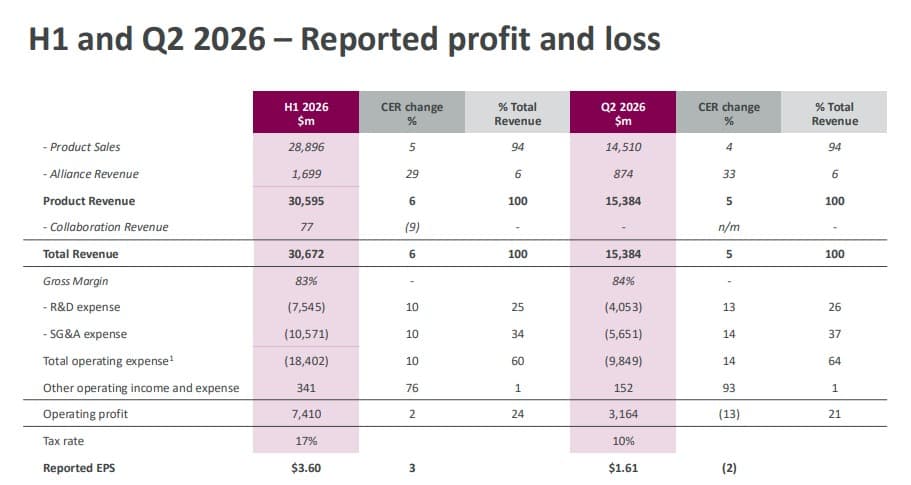
- In H1 2026, product sales were USD 28,896 million, up 5% at constant exchange rates, and accounted for 94% of total revenue.
- Alliance revenue reached USD 1,699 million, growing 29% CER and contributing 6% of total revenue.
- Product revenue totaled USD 30,595 million, up 6% CER, while collaboration revenue was USD 77 million, down 9% CER.
- Total H1 2026 revenue was USD 30,672 million, representing 6% CER growth.
Performance Report
- In Q2 2026, product sales were USD 14,510 million, up 4% CER, while alliance revenue was USD 874 million, up 33% CER.
- Product revenue and total revenue both reached USD 15,384 million, increasing 5% CER. Collaboration revenue was not meaningful in the quarter.
Profitability and Costs
- H1 gross margin was 83%, compared with 84% in Q2.
- H1 R&D expense was USD 7,545 million, up 10% CER, and SG&A expense was USD 10,571 million, also up 10% CER.
- Total H1 operating expense was USD 18,402 million, equal to 60% of revenue. Operating profit was USD 7,410 million, up 2% CER, with a 24% margin.
- Q2 operating profit was USD 3,164 million, down 13% CER, with a 21% margin.
- Reported EPS was USD 3.60 in H1 and USD 1.61 in Q2; tax rates were 17% and 10%, respectively.
Annual Sales Outlook
(Source: reuters.com)
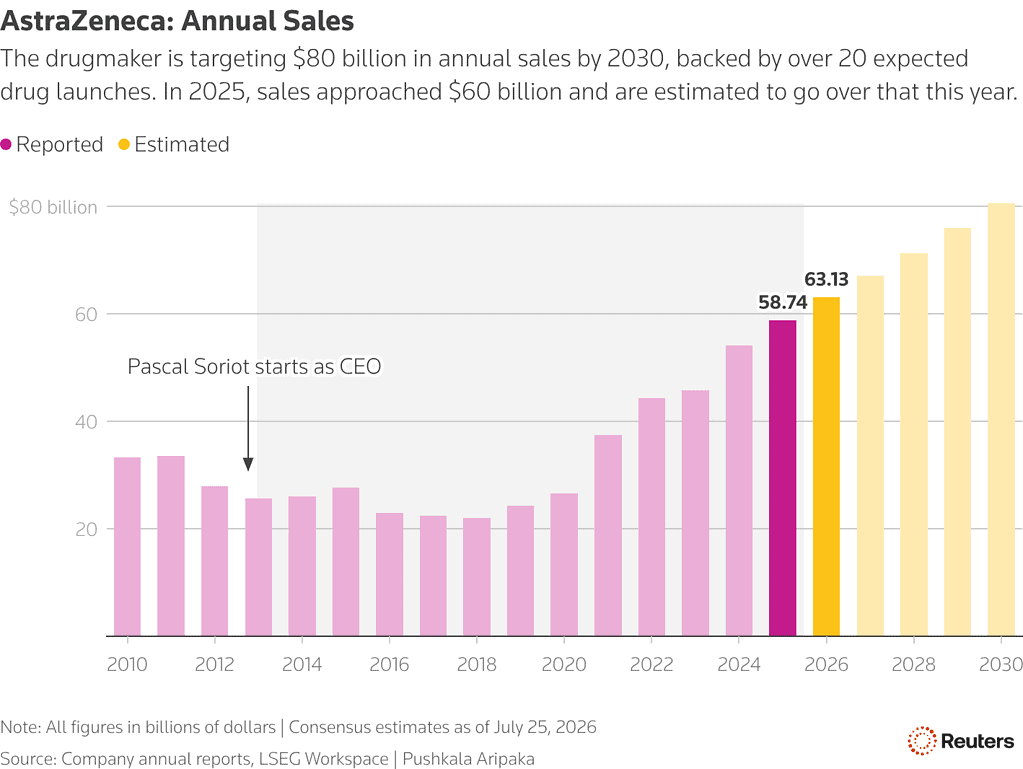
- AstraZeneca reported annual sales of USD 58.74 billion in 2025 and estimates USD 63.13 billion in 2026.
- The company targets USD 80 billion in annual sales by 2030, supported by more than 20 expected drug launches.
AstraZeneca Financial Guidance (2026), Net Debt and Capital Allocation Outlook
(Source: astrazeneca.com)
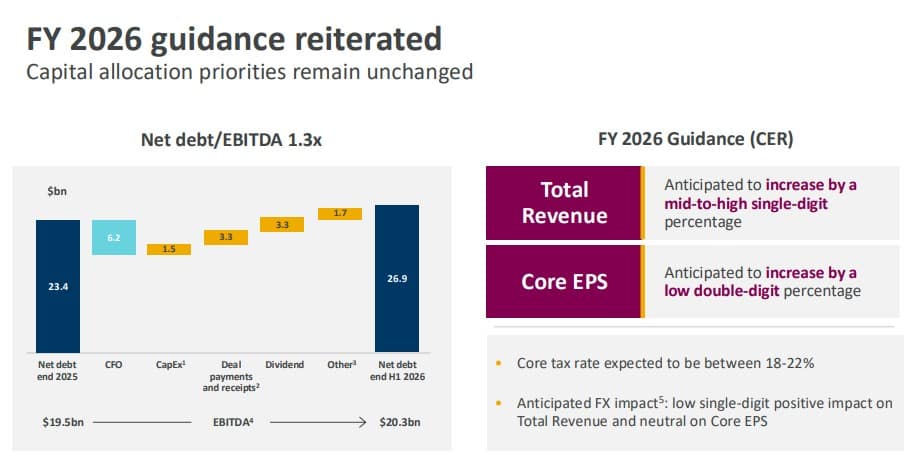
- The company expects its core tax rate to be between 18% and 22%.
- Foreign exchange is expected to provide a low-single-digit positive boost to revenue, while having no material impact on core EPS.
- Net debt is forecast to reach USD 26.9 billion in H1 2026, up from USD 23.4 billion at the end of 2025, with a net debt/EBITDA ratio of 1.3x.
- EBITDA is projected to increase from USD 19.5 billion in FY 2025 to USD 20.3 billion in H1 2026.
- Cash flow is expected to include USD 6.2 billion from operations, USD 1.5 billion in CapEx, USD 3.3 billion in deal payments and receipts, USD 3.3 billion in dividends, and USD 1.7 billion in other items.
AstraZeneca Product Revenue Growth by Therapy Area Report
| Therapy Area | Share of Product Revenue | H1 2026 Revenue and Growth Rate |
| Oncology | 46% | USD 14,123 million; up 15% |
| CVRM | 20% | USD 6,013 million; down 12% |
| Respiratory & Immunology | 16% | USD 4,801 million; up 9% |
| Infectious Disease | 1% | USD 312 million; down 5% |
| Other therapies | 2% | – |
| Rare Disease | 16% | USD 4,911 million; up 11% |
By Geographic Performance
(Source: astrazeneca.com)
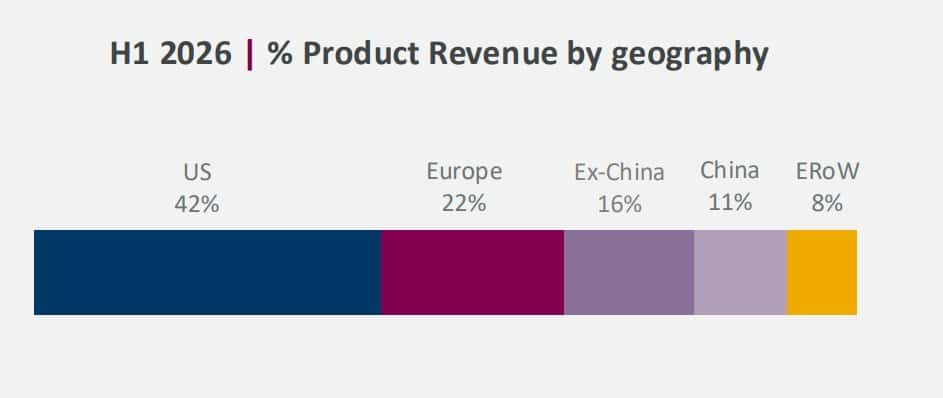
- The U.S. represented 42% of product revenue and generated USD 12,889 million, increasing 8%.
- Europe contributed 22% and generated USD 6,822 million, up 8%.
- Emerging markets represented 16% of product revenue and increased 3%. Ex-China revenue was USD 4,809 million, up 10%, while China revenue was USD 3,196 million, down 5%.
- China represented 11% of product revenue, while the rest of the world (ErOW) accounted for 8%, generating USD 2,565 million and growing 6%.
AstraZeneca Report of Oncology Performance
- AstraZeneca’s oncology revenue reached USD 14.1 billion in H1 2026, increasing 15%. Q2 2026 oncology revenue also grew 15%, supported by strong global demand for key medicines.
- Tagrisso sales increased 6%, supported by accelerating FLAURA2 uptake in the first-line (1L) lung-cancer combination setting.
- Imfinzi revenue rose 27%, while Imjudo declined 7%; growth reflected new launches and robust worldwide demand.
- Calquence increased 16%, maintaining leadership in 1L chronic lymphocytic leukemia (CLL) across major markets.
- Enhertu revenue grew 31%, driven by breast-cancer indication expansion. Truqap increased 37%, reflecting growth outside the US, while US sales remained stable.
- Datroway generated USD 55 million, with share rising in second-line (2L) EGFR-mutated lung cancer and a leading position in third-line-plus (3L+) treatment.
Biopharmaceuticals Performance
- AstraZeneca’s biopharmaceuticals revenue declined 5% to USD 11.2 billion in H1 2026.
- R&I revenue reached USD 4.8 billion, increasing 9%, while CVRM revenue was USD 6.1 billion, declining 12%.
- Fasenra revenue increased 13%, supported by continued IL-5 leadership in asthma, European growth, and the China launch.
- Breztri grew 20%, driven by expanding triple-class use in chronic obstructive pulmonary disease (COPD).
- Tezspire increased 45%, supported by demand in severe asthma and a nasal-polyps launch.
- Saphnelo rose 24%, reflecting increased penetration of the intravenous formulation and subcutaneous launches in the US and EU.
- Farxiga declined 19% because of generic competition in the US and Japan and volume-based procurement in China, partly offset by growth elsewhere.
- Wainua increased 58%, driven by demand in ATTR-PN.
Rare Disease Performance
- According to a report published by AstraZeneca (PDF), AstraZeneca’s rare-disease portfolio generated USD 4.9 billion in H1 2026, representing 11% growth.
- Within the complement-system (C5) franchise, Ultomiris revenue rose 12%, while Soliris revenue declined 28%.
- Beyond the complement portfolio, Strensiq delivered strong 36% revenue growth, and Koselugo revenue increased 27%.
AstraZeneca Sales by Region
(Source: reuters.com)
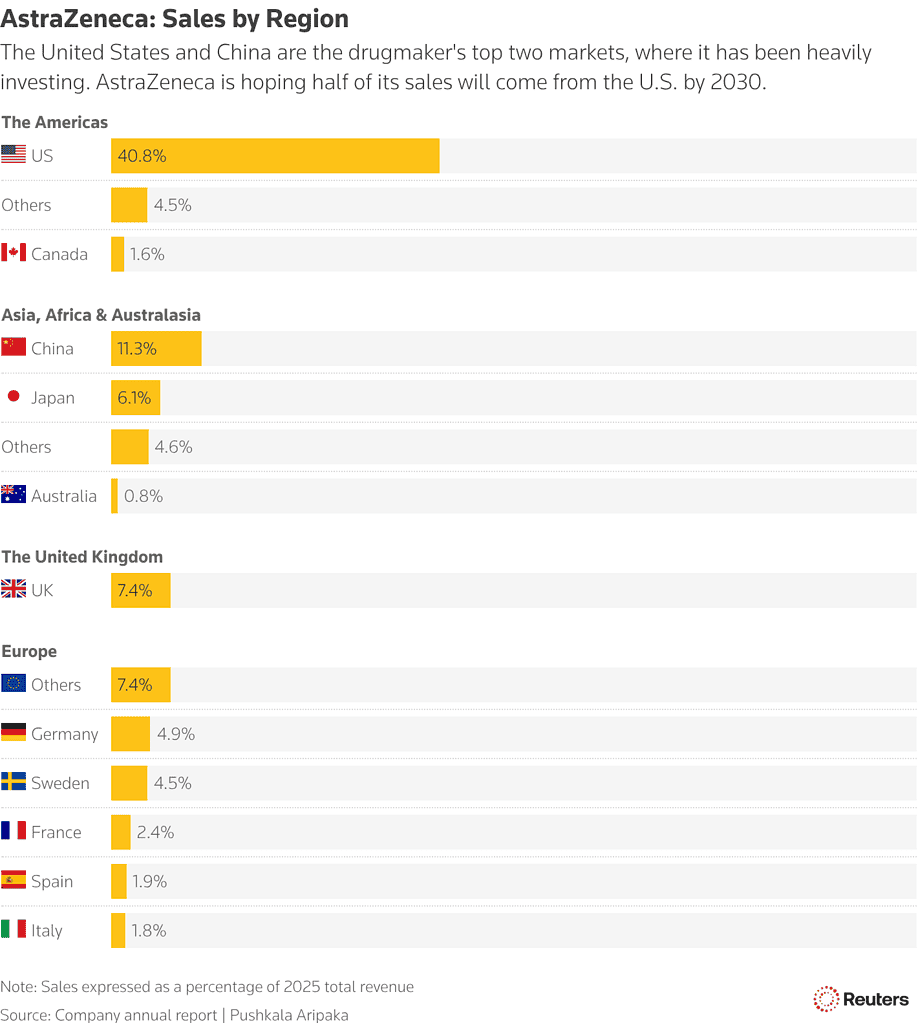
- The United States was AstraZeneca’s largest market, accounting for 40.8% of total 2025 revenue.
- The company aims to generate 50% of its sales from the United States by 2030.
- China was the second-largest market, contributing 11.3% of total revenue. Japan represented 6.1%, while Australia accounted for 0.8%.
- In the Americas, markets other than the United States and Canada contributed 4.5% of revenue. Canada added 1.6%.
- The United Kingdom accounted for 7.4% of AstraZeneca’s total revenue.
- In Europe, other European countries together contributed 7.4%. Germany accounted for 4.9%, Sweden for 4.5%, France for 2.4%, Spain for 1.9%, and Italy for 1.8%.
AstraZeneca (AZN) Stock Analysis by Investment Overview
- AstraZeneca has delivered strong growth over the past three years, supported by its oncology-focused pipeline and expanding portfolio in rare diseases and immunology.
- The company recorded a 13.1% revenue CAGR, 251.6% net income CAGR, and 24.6% free cash flow CAGR.
(Source: openbookanalytics.com)
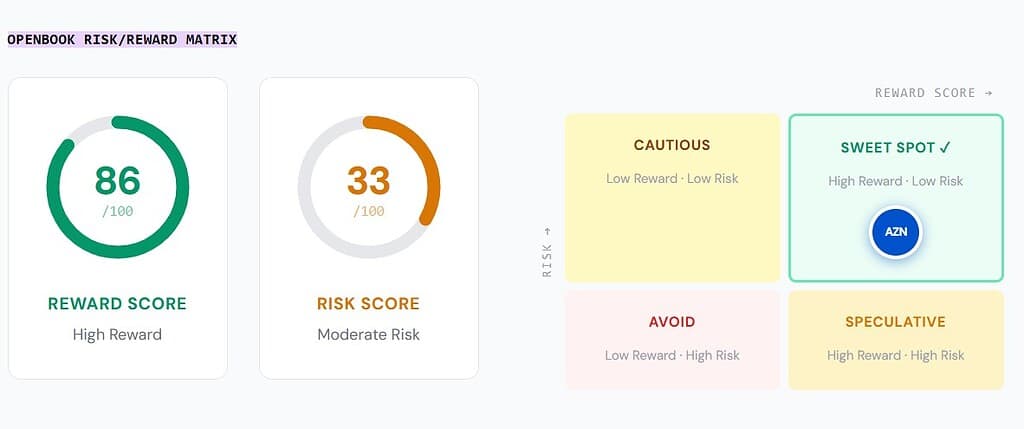
- The stock earns a Reward Score of 86/100 and a Risk Score of 33/100.
By Valuation and Performance
- AstraZeneca trades at a P/E of 29.3x, EV/EBITDA of 10.8x, and PEG of 0.96, indicating its valuation is reasonable relative to its growth.
- The shares gained 2.5% in 1 month, 4.1% in 3 months, 24.7% in 6 months, 19.8% over 1 year, and 55% over 5 years.
- The company has a market value of USD 166.9B.
By Financial Strength and Risks
- AstraZeneca maintains solid profitability with a 13% net margin, 15.5% EBIT growth, 19.8% ROE, and 8.2% ROA, according to a report shared by Open Book Analytics.
- Financial risk remains manageable with 0.60x net debt-to-equity, 6.2x interest coverage, and USD 24.6B in net debt supported by strong cash generation.
- Key risks include patent expirations, regulatory uncertainty in China, 28.5% annualized volatility, and a maximum drawdown of 19.7%.
AstraZeneca Investments and Strategic Deals
- News published by Cision stated that in July 2025, AstraZeneca announced a USD 50 billion investment in US manufacturing and R&D through 2030. The plan supports its goal of reaching USD 80 billion in annual revenue by 2030, with 50% of total revenue expected to come from the U.S.
- In March 2025, the company committed USD 2.5 billion over 5 years to expand its Beijing operations. The investment will increase the local workforce to 1,700 and establish Beijing as AstraZeneca’s sixth global strategic R&D center.
- In January 2025, AstraZeneca invested USD 570 million (originally C$820M) in Canada, creating more than 700 high-skilled jobs.
- In June 2025, AstraZeneca partnered with CSPC, paying USD 110 million upfront. The agreement includes up to USD 1.62 billion in development milestones, USD 3.6 billion in sales milestones, and potential single-digit royalties.
- In January 2026, the company announced a USD 15 billion investment in China through 2030 to expand medicine manufacturing and R&D.
- In July 2026, AstraZeneca licensed Dizal’s Zegfrovy for USD 600 million upfront, with up to USD 900 million in milestone payments plus tiered royalties.
Bottom Line
AstraZeneca has established itself as one of the world’s leading pharmaceutical companies through its commitment to scientific innovation and patient care. The company continues to expand its portfolio with medicines targeting cancer, cardiovascular diseases, rare diseases, respiratory conditions, and other critical health challenges.
Backed by consistent revenue growth and significant investments in research and development, AstraZeneca remains at the forefront of medical innovation. Its expanding global footprint, robust pipeline of new therapies, and focus on addressing unmet medical needs position the company for sustained growth and long-term success in the healthcare industry.
FAQ
The company develops innovative medicines in Oncology, Cardiovascular, Renal & Metabolism (CVRM), Respiratory & Immunology, Vaccines & Immune Therapies, and Rare Diseases.
AstraZeneca has a presence in more than 100 countries worldwide.
Yes, AstraZeneca conducts global clinical trials to evaluate the safety and effectiveness of new medicines

Sources