









Foreword
Fashion Industry Statistics: The fast Fashion industry is more than just clothes; it is a global business that shapes trends, culture, and personal style. From luxury brands to fast fashion and online stores, the industry influences how people dress and express themselves every day. It also creates millions of jobs and contributes significantly to the global economy. Today, technology, e-commerce, and social media are changing the way fashion is designed, produced, and sold. At the same time, consumers are demanding more sustainable and ethical products, encouraging brands to adopt eco-friendly practices.
As fashion continues to evolve, it remains one of the world’s most dynamic and innovative industries, driving creativity, business growth, and changing consumer preferences.
Curated Choice
- The global fashion market is expected to generate USD 957.31 billion in revenue in 2026 and reach USD 1.16 trillion by 2030.
- The global apparel market is projected to grow from USD 1.84 trillion in 2025 to USD 2 trillion by 2028.
- Consumers worldwide spend USD 2.4 trillion on apparel, with spending forecast to reach USD 2.88 trillion by 2029.
- China remains the largest textile and apparel exporter with USD 291 billion in exports and a 32% global share.
- The United States apparel market is valued at USD 365.70 billion in 2025.
- Fashion manufacturing produces 10% of annual global carbon emissions.
- About 60% of garments produced each year end up in landfills.
- The UK fashion and textile industry supports 1.3 million jobs, while U.S. clothing stores employ 1.14 million people.
- Around 84% of consumers are willing to pay more for personalized fashion products.
- The AI in fashion market is expected to reach USD 3.99 billion in 2026, growing at more than 40% annually.
What is the Fashion Industry?
Fashion relates to manufacturing, promotion, footwear, accessories, apparel retail, and design, which are produced or manufactured on demand and sold to consumers directly. As a big-league company globally, fashion contributes to the economy by creating jobs and earning income for different organizations, including multinational companies.
The clothing lines produced, manufactured, and designed are related to the fast-developing customers’ tastes and fast-swapping fashion trends in this exceedingly dynamic business, which can be substantially affected by technology, social media, and culture. Companies and designers are presently keeping up with changing fashion trends.
Fashion eCommerce Market Revenue and User Growth Statistics
- According to Statista, the global fashion market is expected to generate USD 957.31 billion in revenue in 2026.
- The market is forecast to grow at a 4.91% CAGR from 2026 to 2030, reaching USD 1.16 trillion by 2030.
- The United States is projected to remain the largest market, generating USD 241.25 billion in revenue during 2026.
- The number of fashion eCommerce users is expected to reach 2.2 billion by 2030, reflecting wider adoption of online fashion shopping.
- User penetration is estimated at 28.4% in 2026 and is expected to increase to 30.6% by 2030.
- The average revenue per user is projected to be USD 536.07.
Global Apparel Market Size Forecast
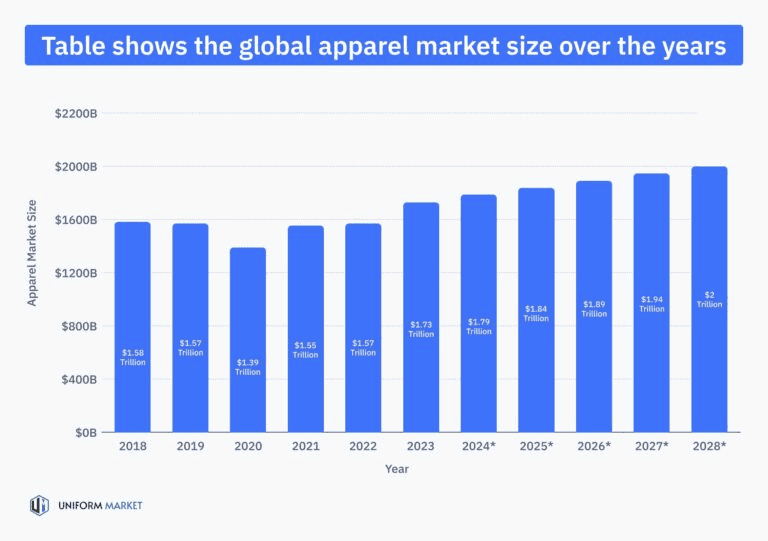
(Source: uniformmarket.com)
- The global apparel market is expected to grow steadily from USD 1.84 trillion in 2025 to USD 1.89 trillion in 2026.
- The market is projected to reach USD 1.94 trillion in 2027 and USD 2 trillion in 2028.
United States Apparel Market Statistics
- The United States apparel market is valued at USD 365.70 billion in 2025 and is expected to grow at a 2.11% CAGR through 2028.
- Retail clothing sales in the United States average USD 25.63 billion per month, while sales reached USD 25.84 billion in April 2024.
Apparel Market by Category
- Uniform Market report stated that the global women’s apparel market is worth USD 930 billion and is projected to exceed USD 1 trillion by 2027.
- The men’s apparel market is valued at USD 587.61 billion, while the children’s apparel market is worth USD 274.25 billion.
Consumer Spending and Shopping Trends
- Globally, consumers spend USD 2.4 trillion on apparel, up 15.94% over the past decade, with spending expected to reach USD 2.88 trillion by 2029.
- Around 82% of shoppers aged 26-35 bought clothes online in the past 12 months.
- Meanwhile, 80% of those aged 36-45 made a clothing purchase during the same period.
- Physical stores account for 79% of fashion sales, while online channels contribute 21%.
- Online shopping is highest in Asia (24%) and lowest in Africa (4.2%).
Fashion Industry Environmental and Economic Impact Statistics
- According to market.us, the global fashion industry is valued at USD 2.4 trillion, making it the 7th largest industry when compared with national GDPs.
- Around 1 in 6 workers worldwide are employed in the garment industry.
- Every year, USD 500 billion in value is lost because clothing is not reused or recycled effectively.
- New York spends USD 20.6 million each year transporting textile waste to disposal sites.
- About 60% of garments produced annually end up in landfills.
- Fashion is the 2nd largest global polluting industry after oil.
- Fashion manufacturing generates 10% of annual global carbon emissions.
- Fast fashion produces 2%-8% of global greenhouse gas emissions, exceeding emissions from international flights and shipping combined.
- Synthetic fabric microfibres contribute 16%-35% of the microplastics entering oceans.
- On average, people wear a garment only 7-10 times before throwing it away.
Global Textile and Apparel Trade Statistics
- A report published by Wazir stated that the global textile and apparel (T&A) trade reached approximately USD 900 billion in 2025, growing at a 3% CAGR since 2020.
- Apparel represented nearly 60% of total global T&A trade value.
- The global apparel retail market was valued at USD 1.9 trillion in 2025 and is projected to reach USD 2.3 trillion by 2030, growing at a 4% CAGR.
- In 2026, the industry is adjusting to new U.S. tariffs, weaker demand in Western markets, and increased sourcing from Vietnam, Bangladesh, India, Cambodia, and Egypt.
Global Export Landscape
- According to fas.usda.gov, China remained the largest exporter in 2025, with T&A exports of USD 291 billion, representing 32% of global exports. This included USD 145 billion in textiles and USD 146 billion in apparel.
- Official customs data reported China’s exports at USD 293.8 billion, down 2.4% year over year, including USD 142.6 billion in textiles (+0.5%) and USD 151.2 billion in apparel (-5%).
- During January-February 2026, China’s exports rebounded 17.6% to USD 50.5 billion, including USD 25.6 billion in textile exports.
- Other leading exporters in 2025 included: EU-27: USD 69 billion (8% share), Vietnam: USD 46 billion (5%), Bangladesh: USD 40 billion (4%), India: USD 37 billion (4%), Turkey: USD 31 billion (3%), and the United States: USD 19 billion (2%).
Country Performance
- Vietnam became the leading apparel supplier to the U.S. market in early 2026, benefiting from lower tariffs.
- Bangladesh exported USD 8.20 billion in ready-made garments (RMG) to the U.S. during 2025, up 11.75%, while total apparel exports reached about USD 38.8 billion.
- India achieved record T&A exports of USD 36.6 billion in FY2024–25, increasing 6.32%. This included USD 15.99 billion in apparel and USD 20.62 billion in textiles.
- India’s exports for 2025-26 reached ₹3,16,334.9 crore (about USD 37 billion), growing 2.1%, with ready-made garments contributing ₹1,39,349.6 crore.
Global Import Landscape
- Fibre2Fashion report further stated that U.S. T&A imports declined to USD 39.13 billion during January-May 2026, down 8.92%.
- During Q1 2026, textile imports totaled USD 23.70 billion (-11.95%), while apparel imports reached USD 17.73 billion (-11.63%).
- Apparel import volumes declined 12.3%, while average unit values increased 0.8%.
- shenglufashion.com further mentioned that China’s apparel exports to the U.S. dropped 57.65% during January-February 2026, falling from USD 2.77 billion to USD 1.17 billion.
- Vietnam captured 22.5% of the U.S. apparel import market during Q1 2026, while India’s shipments fell 27% to about USD 407 million.
- Asian countries supplied 70.2% of U.S. apparel imports by April 2026, compared with 72.0% a year earlier.
Industry Trends and 2026 Outlook
- Apparel accounts for about 60% of global T&A trade, while textiles make up the remaining 40%.
- India’s textile and apparel imports reached about USD 10.5 billion, with fiber imports totaling USD 2.4 billion, representing nearly 25% of total imports.
- Global textile exports were valued at USD 799.2 billion, led by China (USD 260.8 billion, 32.33%), followed by Bangladesh (USD 48.9 billion, 6.07%), Vietnam (USD 42.1 billion, 5.22%), Turkey (USD 38.6 billion, 4.78%), and India (USD 37.5 billion, 4.65%).
- Global footwear exports are worth about USD 150 billion annually, with China controlling over 60% of the market.
- The global textile market is projected to grow from USD 0.74 trillion in 2025 to USD 0.79 trillion in 2026, reaching USD 1.02 trillion by 2031 at a 6.6% CAGR.
- U.S. container imports declined to 25.2 million TEUs in 2025 (-1.4%), while intra-Asia trade is expected to double to USD 350 billion. India’s domestic textile and apparel market is estimated at USD 194 billion for 2025-26.
Leading clothing companies by market value (July 8, 2026)
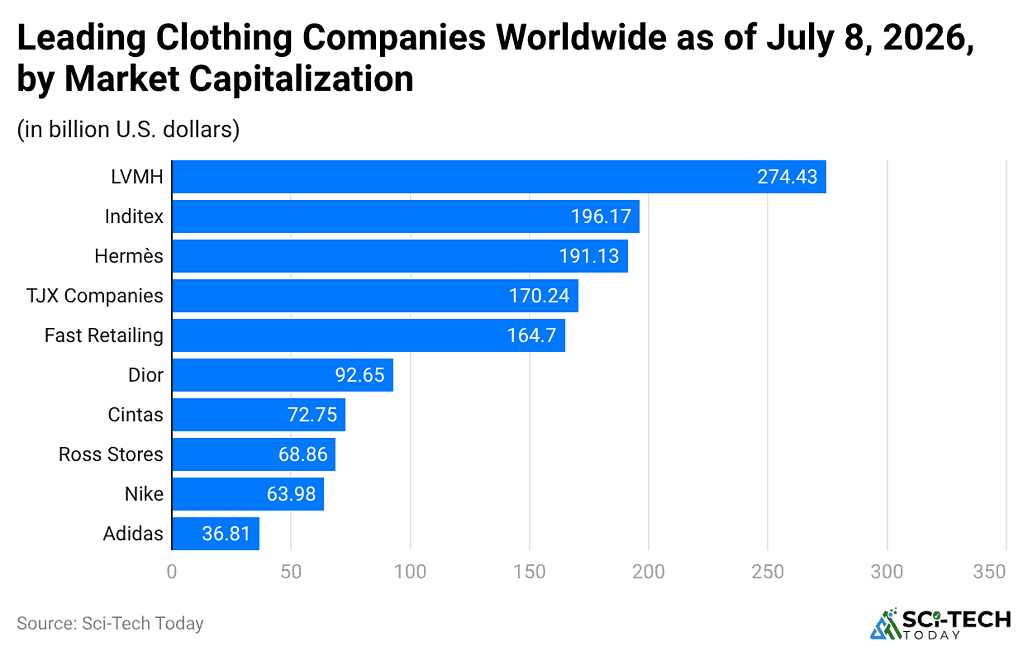
(Reference: statista.com)
- LVMH is the largest clothing group with a market capitalization of about USD 274.43 billion.
- Inditex, owner of Zara and other chains, follows at roughly USD 196.17 billion.
- Hermès holds a strong luxury position with around USD 191.13 billion in market value.
- TJX Companies and Fast Retailing are major retail players at about USD 170.24 billion and USD 164.7 billion, respectively.
- Dior, Cintas, Ross Stores, Nike (USD 63.98 billion), and Adidas (USD 36.81 billion) form the next tier of global leaders.
Country Facts and Figures About The Fashion Industry
| Country | Population | Labor force | Unemployment rate | GDP per capita (PPP) | The domestic market value of fashion | Employment in fashion |
| France | 66.2 million | 30.05 million | 9.9% | $42,726 | $43.3 billion | 340,000 |
| Germany | 80.9 million | 42.0 million | 5.3% | $47,627 | $83,6 billion | 340,000 |
| The Netherlands | 16.9 million | 9.0 million | 6.9% | $52,139 | $16.5 billion | 87,910 |
| Spain | 46.8 million | 23.3 million | 22.7% | $29,863 | $31.1 billion | – |
| United Kingdom | 64.5 million | 33 million | 6.3% | $46,297 | $94.1 billion | 555,000 |
Employment in the Fashion Industry Statistics
- Texintel report further stated that the UK fashion and textile industry supports about 1.3 million jobs in 2026, representing nearly 4% of total employment, or about 1 in 25 jobs.
- According to bls.gov, in the United States, clothing and clothing accessories stores employ around 1.14 million people as of spring 2026.
- Globally, women make up approximately 70%-80% of garment workers.
- Gitnux report also mentioned that Bangladesh employs about 4.4 million ready-made garment workers, with 80%-85% being women.
- India has around 45 million people working in the textile industry, including a large garment workforce.
- Cambodia employs about 800,000 garment workers, with roughly 90% being women.
- Vietnam has approximately 2.5 million garment workers, most of whom are under 35 years old.
Consumer Behaviour in the Fashion Industry
- The part of sales assigned to notable apparel is estimated to grow from 3.7% in 2022 to 5.3% in 2026.
- According to the Fashion Industry Statistics, the worldwide fashion market produces almost 100 to 150 billion individual parts yearly, and almost 80 billion parts are bought annually.
- Around 36% of Gen Z buy branded new attire at least once time in a month.
- The population between 45 and 54 spent the most on girls’ and female clothing in 2021, which was around $995.
- The apparel and shoes section is for very regular online buyers who are women. As of 2022, most of these buyers are between 26 and 35 years old.
- The data reveals substantial consumer interest in product customization, with 84% of individuals willing to pay more for this service. Specifically, 45% of consumers are keen on personalized colors and custom clothing.
- The demand is also significant for everyday clothing (41%), seasonal fashion items (31%), and high-fashion pieces (26%).
Consumer behavior differs notably by country statistics:
| Country | Avg. Val per Item | Avg. Items per Person | Avg. Val. Per Item |
| Japan | $547 | 26 | $20.9 |
| Vietnam | $24 | 2 | $9.81 |
| China | $198 | 30 | $6.73 |
| India | $34 | 5 | $7.01 |
| Egypt | $27 | 2 | $12.63 |
| Norwegian | $1150 | 12 | $28.26 |
| Brazil | $117 | 11 | $10.49 |
| United Kingdom | $889 | 33 | $27.33 |
| United States | $844 | 53 | $16.04 |
- According to Statista, the United States has the highest per capita expense on apparel and footwear, at $1460. In contrast, in Brazil, the average person spends almost $100 every year on clothing.
- According to Fashion United, the average person’s closet contains almost 148 different clothing items.
- The worldwide fashion market manufactures more than 100 to 150 billion individual parts every year.
- According to IFDAQ, France holds the top spot in the global fashion market, boasting over 2,300 index points, surpassing Italy’s 1,866 points and the USA’s 697 points. This ranking considers several factors, including the relative market strength of fashion brands within the country, their actual market value, industry influence, prestige, marketing activities, and performance within their price segments.
By Segments-Apparel Statistics
- According to Statista, the clothing industry creates around 1.7% of the global GDP and is predicted to have a value of 1.5 trillion.
- The clothing market is also the reason for the global CO2 emissions at 8.8%.
- The growth of the fashion industry is estimated to be 4.8% every year through 2026, which means the clothing industry will increase by 26% in total by 2026, resulting in 15% CO2 emissions.
- Statista states that the worldwide fashion industry revenue was $1.58 trillion in 2019, but it decreased to $1.4 trillion at the time of the COVID-19 pandemic.
- The Asian fashion industry generates the highest revenue, at almost 38.8%, followed by Europe with 28.6% and the US with 27.6%.
- By 2025, China is estimated to be the single biggest global market in the Fashion industry, with a 19.4% growth rate.
| Region | Market Share |
| Asia | 38.8% |
| Europe | 28.6% |
| America | 19.4% |
- According to Statista, the sales share of the luxury fashion market is 5%, and that of the used fashion clothing market is 5.5%.
- Statista states that Europe is the biggest importer in the clothing industry, with almost 24.3% of the global share, and China is the biggest exporter, with almost 31.6% of the global share.
- In 2022, the United States will be the biggest fashion industry on the globe. China followed the US very closely and took second place.
- Every person globally will buy a median of 22.01 pieces of clothing worth 179.50 Euros. Almost 35% of this was an online purchase.
- Spain’s Inditex is the largest clothing producer and retailer, with sales of almost $31.01 billion. This is very far from H&M, which has $20.83 billion in revenue.
| Company | Sales/Bn $ |
| Inditex | $31.01 |
| H&M | $20.83 |
| Fast Retailing | $18.45 |
- According to Statista, Hong Kong had the highest per capita spending at almost $498. Worldwide, this is most likely to grow in China by 2026 from $180 to $157 at 6.1%.
- The median cost for clothing products is the highest for men’s clothing at almost 12.32 euros and very low for kids’ clothing at 3.48 euros. Women’s clothing costs 12.32 for each item.
- Brand awareness is high when it is related to appeal, with 47% of US, 48% of Chinese, and 32% of UK customers focused on the importance of the brands when buying clothing.
- Between 2020 and 2026, the menswear industry experienced the highest growth, at 44%.
Fashion Industry Trends by Sustainable and Responsible Fashion
- In 2026, consumers focus on buying products that are durable, ethically made, and environmentally responsible rather than simply premium.
- Fast fashion accounts for about 10% of global carbon emissions and generates 85% of all textile waste, prompting more people to choose sustainable alternatives, according to Gelato.
- Around 68% of consumers consider sustainability important when shopping, while 73% of Gen Z shoppers are willing to pay more for genuinely sustainable products.
- Material innovation is expanding beyond organic cotton to include mycelium-based leather, Tencel Lyocell, and fabrics made from agricultural waste. The mycelium leather market is projected to grow from USD 12 million in 2024 to USD 336 million by 2033.
- The circular apparel economy is expected to reach USD 77 billion in 2026, while the U.S. secondhand apparel market is forecast to exceed USD 80 billion.
AI Improves Sustainable Operations
- AI-powered demand forecasting helps brands produce only what customers need, reducing overproduction that has historically accounted for up to 40% of unsold inventory.
- Digital 3D prototyping and AI-assisted cutting reduce sample waste by more than 60% and shorten product development cycles.
- AI also improves transportation by optimizing delivery routes, lowering logistics costs and carbon emissions.
- AI and blockchain technology provide end-to-end product traceability, helping brands improve transparency and reduce greenwashing.
AI-Driven Design and Personalization
- The AI in Fashion market is expected to reach USD 3.99 billion in 2026, growing by more than 40% annually.
- Designers increasingly use generative AI to create new patterns, colors, and collections. Transformative Teal has been named the Color of the Year 2026, with online searches increasing nearly 10% year over year.
- Poor sizing causes up to 70% of apparel returns, but 3D body scanning and virtual fitting rooms can reduce return rates by up to 50%.
- The virtual fitting room market is projected to grow from USD 6.86 billion in 2025 to USD 24.3 billion by 2032, while the 3D scanning market is expected to approach USD 11 billion in 2026.
- The embroidery market is forecast to reach USD 1.73 billion in 2026, accounting for 42% of decorated apparel.
- Digital-only fashion and AI-powered made-to-order production are also helping brands reduce waste while delivering personalized customer experiences.
Summary
The fashion industry is changing quickly as technology, online shopping, and customer preferences continue to shape the market. At the same time, sustainability and ethical practices are becoming more important for both brands and buyers. Businesses that focus on innovation, quality, and customer needs are more likely to succeed.
As the industry grows, it will continue to create new trends, opportunities, and challenges, making fashion one of the world’s most dynamic and influential industries.
FAQ
The United States has the largest fashion market by revenue, followed by China.
Major trends include sustainable fashion, online shopping, resale and second-hand clothing, AI-powered personalization, digital fashion, and faster omnichannel retail experiences.
Some of the world’s largest fashion companies include Inditex (Zara), H&M Group, Nike, LVMH, Adidas, Fast Retailing (Uniqlo), and PVH Corp.

Sources