









Market Overview
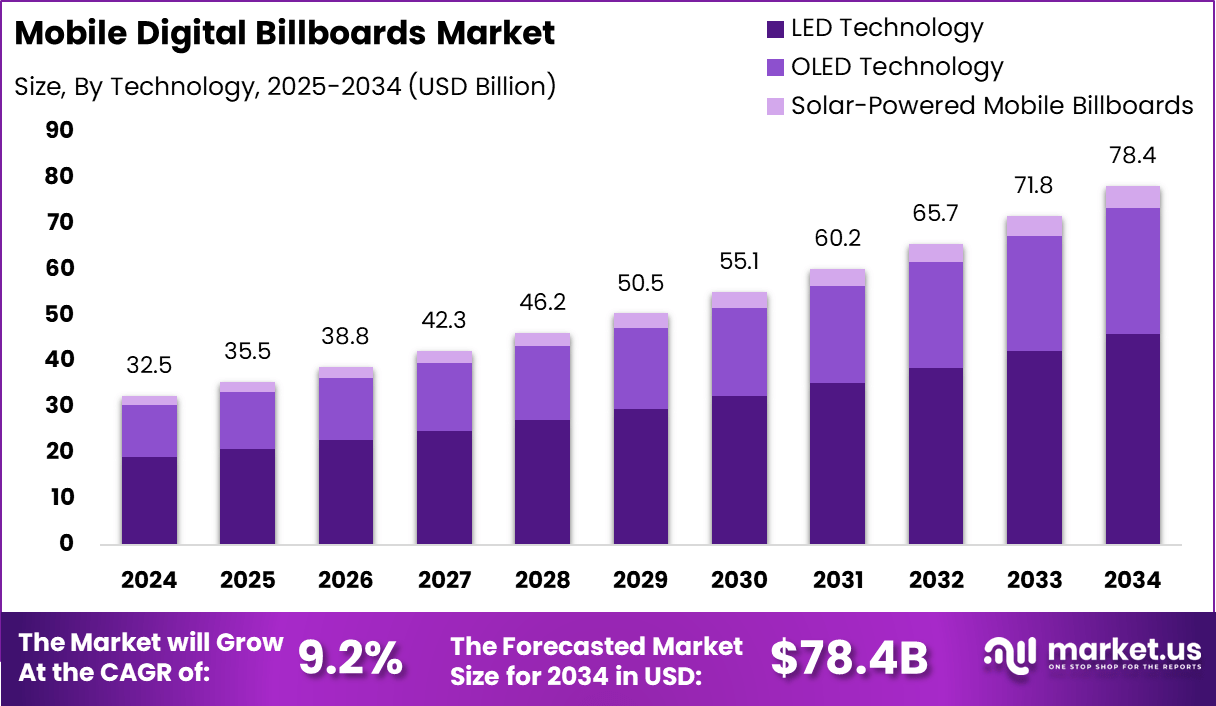
According to Market.us, the global mobile digital billboards market is expected to reach approximately USD 78.4 billion by 2034, rising from USD 32.5 billion in 2024, registering a CAGR of 9.2% during the forecast period from 2025 to 2034.
This growth is supported by the increasing shift toward digital out-of-home advertising, where brands seek dynamic and location-based visibility. Mobile billboards offer flexibility, targeted messaging, and higher audience engagement compared to traditional static formats, making them a preferred choice for advertisers aiming for real-time communication.
Request a report sample to gain comprehensive insights @ https://market.us/report/mobile-digital-billboards-market/free-sample/
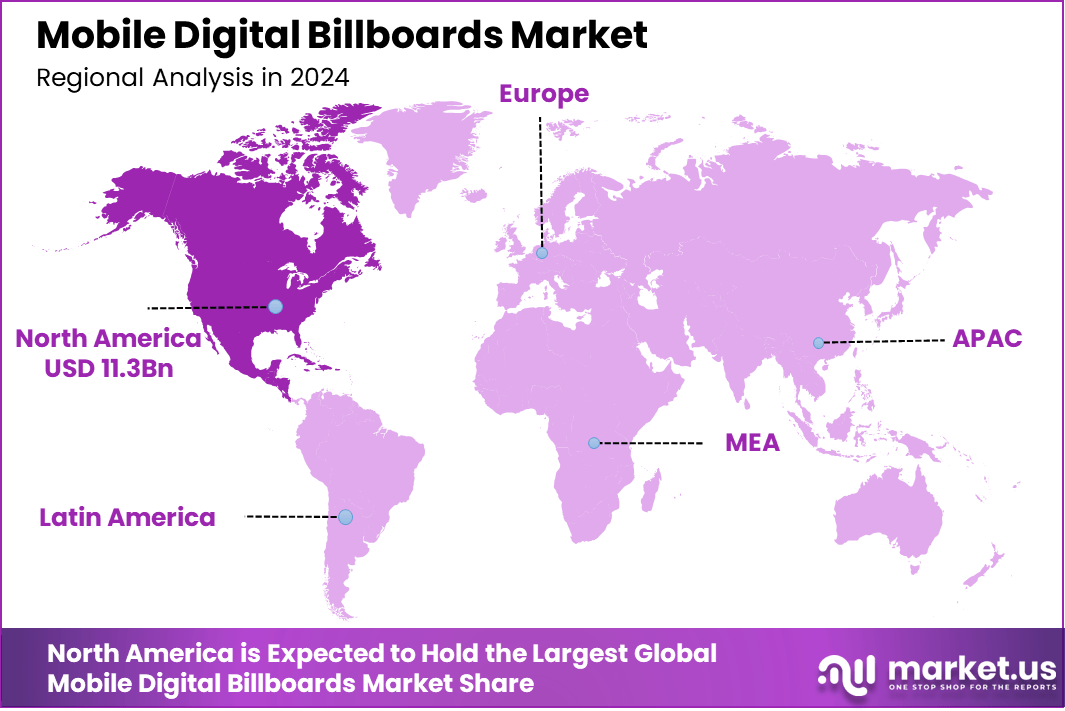
In 2024, North America held a dominant position in the market, capturing more than 35% share and generating around USD 11.3 billion in revenue. This leadership is driven by strong adoption of digital advertising technologies, high urban mobility, and the presence of advanced advertising infrastructure. The demand for mobile digital billboards is also rising due to the growing need for hyper-local advertising, where businesses aim to reach specific audiences in high-traffic areas such as city centers, events, and commercial zones.
Key Takeaways
- The market is projected to expand from USD 32.5 billion in 2024 to USD 78.4 billion by 2034, reflecting steady growth driven by digital advertising adoption.
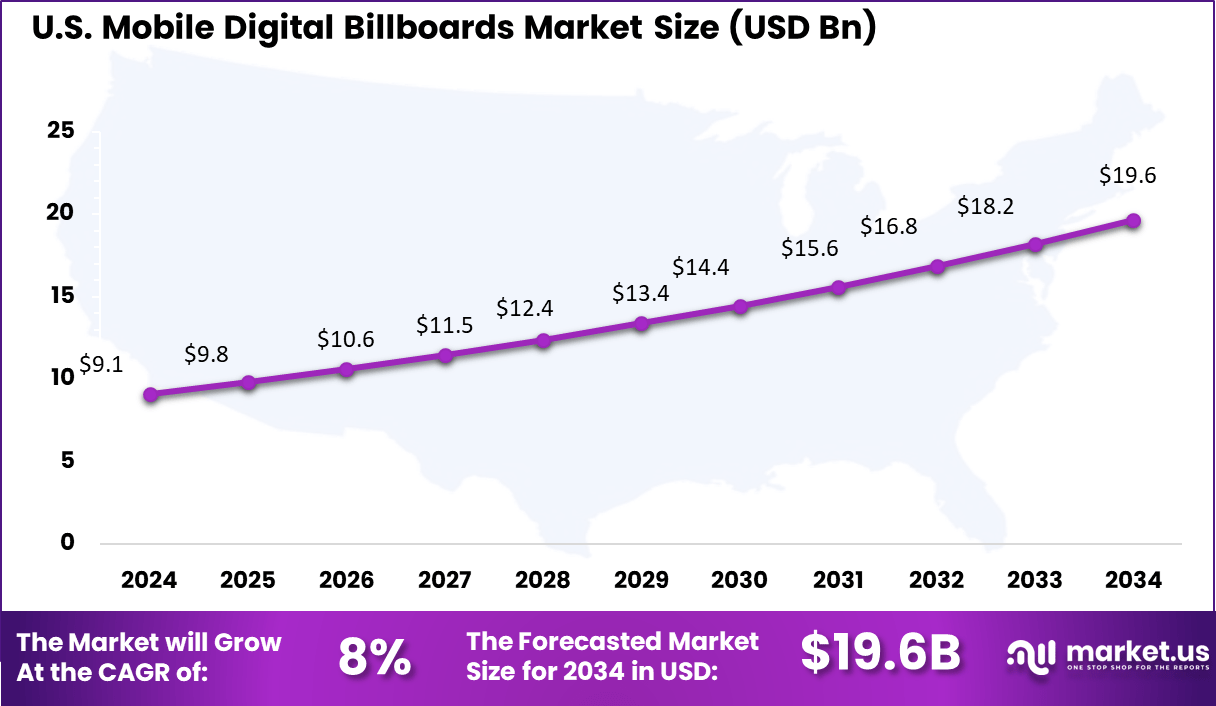
- The United States market is expected to grow from USD 9.1 billion in 2024 to USD 19.6 billion by 2034, supported by strong demand for outdoor media innovation.
- LED technology leads the market with a 58.8% share, highlighting its efficiency, brightness, and durability in outdoor conditions.
- Text-based advertising accounts for 40.8% of the market, reflecting its clarity and effectiveness in high-speed viewing environments.
- The retail sector holds a 28.9% share, driven by demand for localized promotions and real-time marketing.
- Digital LED mobile billboards contribute 32.7% within LED formats, indicating strong adoption of advanced display systems.
How AI is Reshaping the Future of the Mobile Digital Billboards Market?
Artificial intelligence is playing a significant role in transforming mobile digital billboards by enabling real-time content optimization and audience targeting. AI systems can analyze traffic patterns, demographic data, and environmental conditions to display highly relevant advertisements. This improves engagement rates and ensures that advertising content is aligned with audience preferences and location-based insights.
AI is also enhancing campaign measurement and performance tracking. Through computer vision and data analytics, advertisers can assess viewer interactions, estimate impressions, and adjust campaigns instantly. This level of intelligence allows businesses to move from static messaging to adaptive advertising strategies, improving return on investment and enabling more precise marketing execution.
By Technology Analysis
In 2024, LED technology held a dominant position in the mobile digital billboards market, accounting for 58.8% of the technology segment. This leadership is supported by its strong brightness, better visibility in outdoor conditions, and ability to deliver clear content across different environments. Advertisers prefer LED-based systems because they offer sharp image quality and support dynamic messaging. The wider use of energy-efficient display systems has also strengthened the position of this segment.
The strong presence of LED technology is also linked to its durability and lower long-term maintenance needs. Mobile billboard operators are increasingly choosing LED displays because they can support continuous advertising campaigns with reliable performance. These systems are well suited for high-traffic urban areas where visibility and message impact are important. As digital outdoor advertising becomes more advanced, LED technology is expected to remain the leading format.
By Advertising Format Analysis
In 2024, text-based advertising remained a significant format in the mobile digital billboards market, representing 40.8% share. Its strong position reflects the continued value of short, direct, and easy-to-read messaging in outdoor advertising. Text-based content is widely used to communicate promotional offers, brand messages, and event announcements in a quick and effective manner. This format performs well in mobile billboard applications where audiences often view messages in passing.
The popularity of text-based advertising is also supported by its cost efficiency and simplicity in campaign execution. Advertisers can update messages quickly and use concise content to improve recall among viewers. This format is especially effective for local campaigns, time-sensitive promotions, and location-based advertising efforts. Its practical use across different industries continues to support steady demand in the market.
By End-User Analysis
In 2024, the retail sector held a leading 28.9% share in the mobile digital billboards market. This dominance reflects the sector’s strong need for local visibility, customer engagement, and promotional reach in competitive urban environments. Retail businesses are using mobile digital billboards to attract foot traffic, promote store openings, and highlight seasonal campaigns. The format offers flexibility and allows brands to reach audiences in targeted locations.
Retail advertisers also benefit from the ability to run campaigns close to shopping centers, busy streets, and event areas where consumer attention is high. Mobile digital billboards support stronger brand presence by delivering repeated exposure throughout key commercial zones. This approach is especially useful for short-term promotions and regional product launches. As retailers continue to seek more flexible advertising channels, this segment is expected to remain important.
Types of LED Mobile Billboards Analysis
In 2024, digital LED mobile billboards accounted for 32.7% share of the LED billboard type segment. This position highlights the increasing preference for mobile display formats that combine high visual quality with movement-based audience reach. These billboards are widely used for promotional campaigns that require both flexibility and strong visual impact. Their ability to display changing content has made them attractive for brands seeking higher engagement.
The segment is also gaining support from advertisers that want more control over campaign timing and message delivery. Digital LED mobile billboards allow multiple ads to be rotated and adjusted based on location, time, or audience type. This makes them suitable for modern advertising strategies focused on efficiency and visibility. Their growing use across city-based campaigns continues to strengthen demand in the market.
Regional Insights
In 2024, North America held a dominant market position, capturing more than a 35% share, holding USD 11.3 Billion in revenue. North America leads the global mobile digital billboards market due to its advanced advertising ecosystem and high adoption of digital technologies. The region benefits from strong infrastructure, high urban traffic density, and a mature digital advertising industry. Businesses in this region actively invest in innovative outdoor advertising formats to maintain competitive visibility.
The US Mobile Digital Billboards Market is valued at approximately USD 9.1 Billion in 2024 and is predicted to increase from USD 9.8 Billion in 2025 to approximately USD 19.6 Billion by 2034, projected at a CAGR of 8.0% from 2025 to 2034.
The United States remains a key contributor, supported by increasing demand for targeted advertising and the presence of major retail and service industries. Europe follows with steady growth, driven by smart city initiatives and digital transformation in advertising. Asia Pacific is emerging as a high-growth region due to rapid urbanization, increasing vehicle density, and expanding retail sectors that require dynamic advertising solutions.
Growth Factors Analysis
The growth of the mobile digital billboards market is strongly influenced by the shift from static to digital advertising formats. Businesses are increasingly investing in mobile displays that allow flexibility and real-time updates. This transition is supported by the need for more engaging and interactive advertising formats that can capture audience attention in busy urban environments.
Another important factor is the rise in urban mobility and event-based marketing. Mobile billboards can be deployed in high-traffic areas, festivals, and promotional events, offering brands a direct way to reach large audiences. This mobility advantage enhances campaign effectiveness and supports broader brand visibility.
Driver: Demand for Targeted Outdoor Advertising
The increasing demand for targeted and location-based advertising is a major driver for this market. Businesses are focusing on reaching specific audiences in defined geographic areas to improve marketing efficiency. Mobile digital billboards allow advertisers to move campaigns across different locations based on time, audience density, and event relevance.
This capability enhances campaign precision and ensures better audience engagement. As competition among brands increases, the need for flexible and targeted advertising solutions continues to grow, supporting the expansion of mobile billboard adoption.
Restraint: Regulatory and Traffic Restrictions
Regulatory challenges and traffic restrictions act as a restraint in the market. Many urban areas have strict rules regarding digital displays, brightness levels, and moving advertisements to ensure road safety. These regulations can limit deployment flexibility and increase compliance costs for operators.
Additionally, varying regulations across regions create operational complexity for companies managing large fleets. This can slow down market expansion, especially in regions with strict advertising and transportation policies.
Opportunity: Integration with Smart City Infrastructure
The integration of mobile digital billboards with smart city infrastructure presents a strong opportunity. As cities adopt digital technologies, there is growing potential to connect mobile billboards with traffic systems, public data platforms, and location analytics tools. This integration can enhance ad targeting and improve operational efficiency.
Such developments enable advertisers to deliver more relevant content based on real-time city data. This creates new revenue opportunities and strengthens the role of mobile billboards in modern urban advertising ecosystems.
Challenge: High Operational and Maintenance Costs
High operational and maintenance costs remain a key challenge in the market. Mobile digital billboards require regular maintenance, energy supply, and skilled management to ensure smooth functioning. The cost of advanced LED displays and supporting systems adds to the overall investment burden.
In addition, managing vehicle fleets, fuel costs, and technical upkeep increases operational complexity. These factors can impact profitability, particularly for small and medium-sized operators, and may limit market entry for new participants.
Competitive Analysis
The mobile digital billboards market is moderately competitive, with key players focusing on technological innovation and fleet expansion. Companies such as NVIDIA Corporation and Intel Corporation contribute to the ecosystem through advanced processing technologies that support high-performance display systems and AI integration. Their role is critical in enabling smarter and more efficient billboard operations.
Organizations like SoftBank Robotics Group and Boston Dynamics, while primarily known for robotics, influence the broader digital ecosystem by advancing automation and intelligent systems. These innovations indirectly support the development of smart advertising platforms that rely on automation, data processing, and interactive technologies.
Other participants, including Advanced Micro Devices, HANSON ROBOTICS LTD., HYULIM Robot Co., Ltd, Engineered Arts Limited, and KAWADA Robotics Corporation, contribute through advancements in hardware, AI integration, and system design. Their combined efforts support the evolution of intelligent display technologies and enhance the capabilities of mobile digital advertising solutions.
List of Competitive Players
- All Points Co.
- Lead Innovations
- Moving Media
- Lime Media Group
- new target, inc.
- Ingram Micro
- AnyPlace Media Group
- OUTFRONT Media Inc.
- Scala
Conclusion
The mobile digital billboards market is witnessing steady growth driven by the increasing shift toward digital and targeted advertising solutions. The ability to deliver dynamic content, combined with mobility and real-time engagement, positions mobile billboards as an effective marketing tool across industries. Strong demand from retail and urban advertising sectors continues to support market expansion.
Despite challenges such as regulatory constraints and operational costs, advancements in AI, LED technology, and smart city integration are expected to create new growth opportunities. As businesses continue to prioritize flexible and data-driven advertising strategies, the adoption of mobile digital billboards is expected to strengthen across global markets.