









Overview
Workplace Collaboration Statistics: Workplace collaboration is all about people working better together. When employees share ideas, communicate clearly, and support each other, work gets done faster and more smoothly. Good teamwork also helps companies solve problems, spark new ideas, and build stronger relationships among employees. Today, collaboration is even more important as many teams work across different locations and use digital tools to stay connected.
However, poor communication, unclear roles, and a lack of trust can quickly slow things down. That is why businesses need simple ways to improve teamwork and keep employees connected. In this article, we explore key facts, trends, benefits, and challenges in workplace collaboration that show why working together matters more than ever.
Editor Recommended
- Collaborative teams are 5× more likely to achieve higher productivity than teams working in silos.
- Strong collaboration cultures can drive profitability up by as much as 21%.
- 86% of executives and employees identify ineffective communication as a major cause of workplace failures.
- Collaborative teams make decisions 2.5× faster than those working independently.
- Collaboration can increase employee engagement by 17% and retention by 15%.
- 70% of employees report greater job satisfaction in collaborative workplaces.
- Collaboration can improve knowledge sharing across teams by 35%.
- 50% of collaborative teams are more adaptable to workplace changes.
- 93% of employers and 90% of employees consider collaboration tools essential for hybrid work.
- 72% of meetings are considered ineffective, highlighting the need for better collaboration practices and tools.
General Workplace Collaboration Statistics
- Teams that collaborate often are 5 times more likely to achieve higher productivity than teams working in silos.
- Organizations with strong collaboration cultures can achieve up to 21% higher profitability through improved efficiency and idea sharing.
- 33% of employees in collaborative workplaces report more innovation and creative problem-solving.
- Companies that encourage collaboration see a 17% increase in employee engagement, which can support retention and job satisfaction.
- 86% of executives and employees identify ineffective communication as a major cause of workplace failures.
- Collaborative teams are 20% more likely to report strong team cohesion and better workplace relationships.
- Teams that collaborate effectively make decisions 2.5 times faster than those working independently.
- Businesses with strong collaboration report 15% higher employee retention.
- Collaborative workplaces achieve a 35% improvement in knowledge sharing across teams.
- Effective collaboration is linked to a 30% reduction in workplace stress through shared responsibilities.
- Collaboration can reduce project rework and errors, lowering project and operating costs by up to 25%.
- Collaborative teams are 50% more adaptable to workplace changes.
- 70% of employees report greater job satisfaction in collaborative work environments.
- Effective collaboration can increase customer satisfaction by 40% through better solutions.
- 60% of workers say collaborative environments help them learn more and develop new skills.
Workplace Collaboration By Job Level
(Source: market.biz)
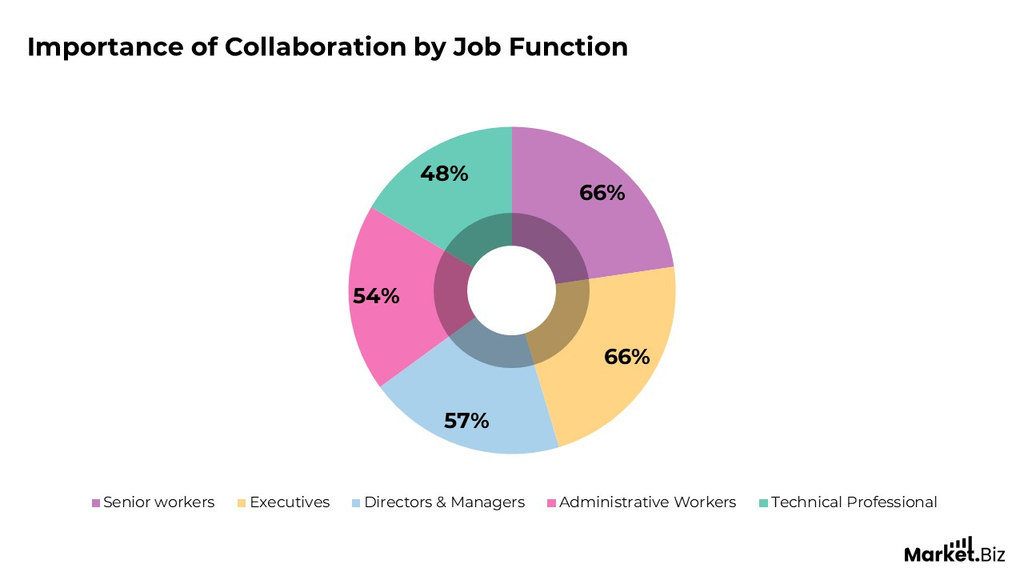
- Collaboration is considered most important by senior workers and executives, with 66% of each highlighting its value in their roles.
- Directors and managers follow at 57%, indicating strong reliance on teamwork for coordination and decision-making.
- Administrative workers report 54%, while technical professionals record the lowest level at 48%.
Workplace Communication Channel Statistics
- Zoom Blog reports that leaders favor instant messaging most (50%), followed by project tools (44%) and meetings (38%).
- Employees show a strong preference for digital communication, with 64% preferring instant messaging and 63% relying on email, while 54% still value in-person meetings.
- 75% of employees use enterprise chat tools to communicate with colleagues.
- For critical internal updates, 67% prefer email or newsletters, 39% prefer in-person meetings, 24% prefer virtual meetings, and 18% prefer chat or instant messaging.
- Email is considered the most effective internal communication channel by 85% of communicators.
- Adoption of video and in-person events is also increasing, reflecting demand for more interactive communication.
- Email (58%) and intranets (67%) remain effective, while collaboration tools and direct supervisor communication each reach 45%.
United States Workplace Collaboration Snapshot
(Reference: gallup.com)
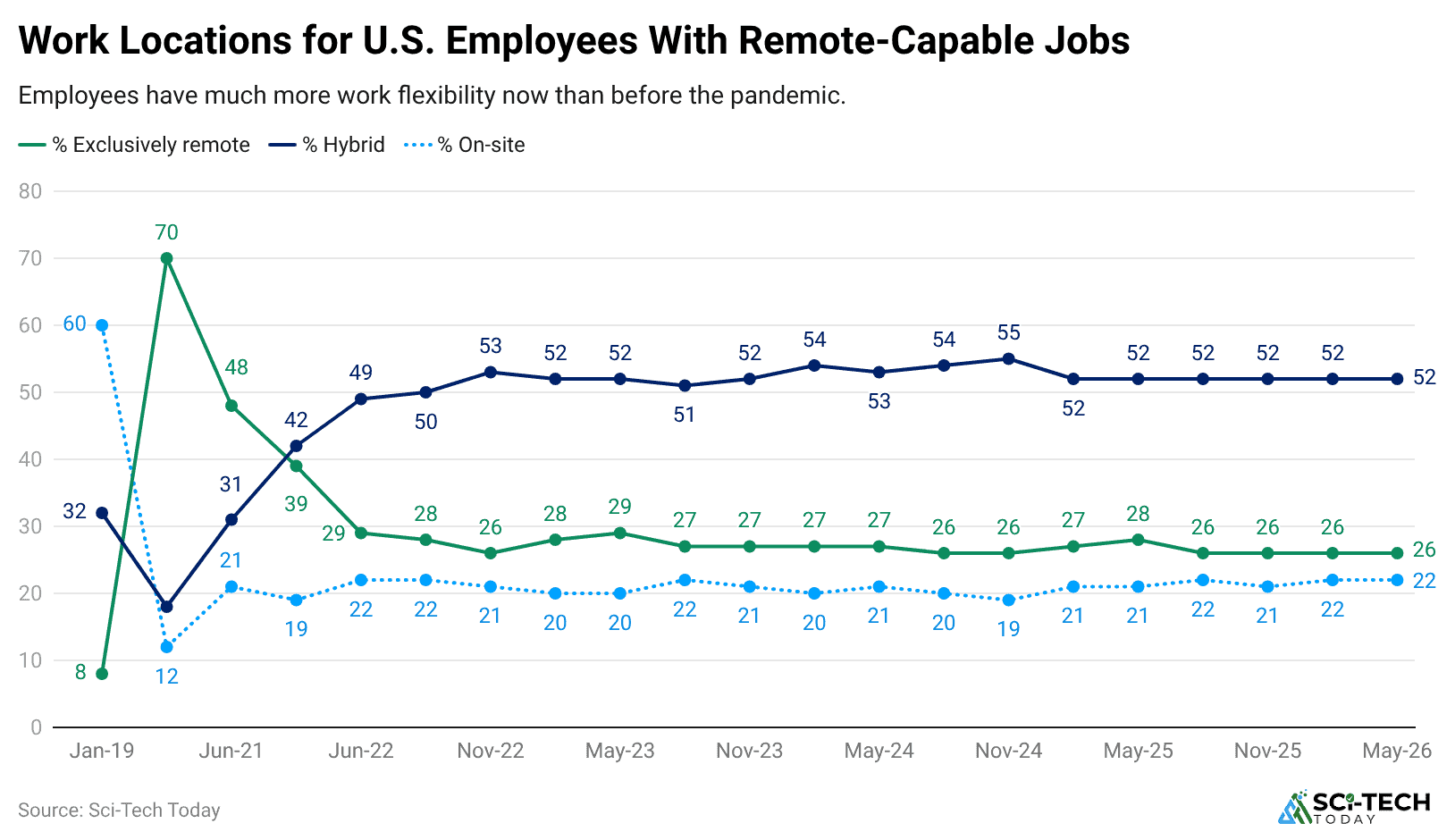
- As of 2026, 52% of remote-capable U.S. employees work in hybrid roles, making hybrid work the most common model.
- 26% work fully remotely, while 22% work fully on-site, showing that many teams now operate across different locations.
- About 78%-79% of remote-capable employees work outside a traditional office at least some of the time, increasing the need for effective digital collaboration.
- A report published by Zoom stated that 52% of employees report stronger team connectedness since adopting hybrid or remote work, although results vary by workplace design.
- According to Chanty, 56% of managers struggle to encourage collaboration in hybrid teams, highlighting gaps in management practices.
- 64% of employees lose at least 3 hours per week due to poor collaboration, including unnecessary meetings and duplicated work.
- 62% of employees say collaboration platforms improve their performance when digital tools fit naturally into their workflows.
- More than one-third of leaders spend at least 1 hour daily resolving collaboration problems, showing the management cost of poor coordination.
Top Workplace Collaboration Tools
- Slack: Messaging and automation; plans start at USD 7.25/user/month, with AI at USD 10/user/month, according to Zapier.
- Microsoft Teams: Chat and meetings; 300+ million monthly users and pricing from USD 6/user/month.
- Zoom Workplace: Meetings; the free tier supports 100 participants for 40 minutes; paid plans start at USD 13.33/user/month.
- Asana: Project management; 10 free members, USD 10.99/user/month, and 300+ integrations.
- monday.com: Flexible workflows from USD 9/user/month.
- Trello: Simple task tracking from USD 5/user/month.
- Notion: Documentation and projects at USD 10/user/month.
- Miro: Whiteboards with 3 free boards, from USD 10/user/month.
- Figma: Design collaboration from USD 16/seat/month.
- Loom: 25 free videos, 5 minutes each; Business costs USD 15/user/month.
- Google Workspace: 15 GB free; plans start at USD 6/user/month.
- ClickUp: All-in-one management with strong AI capabilities.
- Airtable: Compares 20 collaboration tools.
- Fireflies: Unlimited free transcriptions; Pro from USD 10/user/month.
- Clockwise: Scheduling from USD 6.75/user/month.
- MindMeister: 3 free maps; Pro at USD 10.50/month.
- Work section: Project management from USD 3.40/user/month.
Workplace Collaboration Employee Effects
(Reference: enterpriseappstoday.com)
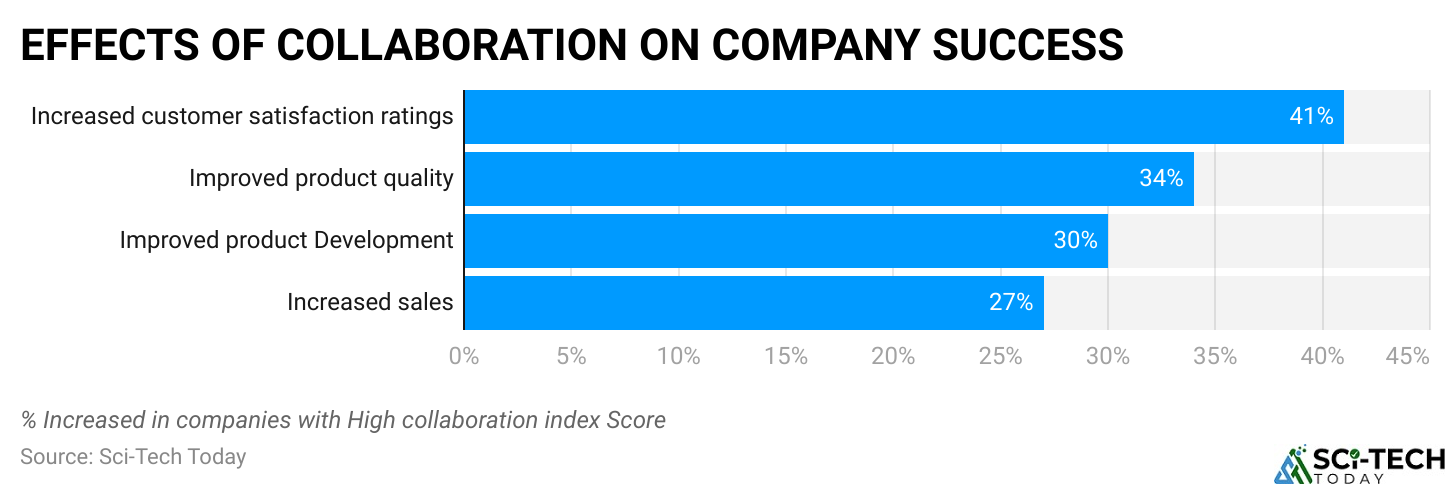
- The first indication concerns measuring a company’s “collaboration index.” This measurement, based on data sourced from Frost & Sullivan, shows that if you increase your company’s collaboration index, your sales could jump by 27%, and your clients’ satisfaction ratings could improve by 41%.
- In addition to that, collaboration heightens the quality of the products 34% of the time, and quicker product delivery is also achieved at 30%.
- Therefore, collaboration, above all, is vital for effective teamwork and its implications on sales growth, customer experiences, and high-quality products, which can be produced much more efficiently.
Workplace Online Collaboration
- Full-time home-employed employees work 48% less time collaborating than their counterparts in an office setting, due mainly to the change in work environments driven by the COVID-19 pandemic.
- Most remote employees spend their time concentrating on solitary tasks.
- Their work time is spent on 62% focusing, 27% collaborating, 6% learning, and 5% socializing.
- Workplace collaboration statistics indicate that 45% of employees across the generations think that collaboration through online social networks improves productivity – 40% of Boomers, 46% of Gen X, and 50% of Millennials see the benefit to workplace productivity in collaboration on social networks.
- Online collaboration tools should also cause distractions, with 41% associated with personal conversations and 39% with new requests interrupting the ongoing tasks and projects of employees.
- Nearly 90% of organizations are equipped to use online collaboration tools solely for internal communication.
- 31% of these use it through Microsoft Teams, 27% through Microsoft Skype for Business, 21% through Google Chat, 15% through Cisco WebEx Teams, and 13% through Zoom.
Workplace Cultural Collaboration
- According to a Microsoft survey, 96 % of decision-makers and 95 % of employees consider communication an integral factor in the success of a workplace.
- This has also emphasized the importance of clear communication, as it would help minimize misunderstandings, maximize success in project delivery, and reduce stress among increasingly connected teams.
- Almost 40 % of Gen Z and millennial employees have reported that the culture of an organization is one of the main determinants of their remaining in their jobs, making it very important for organizations to create an appropriate culture that can retain younger employees who value cultural fit very highly.
- Lack of communication then becomes a major cause of stress, with 80 % of employees experiencing stress due to imprecise guidelines.
- Further, 46 % spend 40 minutes on misunderstandings every day. That is what informs the need for clear, systematic communication to enhance productivity while relieving anxiety.
- Research has identified five specific characteristics of high-performing teams: strong members, collaborative problem-solving relationships, solid contacts, effective leadership, and a supportive organizational culture.
- However, only 20 % of executives believe their teams are high-performing. Talking about these characteristics will improve the team and achieve results. Diversity and alignment are also keys to team success.
- According to Workplace collaboration statistics, diverse teams perform 12 % better because different perspectives drive innovation.
- Likewise, McKinsey found that teams with a common vision are 1.9 times more likely to exceed financial goals than their counterparts. Such results further underline the value of diversity and alignment for achieving organizational goals.
By Employee Get to Gather
(Reference: fitsmallbusiness.com)
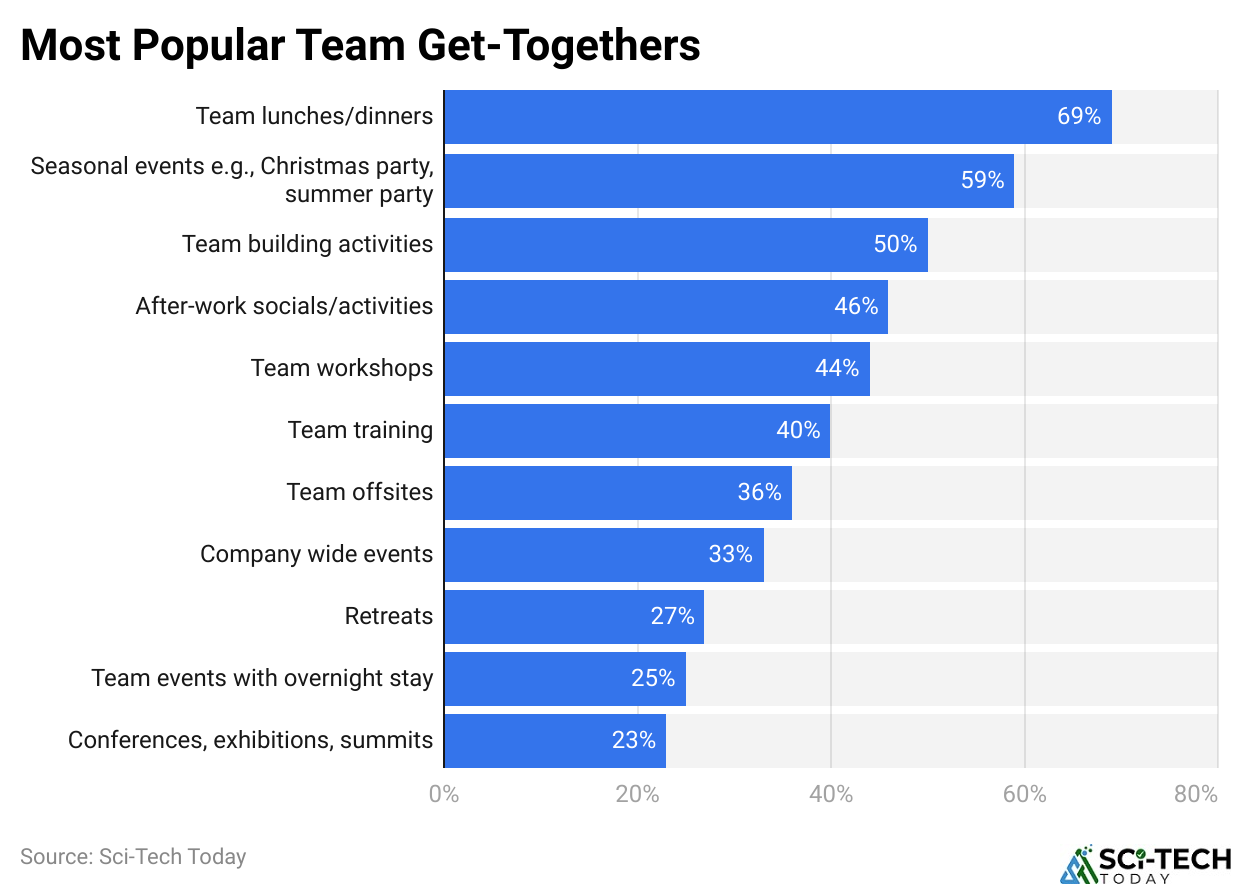
- Workplace collaboration statistics reveal that of the 69% of people who associate teamwork with team lunches or dinners, a significant %age falls with those organizing seasonal celebrations (59%) like Christmas or summer parties. One-half of the surveys planned team activities, while 46% organized off-site social activities.
- Almost 80% of mail is to organize and track attendance for such events. Of those, 58% used the Outlook Calendar, while 43% used Microsoft Excel for their plans.
Employee Views on Workplace Collaboration
- 70% of employees say collaboration creates a more engaging and satisfying workplace.
- 68% believe working with colleagues improves productivity and makes work more efficient.
- 63% feel more connected to their teams when collaboration is encouraged.
- 74% say teamwork helps them solve problems faster by bringing different perspectives together.
- 59% believe collaboration boosts creativity and generates new ideas.
- 82% say collaboration tools improve communication and reduce misunderstandings.
- 77% report higher workplace satisfaction in collaborative environments.
- 65% say teamwork helps build trust and encourages open communication.
- 60% believe collaboration helps them learn new skills and share knowledge.
- 71% feel more motivated when working toward goals as a team.
- 52% of workers consider teamwork essential, rising to 66% among senior executives, 57% among managers, 54% among administrative staff, and 48% among technical and professional employees.
Technology and Workplace Collaboration Statistics
- 93% of employers and 90% of employees consider collaboration tools essential for hybrid work.
- 42% of leaders plan to invest in project-management tools, while 55% plan to invest in digital whiteboards.
- Knowledge workers use 8.8 workplace apps on average, while directors use about 10 apps.
- Communication problems affect 54% of users who use over 10 apps, compared with 34% of those who use fewer than 5.
- Employees spend about 20 hours weekly on digital communication, with 75% using enterprise chat tools.
- Employees prefer instant messaging (64%), email (63%), and in-person meetings (54%) for workplace communication.
- Leaders favor instant messaging (50%), project-management tools (44%), and in-person meetings (38%).
- Project-management tools improve efficiency for 76% of users and communication for 73% of users.
- 72% of meetings are considered ineffective, while knowledge workers spend 60% of their time on work about work.
- Microsoft reports that 49% of Copilot conversations support cognitive work, while 66% of AI users gain more time for high-value work.
Benefits of Workplace Collaboration
- According to market.biz, Effective collaboration makes teams 5 times more productive and improves problem-solving.
- Diverse teamwork can increase creativity and innovation by 33%, while strong collaboration makes quality decisions 2.5 times more likely.
- 86% of employees and executives blame poor communication for workplace failures.
- Collaboration can raise employee engagement by 17%, knowledge sharing by 35%, and team cohesion by 20%.
- 70% of employees report higher job satisfaction, while collaborative companies achieve 15% higher retention.
- 60% of workers learn more through teamwork, and customer satisfaction can improve by 40%.
- Sharing responsibilities can reduce workloads by 25%, stress by 30%, and project completion times by 20%.
- Collaborative teams are 50% more adaptable, while companies can achieve up to 21% higher profitability.
- 78% of employees feel more connected to their company’s mission, while collaboration can reduce project errors and rework costs by up to 25%.
Workplace Communication Challenges
- 54% of employees using more than 10 apps report communication problems, compared with 34% using fewer than five.
- 83% of leaders and 77% of employees say finding time on colleagues’ calendars is a major collaboration barrier.
- 82% of leaders and 81% of employees struggle when colleagues do not respond quickly enough.
- 82% of leaders and 72% of employees lack enough time between meetings or chats to complete their work.
- 68% of people have wasted time because of communication problems, while 53% have missed messages.
- 75% of business leaders say companies underestimate the cost of poor communication.
- 20% of business leaders have lost business because of communication issues. Among them, 86% estimate losses of at least USD 10,000, while 22% estimate losses of USD 50,000 or more.
Summary
Good workplace collaboration helps teams work better, solve problems faster, and reach common goals. Clear communication, trust, shared responsibilities, and the right tools make teamwork easier and more effective. It also helps employees share ideas, support each other, and stay connected.
As workplaces continue to change, strong collaboration will remain important for improving productivity and creating a positive work environment. Companies that build a collaborative culture can help both employees and the business grow together.
FAQ
Workplace collaboration improves communication, boosts productivity, encourages innovation, and helps teams solve problems more effectively.
The most common types include team, cross-departmental, project-based, remote, and external collaboration.
Technology helps teams communicate, share files, manage projects, and collaborate from anywhere.