









Introduction
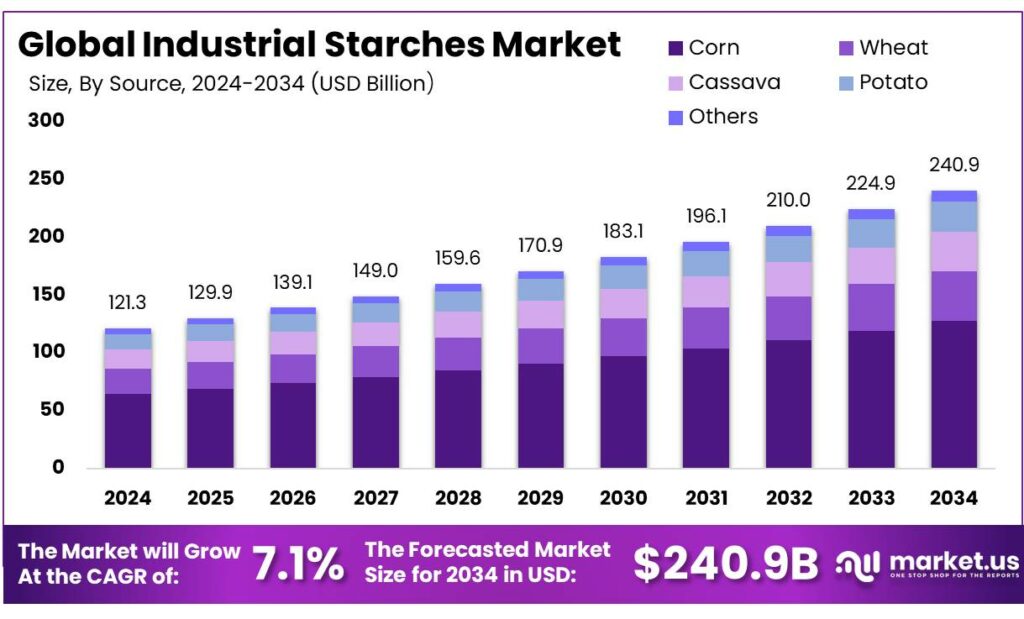
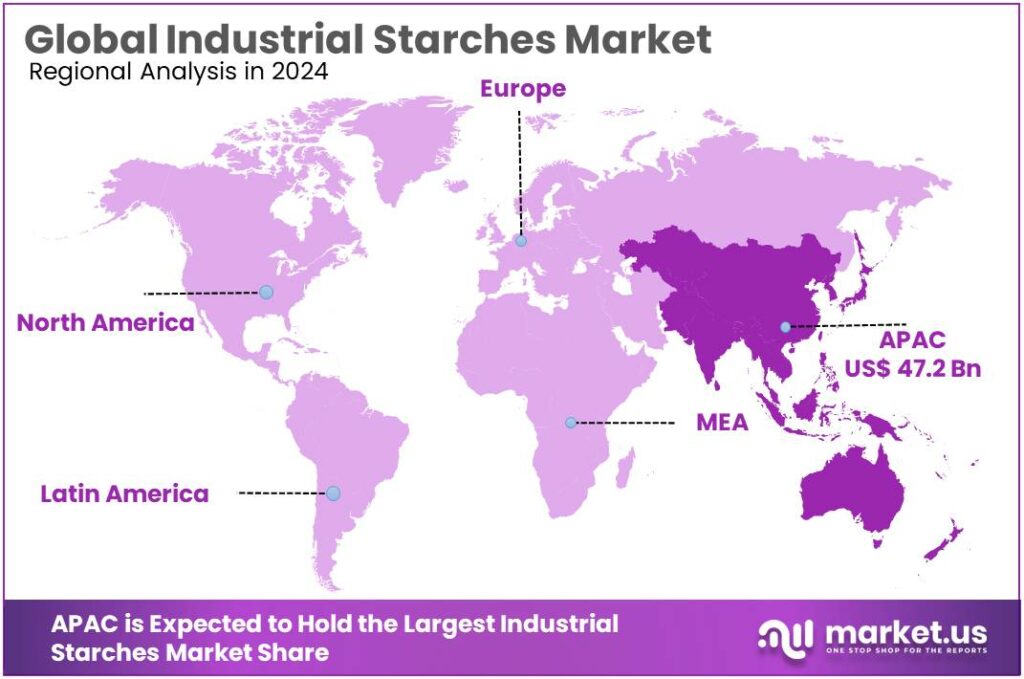
The global industrial starches market is projected to reach USD 240.9 billion by 2034, rising from USD 121.3 billion in 2024, at a CAGR of 7.1% from 2025 to 2034. In 2024, Asia Pacific led the market, accounting for over 39.9% share, with revenue of USD 47.2 billion.
Industrial starches are plant-derived carbohydrates sourced mainly from maize, wheat, potato, and cassava. These starches are processed into native and modified forms to provide essential functions such as binding, thickening, film formation, and adhesion across food and non-food applications. Strong global crop production supports this supply chain, with maize production reaching nearly 1.2 billion tonnes in 2023.
Get a comprehensive report summary that describes the value and forecast along with methodology. Download the PDF brochure
Demand for industrial starch is closely linked to the expansion of global food, feed, and manufacturing industries. Rising cereal utilization and international grain trade continue to strengthen raw material availability, while cassava remains a major starch source in Asia, Africa, and Latin America, supported by global production of around 315 million tonnes.
Growth is also being driven by the shift toward biofuels, sustainable materials, and industrial processing needs. In the U.S., large-scale corn use for food, seed, industrial applications, and ethanol production continues to influence starch economics. Similarly, India’s ethanol blending program, which reached 17.98% in 2024–25, is boosting demand for starch-rich feedstocks.
Government policies are further accelerating market expansion. India’s strong push toward its 20% ethanol blending target by 2025–26, along with the creation of new milling and fermentation capacities, is supporting long-term starch demand. These initiatives are also encouraging procurement stability, product diversification, and investments in starch derivatives across multiple industries.
Top Market Takeaways
- Industrial Starches Market size is expected to be worth around USD 240.9 Billion by 2034, from USD 121.3 Billion in 2024, growing at a CAGR of 7.1%.
- Corn held a dominant market position, capturing more than a 53.2% share in the industrial starches market.
- Modified held a dominant market position, capturing more than a 69.1% share in the industrial starches market.
- Starch Derivatives & Sweeteners held a dominant market position, capturing more than a 36.3% share in the industrial starches market.
- Food & Beverage held a dominant market position, capturing more than a 66.8% share in the industrial starches market.
- Asia Pacific emerged as the dominating region in the industrial starches market, holding a 39.9% share valued at USD 47.2 Bn.
Scope and Research Methodology
The report on the industrial starches market covers a wide range of products made from crops like maize, wheat, potato, and cassava. It looks at both native starches and modified starches used in industries such as food and beverages, paper, textiles, pharmaceuticals, and biofuels.
The study includes analysis of market size, growth trends, key drivers, challenges, and opportunities. It also examines different applications, end-use industries, and regional markets such as Asia Pacific, North America, Europe, and others. The report focuses on both current market conditions and future growth potential up to 2034.
The research is based on a mix of primary and secondary data sources. Primary research includes interviews and discussions with industry experts, manufacturers, suppliers, and distributors to understand real market conditions.
Secondary research involves collecting data from reliable sources such as government reports, industry publications, company reports, and international organizations. This helps in understanding production levels, trade flows, and policy impacts.
By Source Analysis
In 2024, corn-based starch remained the leading source in the industrial starches market, accounting for more than 53.2% of the total share. Its dominance is mainly supported by the easy availability of corn and its broad use across multiple industries. Corn starch can be processed into different grades suitable for food, paper, textiles, and adhesive applications. Its reliable quality, smooth processing, and suitability for large-scale manufacturing make it the most preferred raw material source.
By Type Analysis
In 2024, modified starch held the largest share in the market by type, contributing over 69.1%. This strong position comes from its enhanced functional properties compared to native starch, including better stability, improved viscosity control, and stronger resistance to heat and processing stress. Because of these advantages, industries such as food processing, textiles, paper, and adhesives continue to prefer modified starch for consistent production performance.
By Product Analysis
In 2024, starch derivatives and sweeteners led the market by product, capturing more than 36.3% share. This segment remains strong because of its wide versatility across food, beverage, pharmaceutical, and industrial uses. Products such as syrups, maltodextrin, and specialty starch derivatives help improve sweetness, texture, stability, and shelf life. Their broad functionality keeps demand high across many manufacturing sectors.
By Application Analysis
In 2024, the food and beverage segment dominated the industrial starches market by application, holding over 66.8% share. This leadership is driven by the daily use of starches in common food products including bakery items, dairy products, sauces, soups, snacks, and beverages. Industrial starches play an important role as thickeners, stabilizers, binders, and sweeteners, helping manufacturers maintain consistent taste and texture in mass production.
Regional Analysis: Asia Pacific
In 2024, Asia Pacific led the industrial starches market, accounting for 39.9% of the global share, with a market value of USD 47.2 billion. The region’s strong position is mainly driven by its large population, growing food processing industry, and easy availability of agricultural raw materials. Many countries in Asia Pacific are both major producers and consumers of starch-based products used in food, beverages, paper, textiles, and other industrial sectors. The regular use of starch in daily diets, along with rising demand for processed and packaged foods, continues to support strong market growth.
Another major advantage for the region is its well-established raw material supply network. Asia Pacific has abundant production of corn, rice, cassava, and wheat, which enables starch manufacturers to operate at large scale and at competitive costs. This strong agricultural base helps ensure a stable supply for both domestic markets and export industries. In addition, rapid urbanization and changing consumer lifestyles across key economies are increasing demand for convenience foods, where starch is widely used to improve texture, stability, and shelf life.
Key Regions and Countries
- North America
- The US
- Canada
- Europe
- Germany
- France
- The UK
- Spain
- Italy
- Russia & CIS
- Rest of Europe
- APAC
- China
- India
- Japan
- South Korea
- ASEAN
- Rest of APAC
- Latin America
- Brazil
- Mexico
- Rest of Latin America
- Middle East & Africa
- GCC
- South Africa
- Rest of Middle East & Africa
Top Key Players
- Cargill, Incorporated
- Archer Daniels Midland Company
- Ingredion Incorporated
- Tate & Lyle PLC
- AGRANA Beteiligungs-AG
- Grain Processing Corporation
- Roquette Frères
- Tereos Group
- Royal Cosun
- Altia Industrial
Recent Developments
In 2024, Cargill generated approximately USD 160 billion in revenue and employed more than 160,000 people worldwide, highlighting its strong global presence in agricultural commodities, food ingredients, and industrial supply chains. Its large operational scale continues to support its important role in starch, sweeteners, and other value-added ingredient markets.
In the same year, ADM reported USD 85.5 billion in revenue along with USD 1.8 billion in net earnings. With a workforce of over 44,000 employees and a network of more than 270 processing plants worldwide, the company maintained a strong position in carbohydrate solutions, including starches, sweeteners, and other industrial ingredient products.
Report Scope
| Report Features | Description |
|---|---|
| Market Value (2024) | USD 121.3 Bn |
| Forecast Revenue (2034) | USD 240.9 Bn |
| CAGR (2025-2034) | 7.1% |
| Base Year for Estimation | 2024 |
| Historic Period | 2020-2023 |
| Forecast Period | 2025-2034 |
| Report Coverage | Revenue Forecast, Market Dynamics, Competitive Landscape, Recent Developments |
| Segments Covered | By Source (Corn, Wheat, Cassava, Potato, Others), By Type (Native, Modified), By Product (Native Starch and Starch Derivatives And Sweeteners, Cationic Starch, Ethylated Starch, Oxidized Starch, Acid Modified Starch, Unmodified Starch), By Application (Food And Beverage, Pharmaceuticals, Others) |
| Regional Analysis | North America – US, Canada; Europe – Germany, France, The UK, Spain, Italy, Rest of Europe; Asia Pacific – China, Japan, South Korea, India, Australia, Singapore, Rest of APAC; Latin America – Brazil, Mexico, Rest of Latin America; Middle East & Africa – GCC, South Africa, Rest of MEA |
| Competitive Landscape | Cargill, Incorporated, Archer Daniels Midland Company, Ingredion Incorporated, Tate & Lyle PLC, AGRANA Beteiligungs-AG, Grain Processing Corporation, Roquette Frères, Tereos Group, Royal Cosun, Altia Industrial |
| Customization Scope | Customization for segments, region/country-level will be provided. Moreover, additional customization can be done based on the requirements. |