








Xanadu Quantum Technologies (NASDAQ/TSX: XNDU) reported Q1 2026 revenue of $2.8 million, up sharply year over year but below elevated market hopes, with EPS of roughly –$0.28 on a $20.6 million net loss and the stock falling about 4.6% in after-hours trading following the release.
About Xanadu Quantum Technologies
Xanadu Quantum Technologies Ltd. is a photonic quantum computing company listed on Nasdaq and the Toronto Stock Exchange under the ticker XNDU. Headquartered in Toronto, Canada, Xanadu was founded in 2016 with a mission to build useful and scalable quantum computers using light-based (photonic) architectures and a full-stack approach spanning hardware, software, and cloud-accessible systems.
The company operates the open-source PennyLane software platform, which has attracted more than 35,000 active users as of early 2026, supporting algorithm development for quantum machine learning, chemistry, and optimization.
As of May 2026, Xanadu’s market cap is estimated around $4.7–5.0 billion, placing it among the more highly valued pure-play quantum computing names despite being in a heavy investment and loss-making phase. The shares currently trade with a premium growth profile, and the business employs several hundred staff focused on R&D, engineering, and commercialization.
Top Financial Highlights
- Total revenue grew more than 300% year over year to $2.8 million in Q1 2026, compared with $0.7 million in Q1 2025, driven by government contracts and early commercial engagements.
- Net loss widened to $20.6 million from $12.2 million a year earlier as the company increased R&D and G&A spending to scale its photonic quantum platform.
- Basic and diluted net loss per share was approximately -$0.28, based on a weighted average of 72.5 million shares outstanding in Q1 2026.
- Adjusted EBITDA loss increased to $13.9 million from $10.6 million in Q1 2025, reflecting higher operating investment during the company’s growth phase.
- Gross margin was not explicitly disclosed in the summary, but management emphasized that current revenue still comes from a small base relative to the size of ongoing R&D and infrastructure investments.
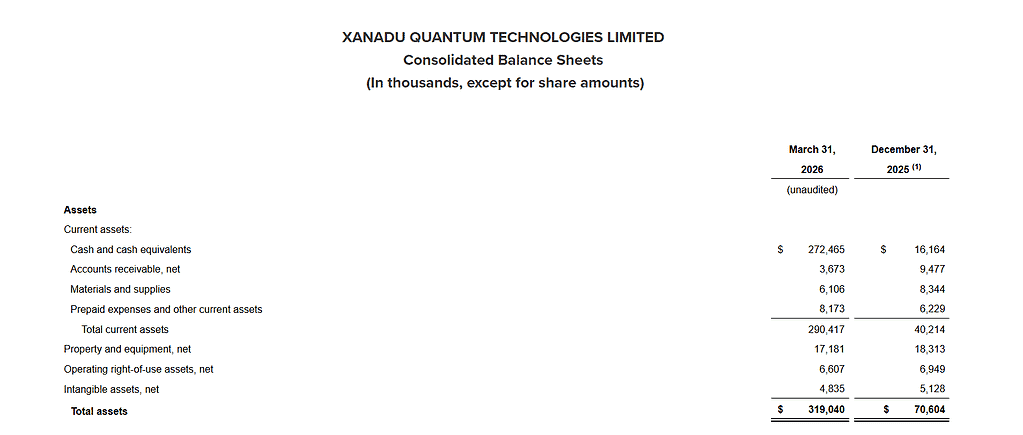
- Operating expenses rose significantly, with total liabilities at $57.1 million and total assets at $319.0 million as of March 31, 2026.
- Cash and cash equivalents stood at a robust $272.5 million at quarter end, providing substantial runway for continued technology development and commercialization.
- The quarter included completion of the business combination with Crane Harbor Acquisition Corp., resulting in Xanadu becoming a publicly listed entity on both Nasdaq and TSX.
- The company entered negotiations for up to roughly $285 million (US) in potential funding from the governments of Canada and Ontario to support domestic quantum manufacturing and R&D.
Beat or Miss?
| Metric | Reported | Estimated / Expected | Difference / Analysis |
| Revenue | $2.8M | N/A (early coverage focused on growth, not a formal consensus) | Strong >300% YoY growth but from a small base; no clear consensus to benchmark a beat or miss. |
| EPS (Basic & Diluted) | ($0.28) | N/A | Loss widened vs. prior year; still in heavy investment phase with limited street EPS focus. |
| Net Loss | -$20.6M | N/A | Loss increased as operating expenses scaled with R&D and G&A. |
| Adjusted EBITDA | -$13.9M | N/A | Larger negative adjusted EBITDA aligns with management’s investment narrative. |
| Cash & Equivalents | $272.5M | N/A | Strong liquidity; supplemented by potential government funding discussions. |
What Leadership Is Saying?
“Our first quarter as a public company underscores both the potential and the investment profile of photonic quantum computing. Revenue more than tripled year over year to $2.8 million as customers and partners deepen their engagement with our systems and PennyLane software, yet the bulk of our effort is still focused on advancing the roadmap. With over $270 million in cash, we are positioned to continue investing in hardware, software, and talent so that Xanadu can deliver fault-tolerant photonic quantum computers capable of solving classically intractable problems for our customers.”
– Xanadu CEO, on strategy and vision
“From a financial standpoint, Q1 2026 reflects the realities of our growth phase. The net loss of $20.6 million and Adjusted EBITDA loss of $13.9 million are the result of deliberate increases in research and development and general and administrative expenses as we scale our platform. With $272.5 million of cash and cash equivalents and ongoing discussions for up to $285 million in potential government funding, we believe we have the balance sheet strength to support our multi-year investment cycle while continuing to grow revenue from a fast-expanding base.”
– Xanadu CFO, on financials and margins
Historical Performance
| Category | Q1 2026 | Q1 2025 | Change (%) |
| Revenue | $2.8M | $0.7M | +300% (approximately 4× growth) |
| Net Loss | -$20.6M | -$12.2M | ~+69% larger loss as spending scaled |
| Adjusted EBITDA | -$13.9M | -$10.6M | ~+31% larger negative Adjusted EBITDA |
| Cash & Equivalents | $272.5M | N/A | Not directly comparable; liquidity now sized for public-company roadmap |
Key Quantum Computing Competitors
| Category | Xanadu Q1 2026 | IonQ Q1 2026 | Rigetti Q1 2026 | Commentary |
| Revenue | $2.8M | $64.7M | $4.4M | IonQ has reached a different scale; Rigetti sits between Xanadu and IonQ. |
| Net Income / Loss | -$20.6M net loss | $804.6M net income (driven by non-cash warrant gains) | GAAP net income of $33.1M boosted by fair-value gains; non-GAAP net loss $14.7M | Headline profitability at IonQ and Rigetti is largely accounting-driven. |
| Operating Expenses | Not fully detailed; driven by R&D and G&A | $336.2M operating expenses | Operating loss $26.0M on higher spend | All three peers carry heavy operating cost structures. |
| Revenue YoY Change | From $0.7M to $2.8M (~+300%) | From $7.6M to $64.7M (+751%) | Revenue “jumps” to $4.4M; beat expectations modestly | Sector-wide, top-line growth is very high off small bases. |
How the Market Reacted?
Following the Q1 2026 earnings release, Xanadu’s U.S.-listed shares closed regular trading at about $15.13 before slipping to approximately $14.44 in after-hours trading, a decline of roughly 4.6%. The reaction suggests investors welcomed the more than 300% revenue growth but remained cautious about widening losses and the magnitude of ongoing R&D and operating spend.
With a market cap around $4.7–5.0 billion, the stock still prices in significant expectations for future commercial scale and technical lead, so results that emphasize long-term investment over near-term profitability can generate volatile short-term moves. Overall, sentiment around the quarter appears constructive but risk-aware, with the strong balance sheet and government funding discussions balancing concerns about the path to sustainable earnings.

Sources