









Quick Verdict
Scholastic Corporation Q1 Fiscal 2027 Earnings results showed Scholastic reported a GAAP diluted loss of $3.77 per share and an adjusted loss of $3.63 per share on Q1 fiscal 2027 revenue of $216.8 million, missing consensus revenue and EPS expectations. Shares fell about 12.7% after hours following the September 24 release, despite reaffirmed full-year guidance.
About Scholastic Corporation
Scholastic Corporation (NASDAQ: SCHL) is a New York-headquartered children’s publishing, education and media company founded in 1920. It produces and distributes children’s books, operates school-based Book Clubs and Book Fairs, supplies literacy and classroom-learning materials, and develops entertainment content based on its intellectual property. The company describes itself as the world’s largest publisher and distributor of children’s books, with operations and reach across more than 135 countries.
At the latest available market-data snapshot following the release, Scholastic had a market capitalization of roughly $640.6 million, a P/E ratio of approximately 24.0x, and a dividend yield of around 2.53%. These figures can change with the share price and should be treated as market snapshots rather than company-reported metrics.
The fiscal first quarter is seasonally small for Scholastic because school-based sales activity is generally limited during the summer. Management emphasized early back-to-school indicators, including Book Fair bookings ahead of the prior year, while acknowledging pressure on Education spending at schools and districts.
Top Financial Highlights
- Total revenue declined 4% year over year to $216.8 million, from $225.6 million in Q1 fiscal 2026.
- GAAP net loss was $71.2 million, essentially flat versus a $71.1 million loss a year earlier.
- GAAP diluted loss per share widened to $3.77, from $2.83 in the prior-year quarter.
- Adjusted diluted loss per share was $3.63, versus an adjusted loss of $2.52 in Q1 fiscal 2026.
- Operating loss was $92.2 million, unchanged from the year-earlier period.
- Adjusted operating loss widened 8% to $88.7 million, from $81.9 million.
- Adjusted EBITDA was a loss of $63.6 million, compared with a $55.7 million loss a year earlier; on a sale-leaseback-adjusted comparable basis, the EBITDA loss improved by $0.6 million.
- Children’s Book Publishing and Distribution revenue declined 3% to $105.8 million. Within this segment, Book Fairs generated $33.2 million, Book Clubs generated $2.1 million, and Consolidated Trade contributed $70.5 million.
- Education revenue fell 24% to $30.4 million, reflecting pressure on school and district funding and spending on supplemental curriculum materials.
- Entertainment revenue increased 48% to $20.1 million, led by higher production revenue.
- International revenue rose 2% to $60.5 million; excluding favorable foreign-exchange effects of $1.2 million, revenue was roughly flat year over year.
- Gross profit was $98.7 million, calculated from revenue of $216.8 million less cost of goods sold of $118.1 million, implying a gross margin of approximately 45.5%. This compares with an estimated 45.3% in the prior-year quarter.
- Operating cash flow was negative $94.6 million, compared with negative $81.8 million in Q1 fiscal 2026.
- Free cash flow use was $110.8 million, compared with $100.2 million a year earlier.
- Cash and cash equivalents totaled $106.8 million as of August 31, 2026. The company reported $184.8 million in lines of credit and long-term debt and net debt of $86.8 million.
- Scholastic returned about $29.6 million to shareholders: $25.8 million through the repurchase of 630,850 shares and $3.8 million in dividends. It retained $157.4 million of repurchase authorization.
- Management reaffirmed fiscal 2027 guidance for revenue growth of approximately 2% to 4%, adjusted EBITDA of $135 million to $145 million, and free cash flow of $35 million to $40 million.
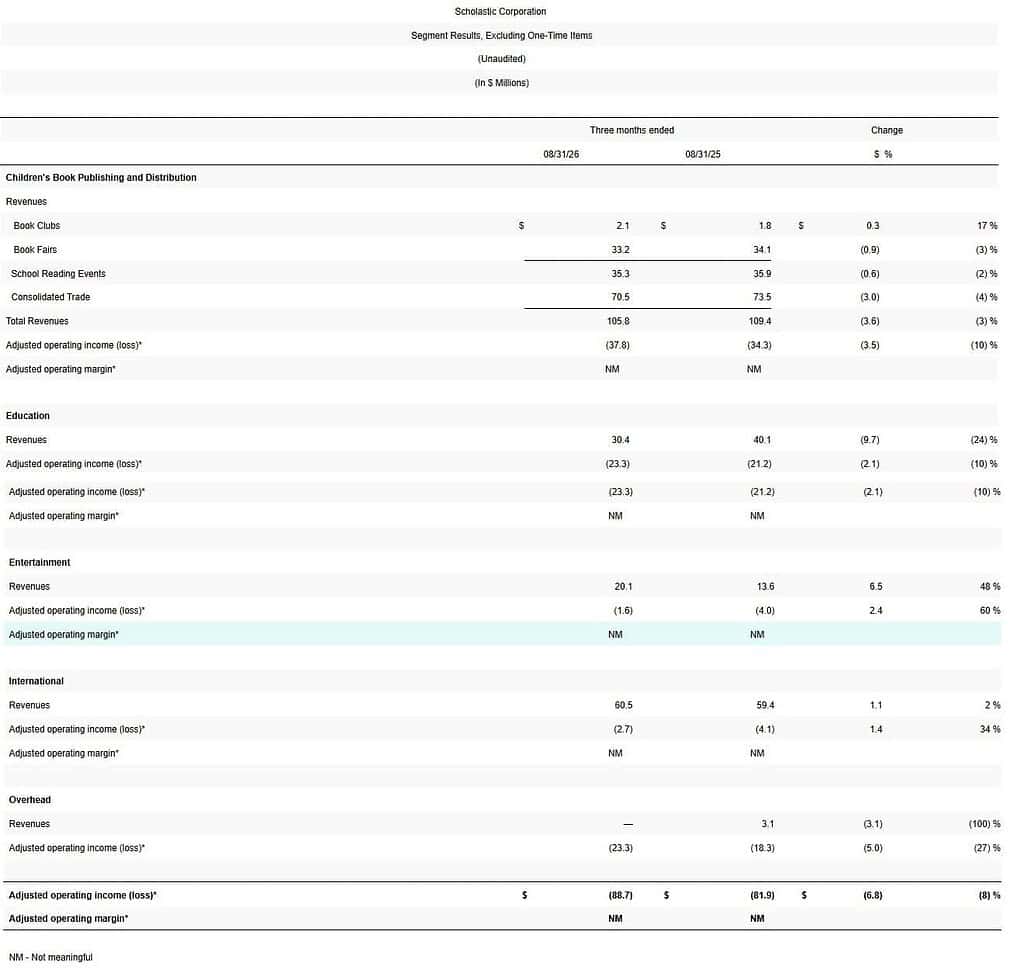
Scholastic Corporation Segment Results, Excluding One-Time Items
(Source: investor.scholastic.com)
- The Children’s Book Publishing and Distribution segment generated $105.8 million in revenue, down from $109.4 million, representing a 3% decline. Book Clubs increased 17% to $2.1 million, while Book Fairs and School Reading Events declined 3% and 2%, respectively. The segment’s adjusted operating loss widened to $37.8 million from $34.3 million.
- The Education segment recorded revenue of $30.4 million, compared with $40.1 million a year earlier, reflecting a 24% decline. Its adjusted operating loss increased to $23.3 million from $21.2 million, indicating continued pressure on segment profitability during the period.
- In contrast, the Entertainment segment showed strong improvement. Revenue increased to $20.1 million from $13.6 million, representing a 48% increase. Its adjusted operating loss narrowed substantially from $4.0 million to $1.6 million, with the improvement in operating performance reaching 60%.
- The International segment delivered relatively stable revenue performance, increasing 2% to $60.5 million from $59.4 million. Adjusted operating loss improved from $4.1 million to $2.7 million, representing a 34% improvement in the reported change.
- Overall, Scholastic’s combined adjusted operating loss increased to $88.7 million, compared with $81.9 million in the prior-year period, representing an 8% deterioration. The results show that stronger performance in Entertainment and International was not sufficient to offset revenue declines and higher operating losses in the Children’s Book Publishing and Education segments.
Beat or Miss?
Scholastic missed the available consensus expectations on both adjusted earnings and revenue. Its adjusted loss of $3.63 per share was $0.21 worse than the estimated $3.42 loss per share, while revenue fell approximately $7.9 million below the $224.69 million consensus forecast.
| Metric | Reported | Difference/Analysis |
| Adjusted diluted EPS | ($3.63) | Consensus loss was $(3.42); miss of $0.21 per share |
| Revenue | $216.8 million | Consensus was $224.69 million; miss of approximately $7.89 million |
| GAAP diluted EPS | ($3.77) | Down from a $(2.83) loss in Q1 fiscal 2026; consensus comparison not provided for GAAP EPS |
| Adjusted EBITDA | $(63.6 million) | Below the prior-year loss of $(55.7 million), but improved by $0.6 million on a sale-leaseback comparable basis |
| Fiscal 2027 revenue outlook | 2%–4% growth | Reaffirmed; management did not lower full-year guidance |
| Fiscal 2027 adjusted EBITDA outlook | $135–$145 million | Reaffirmed; implies confidence in stronger performance in seasonally more important quarters |
The main weakness came from Education, where revenue dropped $9.7 million year over year, and from lower Children’s Book Publishing and Distribution revenue. Higher Entertainment revenue only partly mitigated those declines.
What Leadership Is Saying
“Scholastic continued to advance its fiscal 2027 priorities during the seasonally small first quarter, with strong early indicators across our businesses reinforcing our confidence entering the important back-to-school and fall season.”
— Peter Warwick, President and Chief Executive Officer
“In Education, though increased pressure on school and district budgets impacted sales, we continued to make progress aligning the cost structure and advancing the business’s transformation to support improved performance and long-term growth.”
— Peter Warwick, President and Chief Executive Officer
Historical Performance
| Category | Q1 Fiscal 2027 | Q1 Fiscal 2026 | Change (%) |
| Revenue | $216.8 million | $225.6 million | -4% |
| Net income (loss) | $(71.2 million) | $(71.1 million) | (0.1%) — loss modestly widened |
| Operating expenses | $309.0 million | $317.8 million | -2.80% |
| Operating loss | $(92.2 million) | $(92.2 million) | 0.00% |
| GAAP diluted EPS | ($3.77) | ($2.83) | (33%) — loss per share widened |
| Adjusted operating loss | $(88.7 million) | $(81.9 million) | -8% |
| Operating cash flow | $(94.6 million) | $(81.8 million) | (16%) — higher cash use |
| Free cash flow use | $(110.8 million) | $(100.2 million) | (11%) — higher cash use |
Although total operating expenses declined, the company’s operating loss remained unchanged because revenue fell by $8.8 million. The larger loss per share was also affected by a lower diluted weighted-average share count: 19.589 million shares in Q1 fiscal 2027 versus 25.410 million a year earlier.
Segment Performance
The requested “competitor” comparison cannot be prepared from the company’s earnings release because it does not disclose current-quarter financials for peer companies. A meaningful competitor table would require choosing a peer group with comparable reporting periods and business mix. The following table therefore compares Scholastic’s own principal operating segments year over year, which is the directly available and decision-useful operating comparison.
| Category | Q1 Fiscal 2027 | Q1 Fiscal 2026 | Change (%) |
| Children’s Book Publishing & Distribution revenue | $105.8 million | $109.4 million | -3% |
| Education revenue | $30.4 million | $40.1 million | -24% |
| Entertainment revenue | $20.1 million | $13.6 million | 48% |
| International revenue | $60.5 million | $59.4 million | 2% |
| Children’s Books adjusted operating loss | $(37.8 million) | $(34.3 million) | -10% |
| Education adjusted operating loss | $(23.3 million) | $(21.2 million) | -10% |
| Entertainment adjusted operating loss | $(1.6 million) | $(4.0 million) | 60% improvement |
| International adjusted operating loss | $(2.7 million) | $(4.1 million) | 34% improvement |
How the Market Reacted?
The immediate investor response was negative. Shares fell approximately 12.7% in after-hours trading to $30.41 after Scholastic reported both an adjusted EPS miss and a revenue miss. Subsequent reporting indicated the stock declined nearly 7% in the regular session following the announcement, underscoring market concern over the weaker Education business, a wider adjusted loss, and heavier cash use.
The central offset was guidance: management maintained its fiscal 2027 targets, signaling confidence that back-to-school activity, Book Fair momentum, content and franchise releases, and Entertainment growth could improve results through the remainder of the year.