









Introduction
Customer Experience Management Statistics: CXM has solidified its position as the single greatest competitive differentiator in the modern marketplace. It represents a change from simply managing transactions to intentionally designing, measuring, and optimizing every interaction a customer has with a brand.
A robust Customer Experience Management (CXM) strategy centers on achieving consistency, deep personalization, and effortless problem resolution across all channels and touchpoints. It requires organizational alignment, a commitment to good decision-making, and fostering a culture where every employee understands their role in the customer journey.
I’d like to explain customer experience management in this article to give you all the necessary details. Let’s get started.
Editor’s Choice
- The Global Customer Experience Management (CXM) Market, segmented by analytical tools, was valued at USD 18.8 billion in 2025 and is projected to reach USD 24.9 billion in 2026.
- Around 34% of Gen Z and 35% of millennials want round-the-clock customer support.
- Companies that prioritize customer experience achieve an 80% increase in revenue.
- Traditional customer surveys are becoming less effective, with response rates declining from 30% to 18% within approximately six months.
- Around 49% of customers who left a brand they had previously been loyal to did so due to a poor customer experience (CX).
- CX Leaders achieved a cumulative stock return of 307.3%.
- The global AI customer service market is projected to reach USD 15.12 billion in 2026.
- Email remains the most widely used customer service channel, with 95% of service teams and 98% of customers relying on it for communication.
- Salesforce deploys its Agentforce AI platform across more than 18,000 companies worldwide, generating over USD 100 million in annualized cost savings.
- The most striking perception gap in 2026 is that 66% of CX practitioners believe their company improved customer experience, yet only 17% of consumers agree
Key Customer Experience (CX) Trends Reshaping Customer Experience Management in 2026
- According to getperspective.ai, traditional customer surveys are becoming less effective, with response rates declining from 30% to 18% within approximately six months.
- Organizations are increasingly adopting conversational Voice of Customer programs, with AI-powered voice interactions growing from 6% to 19% of inbound customer service volume.
- Businesses are using AI and natural language processing to automatically analyze large volumes of unstructured customer feedback instead of relying on manual tagging.
- Continuous feedback programs are replacing periodic reviews, with 73% of B2B SaaS companies operating real-time closed-loop feedback systems.
- AI-driven interviews are significantly reducing costs, with average AI-assisted resolutions costing USD 0.62 compared with USD 7.40 for human-assisted interactions.
- Companies are prioritizing unified customer data platforms, as fragmented data remains the #1 barrier to effective AI deployment.
- CX strategies are shifting from measuring scores alone to understanding root causes, as top Net Promoter Scores declined from 80 to 68 year over year.
Customer Experience Management Market Size
(Source: market.us)
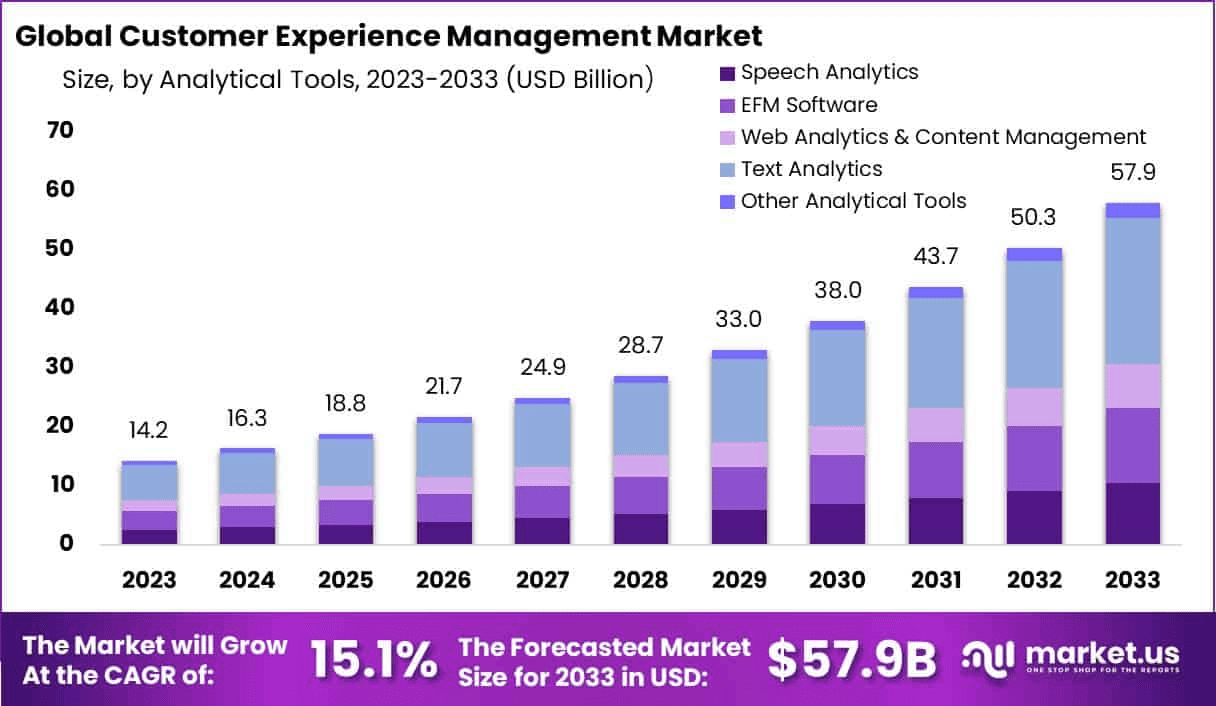
- The Global Customer Experience Management (CXM) Market, segmented by analytical tools, was valued at USD 18.8 billion in 2025 and is projected to reach USD 24.9 billion in 2026.
- The market is forecast to expand at a CAGR of 15.1% and reach a total market size of USD 57.9 billion by 2033.
Customer Experience Statistics
(Source: zoom.com)
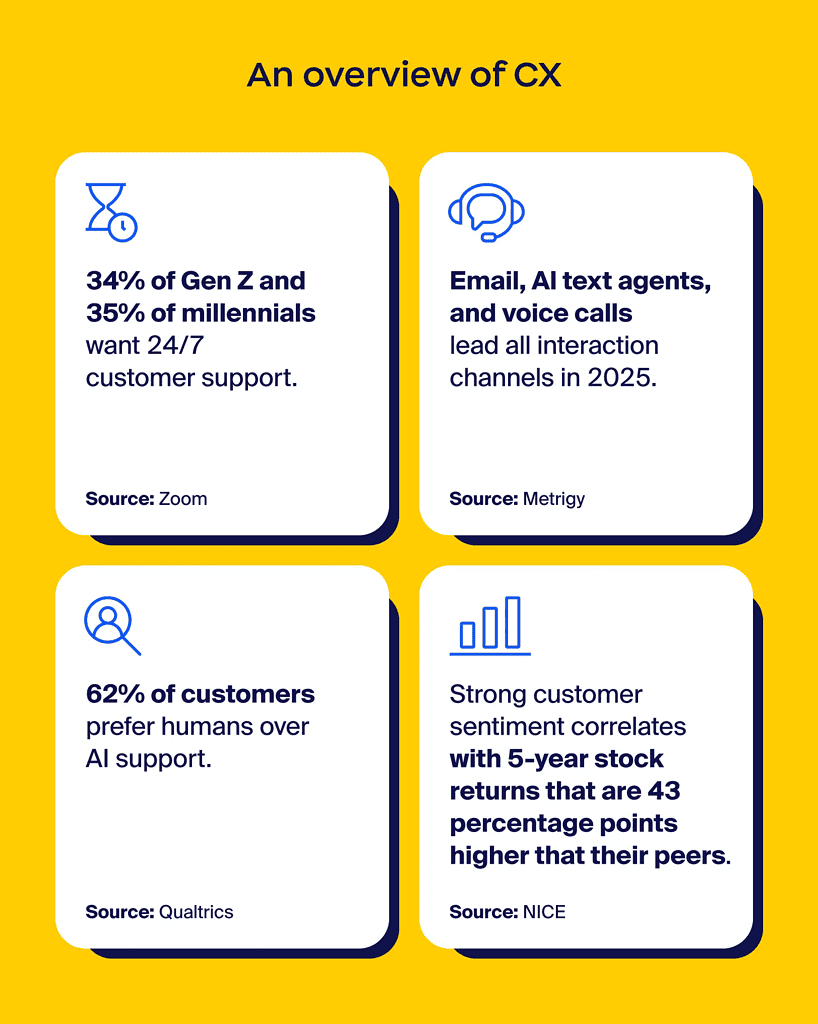
- Around 34% of Gen Z and 35% of millennials want round-the-clock customer support.
- Email, AI text agents, and voice calls were the top interaction channels leading customer engagement in 2025.
- Despite the rise of AI, 62% of customers still prefer human support over AI-driven assistance.
- Companies with strong customer sentiment deliver 5-year stock returns that are 43% higher than those of their industry peers.
Customer Experience Drives Revenue Growth and Business Success
- According to Zendesk report analyses, companies that prioritize customer experience achieve an 80% increase in revenue.
- Customer-focused brands report profits that are 60% higher than those of businesses that do not invest in CX.
- Around 80% of business leaders plan to increase customer service budgets over the next year.
- 90% of organizations now consider CX their top business priority.
- As of 2026, customer-obsessed companies significantly outperform their peers, with 41% achieving at least 10% revenue growth in 2025.
- Organizations that connect customer satisfaction to growth, margins, and profitability are 29% more likely to secure additional CX funding.
- Furthermore, 80% of organizations expect to compete primarily on CX, while 73% of customers rank CX as the most important factor when making purchasing decisions.
Strong Customer Experience (CX) Improves Loyalty and Spending
- Around 49% of customers who left a brand they had previously been loyal to did so due to a poor customer experience (CX).
- 60% of consumers chose one brand over another based on the level of service they expected to receive.
- Customers are 2.4 times more likely to remain loyal when their issues are resolved quickly and effectively.
- Demand for fast support is rising, with 72% of customers expecting immediate service.
- Studies show that 64% of customers are willing to spend more when businesses resolve issues through their preferred communication channels.
- Additionally, 70% of customers expect every representative they interact with to have full knowledge of their history and needs.
- Nearly 48% of consumers also expect personalized treatment in recognition of their loyalty.
ROI and Financial Impact
(Reference: hubspot.com)
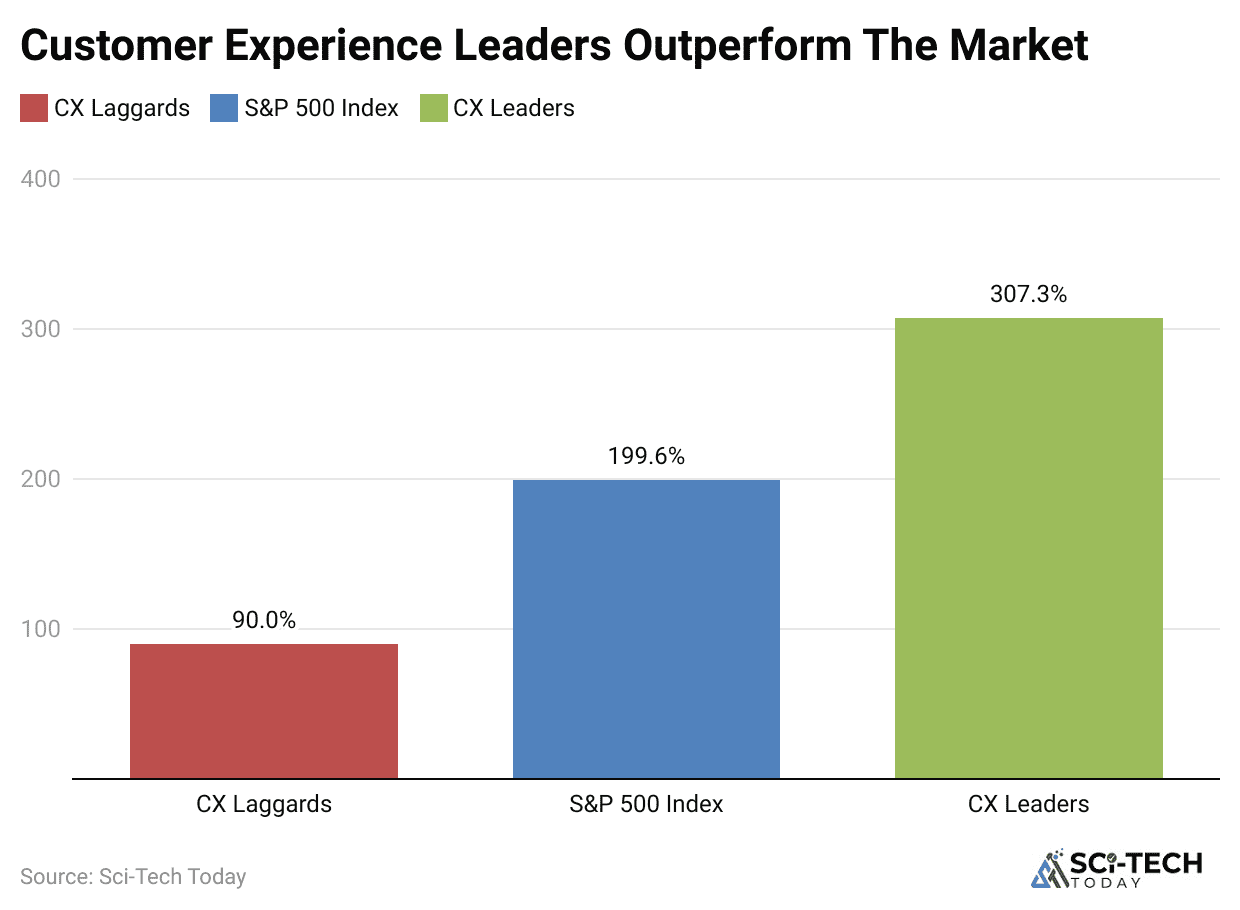
- CX Leaders achieved a cumulative stock return of 307.3%.
- Moreover, the S&P 500 Index delivered a 199.6% return, while CX Laggards generated only a 90.0% return.
- Customer service directly impacts spending behavior, with 87% of consumers saying a positive experience increases their likelihood of making additional purchases.
- Conversely, 97% of consumers change their buying behavior after a poor experience, and 58% stop purchasing from the brand altogether.
- A one-point improvement in customer experience scores can add over USD 1 billion in revenue by boosting loyalty and repeat purchases.
- Companies that improve customer satisfaction by 20% typically achieve a 15%-25% increase in cross-selling, a 5%-10% rise in wallet share, and up to 30% higher customer engagement.
- Following a 5-star experience, consumers are 2.9 times more likely to trust a brand, 3 times more likely to recommend it, and 2.2 times more likely to make another purchase than after a 1 or 2-star experience.
- Additionally, 56% of consumers expect to become repeat customers after receiving a personalized experience.
AI Adoption and Market Growth in Customer Service
- According to lorikeetcx.ai, the global AI customer service market is projected to reach USD 15.12 billion in 2026.
- Market value is expected to grow significantly to USD 117.87 billion by 2034.
- This expansion represents a strong compound annual growth rate of 25.8% between 2026 and 2034.
- AI adoption is also forecast to reduce contact center labor costs by approximately USD 80 billion by 2026.
- The telecom sector leads in AI adoption, at 95%, the highest among all industries.
- Banking and financial services follow closely, with 92% of organizations using AI technologies.
- Overall, 88% of contact centers have implemented some form of AI to support customer service operations.
- Around 25% of contact centers have achieved fully integrated AI automation.
- Industry forecasts suggest that AI could manage up to 95% of all customer interactions by the end of 2026.
- The median cost of a self-service customer interaction is USD 1.84, compared with USD 13.50 for an agent-assisted interaction.
- AI-native customer service platforms can reduce resolution costs to approximately USD 1-3 per customer issue.
- Industry forecasts indicate that AI adoption could lower global contact center labor costs by nearly USD 80 billion by 2026.
- Organizations deploying AI solutions have reported a 40%-50% reduction in customer service interactions.
Omnichannel and Multichannel CEM
(Source: sinch.com)
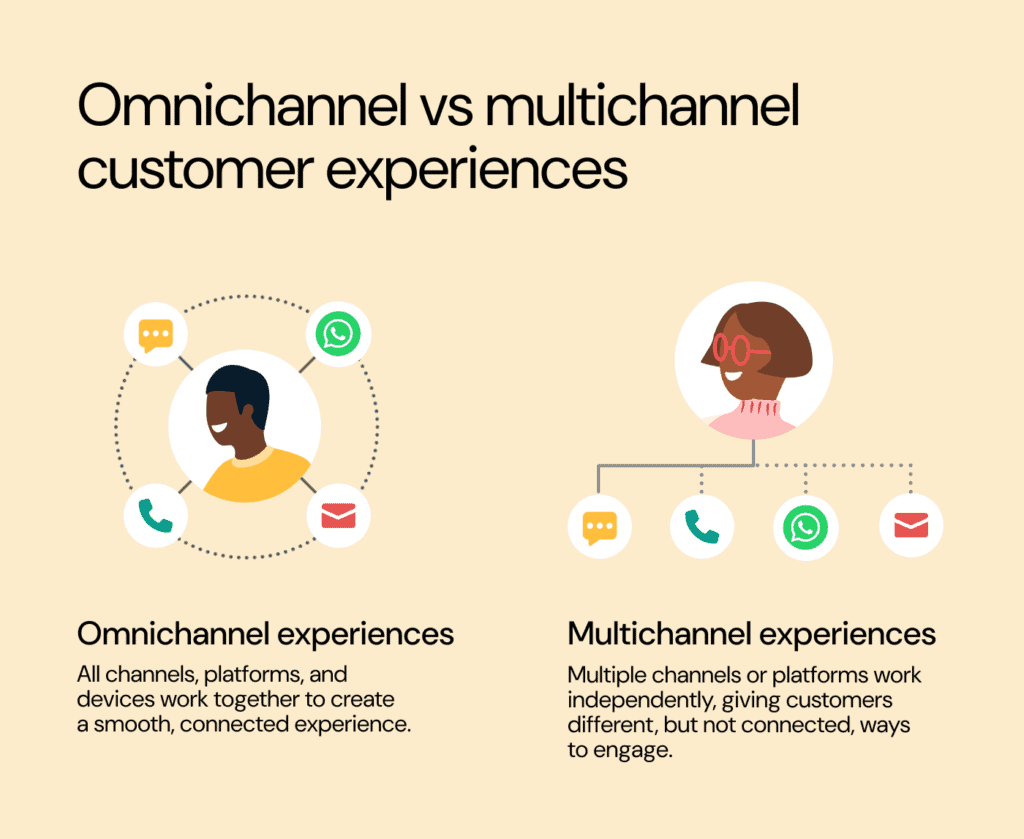
- The typical customer utilizes an average of nine different contact points to fully interact with a business, with a majority of those interactions, about 60%, now occurring entirely through digital channels.
- A significant percentage of consumers, 73%, express a high desire to be able to seamlessly switch between various communication channels during a single interaction without having to repeat their context or information.
- Companies that successfully implement top-tier omnichannel strategies see compelling financial uplift, including a 10% YoY growth, a 10% increase in average order value, and a 25% surge in close rates.
- Despite the overwhelming business case, only a mere 8% of companies report having fully integrated communication channels, meaning a vast 70% still lack truly connected channels for a holistic customer view.
- A majority of customers, 77%, expect that internal teams within a company will collaborate efficiently behind the scenes.
- The desire for seamless engagement is particularly strong on digital platforms, with 62% of customers expressing a wish to utilize a variety of digital channels when engaging with a brand for service or support needs.
| Average Touchpoints | 9 channels used per customer. |
| Digital Dominance | 60% of interactions are digital. |
| Seamless Handoff | 73% of consumers demand it. |
| Business Uplift | 10% YoY growth from top strategies. |
| Internal Efficiency | 77% expect internal teams to collaborate. |
Customer Loyalty and Churn
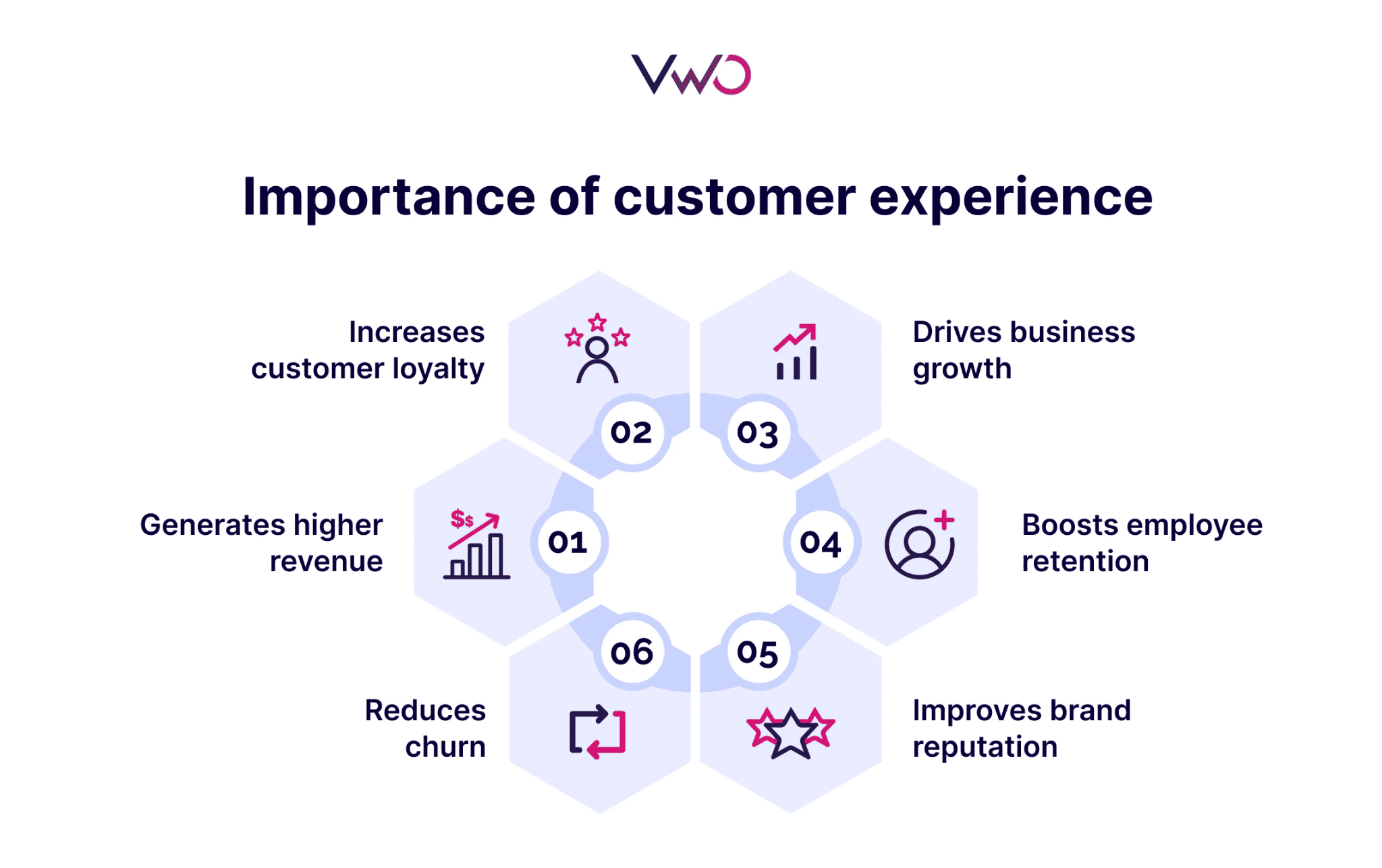
(Source: vwo.com)
- Customer loyalty is extremely valuable, as individuals who are considered brand advocates are five times more likely to make repeat purchases and four times more likely to refer the company to friends or family.
- A negative experience is a major driver of defection, with a significant 49% of customers who left a previously loyal brand in the past year citing poor CX as the definitive reason for their decision.
- Consumers are actively making purchase decisions based on expected service quality, with 60% of consumers choosing one brand over another specifically due to the superior service they anticipate receiving.
- Following a positive support experience, a high number of customers, nearly 79%, indicate that they would enthusiastically recommend the company to others.
- In contrast, after experiencing a negative interaction, a substantial 65% of customers have already demonstrated that they will cut or reduce their spending with the company that failed to meet their CX standards.
- The importance of speed in problem resolution cannot be overstated, as customers are 2.4 times more likely to remain loyal to a brand when their complex issues and problems are solved quickly and efficiently.
| Retention vs. Loss | 65% of customers cut spending after bad CX. |
| Advocate Value | Loyal customers are 5x more likely to repurchase. |
| Purchase Driver | 60% choose based on expected service. |
| Word-of-Mouth | 79% would recommend it after a positive experience. |
| Reason for Leaving | 49% of leavers cite poor CX. |
Customer Preferences and the Attributes of Great CXM
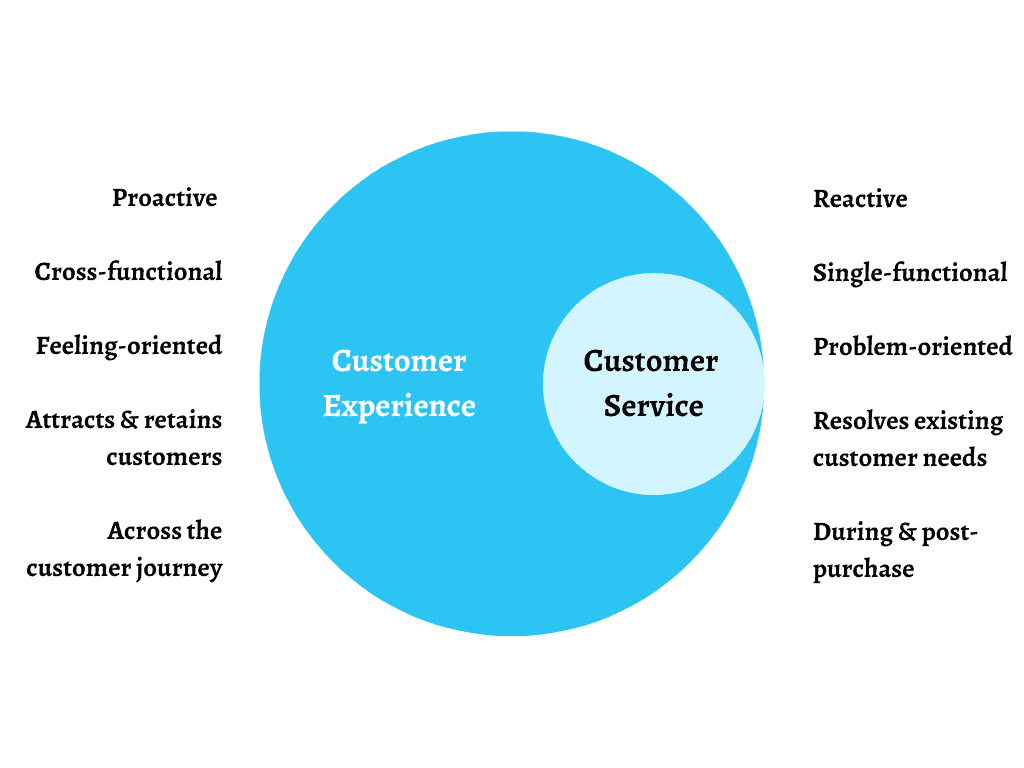
(Source: zonkafeedback.com)
- The most crucial attribute customers look for is speed, with an overwhelming 75% of customers explicitly stating that receiving a quick answer and prompt assistance is their top-ranked priority.
- Following speed, consistency across all channels holds significant weight, with 55% of customers valuing a seamless and uniform experience.
- The human element remains critical, as 52% of customers consider the agent’s knowledge and expertise to be a non-negotiable component of a positive service interaction.
- Furthermore, 62% of customers report that they would actually opt for a personalized customer experience over an interaction that might take less time.
- The clarity of communication is also highly valued, as 46% of customers demand clear and consistent messaging.
- A substantial portion of customers, 42%, are willing to pay a premium simply for a pleasant and welcoming experience.
| Speed/Response Time | 75% rank it as most crucial. |
| Channel Consistency | 55% value a uniform experience. |
| Agent Knowledge | 52% consider it crucial. |
| Willingness for Personalization | 62% prefer personalization over speed. |
| Emotional Connection | 42% pay more for a pleasant experience. |
Utilization of Communication Channels in Customer Experience Management
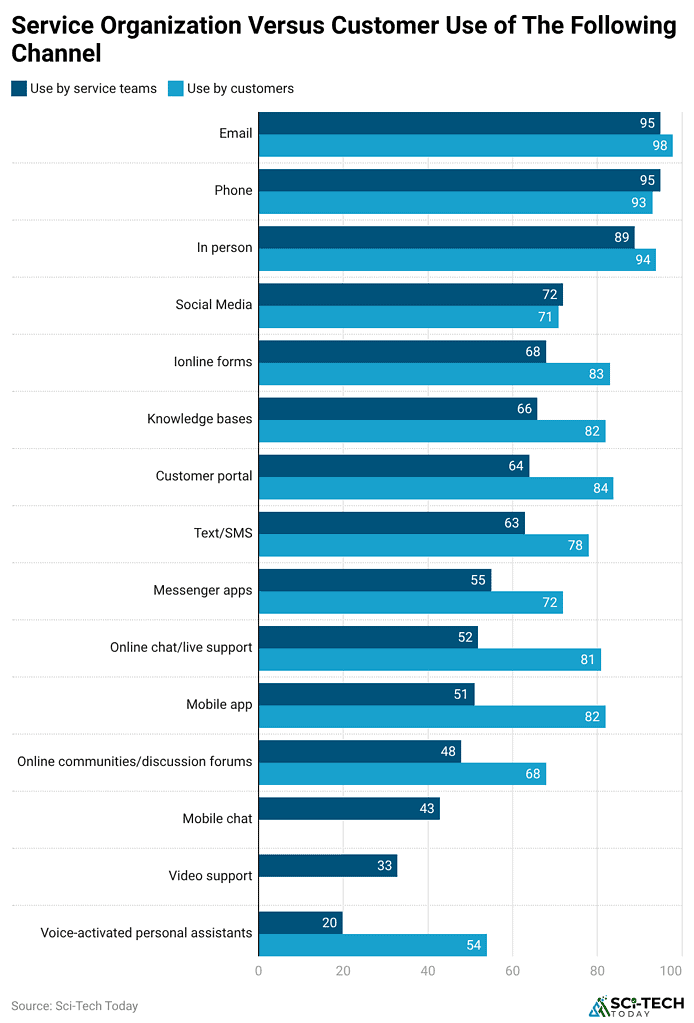
(Reference: hs-marketing-contentful.imgix.net)
- Email remains the most widely used customer service channel, with 95% of service teams and 98% of customers relying on it for communication.
- Phone support continues to play a key role, used by 95% of service teams and 93% of customers.
- In-person interactions remain important, with adoption rates of 89% among service teams and 94% among customers.
- Social media is utilized by 72% of service teams and 71% of customers.
- Online forms are used by 68% of service teams and 83% of customers, while knowledge bases are used by 66% and 82%, respectively.
- Customer portals are used by 64% of service teams and 84% of customers.
- Text/SMS, messenger apps, online chat, and mobile apps are used by 63%-51% of service teams and 72%-82% of customers, highlighting growing demand for convenient digital support.
- Voice-assisted personal assistants show lower adoption, with usage at 20% among service teams and 54% among customers.
How Leading Companies Deploy Customer Experience Management (CXM) in 2026
- Salesforce deploys its Agentforce AI platform across more than 18,000 companies worldwide, generating over USD 100 million in annualized cost savings. Finnair doubled its first-contact resolution rate within four months.
- Zendesk operates a resolution-focused platform where autonomous AI agents achieve over 80% resolution rates across 20,000+ enterprise customers in 80 languages, reducing issue resolution times by 28%.
- Adobe uses AI-powered personalization across digital channels, delivering an average 242% three-year ROI and reducing service call volumes by 40% for enterprise clients.
- Medallia supports more than 550 global brands, achieving a 732% three-year ROI and a 21% average increase in customer satisfaction scores.
- Genesys serves over 8,000 organizations, reporting USD 2.6 billion in Cloud ARR with 35% year-over-year growth, while Banco Bradesco achieved a 30% cost reduction and a 22-point improvement in NPS.
Customer Experience Management Challenges and Gaps
- The Medallia report also noted that the most striking perception gap in 2026 is that 66% of CX practitioners believe their company improved customer experience, yet only 17% of consumers agree.
- Businesses worldwide lose an estimated USD 3.7 trillion in annual sales due to poor customer experiences, and 70% of customers actively switch to a competitor following a single bad service interaction, according to Qualtrics.
- Givainc reported that only 14% of customer issues are fully resolved through self-service channels, while 38% of Gen Z and Millennials simply give up when these tools fail them.
- Data fragmentation continues to cripple CXM delivery, with 95% of organizations struggling to integrate data across systems and 80% identifying data silos as the single biggest barrier to AI and automation adoption.
- B2C response rates have collapsed to just 5%-15% in 2026.
- McKinsey’s 2026 AI Trust Survey found that only 30% of organizations reach a governance maturity level of 3 or higher on a 5-point scale, and 74% cite AI inaccuracy as a high-relevance operational risk.
Benefits of Customer Experience Management
- Around 83% of businesses that prioritize customer satisfaction report higher revenue growth.
- Companies that deliver exceptional customer experiences generate 5.7 times more revenue than competitors with weaker customer engagement.
- For 73% of consumers, a positive experience is a key factor influencing brand loyalty and future purchasing decisions.
- Customer-centric organizations are 60% more profitable than businesses that do not place customers at the center of their strategies.
- Loyal customers are 5 times more likely to make repeat purchases and 4 times more likely to recommend a brand to friends and family, supporting long-term business growth.
Conclusion
Overall, CX is the most powerful and reliable indicator of future business performance. The days of price and product being the primary differentiators are behind us. Today, the winners are determined by those who meticulously design and consistently deliver superior experiences.
From a market value and accelerating revenue growth for CX leaders, to the punishing financial loss inflicted by just a single poor interaction. Investing in Customer Experience Management yields higher profits, fosters unbreakable loyalty, and transforms a brand’s most valuable asset, its customers, into its most effective salesforce. I hope you guys like this article. If you have any questions, kindly let us know. Thanks for staying up till the end.

Sources