









Foreword
AI In Real Estate Statistics: AI is changing the real estate industry faster than many businesses expected. Today, technology can help agents find potential buyers, estimate property values, study market trends, and answer customer questions. It can also power virtual property tours, detect unusual activity, and support building maintenance.
For real estate companies, these tools can speed up everyday work, reduce manual effort, and improve customer service. As more property data becomes available, AI is opening new ways to understand markets and make informed decisions.
This article looks at the latest AI in real estate statistics, key adoption trends, common use cases, and the growing impact of AI on the future of the property industry.
Editor-Selected
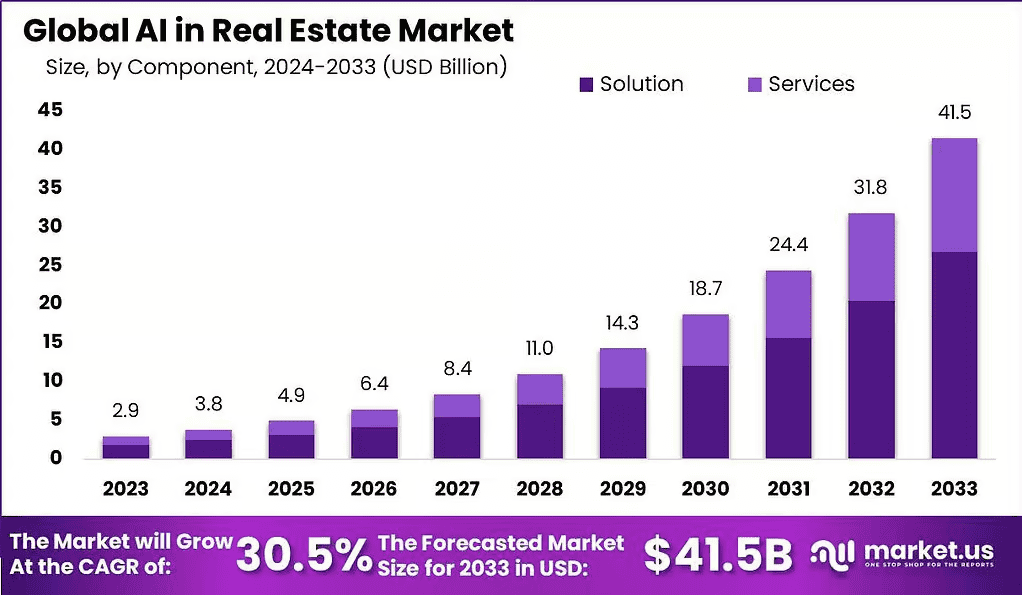
- The global AI market in real estate is expected to reach USD 4.9 billion in 2025 and USD 6.4 billion in 2026.
- AI implementation in real estate typically requires an initial investment of USD 25,000 or more.
- 88% of owners and investors and 92% of occupiers are running AI pilots.
- Around 82% of individual agents used AI in February 2026, up from 68% in mid-2025.
- In 2026, AI-generated listing descriptions are used by 61% of agents and deliver a reported 2.4 times return on investment.
- 64% of brokerages use AI in at least one workflow, while 41% of agents use generative AI weekly.
- AI output accuracy is the leading concern, cited by 63% of agents using AI tools.
- About 37% of real estate tasks can be automated, potentially saving the industry USD 34 billion.
- 81% of agents use technology to save time and complete tasks faster.
- AI could create USD 430-550 billion in annual value across real estate, construction, and development.
- 23% of real estate agents use AI daily, 25% use it weekly, and 31% experiment with it occasionally.
- Real estate receives 1.01% of AI referral traffic in 2026.
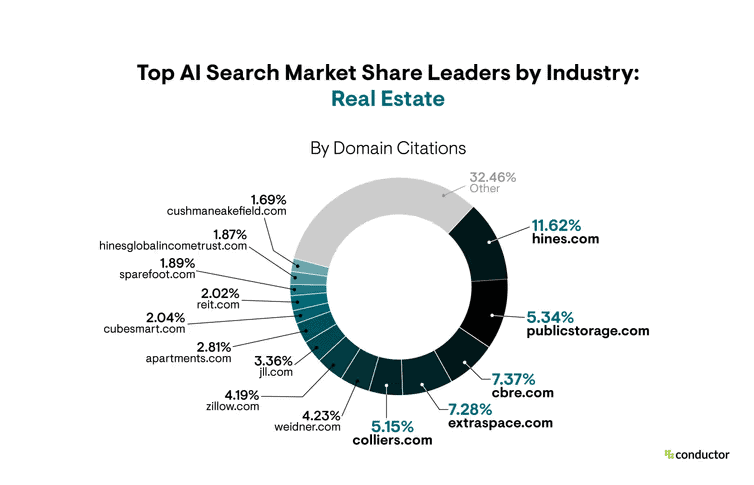
- Hines leads real estate AI search citations with 11.62%, followed by CBRE at 7.37% and Extra Space at 7.28%.
Key Market Trends
- AI valuation models have reduced median error rates to 2.8%, down from 10%-15% five years ago, according to the BLOTT report.
- Global PropTech funding reached USD 16.7 billion in 2025, up 67.9% year-over-year.
- AI-driven predictive maintenance can cut costs by 17.6% and extend equipment life by 25%-30%.
- Smart buildings achieve 14% energy savings and 91% resident satisfaction.
- From 2026 to 2027, autonomous AI may become mainstream, automating up to 70% of junior staff tasks.
Global AI in Real Estate Size
(Source: market.us)
- The global AI market in real estate is expected to reach USD 4.9 billion in 2025 and USD 6.4 billion in 2026.
- By 2033, the market is forecast to reach USD 41.5 billion, growing at a strong CAGR of 30.5%.
Generative AI in Real Estate Market Trends
(Source: precedenceresearch.com)
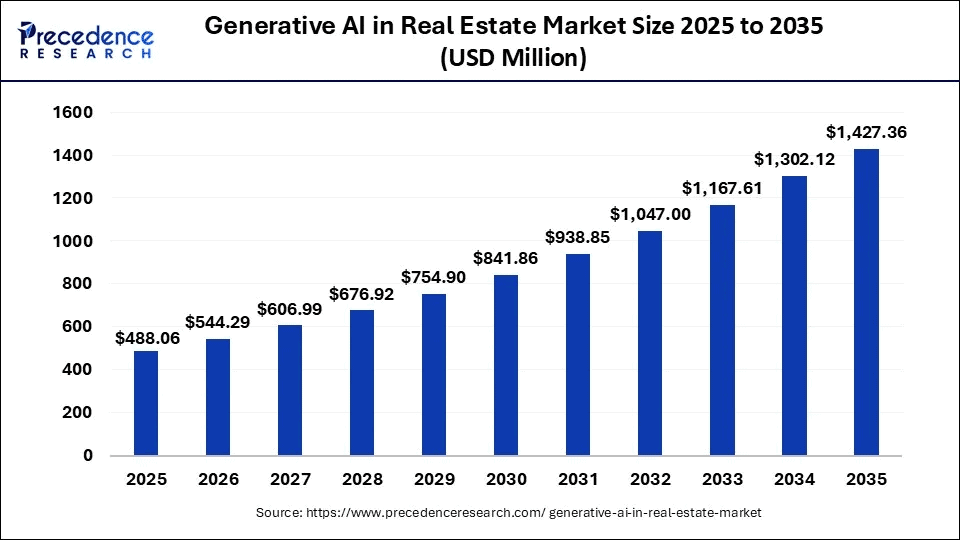
- The global generative AI market in real estate will be valued at around USD 544.29 million in 2026.
- It is projected to reach USD 1,427.36 million by 2035, growing at an 11.33% CAGR from 2026 to 2035.
- In 2025, cloud-based deployments account for 60%, while on-premises deployments account for 40%.
- As of 2026, the U.S. generative AI market size in real estate will reach USD 156.21 million.
(Source: precedenceresearch.com)
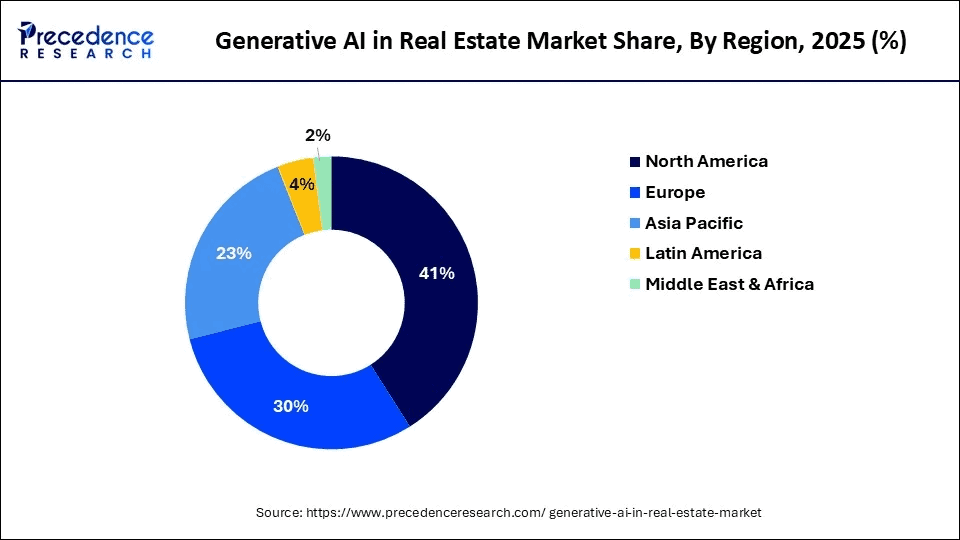
- In 2025, North America led with 41%, followed by Europe at 30% and Asia Pacific at 23%.
- Latin America held 4%, while the Middle East and Africa accounted for 2%.
AI Implementation Costs in Real Estate
- Excellent Web World reports that AI implementation in real estate typically requires an initial investment of USD 25,000 or more.
- Custom AI development generally costs USD 18,000 to USD 150,000.
- AI SaaS tools may cost from USD 100 to several thousand dollars per month.
- Connecting AI tools with existing systems can cost more than USD 10,000.
- Maintenance and regular updates may add 10% to 20% of the initial development cost.
- Data collection, cleaning, and management can cost USD 5,000 to USD 50,000.
AI in Real Estate Statistics: Adoption and Investment
(Source: cdn.sanity.io)
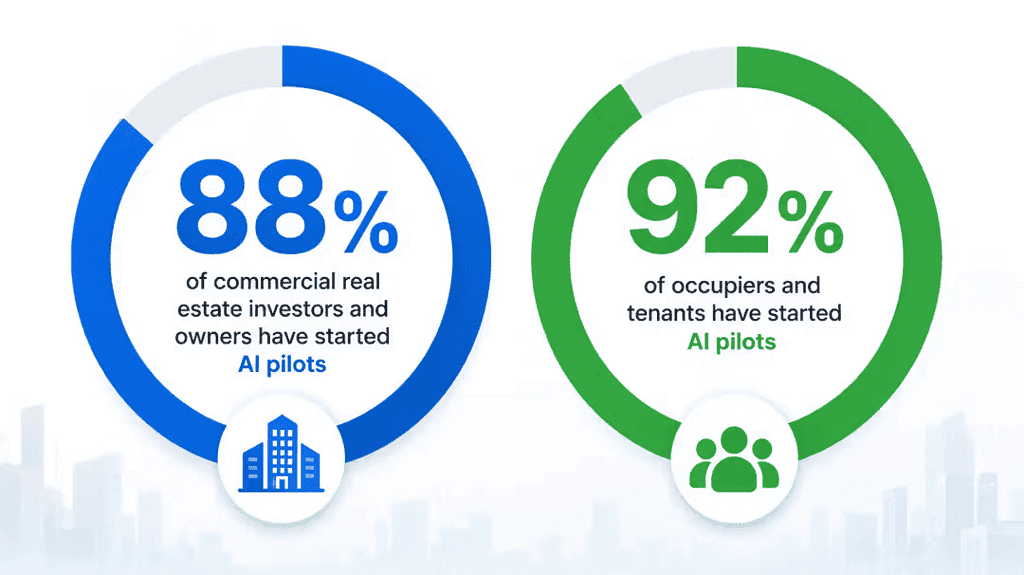
- 88% of owners and investors and 92% of occupiers are running AI pilots.
- 87% are increasing their technology budgets due to AI, while more than 60% are not fully prepared to scale AI.
- Around 92% of commercial real estate firms are piloting or planning AI, according to V7 Labs.
- A JLL survey found that 82% of individual agents used AI in February 2026, up from 68% in mid-2025.
- Only 1.9% of brokerages had no plans to adopt AI in 2026, compared with 10.6% in 2024.
AI Adoption in U.S. Real Estate
- The National Association of REALTORS surveyed a random sample of 49,233 members in its 2025 Technology Survey.
- The Verbaflo.ai survey found that 20% of agents use AI daily, 22% weekly, 27% a few times a month, while 32% do not use AI.
- Among AI users, ChatGPT leads at 58%, followed by Gemini at 20% and Copilot at 15%.
- About 46% use AI for content creation, including listing descriptions.
- PwC and ULI gathered insights from over 1,700 real estate professionals across the US and Canada.
AI Use-Case Statistics in Real Estate, 2026
| AI Application | Adoption / Penetration | Reported ROI |
| AI-generated listing descriptions | 61% | 2.4× |
| Lead scoring and lead routing | 48% | 3.1× |
| Automated valuation models | 44% | 2.8× |
| Virtual staging and photo enhancement | 39% | 2.2× |
| Chat assistants on property portals | 35% | 1.9× |
AI Use and Business Impact
- According to presenc.ai, 64% of brokerages use AI in at least one workflow, while 41% of agents use generative AI weekly.
- 78% of PropTech platforms have launched AI features, and 37% of commercial real estate firms are piloting AI for underwriting.
- 69% of brokerages report positive ROI from AI tools, while 52% of agents save 4 or more hours per week.
- 17% report a significantly positive impact from AI, while 33% report a moderately positive impact.
- Agentic AI could generate USD 430-550 billion annually across real estate, construction, and development.
- 2026 market estimates range from USD 0.6 to 404.9 billion.
United States Real Estate Agent Demographics
- NAR members have a median age of 57 years, showing that AI adoption spans an experienced workforce.
- About 29% of members are 65 or older, making simple tools and effective training important.
- Only 5% of members are under 30, so younger agents make up a small share.
(Source: realestateagentnearme.com)
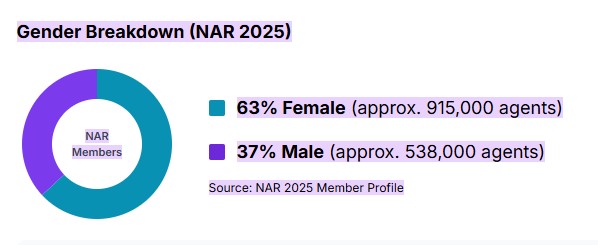
- Women account for 63% of members, compared with 37% of men.
- The typical REALTOR has 12 years of experience.
- About 28% have five years or less of experience, creating a notable group for AI training.
Key AI Concerns Among Real Estate Agents
(Reference: thetooljury.com)
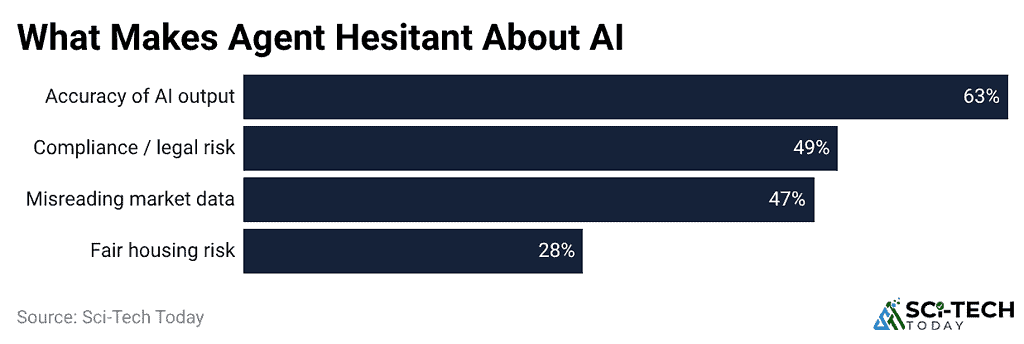
- AI output accuracy is the leading concern, cited by 63% of agents using AI tools.
- Compliance and legal risk concern 49% of agents, while 47% worry about misreading market data.
- Fair housing risk concerns 28% of agents.
AI’s Operational Impact on U.S. Real Estate
- Bay Tech Consulting report further mentioned that AI document processing can cut operational costs by 25% and save 4 hours per transaction.
- About 37% of real estate tasks can be automated, potentially saving the industry USD 34 billion.
- Predictive maintenance can reduce property maintenance costs by 10%-15%.
- AI-based lease administration can reduce errors by up to 42%.
- Automation can lower full-time staffing needs by 15% while improving productivity.
- AI-driven efficiency and new revenue streams can increase NOI by more than 10%.
Why Real Estate Agents Adopt Technology
- According to NAR Realtor, 81% of agents use technology to save time and complete tasks faster.
- Around 71% use it to improve the client experience and communication.
- 57% adopt technology to help close more deals.
- 54% use digital tools to reduce manual work.
- 44% rely on technology to remain competitive in the real estate market.
Most-Used Technologies Among Real Estate Professionals
| Technology / Tool | Share of Respondents Using the Technology |
| MLS platforms | 96% |
| E-signature tools | 79% |
| Showing-scheduling tools | 68% |
| CMA and pricing tools | 59% |
| Drone photography or video | 48% |
| CRM systems | 46% |
| AI-generated content tools, including ChatGPT, Microsoft Copilot, and Google Gemini | 41% |
AI Becomes Part of Daily Real Estate Workflows
- According to Housing Wire, 23% of agents use AI daily, 25% use it weekly, and 31% experiment with it occasionally.
- Only 12% do not use or plan to use AI.
- Among AI users, 75% create listing descriptions, 56% prepare social media posts, and 52% write emails or follow-ups.
- Additionally, 30% create market summaries and personalized marketing content.
- Moreover, 27% use AI for document review and summaries.
AI Adoption Hurdles in Real Estate
- 63% of agents identify the learning curve as their biggest technology challenge.
- Moreover, 59% cite cost as a major barrier.
- Around 18% spend less than USD 50 monthly.
- 36% spend USD 50-250, while 19% spend USD 251-500.
- 22% spend more than USD 500 each month.
Client Response
- According to housingwire.com, 40% of agents say clients respond very positively to technology.
- Meanwhile, 37% find it helpful but have some reservations.
AI Impact on Real Estate, 2026
- McKinsey estimates that AI could create USD 430-550 billion in annual value across real estate, construction, and development. Real estate alone reaches up to USD 550 billion.
- AI-driven workflow improvements could increase NOI, lower operating costs, and reduce cycle times by 10%- 30%.
- Automated maintenance workflows can save more than 30% of time.
- Meanwhile, AI-powered rental workflows may improve renewal rates by 3%-7%.
- Agentic AI can improve homebuyer lead response by more than 90% and reduce financial reporting time by 60%- 80%.
AI Referral Traffic in the Real Estate Industry
(Source: cdn.sanity.io)
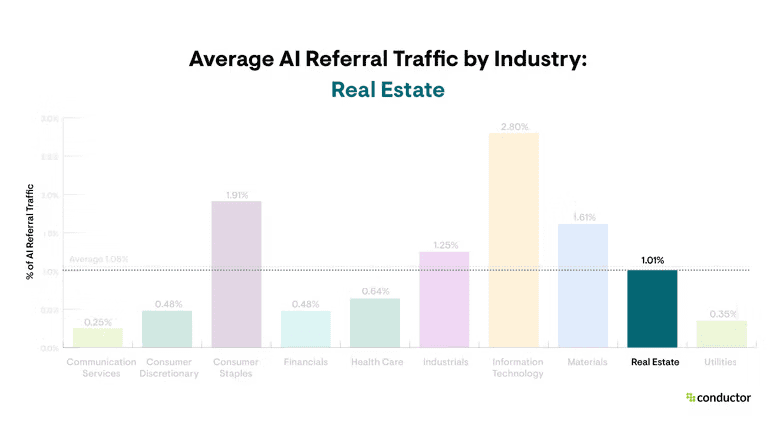
- Real estate receives 1.01% AI referral traffic, below information technology at 2.80% and consumer staples at 1.91%.
AI Referral Traffic by Real Estate Subindustry
(Source: cdn.sanity.io)
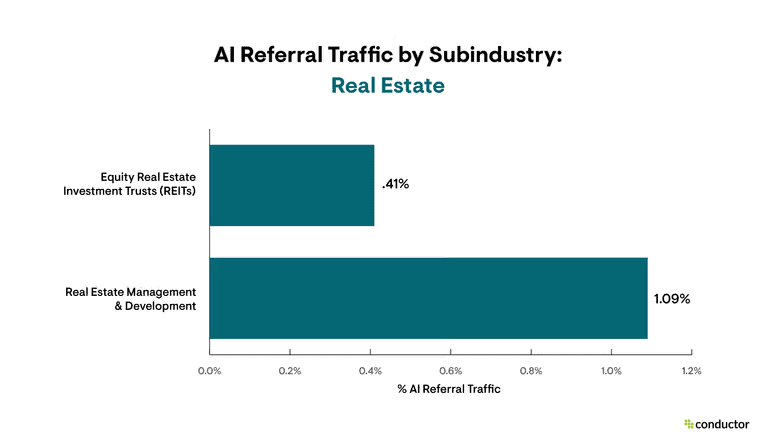
- Real estate management and development records 1.09% of AI referral traffic.
- Equity real estate investment trusts (REITs) receive 0.41% of AI referral traffic.
Real Estate Website Traffic Sources
- Other channels, including direct, paid, social, and referral traffic, generate 87.99% of real estate website traffic.
- Organic Google Search and AI Overviews deliver 11% of traffic, while AI answer engines contribute 1.01%.
AI Search Market Share Leaders in Real Estate
(Source: cdn.sanity.io)
- Hines leads real estate AI search citations with 11.62%, followed by CBRE at 7.37% and Extra Space at 7.28%.
- Public Storage accounts for 5.34%, Colliers 5.15%, and Weidner 4.23% of domain citations.
- Zillow accounts for 4.19%, JLL for 3.36%, and Apartments.com for 2.81%.
- CubeSmart, REIT.com, SpareFoot, Hines Global Income Trust, and Cushman & Wakefield collectively hold 9.51%.
- Other real-estate domains represent the largest share, accounting for 32.46% of AI search citations.
The Top 10 Leading Real Estate Investing Software in 2026
| Tool / Platform | Recommended use case | Pricing |
| DealMachine | All-in-one property data, owner intelligence, comps, skip tracing, and direct-mail outreach | USD 119/month, or USD 99/month annually. |
| PropStream | Detailed property research and comparable-sales analysis | USD 99/month. |
| BatchLeads | High-volume list building, skip tracing, and texting campaigns | From USD 119/month. |
| REI BlackBook | CRM, phone system, and automated investor marketing | USD 97-297/month across Basic. |
| Privy | MLS-connected comps and on-market deal analysis | USD 149/month, or USD 119/month annually. |
| DealCheck | Quick property calculators and investment reports | Free; Plus USD 10/month; Pro USD 20/month. |
| Stessa | Rental bookkeeping, performance tracking, and tax support | Free core; Manage USD 12-15/month; Pro USD 28-35/month. |
| Realeflow | Marketing, lead generation, and rehab workflow management | From about USD 75/month. |
| Mashvisor | Long-term and short-term rental-market analytics | From USD 29.99/month to USD 74.99/month. |
| PropertyRadar | Local property intelligence and list-building | USD 119-599/month. |
Final thoughts
AI is changing how the real estate industry works. It helps businesses study markets, estimate property prices, handle routine work, and serve customers more effectively. Buyers, sellers, and investors can also use AI to make informed decisions.
Still, technology alone is not enough. Real estate companies need good data, skilled teams, and proper security. By combining AI with human experience, businesses can work more efficiently and deliver better results.
FAQ
AI helps real estate with property valuation, market analysis, lead generation, chatbots, document review, and predictive maintenance.
Real estate professionals use ChatGPT, CoStar, Matterport, ReimagineHome, and Zillow AI tools.
AI helps buyers, sellers, agents, lenders, and investors streamline transactions, reduce costs, and make informed decisions.

Sources