








Foreword
AI In Software Testing Statistics: As software becomes more advanced, testing it quickly and accurately is becoming increasingly challenging. This is where Artificial Intelligence is making a difference. It helps testing teams reduce manual work, find bugs faster, and improve software quality. From creating test cases to identifying defects, AI is changing how testing is done.
With AI-powered tools, testers can spend less time on repetitive tasks and focus more on complex issues that need human attention. While AI offers many benefits, challenges such as accuracy and reliability still need to be addressed.
This article explores how AI is reshaping software testing, its benefits, challenges, and future possibilities.
Recommended Read
- The global AI-powered software testing and QA market is expected to grow from USD 9.32 billion in 2025 to USD 11.99 billion in 2026.
- Software platforms accounted for 63.21% of total market revenue in 2025.
- The AI-Powered Software Testing Tool market was valued at USD 3.4 billion in 2025 and is projected to reach USD 3.25 billion by the end of 2026.
- 86% of organizations involve testing teams in release decisions, while 83% of developers participate in DevOps activities.
- AI could reduce manual testing efforts by up to 45% in 2026.
- AI improves test reliability for 33% of organizations and helps reduce defects for 29%.
- A survey of 248 respondents found that API testing (56%), integration testing (45%), and performance testing (40%) were the most widely used automated testing methods.
- Automation runs continuously for 40%, at milestones for 38%, and at fixed intervals for 32%.
- Generative AI reduces the time required to create test cases by 50%.
- In early 2026, Meta linked performance reviews to AI usage, with top performers eligible for bonuses of up to 200%.
- In 2026, Clari reduced test execution time by 90%, cutting regression testing from 4 hours to 30-35 minutes.
- 64% of companies reported ROI exceeding 51% from AI testing, while 18% reported ROI above 100%.
- Higher test accuracy is the leading benefit, reported by 43% of organizations.
Rising Interest in AI and Software Testing
- According to TTC Global’s report, Google searches related to AI and software testing have increased 3 times over the past 24 months.
- A recent Leapwork report found that 79% of respondents use AI-powered testing tools, while 74% expect to increase their investment in them.
- However, only 16% believe their testing processes are efficient.
- Additionally, 68% of respondents who use AI systems reported issues with performance, accuracy, and reliability.
- Overall, 78% agree that AI applications require better testing.
Top 10 Software Testing Trends
- According to TestMatick’s report, AI could reduce manual testing efforts by up to 45% in 2026.
- Over 70% of developers report rewriting or improving AI-generated code.
- The software testing market is estimated at USD 57.73 billion in 2026, with some organizations reporting 50% faster test execution.
- Supply-chain vulnerabilities could account for 45% of global software security incidents by 2026.
- 40% of testing teams have integrated shift-left security into CI/CD pipelines.
- 76% of enterprises had explicit human-review processes by early 2025.
- Teams can scale infrastructure to run 10,000 parallel tests.
- Teams test connected devices for security, reliability, and performance in real-world conditions.
Software Testing Evolution
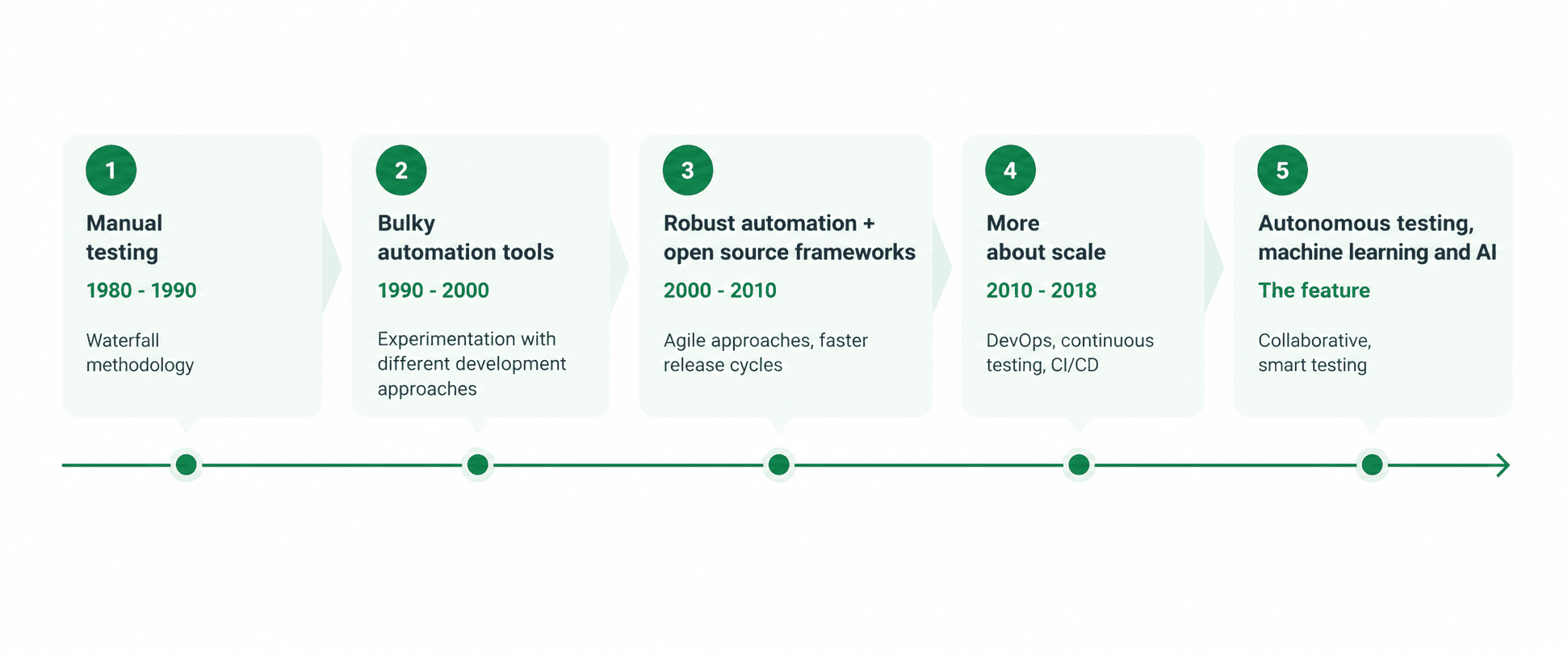
- From 1980 to 1990, manual testing followed the waterfall development approach.
- From 1990 to 2000, bulky automation tools supported experimentation with different development approaches.
- From 2000 to 2010, stronger automation and open-source frameworks supported agile development and faster releases.
- From 2010 to 2018, testing expanded through DevOps, continuous testing, and CI/CD.
- The 2026 overview presents autonomous testing, machine learning, and AI as the future direction.
AI-Powered Software Testing and QA Market
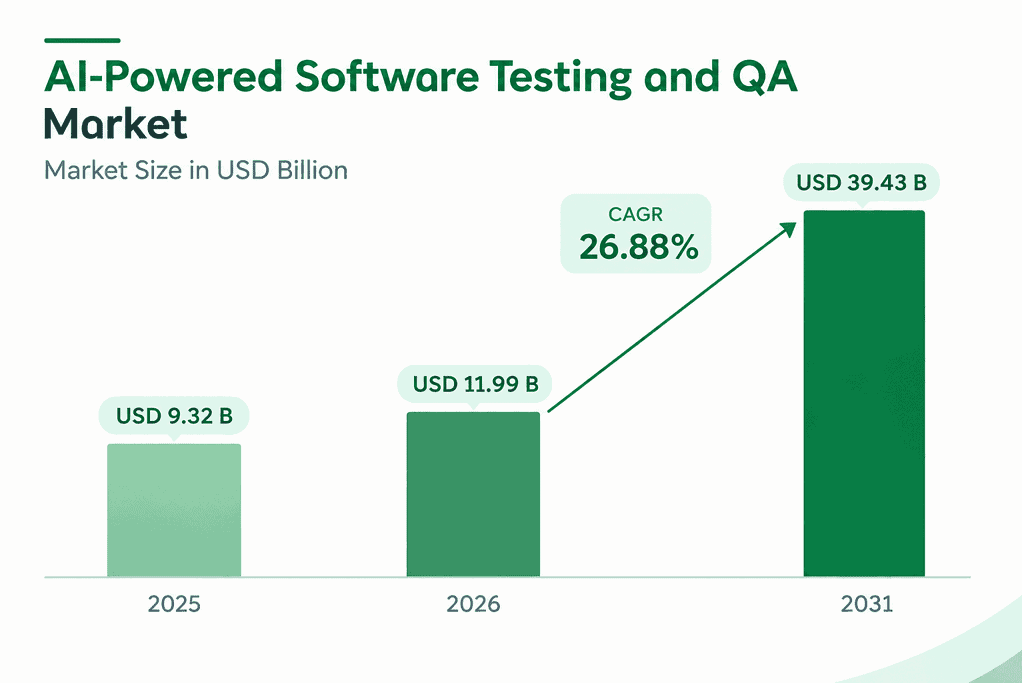
- The global AI-powered software testing and QA market is expected to grow from USD 9.32 billion in 2025 to USD 11.99 billion in 2026.
- The market is projected to reach USD 39.43 billion by 2031, recording a CAGR of 26.88%.
Segmental Analysis
| Segments | Revenue Share in 2025 | Forecast CAGR (2026 to 2031) |
| Software platforms | 63.21% | – |
| Services | – | 27.28% |
| Cloud solutions | 72.48% | 27.48% |
| Security testing | – | 27.88% |
| Healthcare and life sciences | – | 28.28% |
| IT and telecommunications | 31.29% | – |
| North America | 37.51% | – |
| Asia-Pacific | – | 27.52% |
AI-Powered Software Testing Tool Market Insights
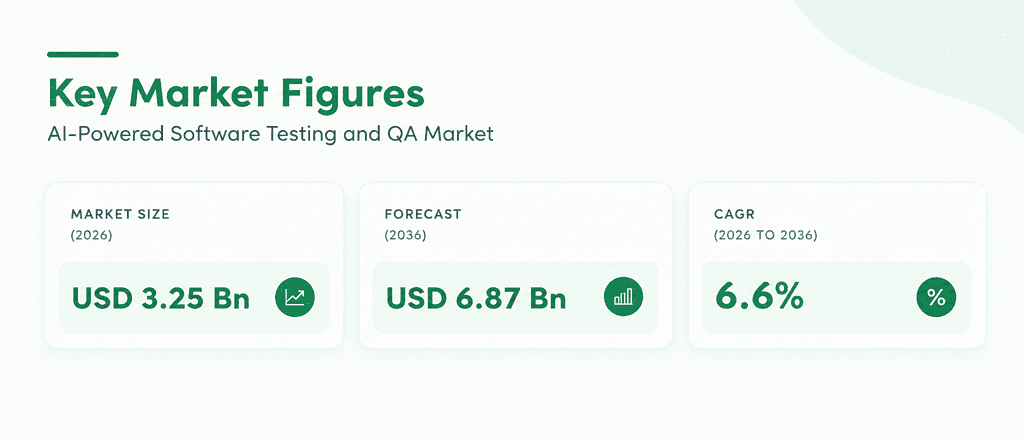
- The market was valued at USD 3.4 billion in 2025 and is projected to reach USD 3.25 billion by the end of 2026.
- The market is forecast to grow at a CAGR of 6.6% from 2026 to 2036, reaching USD 6.87 billion.
- Unit-component testing is expected to account for 40% of the testing-type segment in 2026.
- Large enterprises are projected to account for 66% of the application segment.
- China is forecast to grow at an 8.9% CAGR, followed by India at 8.3%.
AI in Software Testing: Agile and DevOps Testing
- According to PractiTest, 86% of organizations involve testing teams in release decisions, while 83% of developers participate in DevOps activities.
- Hybrid Agile models are used in 52% of large projects, and at least 75% of developers use Scrum or a Scrum-based approach.
- Organizations that successfully scale Agile report 30%- 50% higher productivity and 2-3 times faster time-to-market.
AI and Machine Learning in Software Testing
- The global AI market is projected to grow at a CAGR of 37.3% from 2023 to 2030.
- AI improves test reliability for 33% of organizations and helps reduce defects for 29%.
- By 2028, 75% of enterprise software engineers are expected to use AI coding assistants.
- PractiTest reports that 71% of organizations have integrated AI or GenAI, while 34% use GenAI in quality engineering.
Cybersecurity Testing
- More than 60% of executives identify cybersecurity as a leading enterprise risk.
- Meanwhile, over 85% of organizations consider AI-related vulnerabilities a rapidly growing threat.
- The average cost of a ransomware breach reached USD 4.91 million.
Test Automation and Manual Testing
- Automation testing market revenue was projected to reach USD 29.29 billion in 2025, growing at a 15.3% CAGR.
- Test automation replaced at least 50% of manual testing efforts in 46% of reported cases.
Green Software Testing
- By 2027, 30% of large enterprises are expected to include software sustainability requirements, according to TestGrid’s report.
Common Types of Automated Software Testing
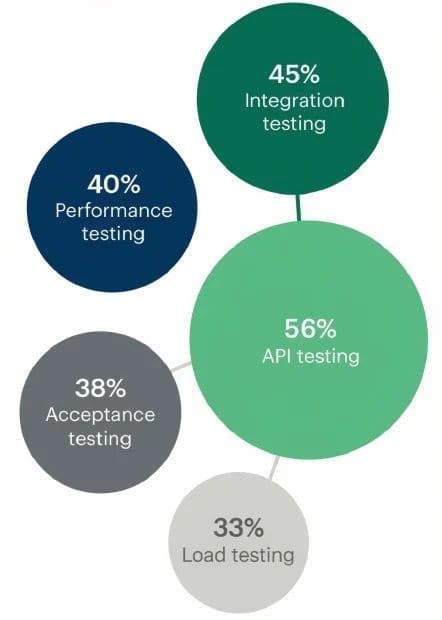
- A survey of 248 respondents found that API testing (56%), integration testing (45%), and performance testing (40%) were the most widely used automated testing methods.
- Other common methods included GUI testing (30%), accessibility testing (29%), regression testing (27%), data-driven testing (25%), and unit testing (24%).
- Less-used methods included security testing (19%), scalability testing (12%), smoke testing (9%), stability testing (9%), recovery testing (9%), gray-box testing (8%), and white-box testing (6%).
- Keyword-driven testing was used by 3% of respondents.
Software Testing Automation Timing
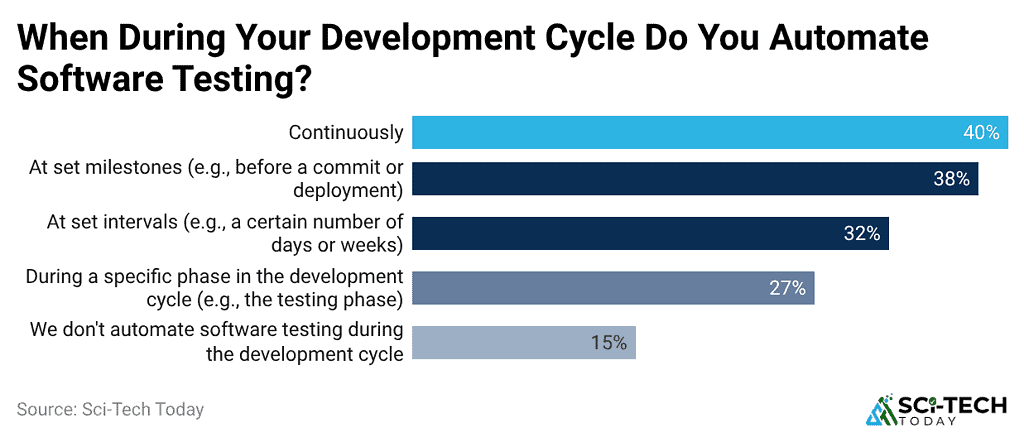
- Automation runs continuously for 40%, at milestones for 38%, and at fixed intervals for 32%.
- Testing is automated during specific development phases by 27%, while 15% do not automate.
- Responses include cannot say (5%), don’t know (2%), unlisted schedules (2%), and other (<1%).
Reasons for Automating Software Testing
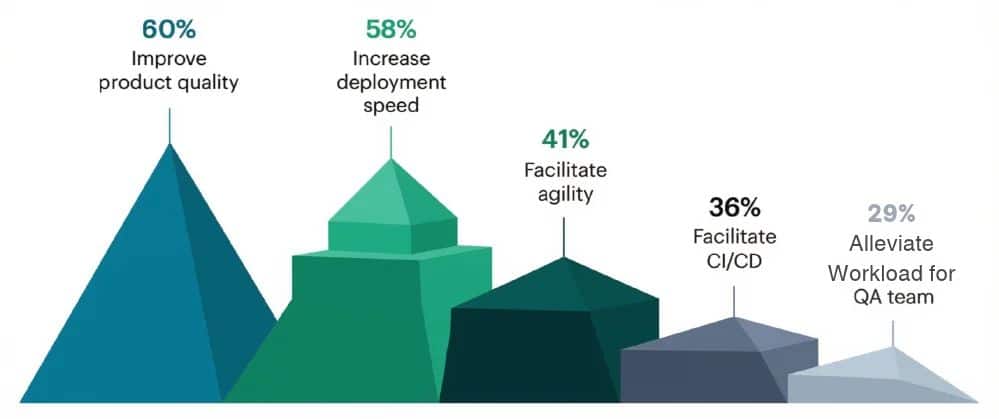
- Product quality drives adoption for 60%, while 58% seek faster deployment.
- Greater departmental agility motivates 41%, and 36% aim to support CI/CD.
- Reducing QA workloads motivates 29%, while 26% want to address bugs and product issues.
Key Areas Where AI Is Transforming Software Testing in 2026
- PractiTest report noted that 69.6% use AI to create tests, while 40.7% of AI adopters report more diverse and complex test cases as a benefit.
- AI supports test repair, with 59.6% using it for maintenance.
- AI-based risk identification is used by 19.9% of respondents.
- In Mabl’s survey, 11% fix broken tests without human help, while 41% identify maintenance as their biggest challenge.
- Around 54% see human intervention as a key bottleneck as test suites expand 10-fold.
- Among highly automated teams, 63% report better QA-development collaboration, and 60% report faster adoption of automation.
- BrowserStack further reported that 61% use AI across most testing workflows, 88% plan to increase spending in 2026, and 37% cite integration as their main challenge.
Generative AI Productivity Improvements in Software Testing
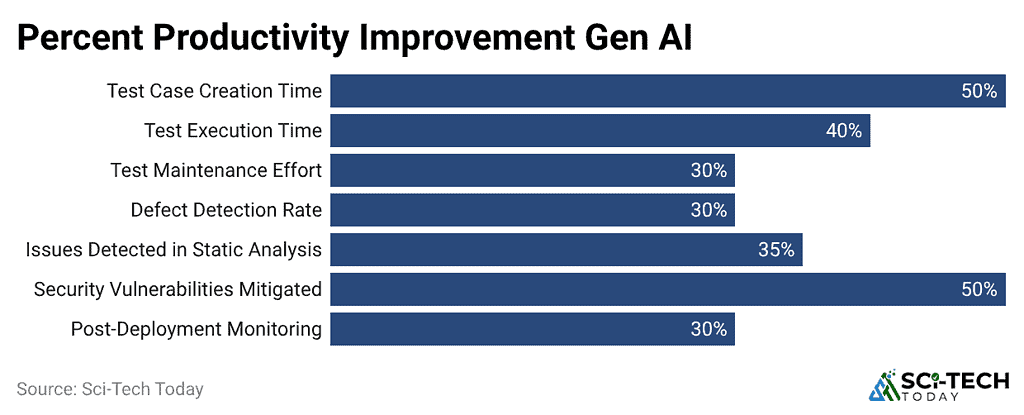
- Generative AI reduces the time required to create test cases by 50%, helping teams prepare tests faster.
- Test execution time improves by 40%, while test maintenance effort decreases by 30%.
- Defect detection improves by 30%, and static analysis identifies 35% more issues.
- Generative AI improves security vulnerability mitigation by 50% and post-deployment monitoring efficiency by 30%.
Key Statistics and Trends in AI Adoption in Software Testing
- According to SmartDev, 20% of teams use AI throughout the software delivery process, while 46% plan to adopt it in 2025.
- Around 60% of practitioners consider software testing the most valuable area for AI investment.
- AI-powered regression testing can reduce testing time by 40% and increase test coverage by 35%.
- AI can reduce manual test creation time by over 50% and speed up critical issue detection by 40%.
- The AI-enabled testing market is expected to grow from USD 856.7 million in 2024 to USD 3.824 billion by 2032, at a 20.9% CAGR.
Why QA Teams Face Pressure to Adopt AI in Software Testing
- Companies increasingly expect employees to use AI to improve productivity and business results.
- In early 2026, Meta linked performance reviews to AI usage, with top performers eligible for bonuses of up to 200%.
- NVIDIA CEO Jensen Huang has encouraged employees to automate tasks wherever possible. Reports also state that 100% of NVIDIA engineers use Cursor.
- McKinsey’s 2025 AI report found that 88% of organizations use AI in at least one business function, while 92% plan to increase AI investment over three years.
- However, fewer than 40% have scaled AI beyond pilot projects, and only 6% report an EBIT impact of more than 5%.
AI Software Testing: Cost Savings and ROI in 2026
- According to Katalon, 64% of companies reported ROI exceeding 51% from AI testing, while 18% reported ROI above 100%.
- 88% planned to increase AI-testing budgets by more than 10% next year, and nearly 25% expected increases of more than 25%.
- Companies using AI testing for more than 4 years were 83% more likely to report ROI above 100%.
- 37% cited workflow integration as their top challenge, while 32% identified budget constraints.
- Test-suite optimization was associated with a 139% higher likelihood of achieving ROI above 100%.
- 61% used AI across most testing workflows, while 50% expected a need for QA upskilling.
AI Software Testing Speed and Efficiency Statistics
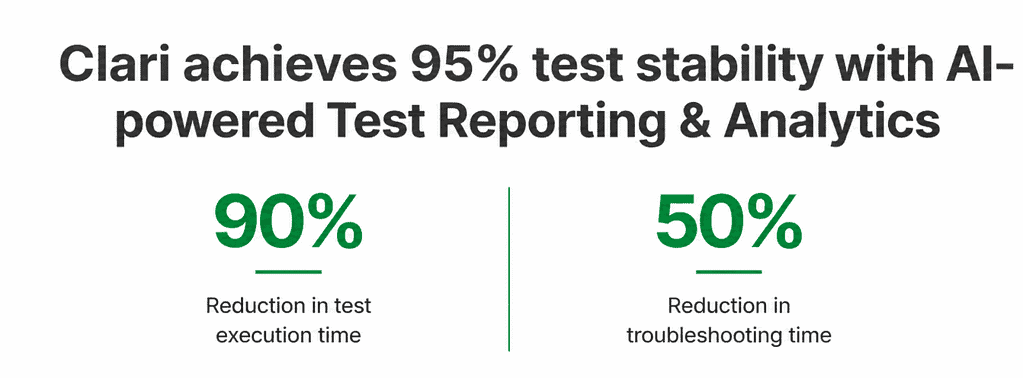
- In 2026, Clari reduced test execution time by 90%, cutting regression testing from 4 hours to 30-35 minutes.
- Clari also reduced troubleshooting time by more than 50%.
- According to DeviQA’s 2026 report, 65% of QA professionals said new features reach testing sooner, while almost 50% reported faster defect fixes.
- However, 64% reported receiving more features simultaneously, increasing testing demands.
- Additionally, 55% reported larger testing backlogs, and 52% experienced more testing, fixing, and retesting cycles.
Benefits of Software Testing Automation
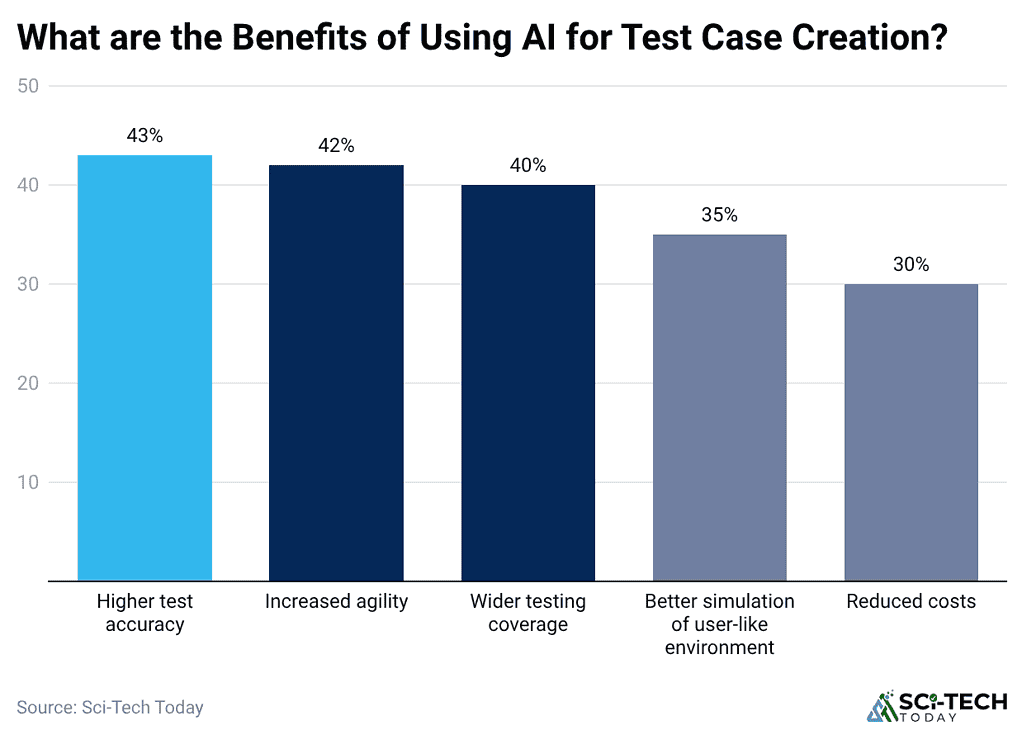
- Higher test accuracy is the leading benefit, reported by 43% of organizations.
- Increased agility helps 42% respond more quickly to changes.
- Wider testing coverage benefits 40% of organizations.
- Better simulation of real user environments supports testing for 35%.
- Cost reduction is a key benefit for 30% of organizations.
Challenges in Software Testing Automation
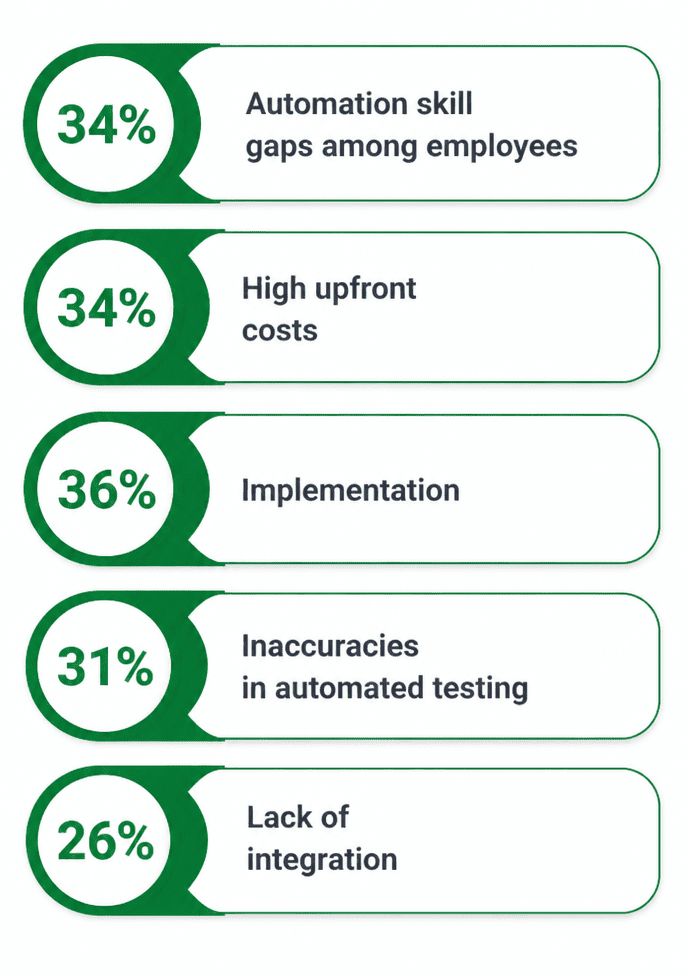
- Implementation is the leading challenge at 36%, while employee skill gaps and high upfront costs each affect 34%.
- Inaccuracies in automated testing are a concern for 31% of organizations.
- Lack of integration creates difficulties for 26% of organizations.
Outcome
AI is changing the way software testing is done. It helps testers find bugs faster, automate repetitive tasks, and save time. However, human involvement is still needed to check results and handle complex problems.
AI works best when combined with human skills and experience. As technology advances, AI will make software testing more efficient and help teams deliver better-quality software with fewer errors and less effort.
FAQ
AI helps testers save time, find bugs faster, reduce manual work, and improve software quality
AI helps generate test cases, automate testing, predict defects, prioritize tests, analyze failures, and maintain test scripts.
Software testing uses machine learning, natural language processing, generative AI, computer vision, and anomaly detection to improve testing efficiency.

Sources