








Overview
AI In Remote Work Statistics: Working from home is no longer just a trend. It has become a part of everyday work life. As remote work grows, Artificial Intelligence is changing how people get things done. From handling routine tasks to setting up meetings and keeping teams connected, AI tools are helping employees work faster and smarter. They save time, reduce workload, and make teamwork easier, even when people work from different locations. But it’s not all benefits. Concerns about data privacy, job security, and human connection remain.
So, how is AI shaping the remote work experience? Let’s look at the ways it is changing the workplace and what it means for the future of work.
Expert’s Choice
- The global AI in remote work market is projected to reach USD 26.5 billion in 2025 and USD 31.4 billion in 2026.
- Around 76% of professionals believe AI skills are essential to remain competitive in the job market.
- In 2026, 83% of employees report improved productivity from AI tools in remote and hybrid work environments.
- 64% of organizations reportedly assess the security and ethics of their AI tools in 2026, compared with 37% in 2025.
- Around 80% of employers use digital tools to monitor remote employees.
- AI reduces the time managers spend preparing performance reviews by 40%.
- Employers reportedly save an average of USD 11,000 per year per employee who works remotely half the time.
- In September 2026, BLS reported that 21.9% of U.S. workers teleworked some hours, while 10.7% teleworked all hours.
- By Q4 2025, AI adoption among employees in remote-capable roles had increased: 66% used AI at work, 40% used it frequently, and 19% used it daily.
- In August 2026, 53% of United States employees used AI at least a few times a year, 32% used it weekly or more, and 16% used it daily.
- 51% of Gen Z workplace AI users rely on AI first when dealing with complex questions.
- AI-Enhanced Remote Hiring stated that remote digital jobs are expected to grow by around 25%, reaching over 90 million by 2030.
AI in Remote Work Market Size
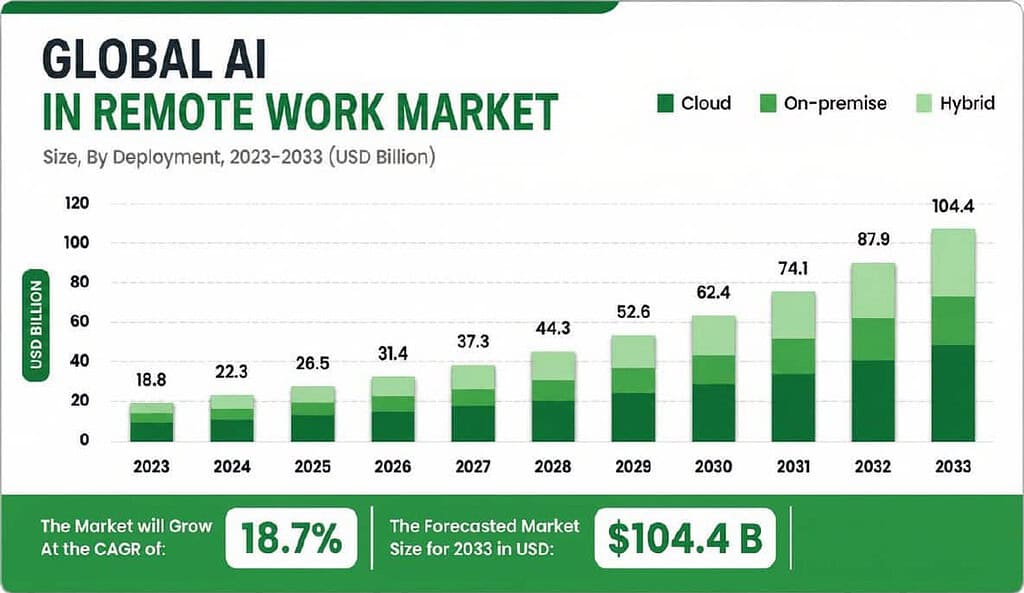
- The global AI in remote work market is projected to reach USD 26.5 billion in 2025 and USD 31.4 billion in 2026.
- The market is forecast to reach USD 104.4 billion by 2033, growing at a CAGR of 18.7%.
AI Adoption and Remote Work Trends
- According to market.us, around 76% of professionals believe AI skills are essential to remain competitive in the job market.
- Meanwhile, 69% expect AI to accelerate career growth, and 79% see better job opportunities.
- Usage of AI-related LinkedIn Learning courses among non-technical professionals has increased by 160%.
- Almost 68% of the fastest-growing U.S. jobs did not exist 20 years ago, while 12% of recruiters are creating AI-related roles.
- 92% of remote teams reportedly use AI-powered collaboration tools for meeting summaries, calendar management, and routine documentation, saving an average of 6 hours per employee each week.
- In Spokane County, IT job postings have nearly doubled, with computer-related employment growing 1.8% annually, three times the overall rate.
- Remote work saves Australian companies USD 7,579 per employee annually.
- United States companies spend USD 11,000 per employee who works remotely half the time.
AI Integration and Remote Work Productivity Gains
- In 2026, 83% of employees report improved productivity from AI tools in remote and hybrid work environments.
- Remote workers spend 41% of their time on deep-focus tasks, compared with 31% for hybrid workers and 45% for on-site employees.
- AI supports 22.3% of focused work activities.
- Remote workers save 72 minutes per day on commuting, and 40% of that time is redirected to work.
- AI-powered project management tools improve workflow efficiency by 35%.
- 90% of Gen Z and 84% of Millennials report improved work output through AI.
- AI tools reduce live meeting time by 25%.
- 66% of managers report higher productivity while working remotely, and 49% see significant improvements.
AI Investment, Security, and Workflow Automation
- 64% of organizations reportedly assess the security and ethics of their AI tools in 2026, compared with 37% in 2025.
- 67% of IT leaders have increased cybersecurity budgets to protect distributed networks.
- 35% of companies report that adopting a document-first work culture helps bridge communication gaps.
- The virtual reality and immersive collaboration tools market is projected to grow at a 26.5% compound annual growth rate through 2031.
Career Advancement and Remote Hiring Trends in 2026
- Remote job postings on FlexJobs increased by 20% in the first quarter of the year.
- Experienced professionals account for 65% of remote job postings, while entry-level roles represent only 6%.
- Remote hiring increased by 40% in sales and business development and 30% in marketing.
- AI-skilled job postings are reported to be 3 times more likely to offer remote or hybrid work options.
- 95% of employers say remote or telework options have a high impact on employee retention.
- 43% of employees would consider quitting if required to return to the office.
- 30% of managers report expanding their talent pools by removing geographical hiring restrictions.
- The average salaries reach USD 136,000 for Senior Product Managers, USD 135,000 for Data Engineers, and USD 142,000 for Cloud Architects.
- 66% of professionals have changed careers or considered doing so for greater location flexibility.
- Jobs requiring AI skills are 3 times more likely to offer remote or hybrid work options.
Performance Management and Employee Engagement
- According to Fueler.io, around 80% of employers use digital tools to monitor remote employees.
- Outcome-based performance systems achieve 91% employee participation by focusing on results rather than hours worked.
- AI reduces the time managers spend preparing performance reviews by 40%.
- Well-being apps are linked to a 33% increase in psychological capital and a 34% rise in sales per hour for client-facing roles.
- 31% of fully remote workers are highly engaged, compared with 19% of on-site workers
- 70% of workers report lower stress after moving to remote or hybrid work, while 75% of women state improvements.
- 77% of respondents in a cited 2026 well-being survey rated their mental well-being at 7 out of 10 or higher, with an average score of 7.7.
- 45% of remote workers reportedly experience daily stress, compared with 38% of on-site workers.
- 22% of remote workers report feeling isolated, and 33% report experiencing burnout symptoms in the past year.
- 59% of employers reportedly offer mental health support to remote employees.
Financial Benefits of Remote Work
- Employers reportedly save an average of USD 11,000 per year per employee who works remotely half the time.
- Fully remote companies reportedly save approximately USD 19,000 per employee annually by eliminating office-related costs.
- Employers in Australia reportedly save approximately USD 7,579 per employee annually through reduced office expenses and other cost differences.
- Employees value hybrid work at the equivalent of an 8% pay increase, while 37% would consider accepting a 10% pay cut to retain remote-work flexibility.
- Businesses reportedly achieve 10%-50% savings on office space costs by reducing their physical footprint.
- A shift to flexible schedules has been associated with a 33% reduction in employee resignations.
Remote Job Statistics
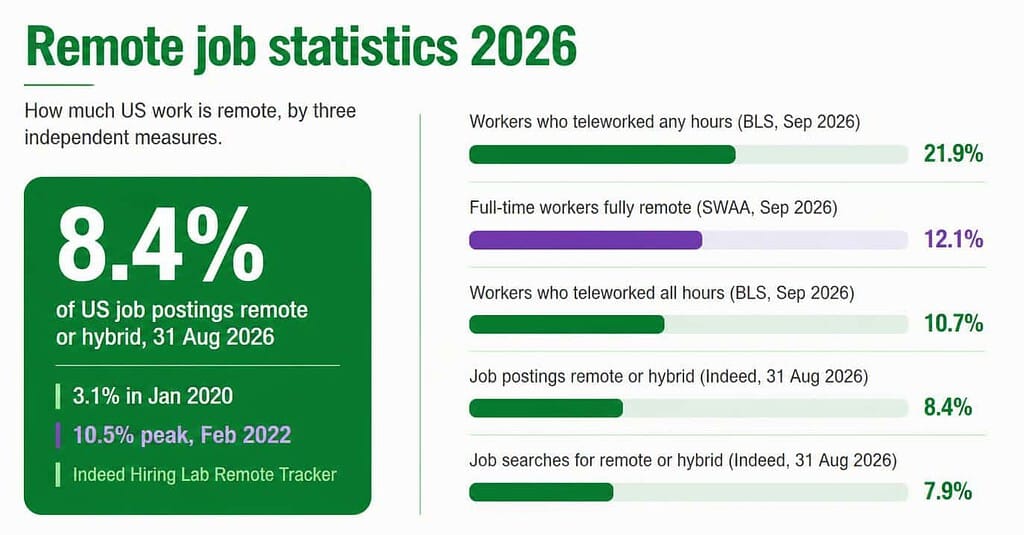
- In September 2026, BLS reported that 21.9% of U.S. workers teleworked some hours, while 10.7% teleworked all hours.
- 12.1% of full-time workers were fully remote in September 2026.
- Remote or hybrid roles accounted for 8.4% of US job postings and 7.9% of job searches as of August 31, 2026.
AI Adoption by Remote Capability
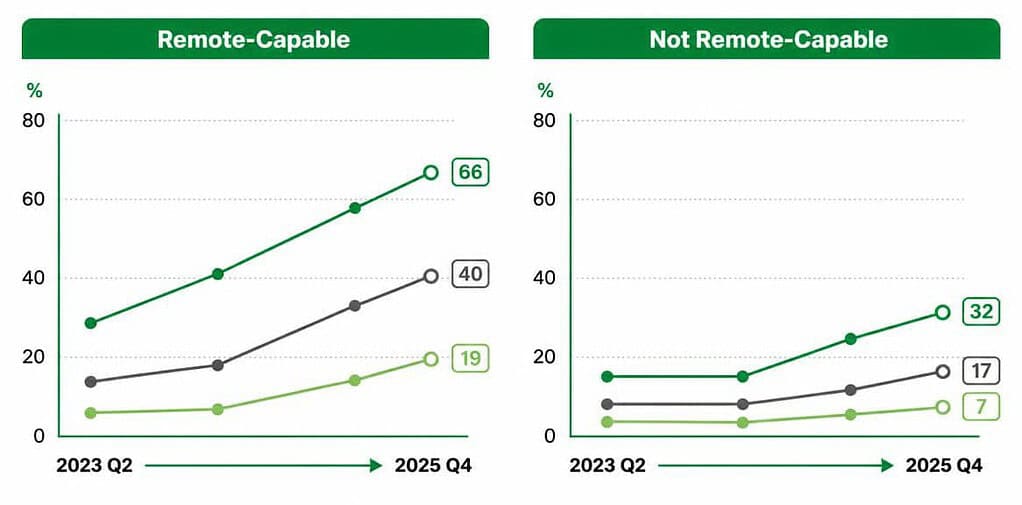
- By Q4 2025, AI adoption among employees in remote-capable roles had increased: 66% used AI at work, 40% used it frequently, and 19% used it daily.
- Non-remote-capable roles recorded 32% overall use, 17% frequent use, and 7% daily use.
- Frequent use includes daily use or several times per week; overall use includes use at least a few times per year.
U.S. Job Categories with the Highest Remote or Hybrid Posting Shares
| Job category | Remote or hybrid share, 31 Aug 2026 | Remote or hybrid share, 31 Aug 2025 |
| Insurance | 39.7% | 36.1% |
| Legal | 32.9% | 32.8% |
| Mathematics | 32.4% | 30.5% |
| Software development | 30.8% | 33.7% |
| IT operations and helpdesk | 30.1% | 32.1% |
| Information design and documentation | 27.5% | 31.1% |
| Marketing | 25.2% | 26.1% |
| Banking and finance | 23.4% | 24.8% |
| Accounting | 21.5% | 21.6% |
| Human resources | 20.8% | 20.6% |
| Sales | 15.0% | 15.6% |
| Physicians and surgeons | 11.8% | 9.2% |
| Customer service | 6.2% | 6.4% |
| Construction | 3.9% | 3.6% |
| Retail | 1.9% | 3.6% |
| Driving | 1.2% | 1.3% |
Remote Job Posting Shares, August 2026
- On August 31, 2026, Ireland led with 17.6%, followed by the United Kingdom at 16.3% and Germany at 14.2%.
- Canada recorded 13.3%, while Australia reached 12.7% and France stood at 11.8%.
- The United States ranked lowest among these countries at 8.4%.
Country-Level Workplace AI Statistics
- United States: In August 2026, 53% of employees used AI at least a few times a year, 32% used it weekly or more, and 16% used it daily, according to Gallup.
- United Kingdom: A PwC survey of 2,023 workers, reported in October 2026, found that 56% had used AI at work in the previous 12 months, while 19% used it daily.
- India: Microsoft reported that 32% of surveyed workplace AI users were “Frontier Professionals,” compared with 16% globally.
- Singapore: In June 2026, 78% of surveyed workplace AI users recognized the need to adapt quickly to AI, compared with 65% globally.
- Australia: Microsoft reported that 68% of surveyed workplace AI users feared falling behind if they did not adapt quickly to AI.
Generational Differences in Workplace AI Adoption
- According to RGP’s 2026 study, 51% of Gen Z workplace AI users rely on AI first when dealing with complex questions.
- Additionally, 33% spend more time interacting with AI than with colleagues.
- Around 52% believe their AI-assisted work reflects their own skills and judgment.
- Only 19% prefer turning to AI first to solve complex problems.
- 11% turn to AI first, and 15% spend more time interacting with AI than with colleagues.
- However, 82% feel their AI-assisted work represents their own expertise.
- 46% of Gen Z worry that excessive AI use could weaken their skills, while 50% fear it could affect their future careers.
- 39% worry that overreliance on AI could weaken their abilities, and 41% believe it could harm their career prospects.
Remote AI Training Pay Statistics by Hourly Rates
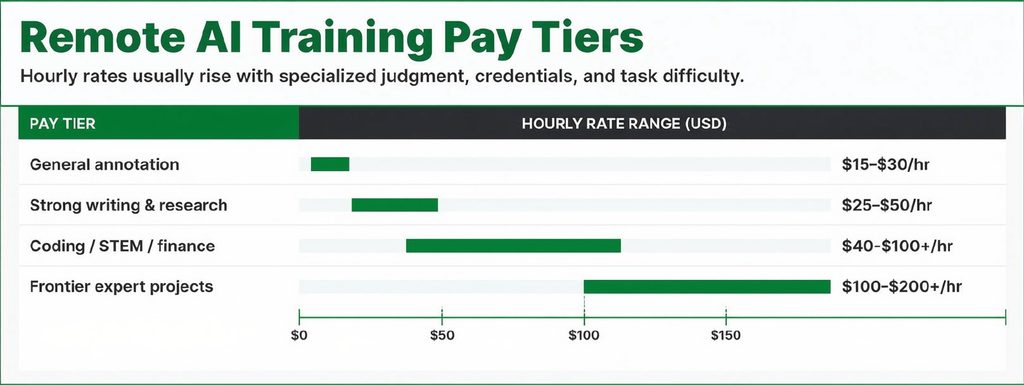
- General annotation pays USD 15-30 per hour.
- Strong writing and research skills earn USD 25-50 per hour.
- Coding, STEM, and finance tasks pay USD 40-100+ per hour.
- Frontier expert projects offer USD 100-200+ per hour.
By Monthly Estimates
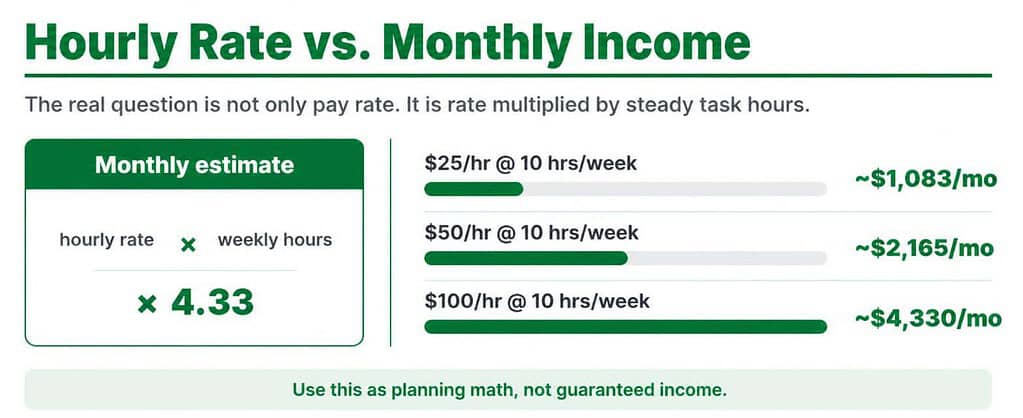
- At 10 hours per week, rates of USD 25, USD 50, and USD 100 yield approximately USD 1,083, USD 2,165, and USD 4,330 per month, respectively.
- Estimates multiply hourly rates by weekly hours and 4.33 weeks.
Future Trends in Remote Work and Recruitment
- AI-Enhanced Remote Hiring stated that remote digital jobs are expected to grow by around 25%, reaching over 90 million by 2030.
- The World Economic Forum projects 170 million new jobs this decade.
- By the end of 2025, around 80% of software engineers were expected to work remotely or mostly remotely in many organizations.
- In the United States, office vacancy rates could reach approximately 24% in 2026 as remote work reduces demand for office space.
- AI will improve hiring processes, while practical skills assessments and human abilities will remain important in recruitment.
Closing Remarks
AI is changing how people work from home. It helps employees complete tasks faster, stay connected with their teams, and manage their daily workload. At the same time, businesses need to focus on data safety and proper employee training.
AI is useful, but human skills and teamwork still matter. When companies use AI wisely, they can simplify remote work, improve productivity, and create a better work experience for their employees.
FAQ
AI is making remote work easier by automating routine tasks, improving communication, boosting productivity, and helping teams collaborate efficiently from anywhere.
AI won’t replace all remote workers, but those who adapt will stay ahead.
AI strengthens remote cybersecurity by detecting threats faster, identifying suspicious activity, and protecting sensitive data across remote networks.