









Starter
Movie Theatre Statistics: Movie theatres are commercial venues that screen films to the public, combining large-format visuals, advanced sound systems, and a shared viewing experience. The sector spans independent cinemas, regional operators, and global chains, many of which now offer premium screens, dine-in service, and event programming to differentiate from home streaming.
Artificial intelligence is increasingly influencing the industry. Exhibitors apply it to audience analysis, dynamic pricing, targeted marketing, and scheduling, while studios use it for audience forecasting, trailer testing, and visual effects. These tools help the market respond more quickly to shifting viewer preferences and improve operational efficiency.
Many are adopting AI as a creative support tool for pre-visualization, editing, and effects work, which can shorten production timelines and lower costs. At the same time, the industry is placing greater emphasis on clear disclosure of AI use, fair credit, and protection of creative rights, helping ensure that theatrical storytelling stays authentic and trusted by audiences.
Best of the Best
- The global movie theatre market is projected to grow at a 6.2% CAGR, rising from USD 69.0 billion in 2024 to USD 118.6 billion by 2033.
- Gower Street projects 2026 global box office at USD 34.7 billion, up about 3% from 2025 and 16% from 2024.
- North American box office was an estimated USD 8.6 billion in 2025, 23% below 2019, while ticket sales fell almost 40% over the same period.
- S&P Global Market Intelligence estimated 470.9 million tickets sold in the first 30 weeks of 2026, versus 747.3 million in the same period of 2019.
- Through July 30, 2026, the average adult admission cost USD 13.46, while premium-format tickets averaged USD 18.22.
- In the US, 67% of adults aged 18–29 watched a movie in a theatre during the previous 12 months, compared with 39% of those aged 65 and older.
- Among non-regular moviegoers, 30% cited lack of interest in most movies as the main barrier, followed by ticket prices at 27% and home convenience at 20%.
- IMAX reported Q3 2026 global box office of USD 712 million, bringing year-to-date receipts to USD 1,256 million through September 30.
- As of October 1, 2026, North American theatre owners had reinvested USD 2.7 billion in cinema upgrades and innovations over the preceding two years.
Recent Movie Theatre Developments
- In October 2026, AMC partnered with Evite to introduce redesigned birthday bookings, offering savings up to 25% on private theatre rentals.
- In September 2026, Cinemark and CJ 4DPLEX announced 20 additional SCREENX auditoriums, comprising 17 U.S. locations and 3 Latin American locations.
- IMAX reported Q3 2026 global box office of USD 712 million, bringing year-to-date receipts to USD 1,256 million through September 30.
- In July 2026, Cinemark announced record Q2 admissions revenue of USD 540 million and concession revenue of USD 433 million, attracting over 60 million moviegoers.
- IMAX’s Q2 2026 revenue increased 12% year-over-year to USD 102.8 million, while its commercial network reached 1,809 systems, with 421 systems in backlog.
- In July 2025, AMC introduced 50% Tuesday and Wednesday ticket discounts for Stubs members, alongside 50% discounts on small popcorn-and-drink combinations.
- In April 2025, AMC opened 2 XL auditoriums featuring screens at least 40 feet wide and 4K projection, targeting up to 50 locations during 2025.
- In March 2025, Dolby and AMC announced 40 additional U.S. Dolby Cinema auditoriums, scheduled for installation through the end of 2027.
India’s Cinema Attendance in the Movie Theatre
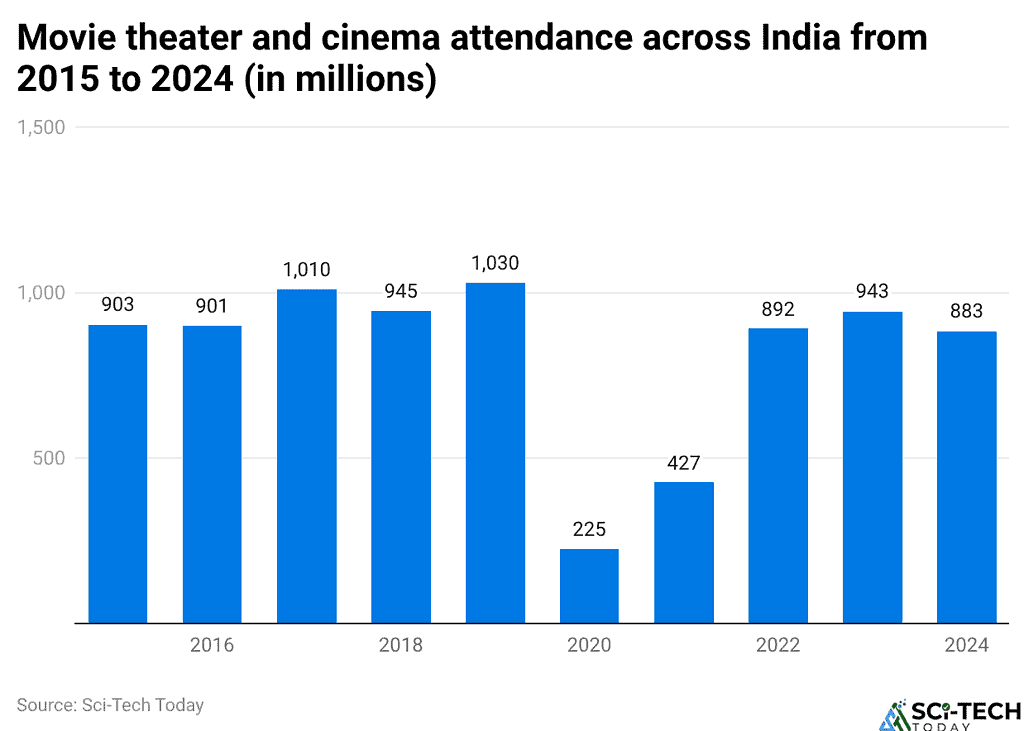
- Cinema attendance stood at 225 million in 2020 before recovering to 427 million in 2021.
- The recovery continued with 892 million admissions in 2022 and 943 million in 2023.
- The attendance fell to 883 million in 2024.
North American Box Office Crisis
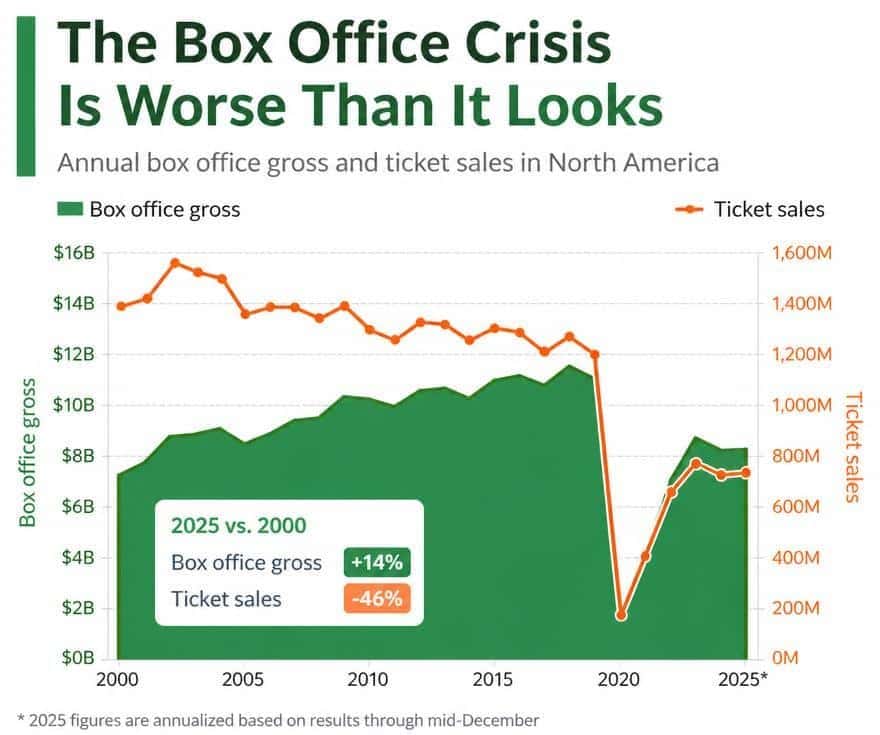
- In 2025, North American box office revenue was estimated at USD 8.6 billion for 2025, roughly matching 2023 but remaining 23% below 2019 and 15% below 2024.
- Ticket sales showed a weaker recovery than revenue, falling almost 40% compared with 2019. Higher ticket prices therefore masked the extent of the decline in cinema attendance.
- North American cinema ticket sales peaked in the early 2000s. Comparing 2025 with 2000, ticket sales declined 46%, while box office revenue increased 14%, highlighting the widening gap between admissions and revenue.
Bleak Outlook for Movie Theatres
- Ticket sales remain well below pre-pandemic levels. S&P Global Market Intelligence estimated 470.9 million tickets sold during the first 30 weeks of 2026, versus 747.3 million in the corresponding 2019 period, according to Reuters.
- Foot traffic indicates an incomplete recovery. Placer.ai data showed U.S. theater attendance increased 8.1% year-over-year through July 2026 but remained 27% below 2019 levels.
- Revenue growth masks weaker underlying demand. Domestic box office revenue reached USD 6.2 billion through August 2, 2026, increasing 15% year-over-year but remaining below the more than USD 7 billion recorded at the comparable point in 2019.
- Higher ticket prices create an affordability challenge. Through July 30, 2026, average adult admission cost USD 13.46, while premium-format tickets averaged USD 18.22.
- Cinema participation has not fully recovered among U.S. adults. Ampere Analysis found that 52% attended a theater during the preceding 6 months in Q1 2026, compared with 55% in Q1 2020.
- International audience recovery also remains uneven. In Q1 2026, 57% of young adults globally reported cinema attendance during the preceding 6 months, below 64% before the pandemic; participation among older adults declined from 58% to 53%.
- Exhibitors remain dependent on concentrated blockbuster supply. Five major distributors, Universal, Disney, Sony, Warner Bros., and Paramount, accounted for 68% of domestic receipts in Reuters’ August 2026 analysis, while Universal alone held 24%.
U.S. Movie Theatre Attendance by Age
- Among adults aged 18–29, 67% watched at least one movie in a theatre during the previous 12 months.
- Among adults aged 30–49, 60% watched at least one movie in a theatre during the previous 12 months.
- Among adults aged 50–64, 48% watched at least one movie in a theatre during the previous 12 months.
- Among adults aged 65 and older, 39% watched at least one movie in a theatre during the previous 12 months.
- Overall, 53% of U.S. adults attended a theatre during the previous 12 months.
| Age Group | Attended at Least One Movie in Theatre |
| 18–29 | 67% |
| 30–49 | 60% |
| 50–64 | 48% |
| 65 and older | 39% |
| Overall (All U.S. Adults) | 53% |
International-Release Movie Ticket Prices by City
- In Zurich, Switzerland, one international-release movie ticket averages USD 21.94.
- In New York, United States, one international-release movie ticket averages USD 20.00.
- In London, United Kingdom, one international-release movie ticket averages USD 18.78.
- In Los Angeles, United States, one international-release movie ticket averages USD 18.00.
- In Sydney, Australia, one international-release movie ticket averages USD 15.68.
- In Paris, France, one international-release movie ticket averages USD 13.93.
- In Dubai, United Arab Emirates, one international-release movie ticket averages USD 13.61.
- In Toronto, Canada, one international-release movie ticket averages USD 13.12.
- In Tokyo, Japan, one international-release movie ticket averages USD 12.19.
- In Singapore, one international-release movie ticket averages USD 11.03.
| City | Country | Average Ticket Price (USD) |
| Zurich | Switzerland | USD 21.94 |
| New York | United States | USD 20.00 |
| London | United Kingdom | USD 18.78 |
| Los Angeles | United States | USD 18.00 |
| Sydney | Australia | USD 15.68 |
| Paris | France | USD 13.93 |
| Dubai | United Arab Emirates | USD 13.61 |
| Toronto | Canada | USD 13.12 |
| Tokyo | Japan | USD 12.19 |
| Singapore | Singapore | USD 11.03 |
North American Movie Theatre Investment
- As of October 1, 2026, North American theatre owners had reinvested USD 2.7 billion in cinema upgrades and innovations over the preceding 2 years.
- Industry-wide reinvestment reached USD 1.2 billion during the preceding year.
- The 8 largest domestic cinema circuits committed USD 840 million to reinvestment during the preceding year, bringing their combined 2-year reinvestment to USD 1.8 billion.
- In September 2024, those same 8 companies pledged more than USD 2.2 billion to modernize and upgrade theatres over 3 years.
- Theatre owners gathered in Los Angeles for a 4-day Fall Summit before the October 1, 2026 announcement.
- Cinema United represents more than 64,000 movie screens worldwide.
- Founded in 1948, Cinema United represents more than 33,000 movie screens across all 50 U.S. states and Canada.
- Cinema United also represents more than 30,000 screens across 81 countries internationally.
- Membership spans cinema operators of different sizes, including single-screen theatres.
U.S. Frequent Moviegoers by Age
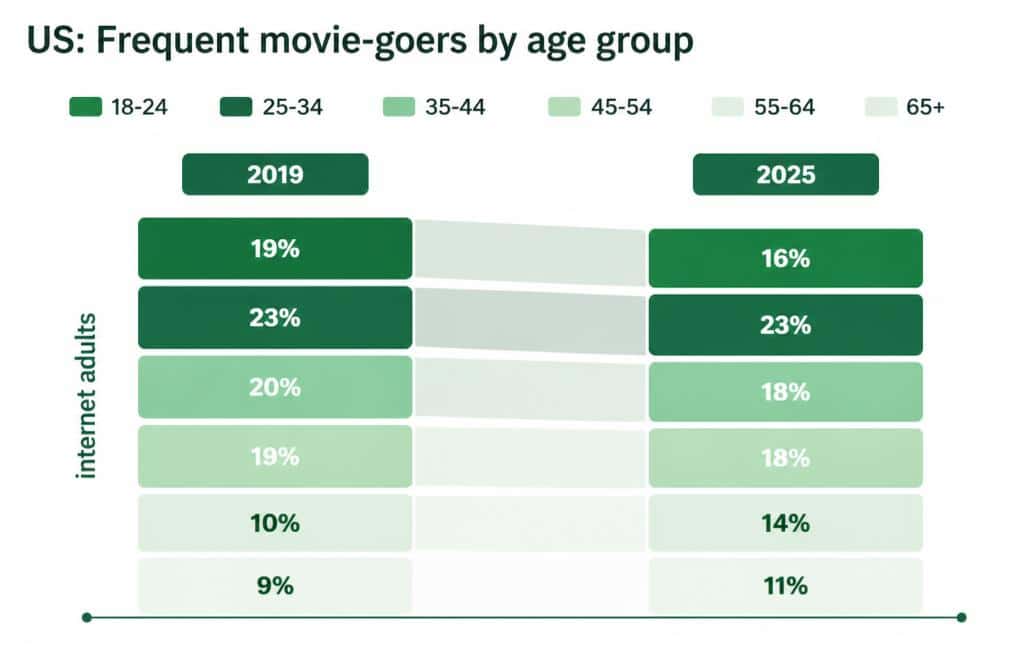
- Adults aged 18–24 accounted for 19% of frequent moviegoers in 2019, declining to 16% in 2025.
- Adults aged 25–34 remained the largest age group, representing 23% of frequent moviegoers in both 2019 and 2025.
- Adults aged 35–44 represented 20% of frequent moviegoers in 2019, falling to 18% in 2025.
- Adults aged 45–54 contributed 19% of frequent moviegoers in 2019, decreasing slightly to 18% in 2025.
- Adults aged 55–64 increased their share from 10% in 2019 to 14% in 2025, recording the largest gain among the age groups.
- Adults aged 65 and older increased their share from 9% in 2019 to 11% in 2025.
Main Barriers to Frequent Theatre Visits
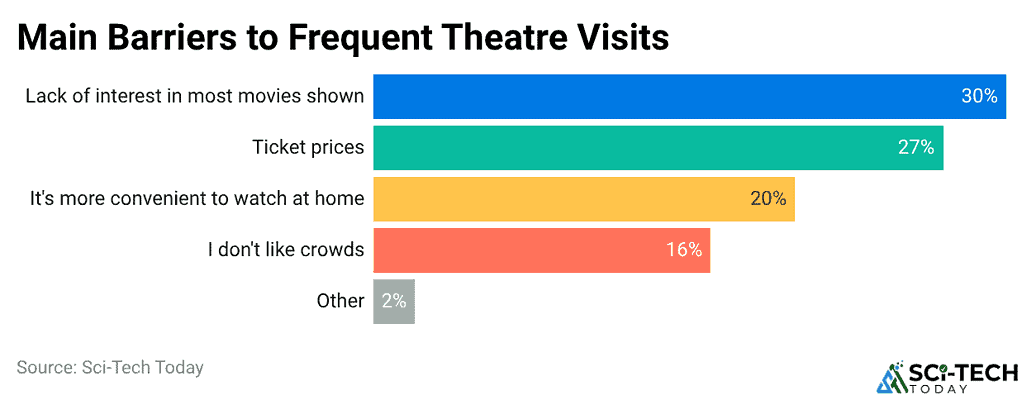
- Among non-regular moviegoers, 30% identified a lack of interest in most movies shown as their main reason for not visiting theaters more often.
- Ticket prices were the main barrier for 27% of respondents, making cost the second-largest concern.
- Watching movies at home was more convenient for 20% of respondents, highlighting competition from home entertainment.
- A dislike of crowds discouraged 16% of respondents from attending movie theaters more frequently.
- Other reasons accounted for 2% of responses, representing a small share of the barriers shown.
Impact of IMAX and Dolby on Movie Theatres
- IMAX generated USD 285 million globally in Q2 2026, increasing 1% year-over-year and recording its strongest second-quarter box office since 2019.
- IMAX’s international box office, excluding mainland China, increased 24% year-over-year in Q2 2026, highlighting stronger premium-format demand across overseas markets.
- The Odyssey generated USD 52 million in IMAX during its July 2026 opening weekend, demonstrating premium screens’ revenue potential for major releases.
- Internationally, The Odyssey earned USD 22.2 million across 441 IMAX screens in 74 markets, capturing 16% of the film’s opening box office.
- Dolby Cinema generated USD 46 million domestically between January 1 and April 6, 2026, increasing 62% year-over-year and strengthening premium-format revenue.
- Dolby Cinema’s domestic box office had grown 26% since 2022, according to April 2026 coverage, indicating sustained demand for enhanced theatrical experiences.
- Dolby’s 2026 expansion reached India’s fourth Dolby Cinema with its Trichy launch, extending premium theatrical experiences into Tamil Nadu.
- Dolby Cinema uses dual 4K laser projection alongside Dolby Atmos sound, differentiating participating theatres through enhanced picture and audio rather than standard screenings.
Numbers of Movie Theatres Globally
- AMC disclosed approximately 850 theatres and 9,600 screens worldwide in May 2026, making it the largest global cinema operator.
- Cinemark disclosed 495 theatres and 5,620 screens across its international network in July 2026.
- Cinemark’s U.S. network included 301 theatres and 4,219 screens across 42 states, according to its July 2026 disclosure.
- Cinemark operated 194 theatres and 1,401 screens across 13 South and Central American countries, according to its July 2026 disclosure.
- Europe’s 50 largest cinema groups represented over 2,300 venues and 18,600 screens; the August 2026 publication used December 2025 counts.
- Those European groups operated across 38 territories and maintained headquarters in 20 countries, illustrating the geographical breadth of major exhibition networks.
Financial Outlook of Movie Theatres Globally
- Gower Street’s April 2026 forecast projects global box office at USD 34.7 billion, revised downward from USD 35.0 billion.
- Global box office is forecast to rise approximately 3% versus 2025 and 16% versus 2024, indicating continued but uneven recovery.
- International box office, excluding China, is projected at USD 18.38 billion, revised upward by approximately USD 350 million, supporting the global recovery.
- China’s 2026 box office forecast fell approximately USD 550 million to USD 6.55 billion, reflecting weaker-than-expected Chinese New Year performance.
Global Movie Theatre Market Stats
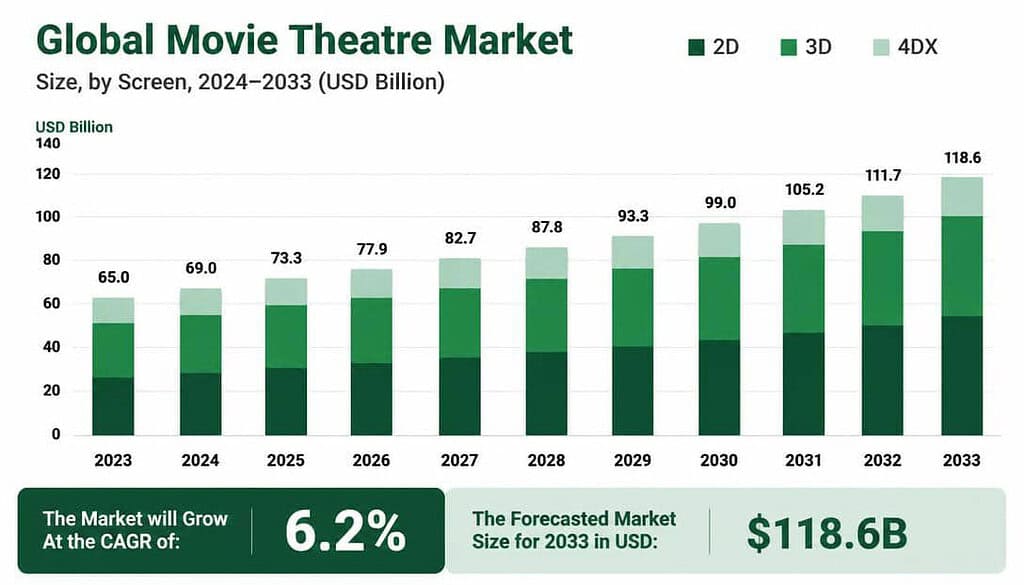
- The global movie theatre market is projected to grow at a CAGR of 6.2%, rising from USD 69.0 billion in 2024 to USD 118.6 billion by 2033.
- Market values reach USD 73.3 billion in 2025, USD 77.9 billion in 2026, and USD 82.7 billion in 2027.
- Across 2D, 3D, and 4DX screens, 2D remains the largest segment.
Final Thought
Movie theatres are recovering, but unevenly. Box office revenue is rising on higher ticket prices, while attendance remains well below pre-pandemic levels. Younger adults still lead theatre visits, yet cost, limited movie interest, and home viewing keep many away.
Premium formats like IMAX and Dolby, along with steady reinvestment by exhibitors, are helping theatres stand out, suggesting the future depends on delivering experiences audiences cannot recreate at home.
FAQ
Younger adults, particularly those aged 18–29, tend to visit movie theatres more frequently compared to older age groups, who show declining attendance as age increases.
Movie ticket prices vary significantly by country and city, with places like Zurich and New York having some of the highest average prices, while cities in Asia often offer more affordable options.
Ticket prices are influenced by factors such as location, theatre type (standard, premium, IMAX), movie format (2D or 3D), time of screening, and local market demand.
Yes, many people still value the theatre experience for big-screen visuals, surround sound, and social outings, even though streaming services have become a popular alternative for home viewing.
Switzerland, particularly Zurich, is known for having some of the highest average movie ticket prices globally, followed by major cities in the United States and the United Kingdom.
The frequency varies by demographic, but studies show that a significant percentage of adults attend at least one movie in a theatre within 12 months, with younger adults attending more often.

Sources


