









Introduction
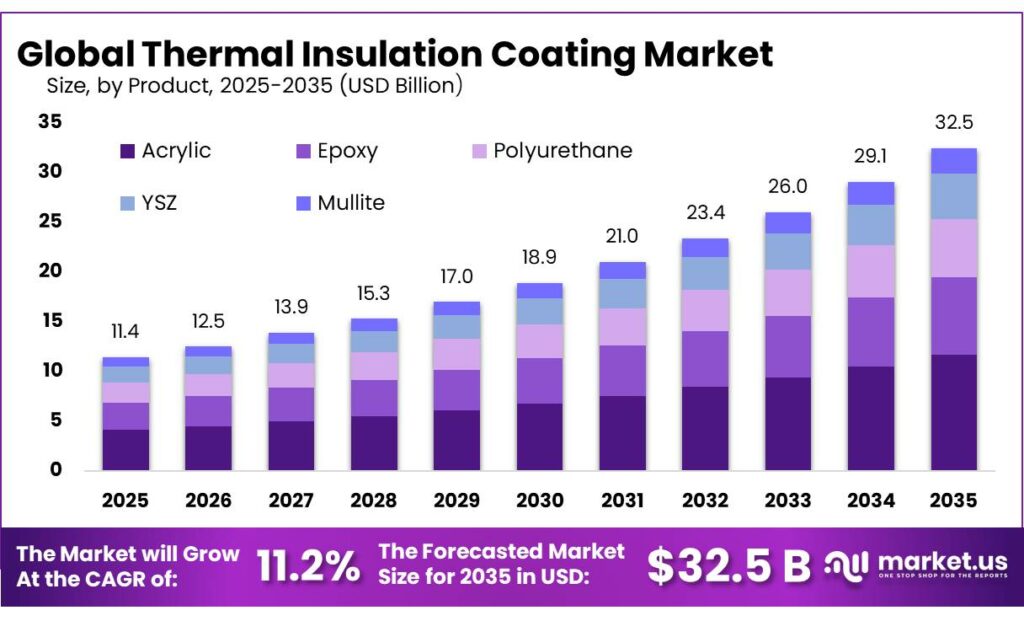
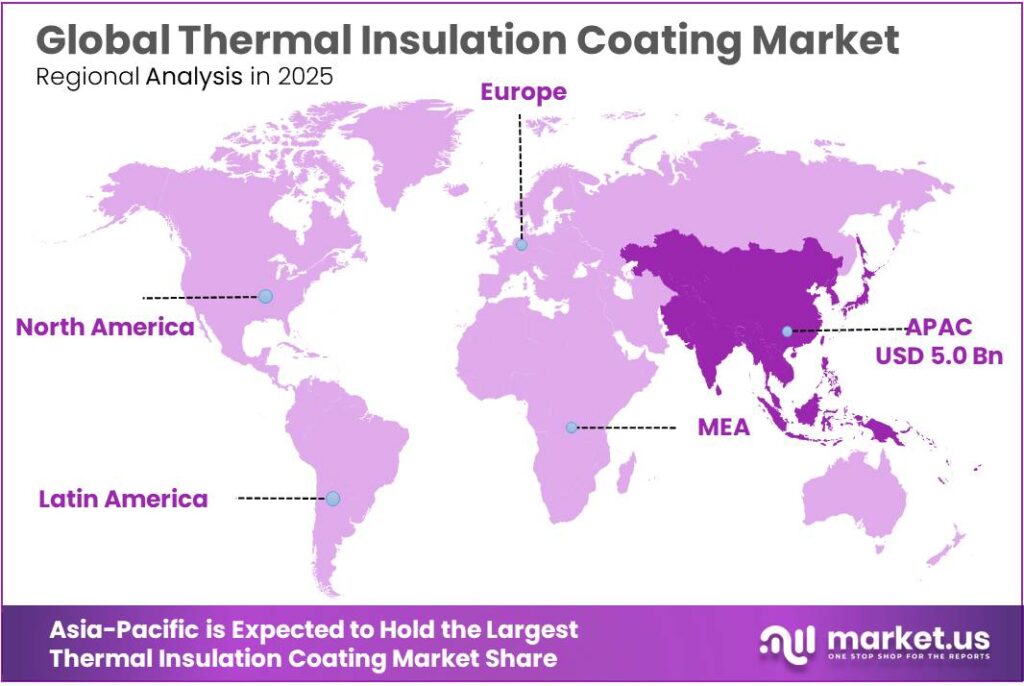
The global thermal insulation coating market is projected to reach USD 32.5 billion by 2035, up from USD 11.4 billion in 2025, growing at a CAGR of 11.2% from 2026 to 2035. In 2025, Asia Pacific held the leading market position, accounting for more than 44.4% share and generating around USD 5.0 billion in revenue. The region’s strong growth is supported by rapid industrialization, infrastructure development, and rising focus on energy-efficient solutions.
Thermal insulation coatings are widely used as specialized energy-saving and asset-protection materials across industries such as process manufacturing, commercial buildings, transport equipment, and cold-chain logistics. These coatings are especially valuable in areas where traditional insulation materials are difficult to install, such as tanks, valves, pipelines, ducts, and complex industrial vessels. Their spray-applied nature makes them suitable for difficult shapes while also reducing maintenance challenges.
Get a comprehensive report summary that describes the value and forecast along with methodology. Download the PDF brochure
The industrial need for these coatings remains strong because a large portion of industrial energy is lost as heat. In manufacturing environments, thermal insulation coatings are increasingly being adopted not only to reduce heat loss, but also to improve worker safety, minimize corrosion under insulation, and support equipment uptime. Their ability to deliver thermal control without requiring bulky cladding systems makes them highly suitable for retrofit projects.
The current market is also being driven by rising energy costs and stricter energy-efficiency regulations. Industries are increasingly investing in retrofit-friendly insulation coatings to meet energy-saving goals while avoiding long shutdown periods. This is particularly beneficial for factories and utility-intensive facilities looking to lower operating costs and improve sustainability performance.
A major demand driver is the food and beverage processing sector, where temperature control directly impacts product quality, refrigeration efficiency, and hygiene standards. Thermal insulation coatings help reduce condensation, improve worker safety, and maintain stable thermal performance in cold storage units, processing lines, and packaging facilities. As food supply chains continue to expand, the need for effective thermal control solutions is rising steadily.
Government policies are also creating a positive growth environment for the market. Stronger energy-efficiency mandates in Europe and increasing industrial technology funding in the United States are encouraging industries to adopt advanced insulation solutions. These initiatives are expected to further support the use of thermal insulation coatings in factories, cold-chain systems, and process heating applications over the coming years.
Top Market Takeaways
- Thermal Insulation Coating Market size is expected to be worth around USD 32.5 Billion by 2035, from USD 11.4 Billion in 2025, growing at a CAGR of 11.2%.
- Acrylic held a dominant market position, capturing more than a 36.7% share.
- Building & Construction held a dominant market position, capturing more than a 39.6% share.
- Asia-Pacific held the dominant position in the thermal insulation coating market, accounting for 44.4% of global revenue and reaching nearly USD 5.0 billion.
Scope and Research Methodology
The thermal insulation coating market report covers special coating materials used to reduce heat transfer and improve energy efficiency across industrial, commercial, and residential applications. These coatings are commonly used on pipelines, storage tanks, roofs, walls, ducts, vessels, and processing equipment where traditional insulation is difficult to apply.
The study includes analysis of market size, growth rate, demand trends, key drivers, restraints, and future opportunities. It also covers segmentation by type of coating, material technology, end-use industry, and regional demand across Asia Pacific, North America, Europe, and other regions. The report also studies the growing use of these coatings in energy saving, corrosion protection, condensation control, and cold-chain applications.
The research methodology uses a combination of primary research and secondary research methods. Primary research includes interviews with coating manufacturers, insulation solution providers, distributors, industry specialists, and end users to understand current market demand, product performance, and application trends.
Secondary research is based on company annual reports, government energy-efficiency guidelines, industrial journals, construction publications, and market databases. This helps collect data related to coating demand, industrial energy use, regulations, and regional construction activities.
After collecting the data, the information is validated through data triangulation, market forecasting models, and cross-verification from multiple sources. The study uses both qualitative analysis (market trends, regulations, technological developments) and quantitative analysis (market value, CAGR, regional share, and segment growth) to ensure accurate future market projections.
By Product Analysis
In 2025, acrylic coatings led the thermal insulation coating market by product, holding more than 36.7% of the total share. This strong position was driven by their excellent weather resistance and wide use across residential, commercial, and industrial building surfaces. Acrylic-based coatings are widely preferred because they provide a strong combination of durability, UV protection, moisture resistance, and easy application. They can be applied effectively on different surfaces such as concrete, metal, roofs, and exterior walls, making them highly versatile.
By Application Analysis
In 2025, the building and construction segment dominated the thermal insulation coating market by application, accounting for over 39.6% share. This leadership was mainly supported by the increasing demand for energy-efficient building envelopes across residential towers, commercial buildings, warehouses, and public infrastructure projects. Builders are increasingly using insulation coatings on roofs, walls, and façades to improve indoor temperature control and reduce energy costs, while also avoiding the added structural weight of traditional insulation systems.
Regional Analysis: Asia Pacific
In 2025, Asia Pacific led the global thermal insulation coating market, capturing 44.4% of total revenue and reaching nearly USD 5.0 billion. The region’s dominant position is mainly driven by rapid urban development, expanding industrial infrastructure, and growing energy-efficiency regulations across major countries such as China, India, Japan, South Korea, and Southeast Asia.
The region continues to see strong demand for thermal control and energy-saving coating solutions across residential towers, logistics parks, factories, warehouses, and commercial buildings, where cooling efficiency and heat management are becoming key cost priorities. This positive growth trend is expected to continue, with the Asia Pacific thermal insulation coating market projected to reach USD 5,304.6 million by 2030, growing at a 7.1% CAGR from 2025 to 2030.
Key Regions and Countries
- North America
- The US
- Canada
- Europe
- Germany
- France
- The UK
- Spain
- Italy
- Russia & CIS
- Rest of Europe
- APAC
- China
- India
- Japan
- South Korea
- ASEAN
- Rest of APAC
- Latin America
- Brazil
- Mexico
- Rest of Latin America
- Middle East & Africa
- GCC
- South Africa
- Rest of Middle East & Africa
Top Key Players
- Evonik Industries AG
- Mascoat
- Carboline
- Nippon Paint Holdings Co., Ltd.
- Akzo Nobel N.V.
- PPG Industries, Inc.
- The Sherwin-Williams Company
- Kansai Paint Co., Ltd.
- Grand Polycoats Company Pvt. Ltd.
- Sika AG
Recent Developments
In 2025, Evonik generated €14.1 billion in total revenue, with operations spanning more than 100 countries and production facilities in 27 countries. This wide global footprint gives the company a strong and reliable supply network for raw materials used in insulation-related and specialty coating applications. Its large-scale presence also supports consistent product availability across regional markets.
In the same year, AkzoNobel reported €10,158 million in total revenue, including €6,068 million from Performance Coatings and €4,090 million from Decorative Paints, both of which are highly relevant to insulation and reflective coating solutions. The company also achieved €1,444 million in adjusted EBITDA with a 14.2% margin, highlighting its strong financial position to support product innovation, advanced coatings, and thermal management technologies.
Report Scope
| Report Features | Description |
|---|---|
| Market Value (2025) | USD 11.4 Bn |
| Forecast Revenue (2035) | USD 32.5 Bn |
| CAGR (2026-2035) | 11.2% |
| Base Year for Estimation | 2025 |
| Historic Period | 2020-2024 |
| Forecast Period | 2026-2035 |
| Report Coverage | Revenue Forecast, Market Dynamics, Competitive Landscape, Recent Developments |
| Segments Covered | By Product (Acrylic, Epoxy, Polyurethane, YSZ, Mullite), By Application (Building And Construction, Automotive And Transportation, Aerospace And Defense, Manufacturing, Others) |
| Regional Analysis | North America – US, Canada; Europe – Germany, France, The UK, Spain, Italy, Rest of Europe; Asia Pacific – China, Japan, South Korea, India, Australia, Singapore, Rest of APAC; Latin America – Brazil, Mexico, Rest of Latin America; Middle East & Africa – GCC, South Africa, Rest of MEA |
| Competitive Landscape | Evonik Industries AG, Mascoat, Carboline, Nippon Paint Holdings Co., Ltd., Akzo Nobel N.V., PPG Industries, Inc., The Sherwin-Williams Company, Kansai Paint Co., Ltd., Grand Polycoats Company Pvt. Ltd., Sika AG |
| Customization Scope | Customization for segments, region/country-level will be provided. Moreover, additional customization can be done based on the requirements. |