









Beginning
Remote Work Statistics: Remote work has changed the way people and businesses work. What started as a response to the pandemic has now become a regular part of the modern workplace. Many companies offer remote or hybrid jobs to attract skilled employees, improve productivity, and support a better work-life balance. At the same time, workers value the flexibility to choose where they work, making remote work an important factor when accepting or staying in a job.
This article shares the latest remote work statistics on employee preferences, hiring trends, salaries, productivity, workplace well-being, and business impact. These insights show how remote work continues to shape the future of jobs and workplaces in 2026.
Best Overall
- Remote work continues to gain strong support, with 91% of employees reporting a positive experience and 97% wanting to work remotely throughout their careers.
- Around 52% of full-time employees work in a hybrid model, while 27% work fully remotely.
- 76% of employees would consider changing jobs if remote work flexibility were removed.
- Remote employees earn about 12% more than office workers, with average annual salaries of USD 74,000 versus USD 55,000.
- Productivity remains high, with 84% of employees and employers reporting better performance in remote or hybrid settings, including an average 13% increase in productivity.
- About 71% of remote workers say flexibility improves work-life balance, although 69% still experience burnout.
- Companies mainly adopt remote work to expand their talent pool (41%) and improve hiring and retention (29%).
- Experienced professionals account for 65% of remote job postings, while only 6% target entry-level candidates.
Remote Work Adoption and Employee Preferences
- According to Achievers, around 27% of full-time employees worldwide work remotely, while 52% follow a hybrid work model.
- The United States is expected to have 36.2 million remote workers, representing a 417% increase compared to pre-pandemic levels.
- About 23% of employees say workplace flexibility influences whether they stay with or leave their current employer.
- Nearly 76% would consider leaving their jobs if remote-work flexibility were removed.
Productivity and Business Performance
- Employees who choose to work on-site are 33% more likely to receive training that encourages proactive work habits.
- 30% of remote employees complete more work in less time, while 20% say flexible work improves their performance.
- 84% believe they are more productive in remote or hybrid work settings.
- Around 78% of managers report that their remote teams meet or exceed performance goals.
Employee Engagement and Workplace Culture
- Employee engagement is higher among remote workers, with 38% reporting high engagement compared with 19% of office workers.
- Remote employees are 21% more likely to receive recognition training and 33% more likely to recommend their managers.
- About 29% of fully remote employees are engaged, compared with 20% of on-site workers.
- Nearly 77% of remote employees maintain or exceed the productivity levels of office-based workers.
Remote Work, Burnout, and Employee Development Statistics
- According to Flair.hr, around 86% of full-time remote employees report experiencing burnout, showing the need for better work-life boundaries.
- Employees who choose hybrid work are 24% more likely to say their managers support their career growth.
- Remote employees are 23% more likely to receive stress management training.
- Organizations with remote teams are 42% more likely to provide technical skills training for managers.
- Moreover, remote employees are 19% more likely to see fair internal career opportunities, while hybrid employees are 26% more likely to believe they have good growth and development opportunities.
Remote Work Adoption Statistics
- Before COVID-19, only 15% of employees worked from home.
- During the pandemic, this increased to nearly 30%, and about 30% of employees still work remotely at least part of the time today.
- Fully remote workers now represent around 7% of the workforce, according to Toggl.
- In the United States, approximately 25% of all paid workdays are now completed from home.
- Among remote-capable employees, 55% follow a hybrid work model, 26% work fully remotely, and 19% work entirely on-site. Before the pandemic, 60% worked only from the office.
- Younger employees are more likely to work in hybrid roles, with 31% of workers in their 20s and 30s choosing hybrid work, compared with 20% of employees in their 50s and 60s.
- Among older workers, 66.6% work fully on-site, while 13.3% work fully remotely.
Importance of Remote Work by H.R. Leaders
(Source: payscale.com)
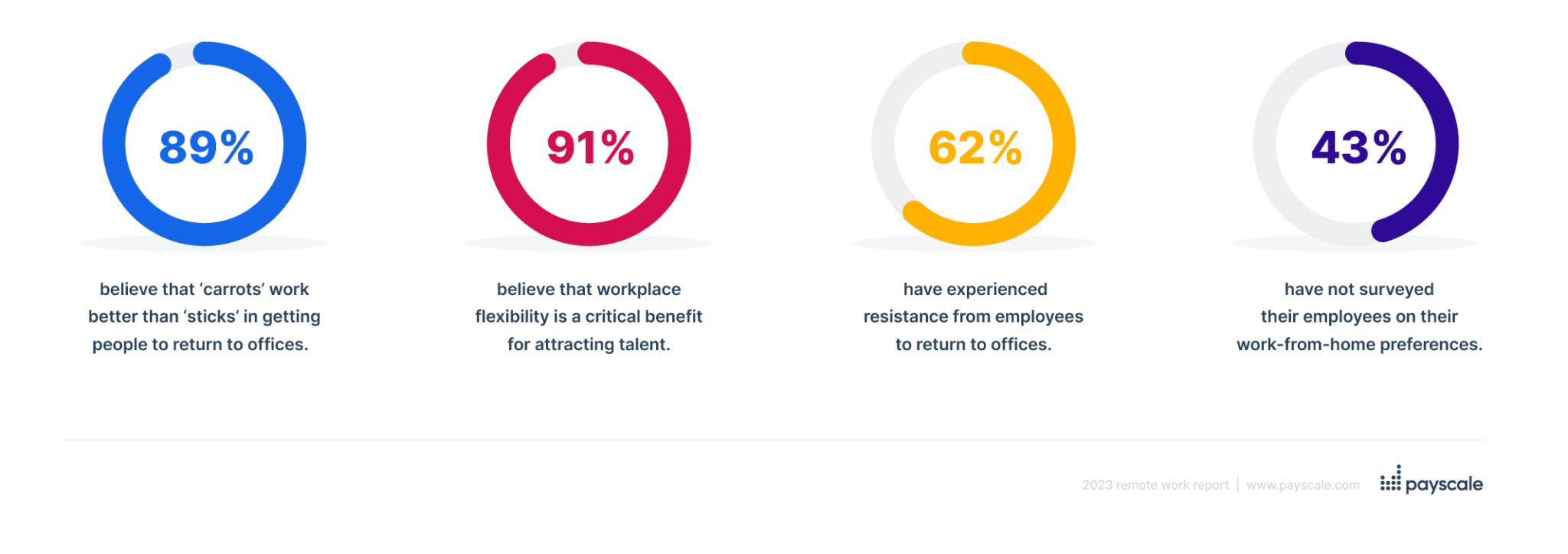
- 89% of H.R. leaders believed that ‘carrots’ work better than ‘sticks’ to motivate employees to return to their offices.
- For attracting talent, 91% of HR leaders believed that workplace flexibility is an effective benefit for employees.
- In returning remote workers to offices globally, 62% of HR leaders have experienced resistance from employees.
- Regarding employees’ work-from-home preferences, 43% of HR leaders never surveyed.
(Reference: usatoday.com)
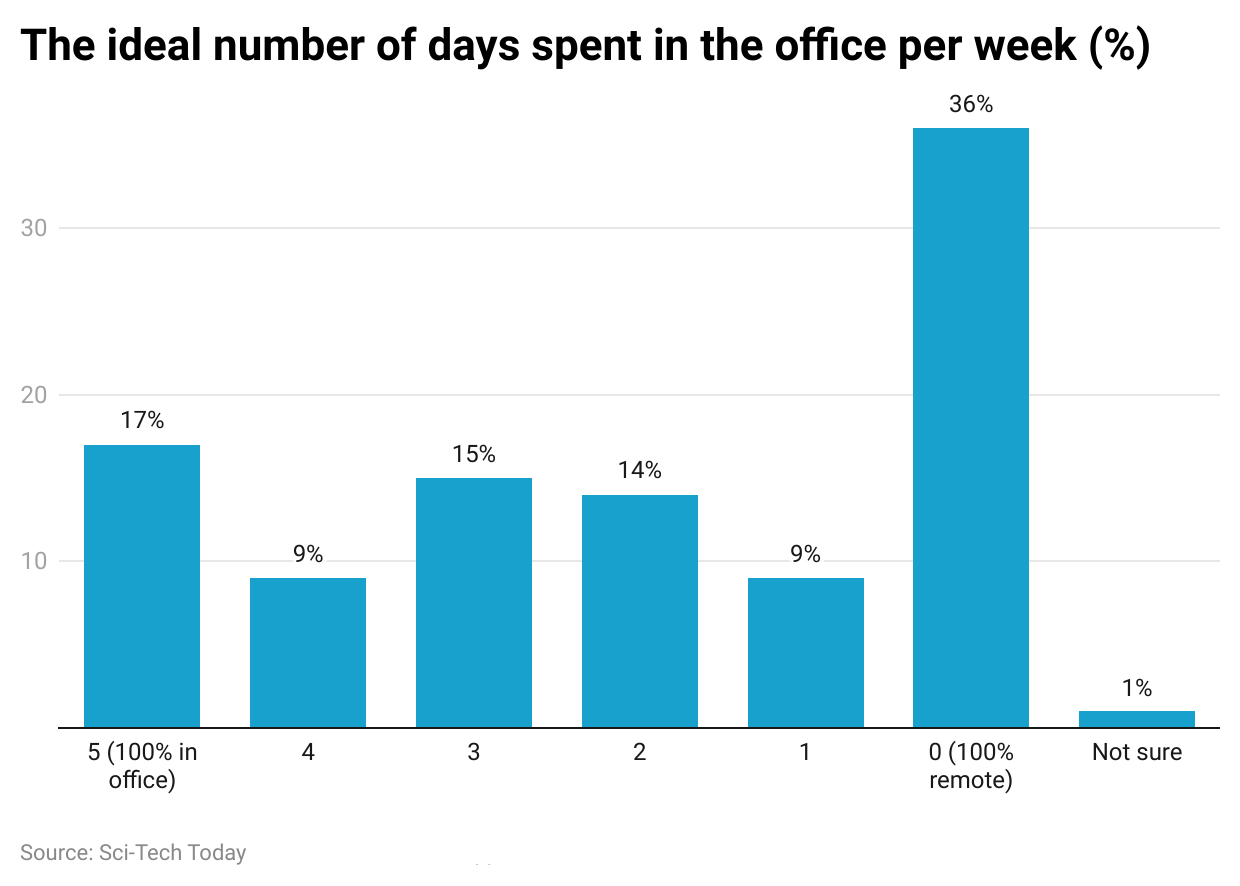
- As represented in Remote Work Statistics 2024, only 17% of in-office U.S. employees worked 5 days a week.
- In addition, 36% of American employees are willing to work from home in 2024 and beyond.
- 9% of employees worked 4 days in-office and 1 day remotely, while others include 15% of employees: in-office (3) & remotely (2).
- 14% of employees: in-office (2) & remotely (3).
- 9% of employees: in-office (1) & remotely (4).
Remote Work Preferences and Employee Engagement
- According to Backlinko, around 36% of U.S. employees prefer to work fully remotely, while 28% favor a hybrid model and 27% prefer working entirely from the office.
- About 64% of fully remote employees say they would look for a new job if remote work flexibility were removed.
- Employee engagement is highest among hybrid workers at 36%, followed by on-site employees in remote-capable roles (33%), fully remote employees (32%), and on-site employees in non-remote-capable roles (27%).
Geographic Differences in U.S. Hybrid and Remote Work
- Oregon has the highest share of fully remote jobs, with 10% of all job openings offering remote work.
- The District of Columbia leads the nation in hybrid work, with 11% of available jobs using a hybrid model.
- Mississippi, West Virginia, and South Carolina remain the most office-focused states, with 94% of open positions requiring on-site work.
- Blue states offer greater workplace flexibility, with an average of 7% hybrid job postings, compared with 4% in red states.
- Among major cities, Detroit has the highest share of fully remote jobs at 8%, San Antonio has the largest share of in-office roles at 92%, and San Francisco leads hybrid work with 18% of openings.
- New York remains one of the least remote-friendly cities, with only 4% of jobs being fully remote.
United States Hybrid and Remote Work Trends by Professional Field
(Reference: roberthalf.com)
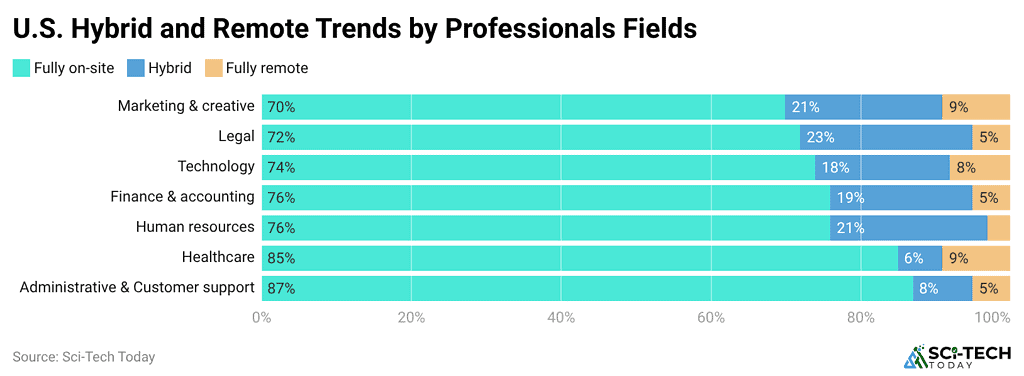
- Robert Half analyzed U.S. job postings across more than 450 job titles to measure hybrid and remote work trends.
- Marketing & Creative offers the most flexibility, with 21% hybrid and 9% fully remote jobs, giving it the highest combined share of flexible roles at 30%.
- Legal ranks second, with 23% hybrid and 5% fully remote roles, for a total of 28% flexible positions.
- Technology records 18% hybrid and 8% fully remote jobs, for a combined flexibility of 26%.
- Finance & Accounting and Human Resources each have 24% of roles as flexible. Finance & Accounting includes 19% hybrid and 5% remote jobs, while Human Resources has 21% hybrid and 3% remote positions.
- Healthcare provides 6% hybrid and 9% remote roles (15% total), while Administrative & Customer Support has the lowest flexibility at 13%, including 8% hybrid and 5% remote jobs.
Working Modes Share by Industry in the U.S., 2026
| Industry | Fully on‑site | Hybrid | Fully remote |
| Information (incl. part of tech) | 28% | 49% | 22% |
| Finance and insurance | 32% | 38% | 30% |
| Professional and business services | 41% | 36% | 23% |
| Arts and entertainment | 47% | 35% | 19% |
| Wholesale trade | 54% | 34% | 12% |
| Real estate | 54% | 36% | 9% |
| Utilities | 57% | 21% | 23% |
| Government | 57% | 26% | 17% |
| Health care and social assistance | 58% | 24% | 18% |
| Construction | 67% | 28% | 5% |
| Education | 69% | 22% | 9% |
| Manufacturing | 71% | 23% | 6% |
| Retail trade | 73% | 19% | 7% |
| Transportation and warehousing | 76% | 18% | 6% |
| Hospitality and food services | 79% | 16% | 5% |
Remote Work and Salary Comparison Statistics
- A 2026 analysis by the Federal Reserve Bank of San Francisco found that remote employees earn 12% more on average than on-site employees, according to Toggl.
- Before adjusting for factors such as education and occupation, employees working from home earn 35.2% higher hourly wages than fully office-based workers.
- According to Forbes Advisor, the average annual salary for remote employees is USD 74,000, compared with USD 55,000 for office employees, creating a pay difference of USD 19,000.
- Besides, remote employees continue to earn around 13.3% higher hourly wages than on-site workers, even after demographic adjustments.
Payment Methodologies Before and After the Pandemic
(Source: payscale.com)
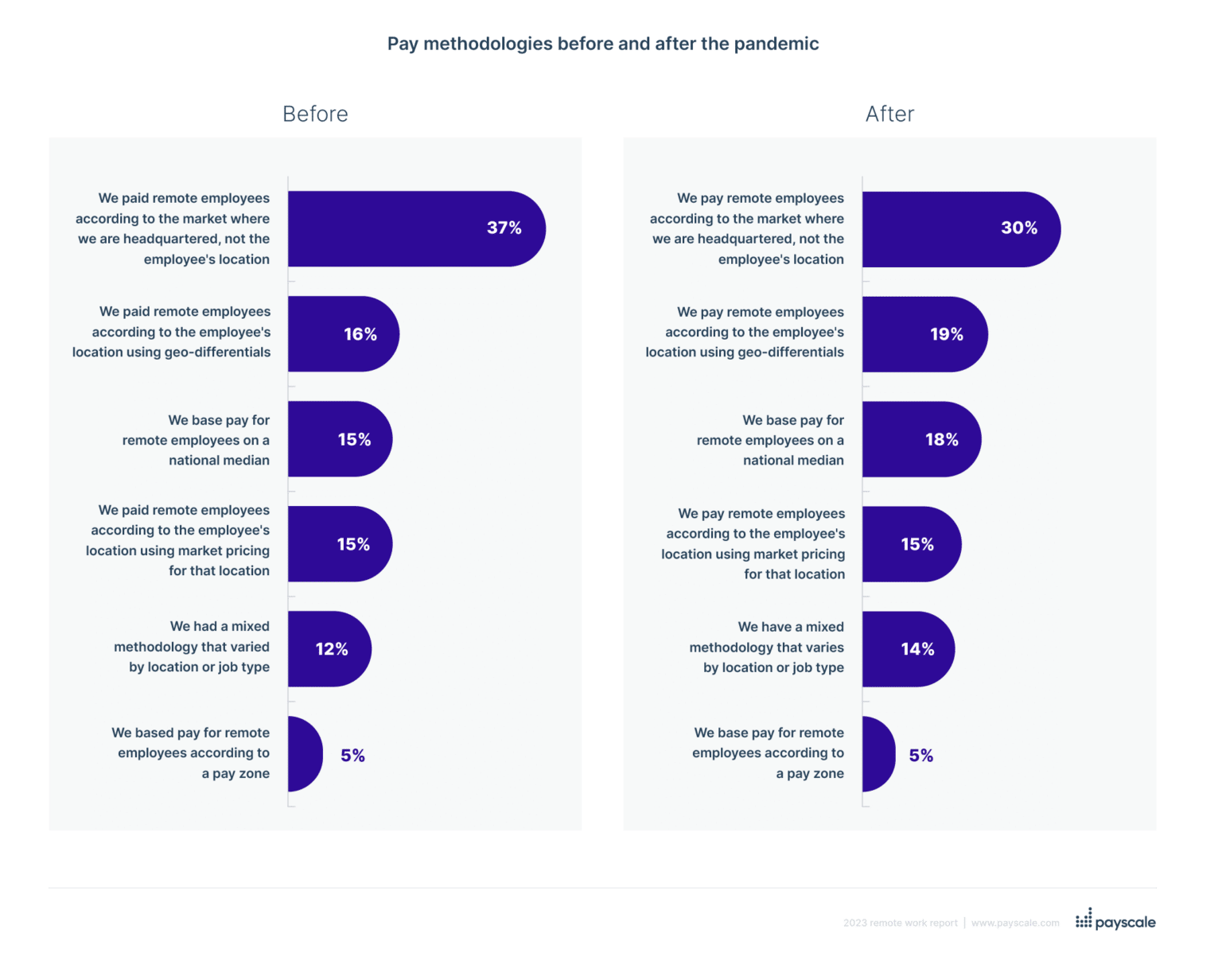
- Remote Work Statistics also mentioned that 37% and 30% of organizations, respectively, paid their employees based on the market, not the employee’s location, before and after the pandemic.
- Before and after the pandemic, 16% and 19% of organizations paid employees based on their location using geo-differentials.
- Depending on the national median, before the pandemic, 15% of worldwide companies paid their employees, and now it is done by 18% of companies.
- As per employee location using market pricing, 15% of organizations paid their employees before and after the pandemic.
- 12% of organizations’ payment methodologies were mixed by location and type of job before the pandemic, and 14% of organizations’ payment methodologies were mixed after the pandemic.
- Salaries of remote employees were based on the pay zone, as claimed by 5% of companies both before and after.
Remote Work Demographics Statistics by Age
- According to bls.gov, in March 2026, around 22.6% of US employees worked remotely.
- Telework rates were 6.7% for workers aged 16-24, 25.1% for those aged 25-54, and 24.1% for employees aged 55+.
- Workers aged 35-44 recorded the highest remote work rate at 27.4%.
By Gender and Ethnicity
- Women were more likely to work remotely than men, with telework rates of 24.9% and 20.5%, respectively.
- Remote work was most common among Asian workers (31.1%), followed by White workers (23.2%), Black workers (16.1%), and Hispanic workers (13.1%).
By Education
- Employees with advanced degrees had remote work rates of 41.2%- 43.6%, while those with a bachelor’s degree or higher had a rate of 38.3%.
- Telework rates declined to 15%-18.4% among workers with some college education, 7%-9.1% among high school graduates, and 3.1%-4.4% among those without a high school diploma.
By Income
- In 2026, remote jobs were most common in the USD 125,000-150,000 salary range, with 9% of roles remote and 9% hybrid.
- Below USD 60,000, only 3% of jobs were remote, and 2% were hybrid.
- Senior-level positions offered the greatest flexibility, with 31% hybrid and 14% fully remote roles.
By New Job Opportunities
(Reference: payscale.com)
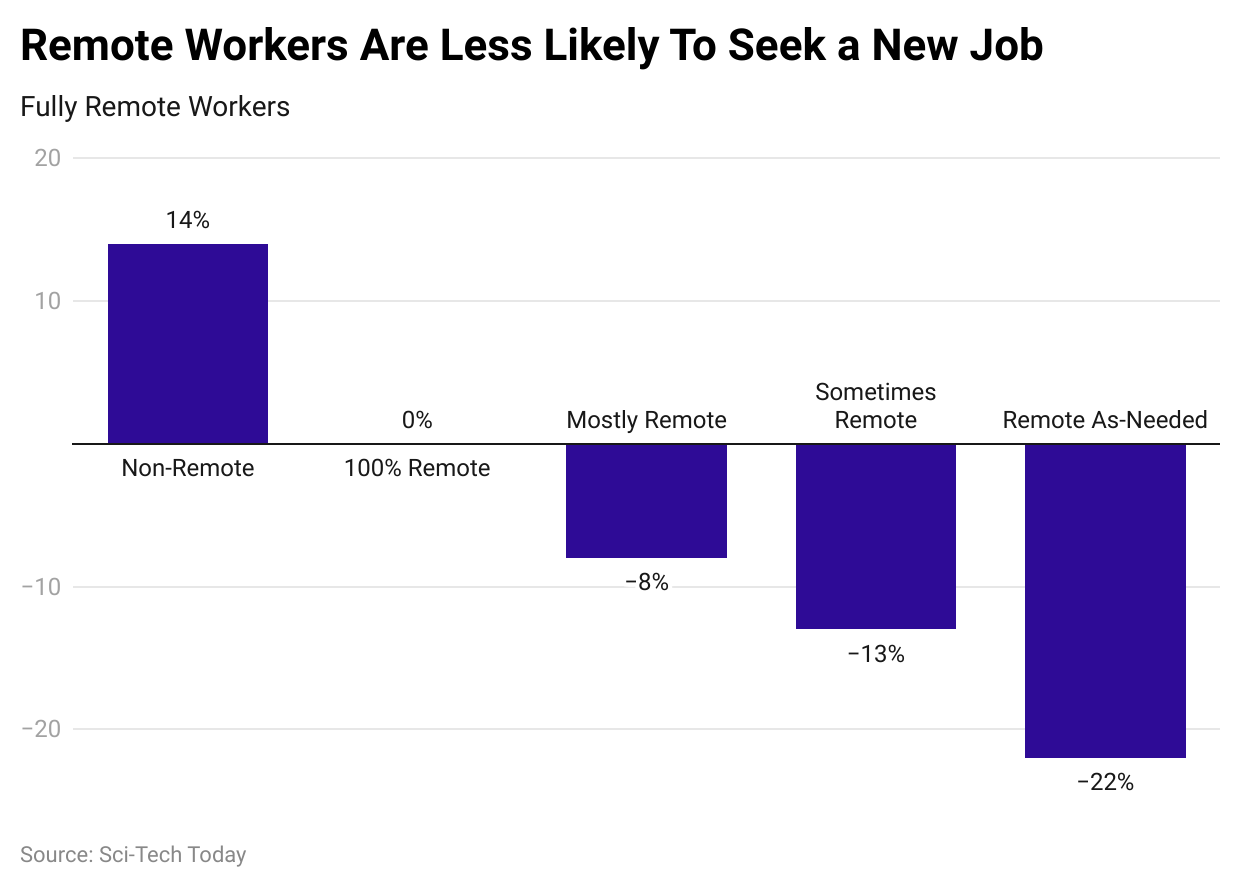
- A report published in 2023 by Payscale states that 100% of fully remote employees never thought about a new job.
- Based on remote work statistics, most remote employees are 8% less likely to seek a new job than fully remote employees.
- Almost 14% of non-remote employees are more likely to seek a new job than those who work from home all the time.
- In contrast, employees who work from home are always 13% less likely to leave their jobs than on-site workers.
- Remote as-needed employees are 32% less likely than on-site employees to seek a new job opportunity.
Remote Work Tools Statistics
(Reference: buttercms.com)
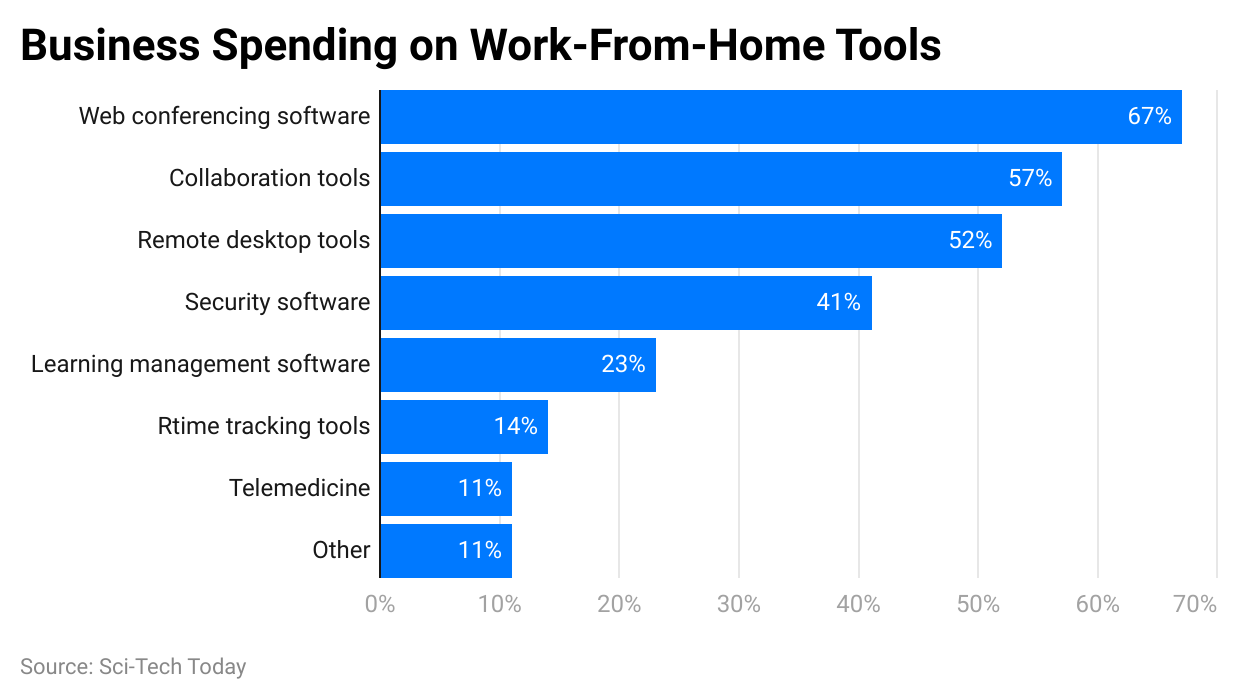
- Remote Work Statistics show that 67% of businesses will spend money on web conferencing software for managing remote employees in 2024.
- Furthermore, other work tools used by a share of businesses are followed by collaboration tools (57%), remote desktop tools (52%), security software (41%), learning management software (23%), time tracking tools (14%), telemedicine (11%), and others (11%).
By Pay Cut
- In 2023, 65% of American remote workers would likely give up a 5% pay cut just to stay and work from home.
- Meanwhile, in the United States, 38% of employed individuals would pay 10% of their annual salary to work remotely.
- In contrast, other American workers who give up pay cuts for working from home are followed by 24% (15% pay cut), 18% (20% pay cut), and 15% (25% pay cut).
Employers’ Monitoring Worker Statistics
- Based on Remote Work Statistics, 58% of work-from-home employees have claimed that monitoring systems are blocking certain content, and that the app is fine but intrusive.
- Almost 21% of employees agreed with the tracking activities of employers, but sometimes it makes them uncomfortable.
- Only 5% of remote workers agree with the practice of employers monitoring systems.
- Furthermore, 11% of remote workers disagree with the practice, and 5% are still unsure about it.
Remote Work Job Listing Statistics
(Source: demandsage.com)
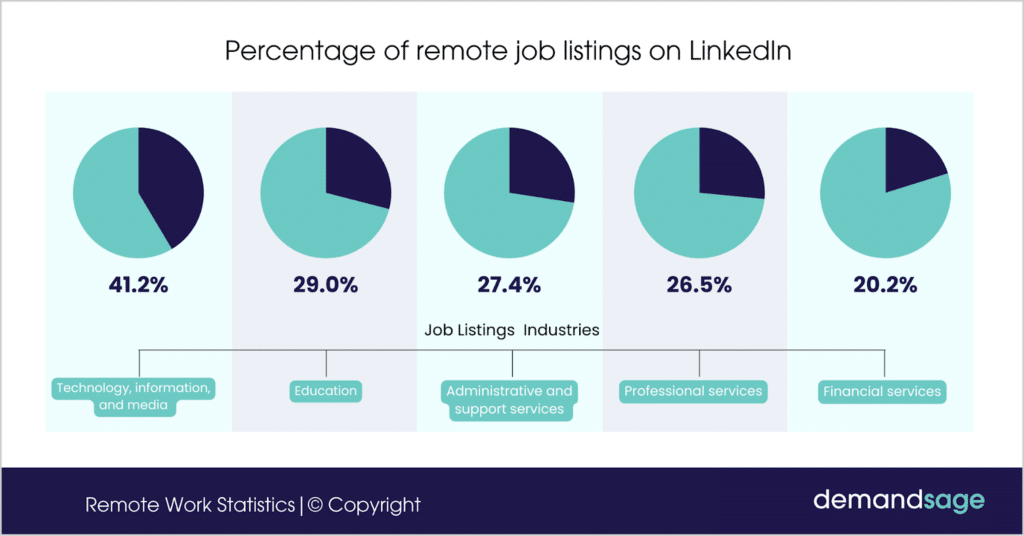
- On LinkedIn, 41.2% of remote jobs are available in the technology, information, and media industries.
- The second and third top industries by share of remote jobs are Education (29%) and Administrative and support services (27.4%).
- 5% and 20.2% of remote jobs were available on LinkedIn in professional services and financial services, respectively.
Remote Work Statistics by Overall Satisfaction
- Pollack Peace Building Research shows that remote work remains highly popular: 91% of remote employees describe their experience as positive, and 97% would recommend remote work and want to continue working remotely throughout their careers.
- Survey findings reveal that 38% of employees changed their preferred work arrangement after the pandemic. Among them, 23% want more remote opportunities, 14% prefer more in-office time, and 37% would work from another country if their employer allowed it.
By Well-Being, Productivity, and Burnout
- Remote work continues to improve employee well-being. Around 74% say they feel happier working remotely, 77% rate their mental well-being at 7/10 or higher (average 7.7), 69% report better work-life balance, and 70% say their stress levels have declined.
- Despite these benefits, 69% of remote workers report burnout, while about 33% say they are close to reaching burnout.
- Remote employees work about 10% longer than office workers, adding roughly 4 hours per week, or 16 hours per month. They also save 72 minutes daily by avoiding commuting, with 40% of that time spent on work and 60% on personal activities.
- Productivity remains strong, with 77% of employees reporting higher productivity and employers recording an average 13% productivity gain. However, 33% struggle to separate work from personal life.
By Career Growth and Return-to-Office Views
- 48% believe return-to-office mandates are driven by micromanagement, while 29% would look for a new job if required to work fully on-site.
- Experienced professionals dominate remote hiring, accounting for 65% of remote job postings, while only 6% target entry-level workers, making remote opportunities less accessible for early-career employees.
How Much Workers Would Sacrifice for Remote and Hybrid Work
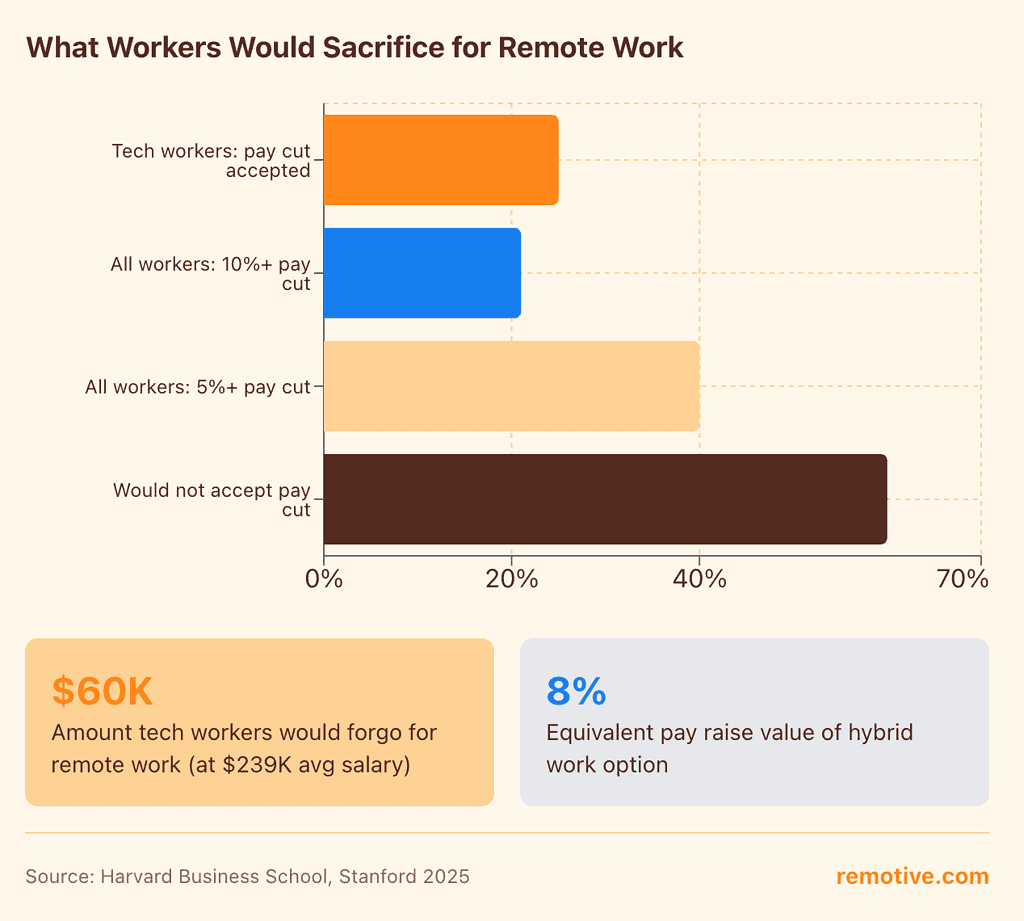
- Research from Harvard Business School’s Zoë Cullen finds that tech workers are willing to give up as much as 25% of their total pay to avoid commuting five days a week.
- With an average tech salary of USD 239,000, this means they would sacrifice about USD 60,000 to keep remote or hybrid flexibility.
(Source: remotive.com)
- In the broader workforce, 40% of workers say they would accept a 5% or greater pay cut in exchange for remote work.
- Within this group, 21% of workers are willing to take a 10% or greater pay cut to work remotely.
- At the same time, around 60% of workers report they would not accept any pay cut, showing that salary still matters more than flexibility for most people.
- The study also estimates that gaining a hybrid work option is worth about an 8% pay raise in perceived value.
Remote Hiring Statistics
- In a survey published by Intuition, 65% of employees in recent years wanted to become full-time remote workers.
- As mentioned in Remote Work Statistics by Owl Labs, remote employees never wanted to return to the office after the pandemic.
- American companies that provide remote work facilities are experiencing 25% lower employee turnover.
- U.S. organizations that enable remote work are more likely to be chosen by 71% of employees.
- In recent years, a hybrid remote work environment has always been preferred by 31% of remote workers.
- In 2024, hiring full-time remote employees is 2 times more likely in small companies than in large companies.
- Around 64% of recruiters want to find high-quality talent only by enabling remote work facilities.
- Flexible working schedules help 80% of companies’ employees stay loyal, and their employees are less likely to leave their jobs.
Top Reasons Driving Remote Workplaces
- According to Remote Work Statistics 2024, the top three reasons for driving remote workplaces are broadening the talent pool (41%), differentiating benefits for attracting and retaining talent (29%), and increasing productivity (9%).
- Furthermore, other reasons shared for driving remote workplaces are reduced costs from office equipment or real estate (9%), improving mental health (7%), diversity, equity, inclusion, and belonging (2%), environmental benefits (2%), lower salaries (2%), and 24/7 availability of workers (1%).
The Boom of Remote Work
The COVID-19 pandemic undoubtedly acted as a catalyst for remote work. With lockdowns and social distancing measures in place, many businesses were forced to adapt and allow employees to work from home. This large-scale experiment proved successful for many organizations, with studies showing that productivity did not suffer and, in some cases, even improved.
Even as pandemic restrictions eased, the remote work trend continued. As of March 2024, a significant portion of the workforce enjoys some level of remote work flexibility:
- 58% of employed Americans report having the option to work from home at least part of the week. This translates to roughly 92 million people across various industries and job types.
- 35% of workers say they can work from home full-time, and another 23% can do so part-time.
The Hybrid Model Takes Center Stage
While some companies have embraced fully remote work, a hybrid model seems to be the sweet spot for many. This approach combines working from home with designated days spent in the office. Here’s a breakdown of the work arrangement preferences:
- 26% of full-time employees work in a hybrid model.
- 36% of job seekers prefer hybrid roles, with 29% favoring fully remote positions.
This preference for flexibility makes sense. Remote work offers several benefits, including:
- Improved work-life balance: 51% of employees believe remote work helps them achieve this balance. This can be due to factors like skipping the commute and having more control over their schedules.
- Increased productivity: Studies have shown that remote workers can be just as productive, or even more productive, than their in-office counterparts. This can be attributed to fewer distractions and the ability to work during their most focused hours.
- Cost savings: Employees save money on commuting expenses like gas and public transportation. Companies can also save on office space overhead.
- Wider talent pool: Companies aren’t limited by geographical location when hiring remote workers, allowing them to tap into a broader pool of qualified candidates.
Key Benefits of Remote Work
- Around 71% of U.S. remote employees say working from home improves work-life balance, while 56% believe it helps them complete tasks and meet deadlines.
- Employee engagement remains positive, with 35% feeling very engaged, 23% somewhat engaged, 12% neutral, 16% somewhat unengaged, and 14% very unengaged.
- The biggest advantages include flexible time management (22%), freedom to choose where to live (19%), and the ability to work from any location (13%).
(Source: backlinko.com)
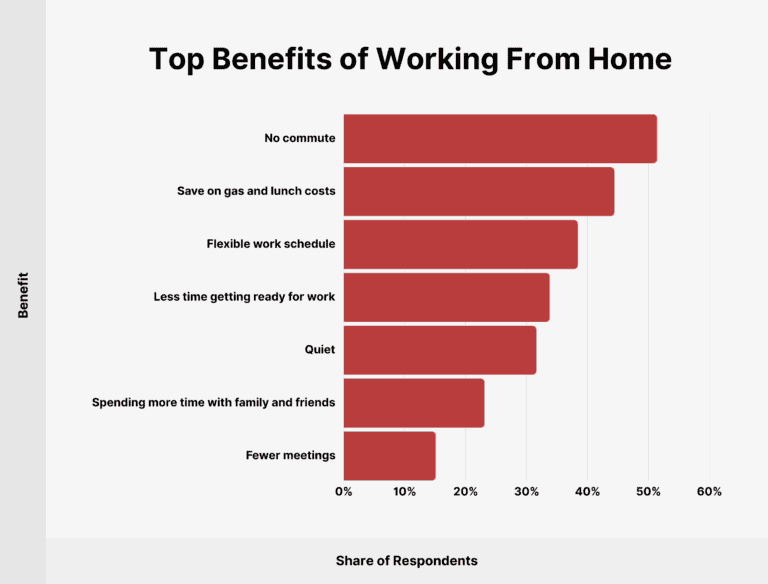
- Other major benefits are no daily commute (51.4%), savings on travel and lunch costs (44.4%), flexible schedules (38.4%), less time getting ready (33.8%), quieter workspaces (31.6%), more family time (23.1%), and fewer meetings (15.1%).
Impact of Remote Work
- According to Gallup, 64% of remote employees use their time more efficiently, while 61% report less fatigue and burnout.
- Moreover, 70% of managers believe remote or hybrid work improves team productivity, while only 12% think it reduces productivity.
- By 2025, 80% of women and 52% of men considered remote work important when choosing a job.
How Remote Work Improves Employee Happiness, 2026
- According to Pumble research, remote and hybrid work improves work-life balance (67%), employee satisfaction (54%), retention (45%), and overall well-being (44%).
- Around 84% of hybrid employees ate healthier meals while working from home, and 51% achieved a better work-life balance.
- Besides, 71% of employees believe flexible working hours improve their quality of life, while 25% are willing to accept a 15% pay cut for greater flexibility.
- Employees value remote work for its flexible schedule (22%), greater control over their time (19%), and the freedom to choose where they work (13%).
The Economic Value of Workplace Flexibility in 2026
- Meanwhile, a 33% fall in resignations linked to flexible schedules is significantly reducing recruitment and onboarding expenses.
- According to fueler.io, employers save about USD 11,000 per year per half‑time remote worker and about USD 19,000 per year per employee in fully remote firms.
- Around 95% of employers report that remote options strongly support retention, and 43% of employees say they may quit if forced back to the office.
- Employees value hybrid work as equal to an 8% pay raise, and 37% are willing to accept a 10% pay cut to retain remote status.
- Mid‑to‑large companies are cutting office space costs by 10%-50%.
- Meanwhile, a 33% fall in resignations linked to flexible schedules is significantly reducing recruitment and onboarding expenses.
Ending
Remote work is no longer a temporary trend; it’s a fundamental shift in the way we work. As technology evolves and employee expectations change, companies that embrace flexibility will be better positioned to attract and retain talent.
Understanding the statistics, trends, and challenges associated with remote work will be crucial for businesses to navigate this new landscape and build successful remote work models.
FAQ
You need a reliable computer, high-speed internet, a webcam, a headset, a comfortable desk and chair, and essential software tools.
Train managers in communication, trust, performance tracking, empathy, collaboration tools, and regular feedback to lead remote teams effectively.
Remote work improves work-life balance by offering flexibility, reducing commuting, and giving employees more personal time overall.

Sources