









Introduction
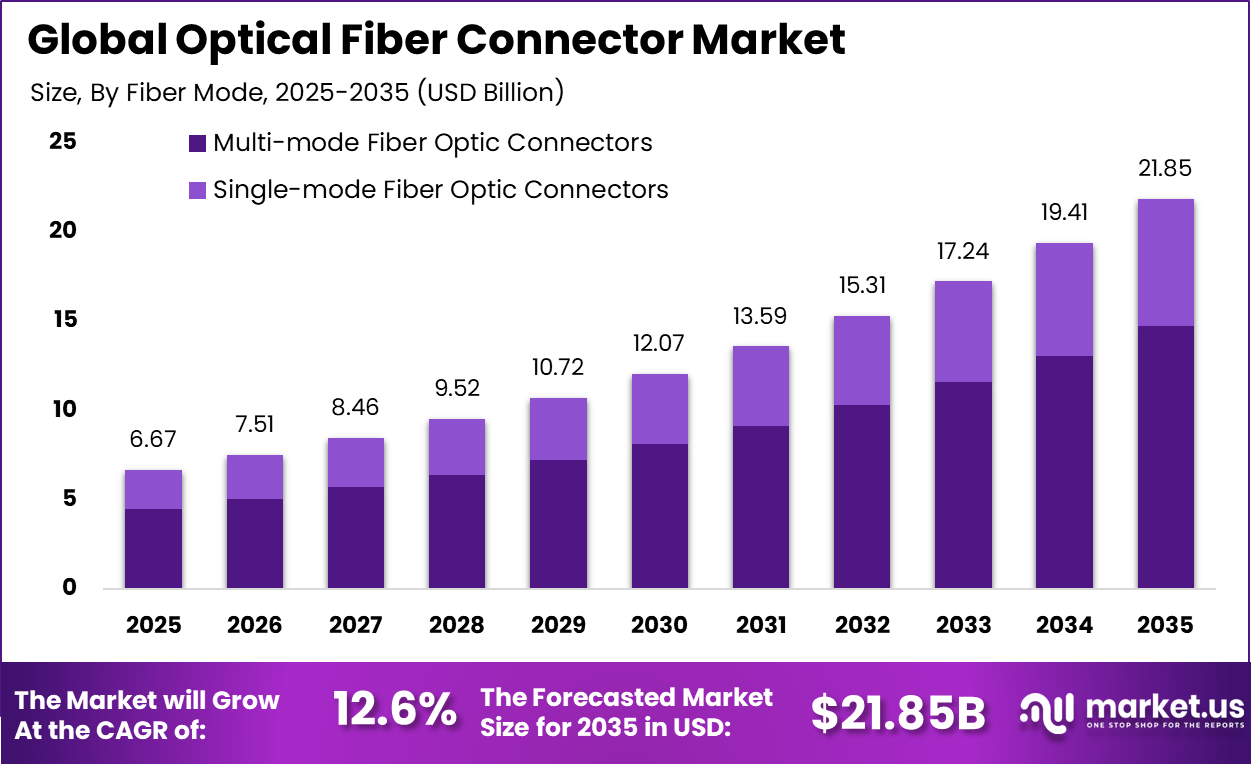
The Global Optical Fiber Connector Market is projected to reach USD 21.85 billion by 2035, up from USD 6.67 billion in 2025, expanding at a CAGR of 12.6%. Growth is fueled by rapid expansion of high-speed networks, data center investments, and rising demand for reliable fiber connectivity. North America leads with 39.3% share, generating USD 2.62 billion in 2025, supported by strong telecom infrastructure and early adoption of advanced networking technologies.
Request For Sample Report Here @ https://market.us/report/optical-fiber-connector-market/request-sample/
Market Overview
According to Market.us, the Optical Fiber Connector Market is experiencing robust growth as global demand for high-speed, low-latency communication networks continues to rise. The increasing deployment of 5G networks, expansion of hyperscale data centers, and growing reliance on cloud-based services are significantly driving the need for efficient fiber connectivity solutions. Optical fiber connectors play a crucial role in ensuring seamless signal transmission, minimal data loss, and scalable network infrastructure.
The market is also benefiting from the rising adoption of fiber-to-the-home (FTTH) and fiber-to-the-premises (FTTP) networks, particularly in urban and semi-urban regions. Governments and telecom operators are investing heavily in broadband infrastructure to support digital transformation initiatives. North America maintains its leadership position due to its mature telecom ecosystem, high data consumption, and early deployment of advanced technologies such as 5G and edge computing. The presence of leading network equipment providers and data center operators further strengthens the region’s dominance.
Additionally, the growing demand for high-performance computing, IoT connectivity, and enterprise networking solutions is expanding the application scope of optical fiber connectors across multiple industries. This trend is expected to sustain long-term market growth and innovation.
Key Takeaways
- Market projected to reach USD 21.85 billion by 2035
- Market valued at USD 6.67 billion in 2025
- CAGR estimated at 12.6% during the forecast period
- North America holds 39.3% market share
- North America revenue reached USD 2.62 billion in 2025
- Strong growth driven by 5G deployment and data center expansion
- Increasing adoption of FTTH and high-speed broadband networks
- Rising demand for low-latency, high-bandwidth connectivity solutions
Connect with expert @ [email protected]
Report Scope
| Report Features | Description |
|---|---|
| Market Value (2025) | USD 6.6 Bn |
| Forecast Revenue (2035) | USD 21.8 Bn |
| CAGR (2025-2035) | 12.6% |
| Base Year for Estimation | 2025 |
| Historic Period | 2020-2024 |
| Forecast Period | 2025-2035 |
| Report Coverage | Revenue forecast, AI impact on Market trends, Share Insights, Company ranking, competitive landscape, Recent Developments, Market Dynamics and Emerging Trends |
| Segments Covered | By Connector Type (Standard Connector (SC), Ferrule Core Connector (FC), ST Connector, Lucent Connector (LC), Plastic FOC Connector, Fiber Distributed Data Interface Connector (FDDI), LX-5 Connector, Others), By Fiber Mode (Multi-mode Fiber Optic Connectors, Single-mode Fiber Optic Connectors), By Distribution Channel (Direct Sales, Channel Sales), By End Use Industry (Telecom, Oil & Gas, Utilities/Energy, Transportation, Aerospace & Aviation, Others) |
| Regional Analysis | North America – US, Canada; Europe – Germany, France, The UK, Spain, Italy, Russia, Netherlands, Rest of Europe; Asia Pacific – China, Japan, South Korea, India, New Zealand, Singapore, Thailand, Vietnam, Rest of Latin America; Latin America – Brazil, Mexico, Rest of Latin America; Middle East & Africa – South Africa, Saudi Arabia, UAE, Rest of MEA |
| Competitive Landscape | Broadcom, Fibertronics, Stäubli, Molex, Multicom, Inc., Panduit, Japan Aviation Electronics Industry, Ltd., Amphenol, TE Connectivity, Neutrik, 3M, Belden, Sun Telecom, WAGO Corp., Bulgin, Others |
| Customization Scope | Customization for segments, region/country-level will be provided. Moreover, additional customization can be done based on the requirements. |
| Purchase Options | We have three license to opt for: Single User License, Multi-User License (Up to 5 Users), Corporate Use License (Unlimited User and Printable PDF) |
How AI is Reshaping the Future of the Optical Fiber Connector Market
Artificial intelligence is playing an increasingly important role in optimizing fiber network performance and connector efficiency. AI-driven analytics are being used to monitor network conditions, predict failures, and improve maintenance processes. This is particularly valuable in large-scale fiber deployments where manual monitoring is inefficient.
According to Cisco, AI-based network management systems can analyze real-time data from fiber networks to detect signal degradation and identify potential connector issues before they lead to downtime. This predictive capability helps telecom operators maintain network reliability and reduce operational costs.
AI is also enhancing the design and manufacturing of optical fiber connectors. Advanced algorithms are being used to optimize connector alignment, reduce insertion loss, and improve durability. Companies such as Corning are integrating AI into their production processes to ensure higher precision and consistency in connector performance.
In data centers, AI is enabling dynamic network optimization by adjusting connectivity based on traffic patterns. This ensures efficient utilization of fiber infrastructure and supports high-speed data transmission requirements. The integration of AI with fiber connectivity solutions is expected to drive innovation and improve overall network efficiency.
Segmentation Deep Dive
By Type
The LC connector segment dominates the market due to its compact size and high performance in dense networking environments. LC connectors are widely used in data centers and telecom networks where space optimization and high-speed connectivity are critical. Their ability to support high-density fiber connections makes them a preferred choice for modern network infrastructure.
SC connectors continue to maintain a strong presence, particularly in legacy systems and FTTH deployments. They are known for their reliability and ease of use, making them suitable for a wide range of applications.
MPO/MTP connectors are gaining traction due to their ability to support high-speed data transmission and multi-fiber connections. These connectors are increasingly used in hyperscale data centers and high-performance computing environments.
By Application
Telecommunication remains the largest application segment, driven by the rapid expansion of 5G networks and broadband infrastructure. Optical fiber connectors are essential for ensuring reliable and high-speed communication in telecom networks.
Data centers represent a rapidly growing segment due to increasing demand for cloud computing and storage services. The need for high-speed data transmission and efficient network management is driving the adoption of advanced fiber connectors.
Enterprise networking is also witnessing steady growth as organizations invest in digital transformation and IT infrastructure upgrades. Optical fiber connectors are being used to support secure and high-performance network connectivity.
Industrial and defense applications are emerging as significant growth areas, with increasing use of fiber connectivity in automation, surveillance, and secure communication systems.
By End-User
Telecom operators dominate the market due to their extensive deployment of fiber networks and continuous investment in infrastructure upgrades. These operators require reliable and scalable connectivity solutions to support growing data traffic.
Data center operators are a key end-user segment, driven by the expansion of cloud services and hyperscale facilities. Optical fiber connectors are critical for maintaining high-speed and low-latency connections within data centers.
Enterprises are increasingly adopting fiber connectivity solutions to support digital transformation initiatives. This includes industries such as finance, healthcare, and IT services.
Government and defense sectors are also adopting optical fiber connectors for secure communication and data transmission, contributing to market growth.
Regional Analysis
North America leads the Optical Fiber Connector Market with a 39.3% share, generating USD 2.62 billion in 2025. The region’s dominance is driven by strong investments in telecom infrastructure, widespread adoption of 5G technology, and the presence of major data center operators. The United States plays a central role, with high demand for high-speed connectivity and advanced networking solutions.
The region’s mature digital ecosystem and early adoption of emerging technologies such as AI and edge computing further support market growth. Additionally, government initiatives aimed at expanding broadband access and improving digital infrastructure are driving the deployment of optical fiber networks.
North America’s leadership is also supported by the presence of leading technology companies and network equipment manufacturers, which continue to invest in innovation and advanced fiber connectivity solutions.
Market Leaders
The Optical Fiber Connector Market is highly competitive, with key players focusing on innovation and strategic partnerships:
- Corning Incorporated
- Amphenol Corporation
- TE Connectivity
- Molex LLC
- CommScope Holding Company Inc.
- 3M Company
- Fujikura Ltd.
- Sumitomo Electric Industries Ltd.
- Rosenberger Group
- Radiall
These companies are investing in advanced connector technologies, high-density solutions, and AI-driven manufacturing processes to strengthen their market position.
Recent Developments
Corning Incorporated introduced advanced fiber connectivity solutions in 2024, focusing on high-density connectors for data centers and 5G networks.
Amphenol Corporation expanded its product portfolio in 2025 by launching new high-performance optical connectors designed for hyperscale data centers.
TE Connectivity announced enhancements to its fiber connector solutions in 2024, targeting improved durability and performance in telecom applications.
Molex LLC introduced next-generation fiber connectors in 2025, designed to support high-speed data transmission and compact network designs.
CommScope Holding Company Inc. expanded its fiber connectivity solutions portfolio in 2024, focusing on scalable and efficient network infrastructure.
Conclusion
The Optical Fiber Connector Market is set for strong growth as global demand for high-speed connectivity continues to rise. The expansion of 5G networks, data centers, and broadband infrastructure is creating significant opportunities for fiber connectivity solutions.
Technological advancements, including AI integration and high-density connector designs, are enhancing performance and scalability. With increasing investments in digital infrastructure and growing adoption across industries, the market presents substantial opportunities for innovation and long-term growth.