









Opening Remark
AI in Fraud Management Statistics: Fraud is becoming harder to spot as more people and businesses move their activities online. From fake transactions to stolen identities, these threats can cause serious financial losses. Artificial intelligence is helping businesses tackle this problem more effectively. It can scan large volumes of data, identify unusual patterns, and flag suspicious activity before it causes major damage. Banks, insurance companies, and online stores are using AI to make fraud checks faster and more accurate.
Still, the technology has its limits, including false alerts and data privacy concerns. As fraud methods continue to change, AI is becoming a valuable tool for protecting money, information, and customer trust.
Top Recommended
- The global AI in fraud management market is valued at USD 15.6 billion in 2025, with projections indicating it will grow to USD 18.7 billion in 2026.
- AI-powered fraud prevention software accounts for USD 25.9 billion of the market.
- AI fraud prevention software will account for 57.3% of the solution segment in 2026.
- China leads the projected market growth with a CAGR of 25% from 2026 to 2036, followed by India at 23.1%.
- The top 10 competitors account for 50.78% of total market revenue in 2025.
- In Q2 2026, IBM generated USD 17.16 billion in revenue and reported adjusted operating EPS of USD 2.93, a 5% YoY increase.
- 82% of organizations use at least one anti-fraud data analytics technique.
- Generative AI adoption stands at 16%, while 58% plan to adopt it and 26% have no plans to use it.
- 83% of organizations face budget constraints, while 55% expect anti-fraud technology budgets to increase within 2 years.
- IBM found that 61% of banking executives consider fraud detection AI’s most valuable business application.
- Around 99% of financial organizations surveyed by Alloy used AI or machine learning to fight fraud.
AI in Fraud Management Market Size
(https://market.us)
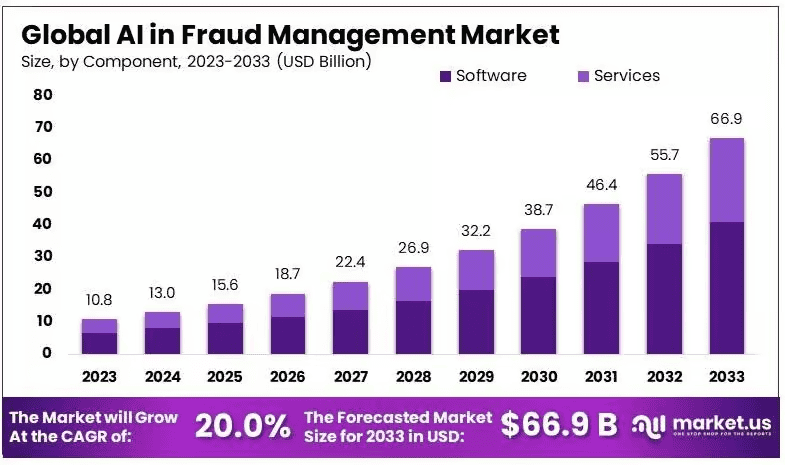
- The global AI in fraud management market is valued at USD 15.6 billion in 2025, with projections indicating it will grow to USD 18.7 billion in 2026.
- The market is expected to expand at a CAGR of 20% and reach USD 66.9 billion by 2033.
AI Fraud Management Segments
(Reference: thebusinessresearchcompany.com)
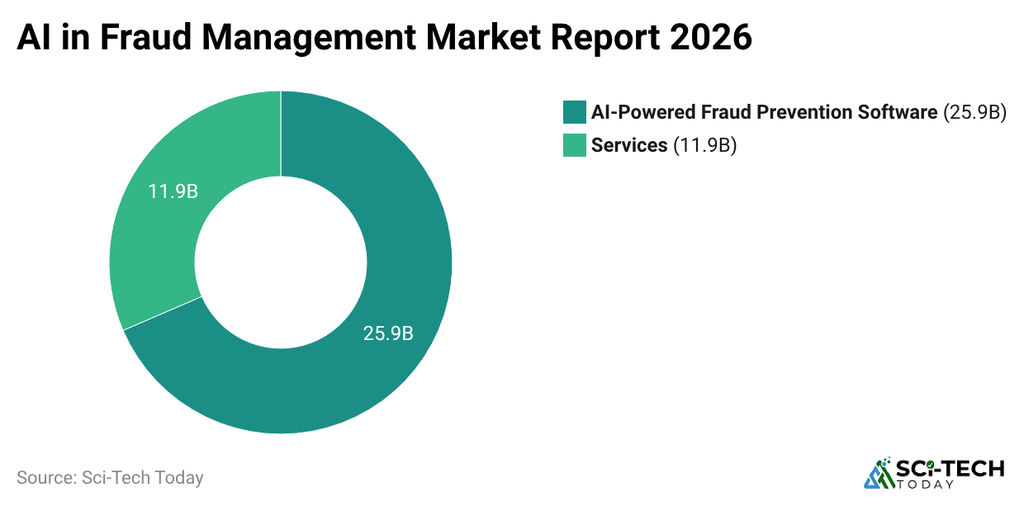
- AI-powered fraud prevention software accounts for USD 25.9 billion of the market.
- Services contribute USD 11.9 billion to the market in 2026.
Product and Segment Analysis
- Future Market Insights stated that AI fraud prevention software will account for 57.3% of the solution segment in 2026.
- Identity theft protection represents 46.5% of the application segment.
- Small and medium enterprises account for 38.6%.
AI in Fraud Management: Country Growth Outlook (2026-2036)
(Reference: futuremarketinsights.com)
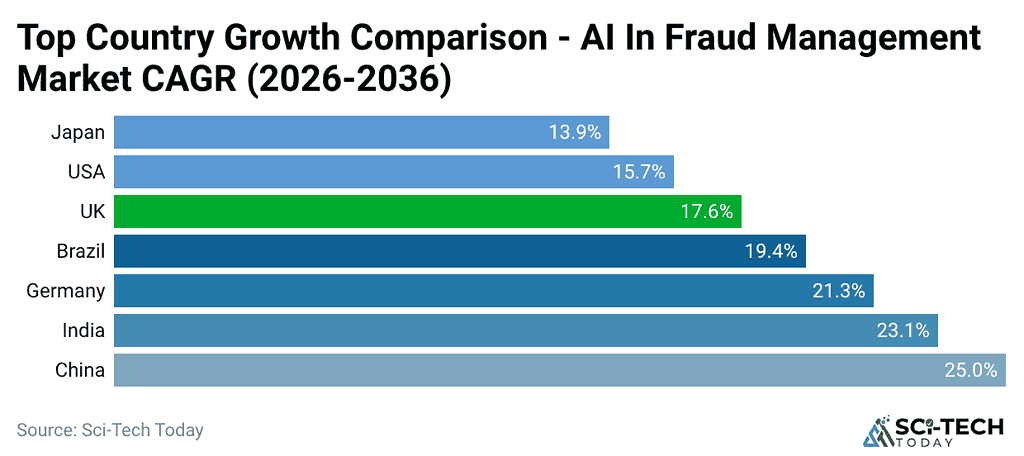
- China leads the projected market growth with a CAGR of 25%, followed by India at 23.1%.
- Germany and Brazil are expected to grow at 21.3% and 19.4%, respectively, ahead of the UK at 17.6%.
- The USA is projected to grow by 15.7%, while Japan is projected to grow by 13.9%.
AI in Fraud Management Market Share by Competitor
- The Business Research Company reported that the market remains fragmented, with the top 10 competitors accounting for 50.78% of total market revenue in 2025.
- International Business Machines Corporation (Trusteer) holds a 17.44% share, followed by Cognizant Technology Solutions at 16.67%.
- Temenos AG accounts for 2.90%, while Capgemini SE holds 2.77% and SAS Institute Inc. has 2.32%.
- Hewlett Packard Enterprise holds 2.04%, Cisco Systems (Splunk) holds 1.88%, and LexisNexis Risk Solutions (BehavioSec) holds 1.68%.
- NICE Actimize holds 1.61%, while Riskified Ltd. accounts for 1.48%.
Financial Performance and Market Valuation of AI Fraud Management Companies
- In Q2 2026, IBM generated USD 17.16 billion in revenue and reported adjusted operating EPS of USD 2.93, a 5% YoY increase. Its market capitalization stood at approximately USD 211.13 billion.
- Cognizant’s revenue grew 4.5% to USD 5.481 billion in Q2 2026, while its market value reached around USD 29.57 billion.
- In the first half of 2026, Temenos revenue increased 7% to USD 534.4 million, supported by USD 880.6 million in annual recurring revenue.
- Capgemini recorded EUR 12.082 billion in revenue in H1 2026, an 8.8% increase.
- Subex’s operating revenue will reach INR 794.5 million in Q1 2027.
- Hewlett Packard Enterprise revenue in Q3 2026 climbed 34% to USD 12.2 billion.
- BAE Systems’ revenue rose 8% to GBP 14.615 billion in H1 2026.
- Pelican AI’s trailing 12-month revenue was USD 8.69 million, but the company reported a net loss of approximately USD 378,910.
AI in Fraud Management Statistics: Adoption and Applications
- 2026 Anti-Fraud Technology Benchmarking Report found that 25% of organizations currently use AI and machine learning for anti-fraud data analysis, up from 18% in 2024.
- 28% of organizations expect to adopt AI/ML within the next 1-2 years.
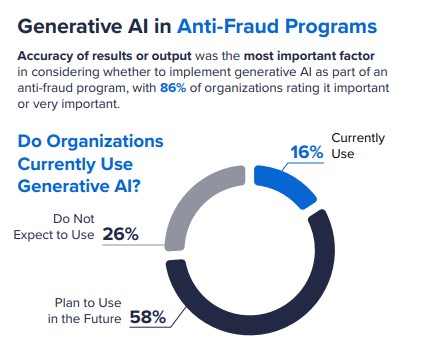
- Moreover, 16% of organizations currently use generative AI in their anti-fraud programs, while 58% plan to adopt it in the future and 26% do not expect to use it.
- 10% of organizations use cloud-native fraud detection platforms, while 29% automate routine fraud investigation tasks.
- 82% of organizations use at least one anti-fraud data analytics technique.
- Only 7% of organizations feel well prepared to handle AI-powered fraud.
- 16% used generative AI for fraud prevention, while 58% planned to adopt it in the future.
- 8% used agentic AI to fight fraud, and another 31% are expected to adopt it by 2028.
(Source: sas.com)
- Generative AI adoption stands at 16%, while 58% plan to adopt it and 26% have no plans to use it.
- Among GenAI users, 49% use it to detect phishing and scams, 46% for risk assessment, and 45% for report writing.
- AI/ML adoption increased from 18% in 2024 to 25% in 2026, with another 28% expecting adoption within 2 years.
Trust and Governance
- Accuracy matters to 86% when adopting GenAI.
- Explainability matters to 82%, but only 6% can confidently explain AI decisions.
- Bias concerns matter to 75%, yet only 18% test models for fairness.
Investment and Technology
- 83% of organizations face budget constraints, while 55% expect anti-fraud technology budgets to increase within 2 years.
- Around 62% believe quantum computing and AI could significantly affect fraud prevention within 5 years.
- Cloud-native fraud detection adoption stands at 10%, while 29% automate routine investigations.
- 51% participate in or are willing to join data-sharing consortia.
- Physical biometric adoption has increased from 34% in 2022 to 45%.
AI Is Making Identity Fraud More Difficult to Detect
- AI-driven identity fraud is becoming a major concern, with 54% of organizations surveyed by Ping Identity in 2024 reporting it as such.
- Deloitte estimates that U.S. fraud losses linked to generative AI could climb from USD 12.3 billion to USD 40 billion by 2027, reflecting a 32% CAGR.
- By 2030, AI-powered cybercrime could cause USD 10 trillion in annual damage as criminals use automation to expand scams, phishing, and impersonation.
- Generative AI could push email fraud losses to USD 11.5 billion by 2027, according to Deloitte.
- The report further stated that cloned voices deceived listeners 58% of the time, while generic AI-generated voices fooled 44%.
- Deepfake files rose from 500,000 in 2023 to more than 8 million in 2025.
- Meanwhile, North America recorded a 1,740% increase in deepfake-related fraud between 2022 and 2023.
- Regula found that 88% of organizations view synthetic identity fraud as a threat, and 46% have experienced it.
- Voice fraud affected 37% of organizations, while 29% reported deepfake-related fraud.
AI Fraud Detection Is Delivering Measurable Results
- A UK bank cut fraud alerts by 50%, detected 30% of fraud before payment attempts, and reduced overall fraud by 20% using machine learning.
- J.P. Morgan reduced account validation rejection rates by 15%-20% through AI-powered payment screening.
- Companies using proactive data analytics report 50% lower fraud losses than those without AI-powered analytics.
- IBM found that 61% of banking executives consider fraud detection AI’s most valuable business application.
Key AI Fraud Detection and Prevention Statistics
- Around 99% of financial organizations surveyed by Alloy used AI or machine learning to fight fraud.
- 93% of Alloy respondents believed AI would transform fraud detection.
- Nearly one-third of financial organizations reported direct fraud losses exceeding USD 1 million.
- 83% of industry leaders said AI reduced false positives and customer churn, according to Mastercard.
- 85% of Experian India respondents agreed that generative AI had permanently changed the fraud landscape.
(Reference: stripeassets.com)
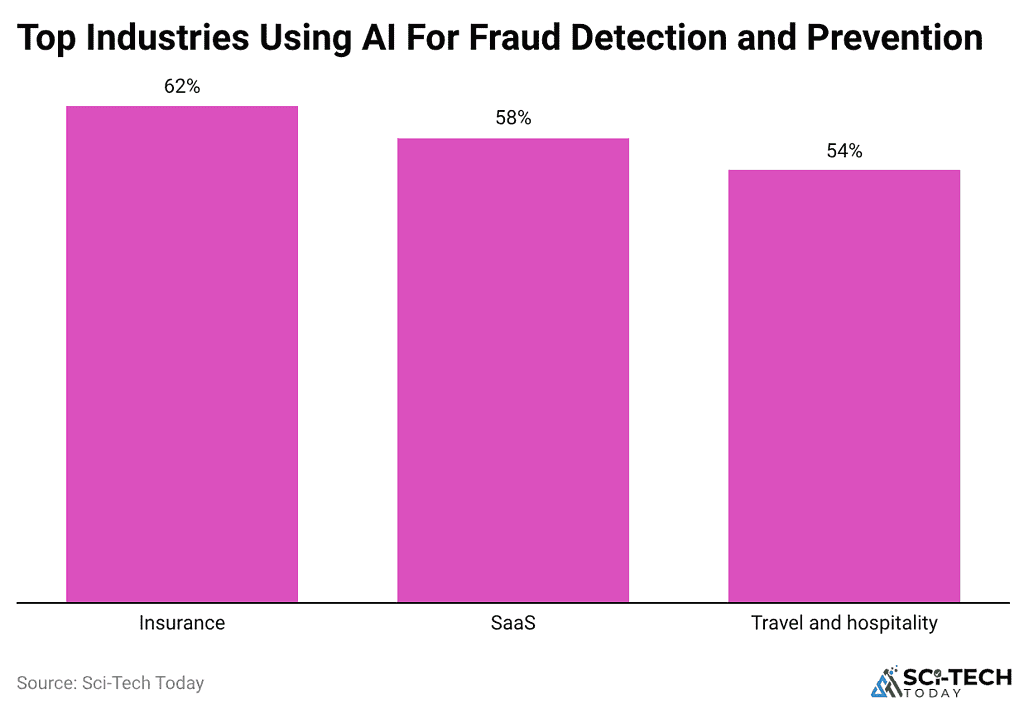
- Insurance leads the industries shown, with 62% using AI for fraud prevention.
- SaaS follows at 58%, ahead of travel and hospitality at 54%.
AI-Enabled Fraud Risks and Detection Challenges
- 81% of 230 senior financial leaders surveyed by Certos in August 2026 reported attempted fraud involving AI-generated or AI-enhanced content in the previous year.
- Payment Dive stated that 84% said AI-enabled fraud was harder to detect than traditional fraud.
- 87% felt prepared for advanced AI fraud, but only 50% were confident they could detect it before funds left their organization.
- 79% were highly concerned about damage to customer trust.
- 43% cited payment diversion, 38% detection gaps, and 21% executive deepfakes as key concerns.
- Additionally, 93% said AI fraud was changing partner expectations, while 51% wanted better suspicious-activity detection.
Benefits of AI in Fraud Detection and Risk Management
- According to a research paper published on the Social Science Research Network, AI can reduce false positives by 50%.
- Machine learning can detect 20%-30% more fraud cases than traditional rule-based systems.
- AI-supported analysis and automation can reduce investigation time by 60%.
- Large financial institutions could potentially save over USD 10 billion annually through AI-driven fraud prevention.
Closing Remark
AI is making fraud detection faster and more effective. It helps businesses spot suspicious transactions, find risks, and protect sensitive data. However, technology alone is not enough to stop fraud. Companies also need human judgment, regular system updates, and strong security practices.
As fraud techniques continue to change, businesses that use AI alongside traditional security methods can reduce losses, protect customers, and build greater trust.
FAQ
AI detects fraud faster, improves accuracy, reduces losses, automates monitoring, and strengthens risk management.
AI detects fraud faster, improves accuracy, reduces losses, automates monitoring, and strengthens risk management.
Machine learning detects fraud by analyzing transaction patterns, spotting unusual behavior, and flagging suspicious activities in real time.

Sources