








Overview
AI In Mining Statistics: Mining is entering a new digital era, and AI is becoming a key part of that shift. Companies are using AI to explore mineral deposits, monitor equipment, improve mine planning, and make daily operations safer. Instead of relying solely on manual checks and historical data, mining teams can now use AI to spot patterns, predict problems, and support faster decision-making. This can help reduce equipment downtime, lower operating costs, improve productivity, and protect workers. The growing need for critical minerals is also pushing miners to find more efficient ways to operate.
This article looks at how AI is being used in mining, its major benefits and challenges, and what the future may hold.
Featured Choice
- The global AI in mining market is projected to reach USD 1,413.9 million in 2025 and USD 1,734.8 million in 2026.
- Machine Learning and Deep Learning led the global AI in Mining market, accounting for 39% of revenue share in 2025.
- In 2026, North America recorded 36% adoption, over 13,000 mining sites, and 6,000 digitally equipped mines.
- The global use of digital mining technologies increased by 26% in 2025, while 75% of firms used cloud-based AI solutions.
- At Caterpillar, nearly 700 autonomous trucks have hauled more than 13 billion tonnes cumulatively, covering over 455 million km.
- The global mining M&A reached USD 21.6 billion in Q1 2026.
- AI analyzes geological data to improve exploration despite discovery rates below 1%.
- AI-driven autonomous trucks can reduce fuel consumption by 10% to 15% through optimized haulage routes.
- In 2026, Mature AI applications have improved site throughput by 2% to 5% and margins by 2% to 4%.
- Real-time AI detection and automated responses can reduce pollution incidents by up to 90%.
- Over 35% of large open-pit mines use autonomous trucks with AI fleet management.
- AI can also reduce drilling costs by 25%.
Global AI in Mining Market Size
(Source: market.us)
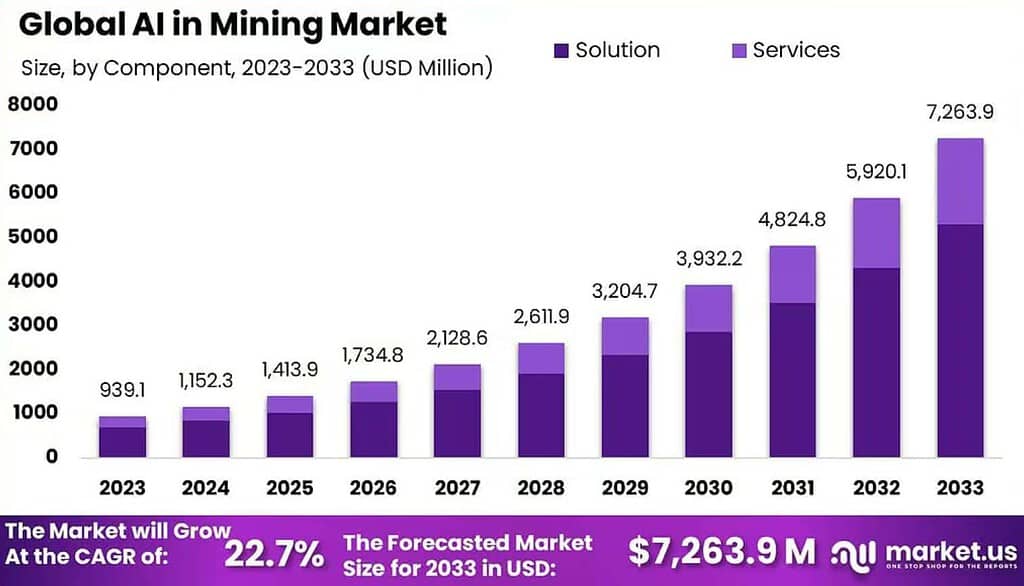
- The global AI in mining market is projected to reach USD 1,413.9 million in 2025 and USD 1,734.8 million in 2026.
- The market is expected to grow at a CAGR of 22.7% from 2023 to 2033, reaching USD 7,263.9 million by 2033.
Key Segment Insights
- S&S Insider’s report further stated that Machine Learning and Deep Learning led the global AI in Mining market, accounting for 39% of revenue share in 2025.
- Computer Vision will expand the fastest, recording an approximate 46% CAGR from 2026 to 2035.
- Cloud-based AI led deployments in 2025, capturing approximately 43% of the revenue share.
- Autonomous Drilling is expected to record the fastest growth, reaching a 44.60% CAGR from 2026 to 2035.
Regional AI Mining Overview, 2026
- According to Congruence Market Insights, North America records 36% adoption, over 13,000 mining sites, and 6,000 digitally equipped mines.
- Moreover, downtime falls by 28%, with over 300 AI-enabled trucks deployed.
- Europe holds 24%; over 40% of large miners use AI analytics, improving recovery by 18%.
- Asia-Pacific holds 29%, with over 10,000 operations; transport efficiency improves by 20%.
- China, Australia, and India supply over 55% of iron ore and rare earth minerals.
- South America holds 12%; Chile supplies over 25% of copper, and downtime falls by 20%.
- The Middle East & Africa account for 9%.
Digital Mining Adoption and Transformation Trends
- According to market.us, the global use of digital mining technologies increased by 26% in 2025, while 75% of firms used cloud-based AI solutions.
- Digital systems improved operational efficiency by 28% and reduced equipment downtime by 25% to 28%.
- Smart mining technologies reduced workplace safety incidents by 30%-35%.
- Around 70% of small and medium-sized mining firms delayed digital transformation in 2024, with initial costs often exceeding USD 2 million.
- About 65% of operators faced deployment delays because of shortages of digital and technical talent.
Technology Enablement Analysis
| Technology Enabler | Impact on CAGR(2025 to 2035) |
| Internet of Things Sensors for Equipment Monitoring | +3.1% |
| AI-driven Predictive Maintenance Systems | +2.7% |
| Autonomous Mining Vehicles and Machinery | +2.3% |
| Cloud-based Mining Data Platforms | +1.8% |
| Digital Twin Technology for Mine Planning | +1.4% |
Key AI-in-Mining Players in 2026
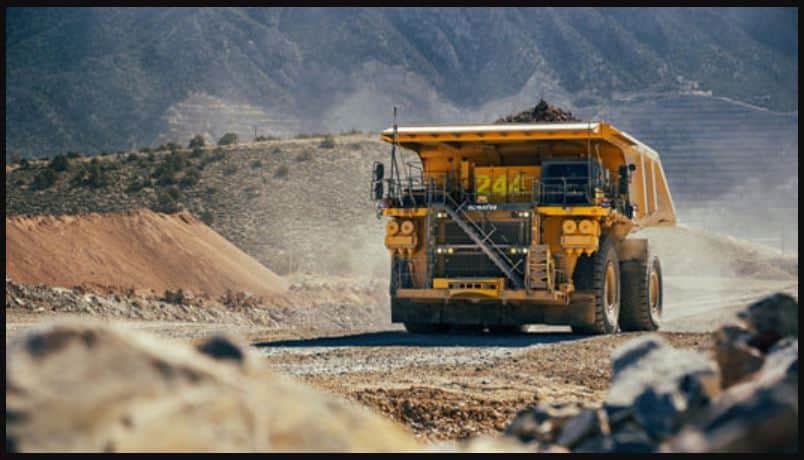
- At Caterpillar, nearly 700 autonomous trucks have hauled more than 13 billion tonnes cumulatively, covering over 455 million km.
(Source: scene7.com)
- Komatsu reached its 1,000th autonomous ultra-class truck milestone, with customers moving over 11.5 billion metric tonnes.
- In Sandvik, Byrnecut ordered AutoMine systems for 5 sites, while AutoMine Aura increased material movement by 15% in one validated deployment.
- According to Epiroc Group, Epiroc secured a SEK 380 million order for autonomous electric drilling equipment, with deliveries through 2027.
- Vale and ABB plant, using over 100 cameras and 7,000 instruments, achieved 25% higher productivity and 26% lower iron losses.
- A 2026 Rockwell Automation study found that 34% of operations were AI-augmented, and 90% of manufacturers viewed digital transformation as essential.
- Hindustan Zinc company targeted ₹2,000 crore in value creation through over 100 projects with more than 50 startups.
AI Investment and Payback in Mining
| AI Application | Estimated Investment | Potential Operational Benefits | Estimated Payback Period |
| Predictive maintenance | USD 1-5 million per site | Reduce downtime by 10%-30%. | 12-24 months |
| Process optimization | USD 2-8 million | Increase throughput by 2%- 5% and reduce energy use by 5%- 15%. | |
| Vision-based safety | USD 0.5-3 million | Improve safety monitoring. | 18-36 months |
| Autonomous haulage | More than USD 100 million | Improve productivity by 15%-20%. | 4-7 years |
| Exploration analytics | USD 1-4 million | Improve discovery rates. | 3-5 years |
Mining M&A Gains Momentum
- According to Mining.com, the global mining M&A reached USD 21.6 billion in Q1 2026.
- Deal volume rose to 121 transactions, compared with 117 in Q1 2025 and 102 in Q1 2024.
- Deal value increased 34% year over year and 55% from Q1 2024.
- In 2025, M&A reached USD 93.7 billion, the highest in 13 years.
- Strategic partnerships are gaining importance, with 32% of survey respondents favoring them.
- Gold and critical minerals are expected to lead consolidation over the next 12 months.
Primary AI Applications in Mining
- AZO Mining mentioned that AI analyzes geological data to improve exploration despite discovery rates below 1%.
- KoBold Metals raised USD 537 million in 2025, reaching a valuation of nearly USD 3 billion through AI-driven exploration.
- Earth AI reports a 75% success rate when identifying new mineral prospects.
- Rio Tinto and BHP use AI-powered autonomous trucks and drills for continuous extraction.
- Rio Tinto’s AutoHaul uses AI across 1,700 km of Western Australia’s rail network.
- BHP’s Azure Machine Learning deployment at Escondida generated USD 18.9 million in value through improved copper recovery.
Mining Technology Adoption
(Source: springer.com)
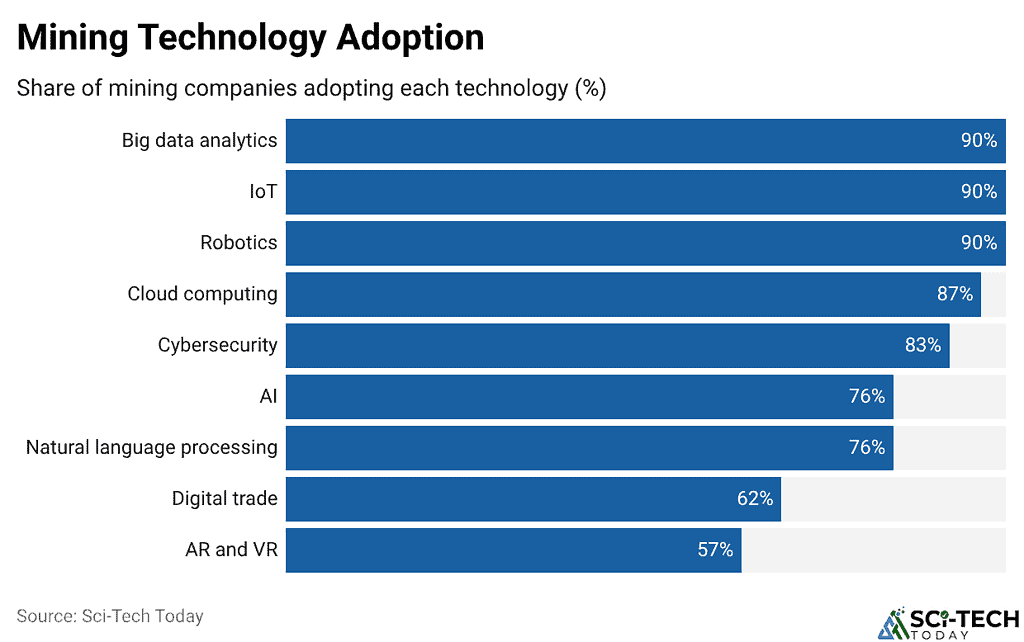
- Big data analytics, IoT, and robotics lead adoption at 90% each, followed by cloud computing at 87%.
- Cybersecurity adoption reaches 83%, while AI and natural language processing each record 76%.
- Digital trade adoption stands at 62%, while augmented and virtual reality reach 57%.
AI-Enabled Mining: Key Efficiency and Workforce Insights
- According to the MINEX Forum, AI-driven autonomous trucks can reduce fuel consumption by 10% to 15% through optimized haulage routes.
- Eurasian Resources Group’s Vostochny mine transported over 2 million tonnes of rock using driverless trucks.
- Its digital tools and 3D digital twins generated over USD 111 million in annual economic benefits.
- A 0.5% improvement in mineral recovery can add millions of dollars in profit.
- Automation could lower labor’s share of operating costs from 40% to about 20% by 2031.
- Meanwhile, reducing all-in sustaining costs by 15%-22%.
AI’s Operational Impact on Mining
- In 2026, Mature AI applications have improved site throughput by 2% to 5% and margins by 2% to 4%.
- One mining company reached its ROI target within 3 months, achieved up to 5% in cost and capital savings, and improved productivity by up to 5 times.
- BHP reduced targeted granulometry-related production losses at Escondida by around 70%.
- BHP’s WAIO disruptions had historically caused over 1,000 hours of downtime.
- BHP reported more than USD 2 billion in value over 4 financial years.
- BHP reduced some geological-record tasks from months to hours.
AI’s Environmental Impact in Mining
- RTS Labs’ report further noted that AI-based process optimization and leak detection can reduce water use per tonne by 10%- 40%.
- AI can optimize equipment and haulage, potentially reducing energy use per tonne by 5%-20%.
- AI sensors and satellite monitoring can identify risks days to weeks earlier.
- AI forecasting can help reduce dust and emissions exceedances.
- Real-time AI detection and automated responses can reduce pollution incidents by up to 90%.
AI in Mining Market Trends
- Congruence Market Insights shows that over 35% of large open-pit mines use autonomous trucks with AI fleet management.
- These systems improve haulage productivity by nearly 20% and reduce fuel use by around 15%.
- Autonomous fleets reduce safety incidents by 25% and improve equipment use by approximately 18%.
- Australia has over 400 autonomous iron-ore trucks, each carrying more than 300 metric tons per trip.
- AI maintenance systems analyze over 500 sensor streams to detect equipment problems.
- Predictive maintenance reduces breakdowns by nearly 30% and extends equipment life by approximately 20%.
- Nearly 45% of large-fleet operators use machine learning, while underground equipment availability improves by over 18%.
- AI exploration improves accuracy by up to 40%, with approximately 28% adoption and over 100 variables assessed.
- AI shortens discovery cycles by nearly 35%, while sorting exceeds 90% accuracy and improves recovery by approximately 15%.
- Nearly 30% of new processing plants adopt sorting systems analyzing up to 1,000 fragments per second.
How AI Is Transforming the Mining Industry
- AI analyzes geological, seismic, magnetic, and satellite data to improve exploration.
- RSM UK source stated that some AI tools can raise discovery rates by up to 20% and modeling accuracy by 15%.
- AI can also reduce drilling costs by 25%.
- AI supports ESG by monitoring air, water, forests, and land using sensors and satellite data.
- In 2023, the U.S. recorded 42 mining fatalities.
- Autonomous systems can reduce accidents by up to 80% and increase productivity by 15%-30%.
- Mentions of robotics in mining filings have grown at a 51% CAGR since 2020.
- AI adoption reached 45% among mining firms, with the market projected to reach USD 3.2 billion by 2026.
- AI can reduce downtime by 30%, labor costs by 10%, and energy use by 15%, while improving ore recovery by 10%-25%.
AI Benefits in Mining Operations
| Category | Benefit | Response |
| Technical | Solutions for complex mining conditions | 34.3% |
| Smart mining solutions | 31.3% | |
| Intelligent and self-governed mines | 13.4% | |
| Safety | Behavior monitoring and intervention | 20.79% |
| Predicting geotechnical issues | 17.82% | |
| Intelligent LHD and drilling | 15.84% | |
Cost savings | Operational efficiency | 48.5% |
| Increased productivity | 21.2% | |
| Automated exploratory drilling | 10.6% | |
| Environmental | Monitoring systems | 44.8% |
| Waste reduction | 29.9% |
Barriers to AI Investment in Mining
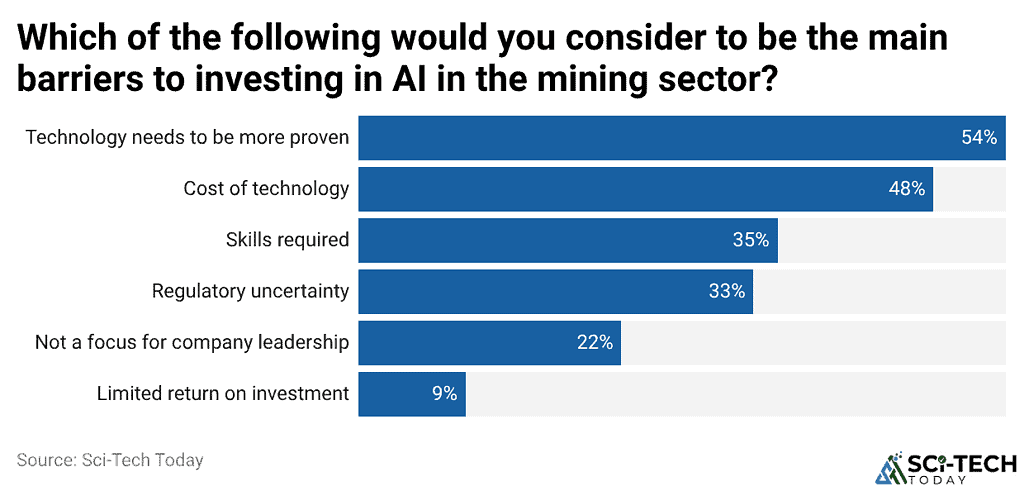
(Reference: nridigital.com)
- Unproven technology concerns 54% of respondents, while technology costs discourage 48%.
- Skills requirements affect 35%, and regulatory uncertainty creates barriers for 33%.
- Limited leadership focuses on concerns 22%, while low investment returns discourage 9%.
Wrap-up
AI is becoming a practical tool for modern mining operations. It helps companies monitor equipment, improve safety, reduce downtime, and make faster decisions. Still, high costs, poor digital infrastructure, data issues, and a lack of skilled workers can limit adoption.
As mining companies expand their use of automation and AI, these technologies can support higher productivity and better resource use. Companies that invest in technology and workforce skills will have a stronger position as the industry becomes more digital.
FAQ
AI improves mining safety by detecting hazards, predicting equipment failures, and monitoring workers in real time.
Yes, AI can reduce mining costs by improving efficiency, predicting failures, and optimizing operations.
AI enables autonomous mining by guiding equipment, optimizing operations, predicting failures, improving safety, and reducing costs.