








Opening
Data Center Cooling Statistics: The rapid growth of AI and cloud services is putting data centers under more pressure than ever. Powerful servers generate significant heat, making reliable cooling essential for keeping equipment stable and operations running smoothly. Data center operators are therefore moving beyond traditional cooling methods and exploring solutions such as liquid, immersion, and direct-to-chip cooling. These technologies can handle higher heat loads while helping facilities manage energy consumption more effectively.
At the same time, the expansion of hyperscale, edge, and AI-focused data centers is creating new opportunities for cooling technology providers. As computing needs continue to rise, efficient heat management will become a key factor in data center design, performance, and sustainability.
This article examines the market, technologies, trends, and growth opportunities shaping data center cooling.
Best Choice
- The global data center cooling market is projected to reach USD 20.5 billion in 2025 and USD 23.4 billion in 2026.
- Precision Air Cooling generated USD 7.80 billion in 2025 and is expected to hold 25% of revenue by 2035.
- North America leads the 2026 market with a 55% share.
- The data center liquid cooling market is expected to grow from USD 5.11 billion in 2025 to USD 6.44 billion in 2026.
- Single-phase cooling leads the 2026 market at USD 10.2 billion.
- Liquid Cooling Adoption is projected at 33% in 2025 and 40% in 2026.
- Asetek forecasts USD 55-60 million in revenue in 2026, including USD 44-48 million from liquid cooling.
- Retrofit costs include electrical work and piping, while direct-to-chip hardware ranges from USD 5,000 to 15,000 per rack, and complete deployments range from USD 30,000 to 50,000.
- Accelsius reports cooling capacity above 4,500 W per socket and up to 250 kW per rack.
- Global data centers consumed 485 TWh of electricity in 2025, with demand rising 17% year over year.
Major Growth Factors in the Liquid Cooling Market
- AI GPU power could exceed 4,000 W by 2029, making liquid cooling increasingly necessary for high-density racks.
- Global Market Insights stated that data center cooling shipments reached 350,000 units in 2025.
- Standardized cooling interfaces could accelerate adoption across enterprise and colocation facilities within 2-3 years.
- According to Navistrat Analytics, as of March 2025, the United States had 5,426 data centers, followed by Germany with 529 and the United Kingdom with 523.
- In February 2025, Modine secured USD 180 million in cooling-system orders from an AI infrastructure customer.
Data Center Cooling Trends
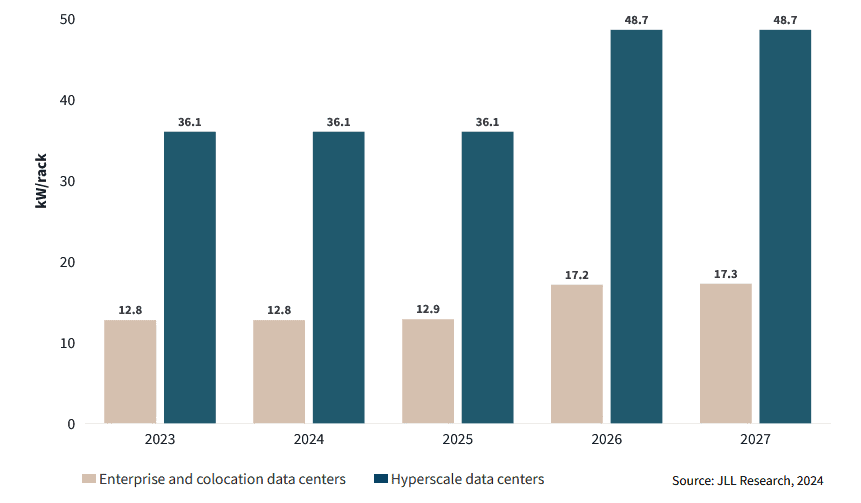
(Source: compu-dynamics.com)
- Enterprise and colocation rack demand reaches 12.8, 12.8, 12.9, 17.2, and 17.3 kW in 2023-2027, respectively.
- Hyperscale demand reaches 36.1 kW in 2023 to 2025 and 48.7 kW in 2026 to 2027.
Global Data Center Cooling Market Trends
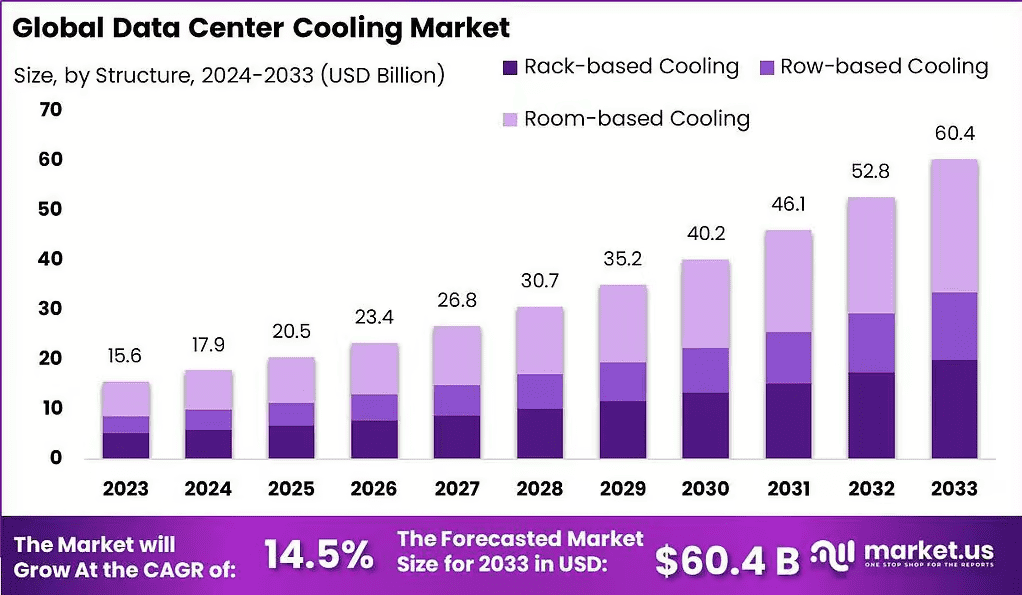
(Source: market.us)
- The global data center cooling market is projected to reach USD 20.5 billion in 2025 and USD 23.4 billion in 2026.
- By 2033, the market is forecast to reach USD 60.4 billion, growing at a CAGR of 14.5%.
Segmental Growth Outlook
- According to Global Market Insights, precision air cooling generated USD 7.80 billion in 2025 and is expected to hold 25% of revenue by 2035.
- Chillers could reach USD 12.36 billion by 2035, growing at an 11.1% CAGR from 2026 to 2035.
- Liquid cooling held 17.1% in 2025 and could reach USD 22.67 billion by 2035.
- Cooling towers and dry coolers generated USD 2.30 billion in 2025 and could grow at an 11% CAGR.
- Controls and BMS could reach a 7% share by 2035, growing at a 12.4% CAGR.
- Hyperscale and cloud data centers generated USD 9.22 billion in 2025 and could hold 53% by 2035.
- Colocation could reach USD 15.11 billion at 10.8% CAGR.
- Edge computing leads growth at a 15% CAGR, reaching USD 5.49 billion by 2035.
Market Share by Region
- Global Market Insights stated that North America led with USD 8.82 billion in 2025 and could reach USD 26.10 billion by 2035.
- The United States rose from USD 7.99 billion to USD 23.70 billion between 2025 and 2035.
- Europe generated USD 4.51 billion in 2025 and could grow at an 11.3% CAGR.
- Meanwhile, Germany expands at 11.9%, and the UK reaches USD 3.02 billion.
- Asia Pacific reached USD 5.33 billion and could grow at a 13.9% CAGR.
- India is the fastest-growing market, with an 18% CAGR, reaching USD 3.40 billion.
- Latin America, the Middle East, and Africa could reach USD 4.12 billion and USD 3.44 billion, respectively, by 2035.
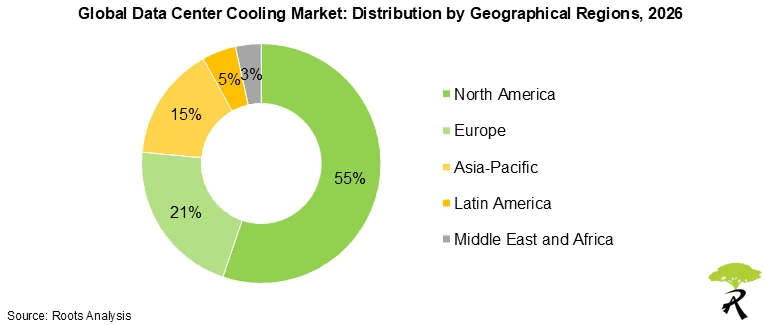
(Source: rootsanalysis.com)
- North America leads the 2026 market with a 55% share.
- Europe holds 21%, followed by Asia-Pacific at 15%.
- Latin America represents 5%, while the Middle East and Africa account for 3%.
Data Center Liquid Cooling Market
(Source: thebusinessresearchcompany.com)
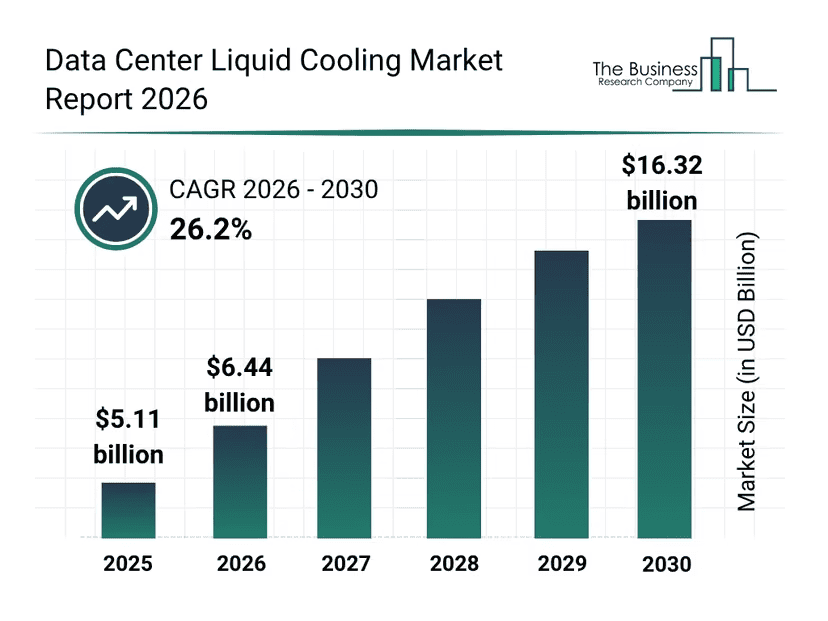
- The data center liquid cooling market is expected to grow from USD 5.11 billion in 2025 to USD 6.44 billion in 2026.
- The market is projected to reach USD 16.32 billion by 2030, growing at a CAGR of 26.2% from 2026 to 2030.
Market Segments
(Source: thebusinessresearchcompany.com)
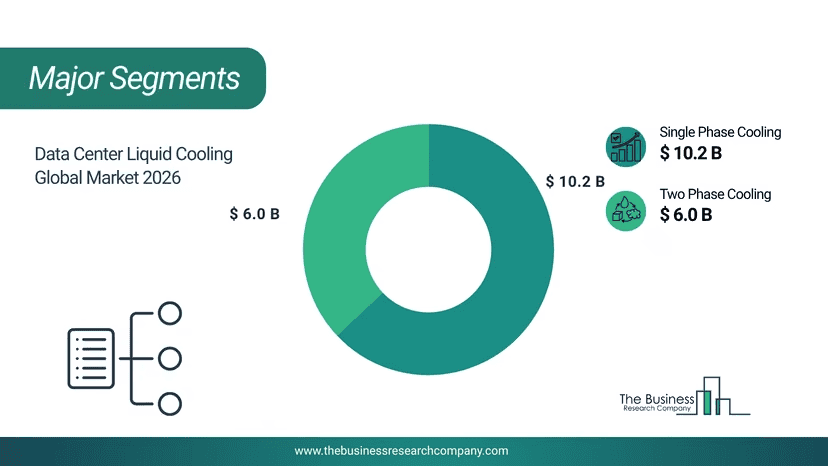
- Single-phase cooling leads the 2026 market at USD 10.2 billion.
- Two-phase cooling accounts for USD 6.0 billion.
Competitive Landscape of the Data Center Liquid Cooling Market
- According to The Business Research Company’s 2026 Data Center Liquid Cooling Market Report, the market remains fragmented, with the top 10 companies holding 20.69% of total revenue.
- Vertiv leads with 2.99%, followed by Schneider Electric at 2.42% and Rittal at 2.39%.
- Stulz holds 2.33%, followed by Delta Electronics (2.26%), Mitsubishi Corporation (2.20%), 3M (2.13%), Alfa Laval (1.86%), IBM (1.34%), and Asetek (0.77%).
Regional Liquid Cooling Market
(Source: cloudfront.net)
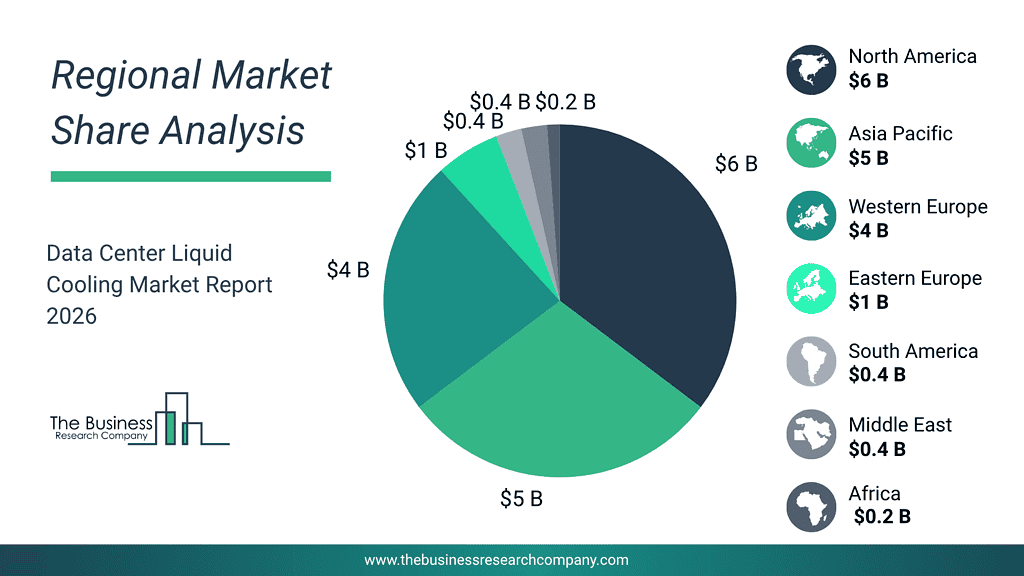
- In 2026, North America leads the liquid cooling market at USD 6 billion, followed by Asia Pacific at USD 5 billion.
- Western Europe contributes USD 4 billion, and Eastern Europe accounts for USD 1 billion.
- South America and the Middle East each represent USD 0.4 billion, while Africa accounts for USD 0.2 billion.
Liquid Cooling Adoption Trends
(Reference: trendforce.com)
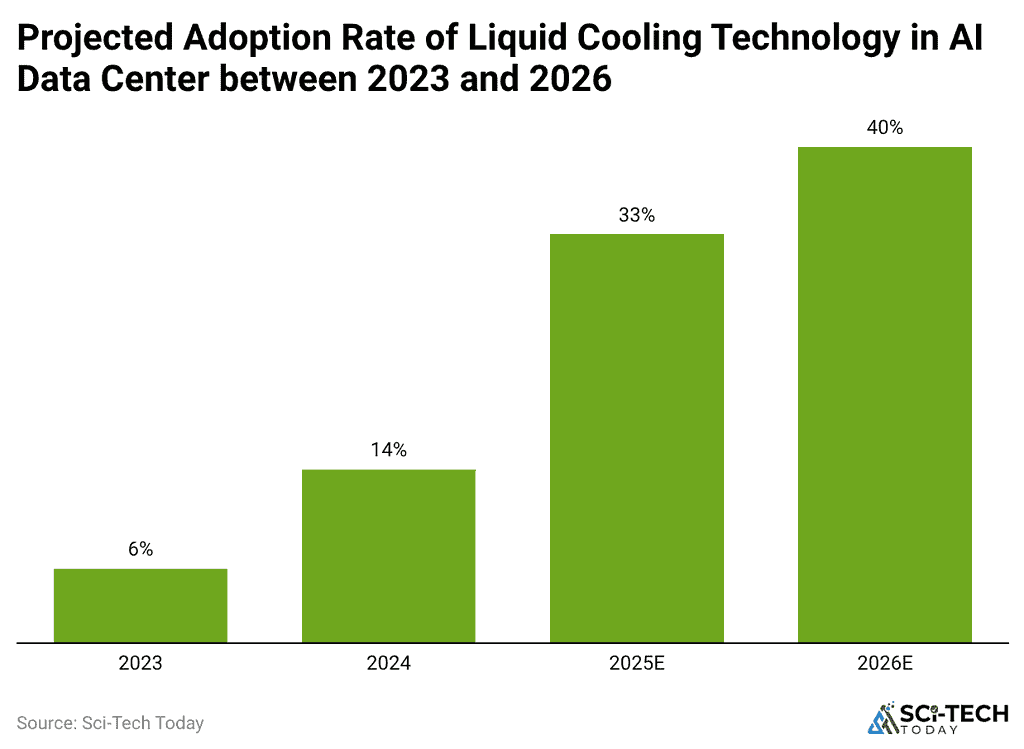
- Adoption of AI data center liquid cooling increased from 6% in 2023 to 14% in 2024.
- Adoption is projected at 33% in 2025 and 40% in 2026.
Competitive Company Performance and Market Position
- Asetek forecasts USD 55-60 million in revenue in 2026, including USD 44-48 million from liquid cooling. Its DKK 1.72 per-share takeover price reflects the company, not cooling sales.
- Mitsubishi Electric reported JPY 32 billion in IT Cooling revenue in 2026 and forecasts JPY 40 billion for 2027.
- Daikin recorded JPY 5.015 trillion in sales in 2026, while Dell generated USD 113.538 billion in sales, including USD 24.683 billion from AI-optimized server revenue.
- Fujitsu reported JPY 3.503 trillion in revenue in 2025, while Hitachi reported JPY 10.587 trillion.
- Johnson Controls reported USD 18.553 billion in nine-month 2026 sales, with data center revenue expected to represent a high-teens share.
Data Center Cooling Startup Funding
| Startup | Funding Valuations |
| ZutaCore | USD 111 million |
| Accelsius | USD 89 million |
| Submer | EUR 80 million |
| Iceotope | USD 72-107 million |
| Corintis | USD 53 million |
| Asperitas | USD 2 million |
| LiquidStack | USD 45 million |
Data Center Cooling Retrofit Costs and ROI in 2026
- Retrofit costs include electrical work and piping, while direct-to-chip hardware ranges from USD 5,000 to 15,000 per rack, and complete deployments range from USD 30,000 to 50,000.
- IT Voice article also stated that a 20-rack retrofit can cost about USD 3.3 million.
- ROI becomes more attractive at 45-50 kW per rack and at electricity costs above USD 0.11/kWh.
- Below 30 kW, advanced air cooling can remain more economical.
- Liquid cooling can reduce cooling energy by 30%-50%, with a typical payback of 18-36 months.
Data Center Cooling Performance
- According to New Market Pitch, Accelsius reports cooling capacity above 4,500 W per socket and up to 250 kW per rack.
- ZutaCore has a certified cooling configuration for chips consuming up to 2,800 W.
- LiquidStack reports testing up to 250 kW per rack and validating cooling distribution units with capacities up to 14 MW.
- GRC reports cooling 100 kW per rack with warm water.
- Iceotope reports stable cooling for a 1,500 W processor.
- Corintis reports removing up to 3 times as much heat and reducing the temperature rise by 65%.
Data Center Cooling Statistics: Energy and Cooling Demand
- Global data centers consumed 485 TWh of electricity in 2025, with demand rising 17% year over year.
- International Energy Agency reported that AI-focused data center electricity use grew 50% in 2025 and could triple between 2025 and 2030.
- Global data center electricity demand could reach 950 TWh, or about 3% of global electricity demand, by 2030.
- AI server power density increased 11 times from 2020 to 2025 and could rise another fourfold by 2027.
- Cooling and power conditioning can account for 10%-20% of IT energy in efficient large facilities and 80%-120% in smaller facilities.
Liquid Cooling Benefits
- According to IEA 4E EDNA, liquid cooling can reduce server electricity use by 5%-8%, cooling-related energy by 30%-40%, and total facility energy by 10%-21%.
- A modeled 2030 direct-to-chip scenario could save 22.6 TWh (about 11%).
- Meanwhile, optimized immersion could save 70.8 TWh (about 34%).
- According to a WSP life-cycle assessment, life-cycle studies indicate 15%-21% lower greenhouse gas emissions, followed by 15%-20% (lower energy demand), and 31%- 52% (lower freshwater use).
Water and Community Impact
- University of California source further stated that the U.S. data centers may need 697 million to 1.45 billion gallons/day of additional peak water capacity by 2030.
- Meeting this demand could require USD 10-58 billion in infrastructure investment.
- Peak water demand can reach 6-10 times the average demand, while some planned facilities may exceed 30 times.
- Some large facilities may withdraw over 1 million gallons/day, with allocations reaching 8 million gallons/day.
AI-Driven Data Center Energy Demand
- The International Energy Agency further noted that servers account for around 60% of data center electricity use.
- Moreover, storage and networking each account for about 5%.
- Cooling accounts for about 7% of electricity in efficient hyperscale facilities and over 30% in less-efficient enterprise centers.
- Data centers consumed about 415 TWh, or 1.5% of global electricity, in 2024, growing 12% annually over five years.
- By 2030, consumption could reach 945 TWh, representing nearly 3% of global demand and growing around 15% annually.
- AI-driven accelerated servers could grow 30% annually, compared with 9% for conventional servers.
Closing
The need for better data center cooling is growing with the rapid rise of AI, cloud services, and high-performance computing. Cooling systems must now handle higher heat levels while keeping energy costs under control. Air cooling remains widely used, but liquid and immersion cooling are gaining attention for advanced workloads.
Going forward, data center operators will seek cooling solutions that offer better efficiency, reliable performance, lower costs, and room for future growth.
FAQ
Cooling prevents overheating, protects equipment, improves performance, and reduces energy-related operational risks.
Main types include air cooling, liquid cooling, evaporative cooling, and immersion cooling.
AI increases data center heat output, driving higher cooling demand, energy use, and the adoption of advanced liquid cooling.

Sources