








Overview
Voice Cloning And Detection Statistics: In 2026, Voice cloning can replicate a person’s voice with surprising accuracy using just a few seconds of audio, creating synthetic speech that sounds virtually identical to the original speaker. In 2025, voice cloning experienced explosive growth, with the global voice cloning market projected to surpass USD 20 billion by 2035 and detection technologies racing to keep pace with increasingly sophisticated synthetic audio.
The dual nature of this technology makes it one of the most fascinating and concerning developments in the AI landscape today. It also carries risks, including deepfake audio scams, identity theft, and the spread of misinformation through fake audio recordings.
This article will explore the voice cloning and detection statistics, market trends, and growing challenges.
What Caught The Editor’s Eye
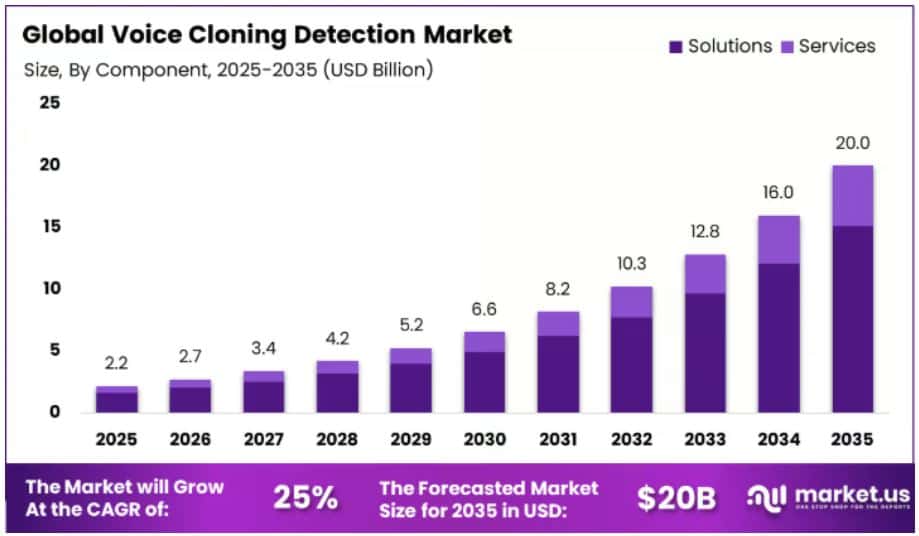
- The market for Global Voice Cloning Detection earned USD 2.2 billion in 2025, and it is expected to expand from USD 2.7 billion in 2026 to a whopping USD 20.0 billion by 2035.
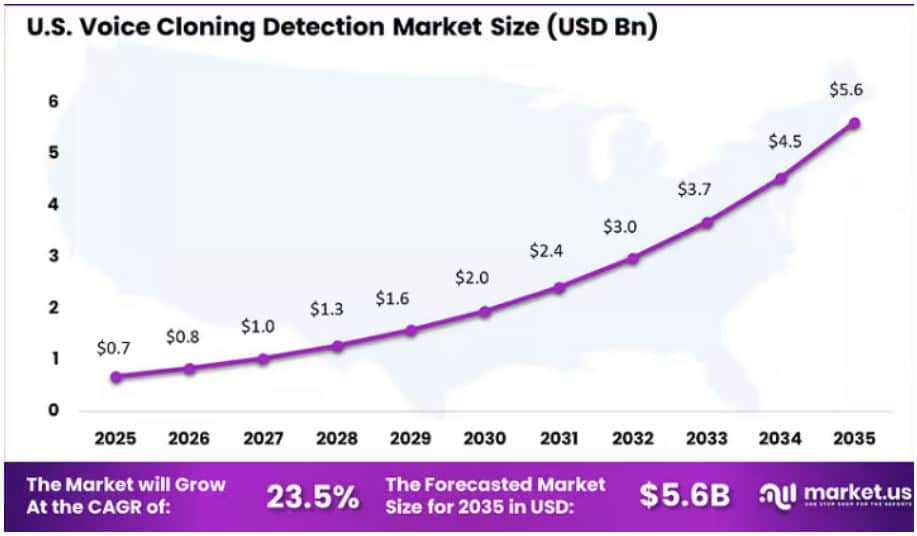
- The USA earned around USD 0.68 billion in the region’s market of the region and is expected to register a CAGR of 23.5%.
- It should be noted that a human’s capability to detect AI voice is less than 30% in the case of high-quality deepfake generation.
- ElevenLabs dominates the market with 28% market share, providing 95%+ accuracy in 70+ languages for only USD 5/month.
- Resemble AI positions itself as a cheap and enterprise-grade product at USD 0.018 per minute.
- Q1 of 2025 witnessed more than 60% of incident response cases of vishing in comparison with phishing.
Voice Cloning Detection Market Share
(Source: Market.us)
- The Global Voice Cloning Detection Market generated USD 2.2 billion in 2025 and is projected to grow from USD 2.7 billion in 2026 to an impressive USD 20.0 billion by 2035, expanding at a strong CAGR of 25.0% throughout the forecast period.
- North America leads the market regionally, holding a 37.3% global share, with the U.S. market alone valued at USD 0.68 billion and growing at a CAGR of 23.5%, fueled by FCC regulatory mandates and increasing security requirements across contact centers and financial institutions.
Regional Voice Cloning Detection Market
(Source: Market.us)
- North America holds a 37.3% share of the global Voice Cloning Detection Market, driven by strong and growing demand for technologies that can accurately identify synthetic or manipulated audio across a wide range of industries.
- Organizations in sectors such as banking, telecommunications, media, and public safety are increasingly adopting voice authentication and verification tools to protect against fraud, identity theft, and unauthorized access.
- The United States generated approximately USD 0.68 billion within the regional market and is projected to grow at a CAGR of 23.5%, reflecting the country’s aggressive push toward securing voice-based systems.
- Businesses across the U.S. are placing greater emphasis on defending against voice-based fraud, particularly within customer service centers, financial transactions, and digital identity verification platforms where synthetic audio poses the greatest risk.
Voice Cloning Detection and Accuracy Statistics
- Human capability to identify artificial intelligence voice is lower than 30% when it comes to high-quality deepfakes.
- Some studies reveal that detection accuracy is only 24.5% in the case of high-quality audio.
- Detection systems based on artificial intelligence can be accurate up to 90% in a controlled environment, but the performance of such technology is lower in real conditions.
- The accuracy of detection is decreased by 40 to 50% due to the presence of noise or compression in the audio.
- Voice biometric systems cannot recognize deepfakes in almost one-fifth of cases.
- Not more than 32% of companies use AI-powered voice fraud detection solutions.
- Employees trained for fraud detection increase detection accuracy up to 60%.
- Tools for real-time detection of deepfakes decrease the rate of fraud success by more than 45%.
- Multi-factor authentication decreases the voice fraud risk by more than 70%.
Voice Cloning Platform Statistics
- ElevenLabs leads the market with a 28% market share, offering 95%+ accuracy across 70+ languages at just USD 5/month, making it the most widely adopted voice cloning platform globally.
- Cartesia Sonic stands out as the speed leader, delivering an impressive 96%+ accuracy with an ultra-low latency of just 87ms, making it the fastest platform available for real-time voice cloning applications.
- Microsoft Azure dominates the enterprise segment, supporting the widest language coverage at 129 languages with 94%+ accuracy, positioning it as the go-to choice for large-scale global enterprise deployments.
| Platform | Accuracy | Latency | Languages | Pricing | Market Position |
| ElevenLabs | 95%+ | 200ms | 70+ | USD 5/month | Market Leader (28% share) |
| Microsoft Azure | 94%+ | 300ms | 129 | Enterprise | – |
| Google Cloud | 93%+ | 250ms | 40+ | USD 16/1M chars | – |
| Cartesia Sonic | 96%+ | 87ms | 50+ | Custom | – |
| Resemble AI | 92%+ | 400ms | 60+ | USD 0.018/min | – |
AI Cloned Voices Cost Per Minute
- Resemble AI markets itself as a budget-friendly, enterprise-class solution at USD 0.018 per minute.
- Enterprise-class solutions cost USD 0.05-USD 0.15 per minute of service on average, with fully managed services priced at 5-10 cents per minute.
- ElevenLabs has a starting price of USD 5 per month for 30,000 characters (30 minutes), allowing independent creators to enter the field of professional cloning.
- Google Cloud TTS and Amazon Polly charge roughly USD 16 for 1 million characters from cloud-based solutions for neural synthesis.
Voice Phishing Statistics
- In Q1 2025, vishing accounted for over 60% of all incident responses in relation to phishing.
- It is estimated that deepfake scams will cost the global economy USD 40 billion by 2027.
- Deepfake vishing attacks increased by 1,633% in Q1 2025 compared to Q4 2024.
- Complaints in the United States related to tech support scams increased to 37,560 in 2023 from 32,538 in 2022.
- Losses reported due to tech support scams in the United States amounted to USD 924.5 million in 2023.
- Call center fraud caused 53,369 complaints and USD 1.9 billion in losses in 2024.
- Vishing attacks result in losses of USD 14 million every year for companies.
- Approximately 70% of organizations gave out confidential information during vishing simulation tests.
AI Voice Cloning Startup Funding Insights
- AI voice cloning startups collectively raised USD 712 million in total funding during 2024–2025, with Series A rounds averaging USD 23.4 million.
- Voice AI startups raised over USD 398 million in 2024 alone, highlighting the explosive growth of investment activity in the voice cloning space within a single year.
- ElevenLabs secured USD 180 million in January 2025, reaching a valuation of USD 3.3 billion and cementing its position as the most well-funded and highly valued voice AI company globally.
- Smaller players are also attracting significant investment, with PlayAI raising a USD 21 million seed round from 500 Startups and Kindred Ventures, and Turkish startup Voiser valued at USD 10 million, demonstrating the truly global reach of voice AI investment activity.
AI Voice Cloning Deepfake Scams
- Approximately 23% of unauthorized voice cloning incidents involve fraudulent activities, with financial scams comprising a staggering 67% of these cases.
- Deepfake-related fraud losses reached USD 200 million in Q1 2025 alone, with total cumulative losses now sitting at USD 897 million, nearly half of which (USD 410 million) occurred within just the first six months of 2025.
- At least 10 major organizations have reported serious deepfake-related incidents, underscoring that voice cloning fraud is no longer a threat limited to individuals but is increasingly targeting large corporations and institutions at an alarming scale.
Industries Leading In AI Voice Cloning Adoption
- Entertainment and Media lead AI voice cloning adoption with a 45% share, with streaming platforms and content creators leveraging the technology for multilingual dubbing, localization, and faster production cycles.
- Healthcare follows with a 28% adoption rate, with Salesforce projecting that 90% of hospitals will adopt AI agents by 2025, many incorporating voice cloning for patient communication and accessibility services.
- Financial Services ranks third with a 22% adoption rate, with Odin AI reporting that 82% of financial institutions have already achieved significant operational cost reductions through AI voice implementations.
- Retail is close behind at 18% adoption, with 69% of retailers using AI agents reporting significant revenue growth from personalization and customer engagement powered by AI-driven voice technologies.
Public Awareness Of Voice Cloning Frauds
- Just 29% of consumers claim to know everything about AI voice cloning risks.
- In spite of increasing awareness, more than 60% of the population remains unprepared for spotting AI scams.
- One in three Americans is convinced that he/she may fall victim to a cloned voice call.
- Social media users are twice as likely to be aware of deepfake scams as non-users.
- The results of educational campaigns have shown a 35% increase in scam recognition rates.
- More than half of victims admit that they did not know about voice cloning scams beforehand.
Recent Voice Cloning and Detection Statistics
- In January 2026, ElevenLabs reported that its voice cloning platform surpassed 1 million active users worldwide, with over 2,000 unique voice models being created daily.
- In March 2026, the FBI issued a warning reporting a 300% increase in voice cloning-related fraud cases since 2024, with financial losses from deepfake audio scams exceeding USD 2.5 billion globally.
Final Thoughts
Voice cloning and detection technologies are developing at an unusual rate and are fast becoming one of the most significant yet dangerous advances in the field of artificial intelligence. There is an unprecedented growth trend in the market thanks to an increasing need for the technology in sectors such as healthcare, entertainment, banking, and cybersecurity, which either employ this synthetic voice technology or are in constant competition with it.
As more advanced methods of detection emerge, the eternal struggle between the development of voice cloning technology and its prevention will ultimately shape the way we communicate and authenticate audio in the digital world.
FAQ
Voice cloning is an AI-powered technology that creates a synthetic replica of a person’s voice using just a few seconds of audio recording. It uses deep learning and neural networks to produce speech that sounds virtually identical to the original speaker.
Modern voice cloning technology has reached remarkable levels of accuracy, with leading platforms able to replicate a voice with over 95% similarity to the original. Some advanced models require as little as 3-5 seconds of audio to generate a convincing voice clone.
Voice cloning detection tools use AI algorithms to analyze audio patterns, breathing rhythms, and subtle acoustic inconsistencies that distinguish synthetic speech from natural human voices. Leading detection tools like Microsoft’s VASA-2 can identify AI-generated audio with up to 96.3% accuracy.

Sources