









Opening Remarks
Workplace Romance Statistics: Workplace romance is becoming more common as employees spend long hours working together and building strong connections. Some office relationships can improve happiness, teamwork, and employee engagement, while others may lead to misunderstandings, favoritism, or conflicts at work. As workplaces continue to change with hybrid and remote work, the way employees form personal relationships is evolving as well.
Many companies now have workplace dating policies to ensure professionalism and fairness for everyone. Understanding the latest workplace romance trends, benefits, challenges, and company guidelines helps employers and employees create a positive, respectful, and productive work environment where personal relationships do not affect professional responsibilities.
Top Picks
- Workplace romance is more common than many realize, with up to 80% of employees reporting they have experienced an office relationship, casual dating, or romantic encounter during their careers.
- Gen Z is redefining office dating. While 77% don’t mind coworkers dating, 36% believe workplace romance is inappropriate, and 37% oppose supervisor-subordinate relationships.
- Power imbalance remains the biggest red flag. Nearly 9 in 10 employees support rules governing manager-employee relationships.
- Love can come at a professional cost. Around 22% of employees have lost their jobs, and 29% have resigned because of workplace romance-related issues, highlighting the potential career risks.
- Office romances frequently stay under wraps. Between 35% and 57% of employees choose not to disclose workplace relationships.
- Many workplace relationships lead to lasting commitments. Research suggests that 40%-43% of office romances eventually result in marriage.
- Favoritism and gossip remain the biggest workplace concerns. Around 50% of employees fear favoritism, while 40% report gossip.
- Most companies regulate workplace relationships rather than ban them. Only 2% of organizations prohibit office romance entirely.
- Shared experiences make the workplace a natural place to find love.
- Professional boundaries determine whether workplace romance succeeds or fails.
Workplace Romance Research Findings, 2026
(Source: cdn-images.zety.com)
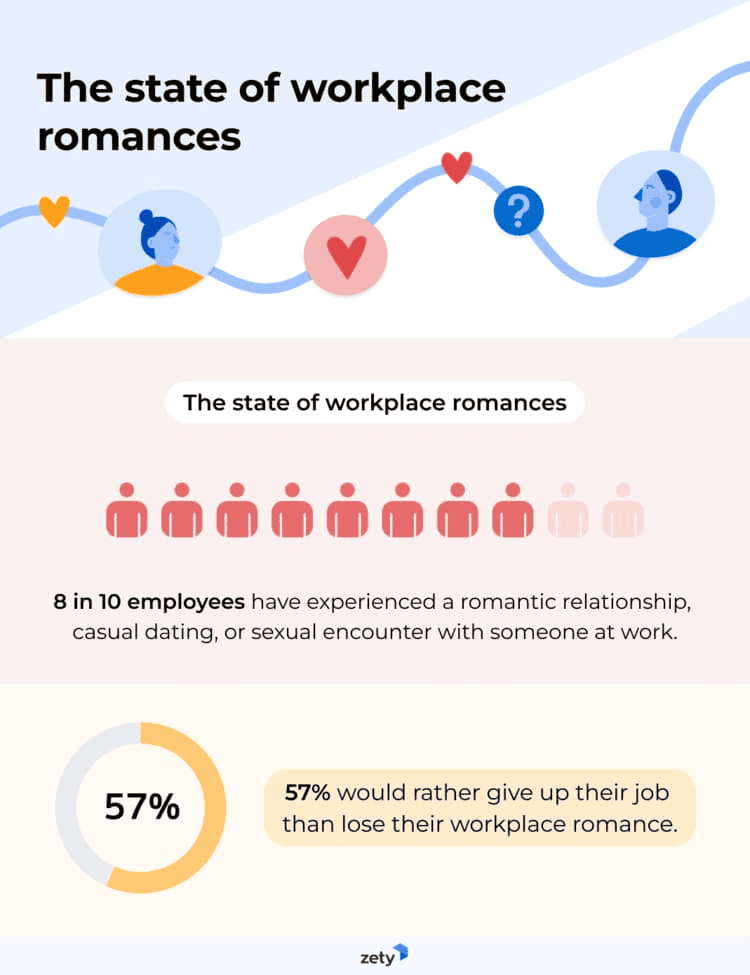
- 80% of employees have experienced a workplace romance, casual dating, or a romantic encounter.
- About 44% had 1 workplace romance, while 56% had 2 or more.
- Workplace romance was most common among baby boomers (90%), followed by Generation X (81%), millennials (76%), and Generation Z (70%).
- Around 41% dated a direct supervisor, including 24% in a long-term relationship and 9% in a one-night stand.
- About 36% dated a coworker, with 32% reporting a long-term relationship and 23% a one-night stand.
- Nearly 33% dated a direct subordinate, including 30% in a long-term relationship and 15% in a one-night stand.
- Most employees support workplace relationship restrictions, with 91% favoring rules for coworkers and 89% for manager-subordinate relationships.
- About 57% would rather leave their job than end a workplace relationship.
Office Romance – Keep It Professional and Protect Your Career
- Read your company’s policy before dating a coworker.
- Avoid relationships where one person has authority or influence over the other.
- Make sure both people freely agree, and respect a “no” immediately.
- Keep work and personal life separate during office hours.
- Never use company email, chat, or devices for romantic messages.
- Tell HR if company rules require disclosure.
- Plan how to handle a breakup professionally before dating.
- Avoid favoritism, gossip, and public displays of affection at work.
- Managers should never make decisions about someone they are dating.
- As a research analyst, weigh the risks and benefits carefully because poor decisions can affect career growth by 100%, while professionalism improves trust and long-term success.
Office Romance Statistics and Trends in the United States
- According to Forbes, more than 60% of U.S. adults have experienced a workplace romance at some point.
- Around 33% of employees say they have dated a coworker or manager in recent years.
- Over 50% of workers admit they have had a crush on a coworker.
- About 40%-43% of workplace romances eventually lead to marriage.
- Nearly 40% of office romances involve at least one person who was already in another relationship.
- About 40%- 50% of U.S. employees say they have flirted with someone at work.
- 35%-57% of employees in workplace relationships choose not to tell their employer.
- Around 79% of workplace relationships occur between coworkers at the same job level rather than between managers and subordinates.
- Generation Z and younger millennials are more open to office romance than older generations.
By Impact on Work and Career
- About 22% of employees lost their jobs due to workplace romance issues.
- 29% chose to leave their job after experiencing relationship-related challenges at work.
- According to Zety report insights, nearly 57% said they would rather leave their job than end a workplace relationship.
- More than 50% reported that office romance changed their professionalism or how coworkers viewed them.
- Around 54% experienced a negative impact on work-life balance.
- Approximately 35%-38% reported improved productivity or higher job satisfaction, while 43% said their workplace romance eventually led to marriage, according to a Forbes report.
Generational and Social Insights
- Openness to office romance is 33% among Generation Z, 15% among older millennials, 27% among Generation X, and 23% among baby boomers and traditionalists.
- The average person spends about 90,000 hours at work.
- Workplace romances started through personal dates (27%), phone conversations (79%), and work events such as parties or happy hours (55%).
The Effect of Workplace Romance on Careers
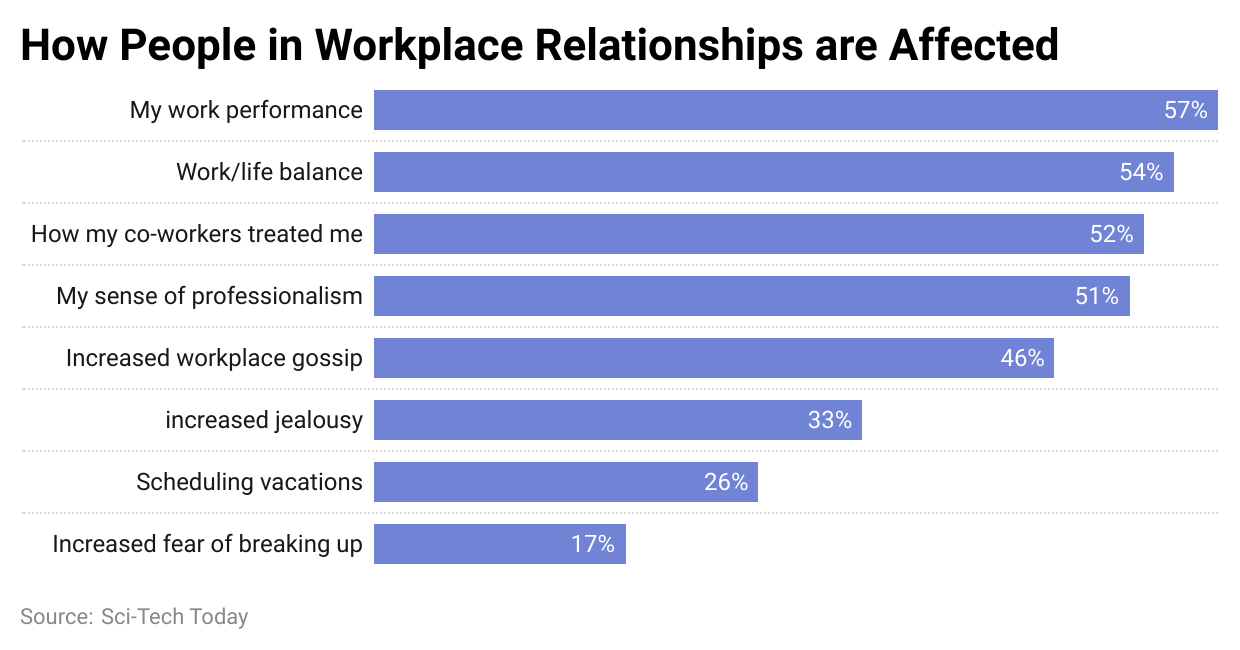
- Workplace affairs develop the fear of breaking up by 17%.
- Around 50% of the employees stated that office romance affects their insight into differences.
- Among professionals who report having a workplace romance, 54% said their relationship affects their work-life balance.
- Fifty percent of the professionals state that their relationship impacts how their employees treat them, but 33 percent of the employees said it develops jealousy, and about 50% said workplace gossip.
(Reference: forbes.com)
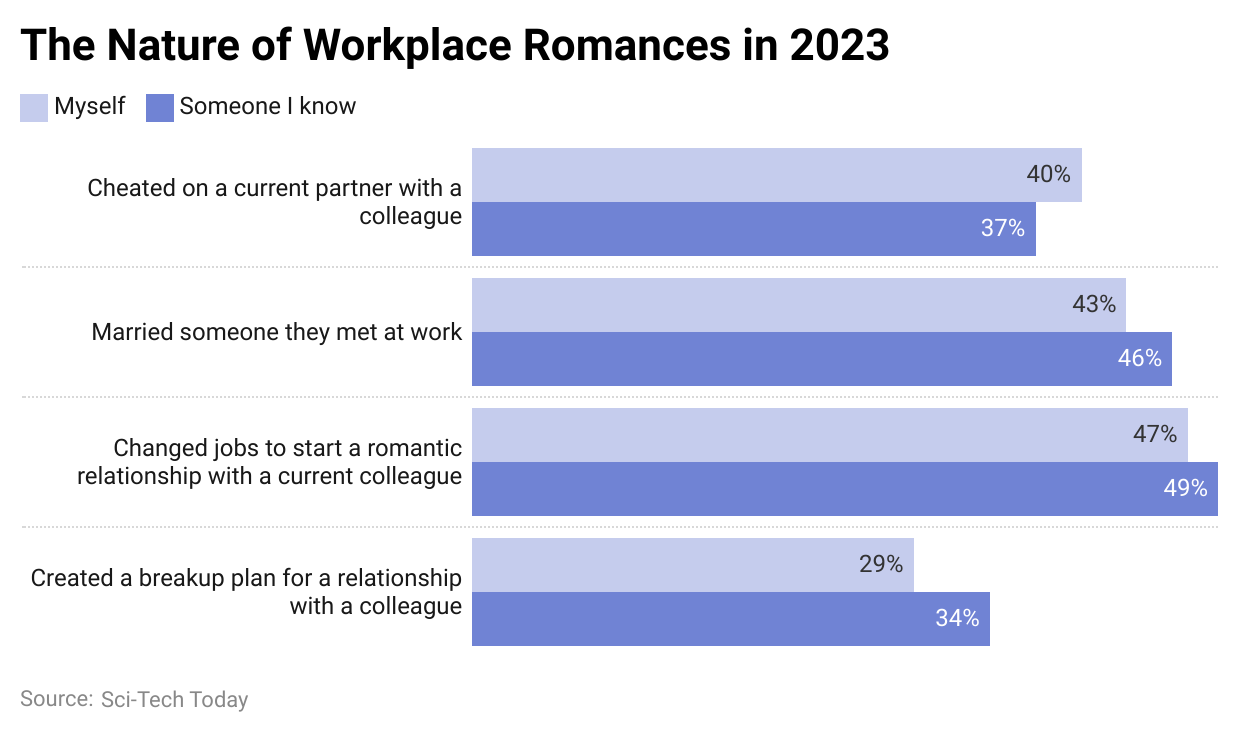
- Market researchers found that almost 40 out of every 100 people admitted to being unfaithful to their partner or coworker.
- In a survey, they discovered that 43 out of every 100 couples who started dating at work ended up getting married to each other.
- About 47 out of every 100 professionals have switched jobs to date a coworker.
- Additionally, around one-third of employees make a plan for dealing with a breakup when they are dating a coworker.
(Reference: forbes.com)
- Human Resources Relationship: Most workers (62 out of 100) talk to Human Resources about their jobs.
- Flirtatious Behavior: Half of the workers (50 out of 100) have acted flirtatiously with their coworkers.
- Productivity Impact: Some workers (9 out of 100) think that having romantic relationships at work can make people work less. A few others (14 out of 100) feel uncomfortable with office romances because they think it leads to unfair treatment.
- Gossip: Six out of every ten workers (60 out of 100) have heard rumors about their colleagues having romantic relationships at work.
- Public Displays of Affection: About four out of ten workers (41 out of 100) don’t like it when their coworkers show affection in public.
- Distraction: Half of the workers (50 out of 100) have been distracted by romantic relationships at work at some point.
- Perception of Favoritism: Half of the workers (50 out of 100) believe that workplace romances lead to favoritism.
Company Policies and Keeping Secrets
As we know, office affairs are not allowed. That is part of the charm. Even though the pandemic has altered offices and the 2022 workplace looks like no workplace before, similar rules still apply. These workplace romance statistics will show how people feel about these rules, how they behave, and how it is affecting their professional relations.
- According to Forbes, almost 41% of workers do not know the organization’s policies on office romance.
- Vault and CNBC: Almost 64% of employees keep their relationships a secret from their colleagues, and around 26% like to disclose them.
- As per CNBC, just 11% of the dating colleagues were punished by their company.
- BambooHR states that almost 75% of Human Resources employees say that “ love contracts” are ineffective.
(Reference: vault.com)
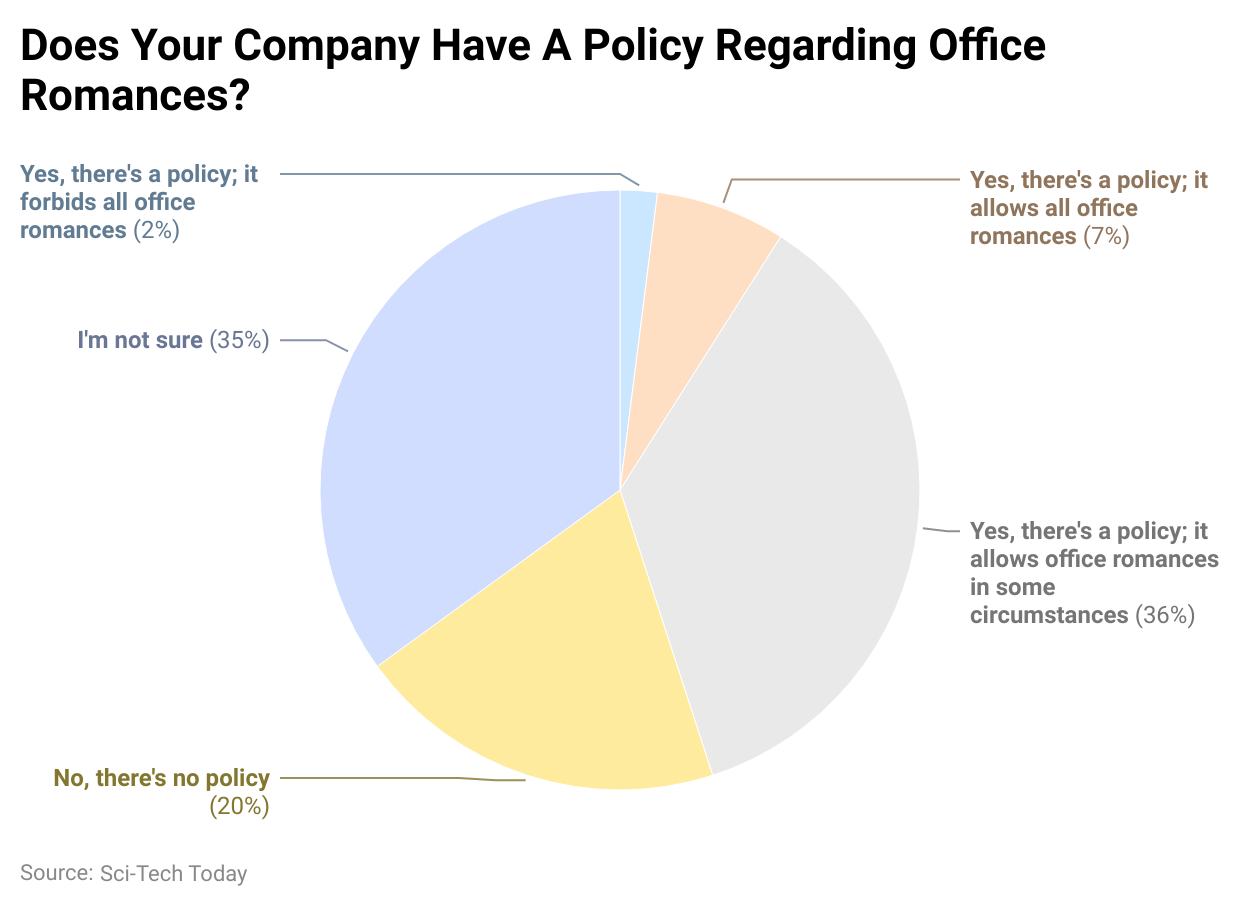
The above chart shows the percentage of companies that have a policy regarding office romances.
- As we can see, just 2% of the companies state, “Yes, there is a policy, and it forbids all office romances.”
- Whereas 7% of companies state that “Yes, there is a policy that allows all workplace romances.
- Nearly 36% of the companies have an opinion that “Yes, there is a policy and it allows office romances in some circumstances.
- 20% of companies reject having any such policy and state,” No, there is no policy.”
- Almost 35% of the employees are unaware of any such policy in their company.
Workplace Romance Acceptability Statistics
| Scenario of workplace romance | Share of respondents who say it is unacceptable |
| Between employees at different job levels | 43% |
| Between coworkers working on the same project | 34% |
| Between all employees (blanket opposition to any workplace romance) | 24% |
| Between employees from different companies working together (client-vendor, partners, etc.) | 23% |
| Between coworkers in the same department | 21% |
| Between coworkers in the same office location | 5% |
| Any workplace romance is never acceptable (under any circumstances) | 4% |
| Between coworkers at the same job level | 4% |
| Between employees in different departments | 3% |
| Between employees in different office locations | 2% |
How Employees View Workplace Romance, 2026
- According to Doulike, about 50% of employees believe workplace romance can lead to favoritism.
- 40% say office relationships often create workplace gossip.
- Nearly 75% feel comfortable with coworkers being in a workplace relationship.
- About 54% believe office romances can create tension after a breakup, affecting teamwork.
- Around 18.1% think workplace romance can negatively affect the organization by reducing productivity or harming team morale.
Minimizing Risk From Workplace Romance
In the workplace, bosses and employees dating each other can be risky. It can lead to problems like sexual harassment claims. But companies have ways to handle this:
- Stop bosses from dating employees they manage: It’s risky for a boss to date someone they supervise. Companies can manage this risk by making a rule against it, which tells everyone what’s expected.
- Use a love agreement: A love agreement is a paper in which two employees agree they’re dating by choice, not because of pressure. It reminds them to act professionally, which can help companies lower their risks and keep the workplace comfortable.
- Train employees about sexual harassment: Some places now require companies to teach employees about sexual harassment. This helps lower the chances of bad behavior. Also, having a way for employees to report problems easily, like a hotline, can help.
- Tell employees that their messages might be checked: Harassment can happen through messages. So, companies might tell employees that they should check their messages. This can stop people from misusing company tech.
- If something goes wrong, courts might look at what companies did to stop the problems. Companies with strong rules and who follow them have a better chance in court.
Workplace Romance Statistics and Types of Industries
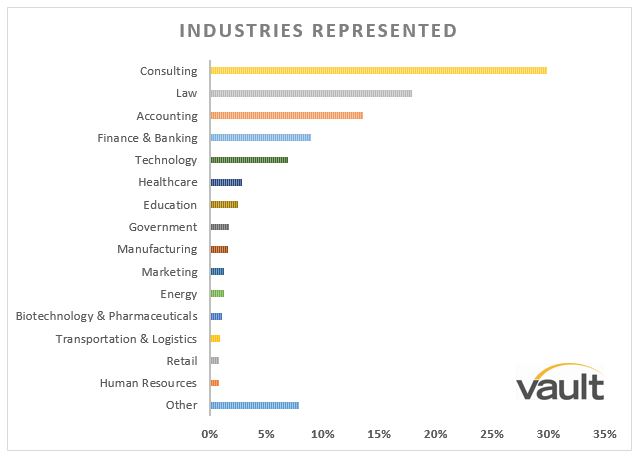
(Source: vault.com)
- In a recent study on workplace relationships, researchers uncovered some intriguing findings about different industries.
- They discovered that HR professionals, those working in retail, and those in the technology sector are most likely to engage in office romances.
- Specifically, 57% of HR professionals admitted to having had a workplace romance at some point in their career, closely followed by 62% in retail and 60% in technology.
- Conversely, marketing professionals are less inclined to pursue romantic relationships with colleagues. This could suggest that they prioritize building connections outside their field of work.
- HR professionals: 57% have engaged in workplace romances.
- Retail workers: 62% have participated in office relationships.
- Technology sector: 60% have been involved in workplace romances.
- Marketing professionals appear less likely to pursue romantic relationships with colleagues.
- These statistics shed light on the varying dynamics within different industries when it comes to office romances.
(Source: vault.com)
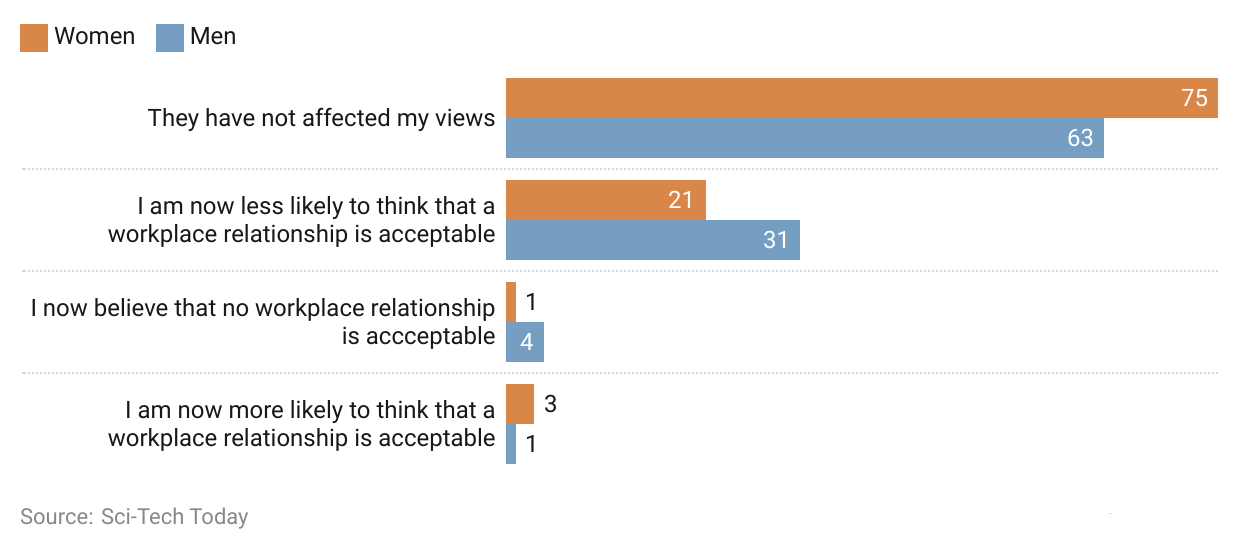
- The above chart shows the effect of office romance on different genders. The respondents to this survey included people of all ages.
- Almost 75% of the females and 63% of the males responded that office romances hadn’t affected their views.
- Nearly 21% of the females and 31% of the males responded that they are now less likely to think that workplace relations are acceptable.
- Virtually 1% of the females and 4% of the males responded that they now believe that no workplace relationship is acceptable.
- Practically, nearly 3% of the females and 1% of the males responded that they are now more likely to think that a workplace romance is acceptable.
Manager Views on Workplace Romance and Policies
(Source: nypost.com)
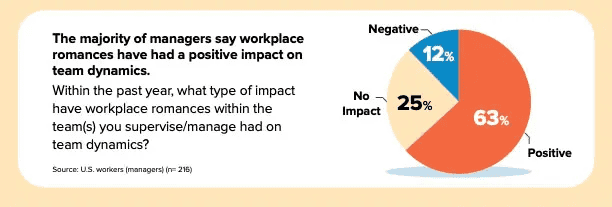
- Around 63% of managers say workplace romances had a positive effect on team dynamics in the past year.
- 25% report no impact of workplace relationships on team dynamics.
- Nearly 12% believe workplace romances hurt their team.
- According to SHRM, most organizations rely on the employee handbook to explain romance rules, with 64% of employers citing it.
- 22% use the onboarding process to communicate workplace romance policies.
- 15% share these guidelines during training sessions.
- 11% use internal communications, such as emails or intranet posts.
- Roughly 7% mention policies in company meetings or presentations.
- Around 4% rely on other informal methods.
- About 22% admit their organization does not communicate or have any workplace romance policy at all.
Gen Z Workplace Romance Statistics, 2026
- A report published by EduBirdie found that about 36% of Gen Z employees believe workplace romance is inappropriate, while 37% oppose relationships between supervisors and direct reports.
- Around 77% say they do not mind coworkers dating, although 16% feel uncomfortable and 7% admit feeling jealous.
- Only 45% believe their employer clearly explains workplace relationship policies, while 55% find the rules unclear.
- 21% see work as a place to find a partner, including 15% who choose employers based on the people and 6% who research future coworkers before applying.
- Around 34% believe returning to the office increases dating opportunities, while 46% value shared commutes and 50% enjoy common interests.
- Nearly 40% say dating a coworker improves motivation, 37% have dated a coworker, 22% have liked their boss, and 50% have had a work spouse.
Why People Find Love at Work
(Reference: forbes.com)
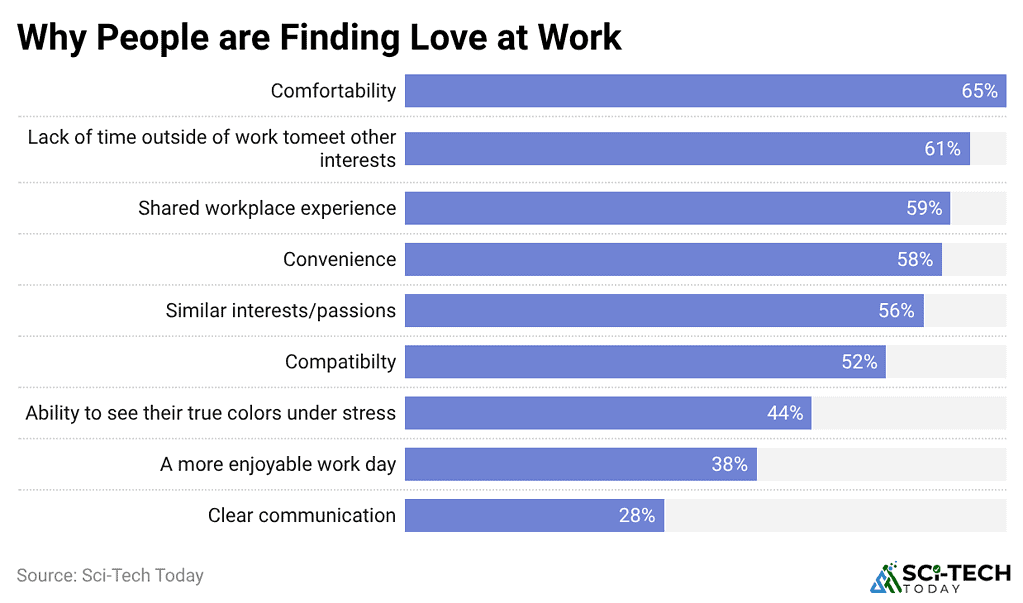
- 65% of employees say they fall in love at work because they feel comfortable with colleagues.
- 61% report limited time outside work to meet other romantic interests.
- 59% point to shared workplace experiences that build strong bonds.
- 58% cite simple convenience as a driver of office romance.
- 56% mention similar interests or passions with coworkers.
- 52% see strong compatibility with colleagues.
- 44% value seeing coworkers’ true colors under stress.
- 38% enjoy a more pleasant workday due to romance.
- 28% highlight clear communication as a key factor.
Negative Effects of Workplace Romance, 2026
- A Zety survey found that 88% of employees have seen conflicts or problems caused by workplace romances.
- The most common issues include retaliation (34%), poor work–life balance (33%), and a lower sense of belonging at work (30%).
- Workplace relationships can also affect careers, with 29% of employees leaving their jobs and 22% losing theirs because of office romances.
- About 92% said their workplace relationship went against company policy.
- Around 33% admitted they cheated on their partner with a coworker.
(Source: kickresume.com)
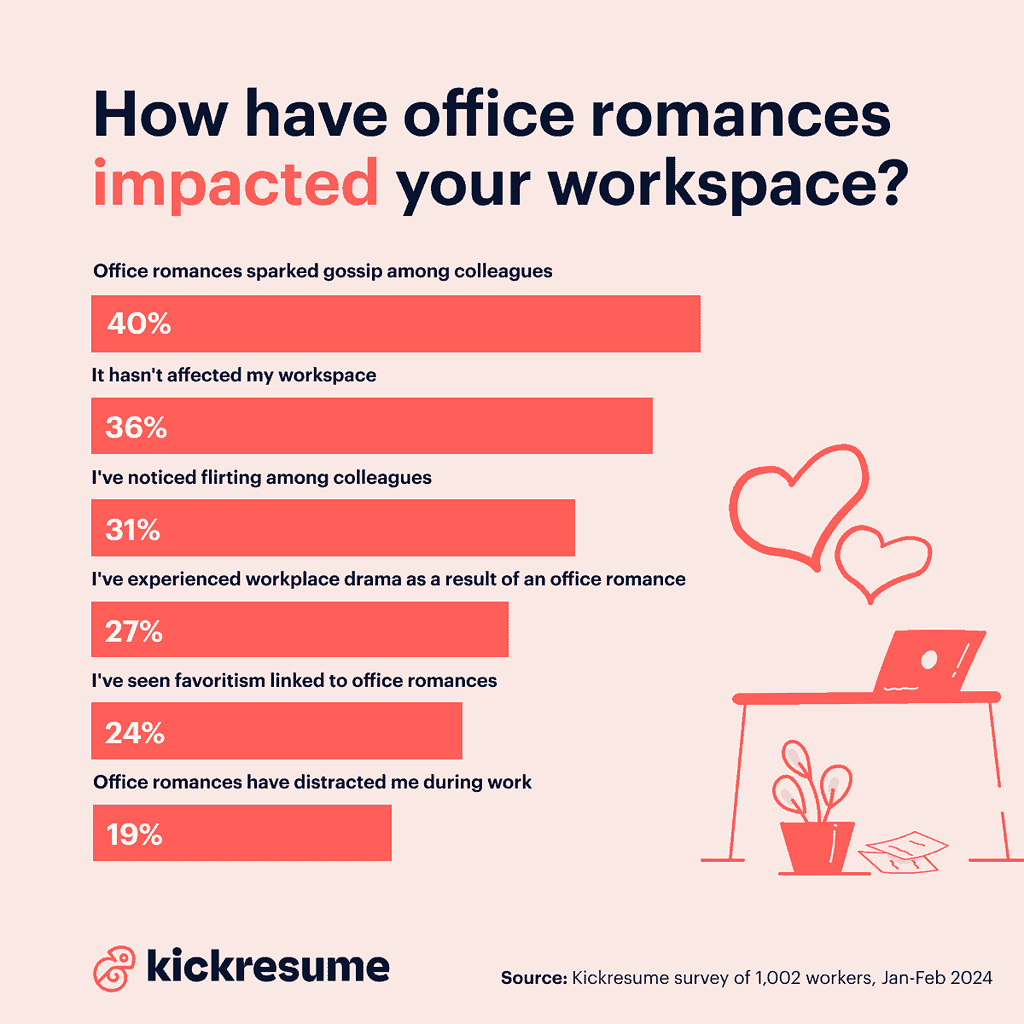
- 31% of employees have noticed casual flirting at work several times.
- About 27% have witnessed office drama caused by workplace relationships.
- Around 24% worry that office romances can lead to favoritism and unfair treatment.
- Only 19% believe workplace relationships disrupt their daily work.
- 41% know their company’s workplace romance policy.
- 31% work in offices where office relationships are allowed with rules in place, while 15% work in offices where they are banned.
- Around 14% say their workplace fully accepts office romance.
- Nearly 49% prefer to keep workplace relationships private, while 23% inform managers or HR.
- About 21% are unsure about disclosure rules, and only 7% would report a new relationship to HR.
- Additionally, 67% know someone who cheated with a coworker, 19% admitted doing so, 85% say affairs begin at work, 38.8% of women and 30.7% of men reported coworker affairs, while 75%, 74%, and 73% associate workplace romance with favoritism, lower productivity, and unprofessional behavior.
Final Perspective
Office affairs are so everyday that many believe in the initial stage. According to workplace romance statistics, in-office relationships affect everyone in the organization, not just those in the relationship. Professionals must be proactive in establishing policies that foster a positive working environment for all parties by detailing how to approach and manage office matters.
It also includes processes and systems for handling such relationships. Businesses that work to protect their staff also effectively protect their company’s culture and working environment. The data indicate a need for companies to implement clear and comprehensive policies in workplace matters. Workplace romance statistics are even more apparent in this report.
FAQ
A healthy workplace romance can improve communication, increase job satisfaction, provide emotional support, and strengthen teamwork when handled professionally.
Workplace romance can cause conflicts, favoritism, gossip, reduced productivity, legal issues, and uncomfortable situations after breakups.
Yes, employees should disclose workplace relationships if company policies require transparency and fairness.