






Overview
Employee Engagement Statistics: Employees are the heart of every successful business, and keeping them happy and motivated is key to long-term growth. Employee engagement is about how connected, committed, and enthusiastic people feel about their work and the company they work for. When employees enjoy their jobs and feel valued, they perform better, work well with others, and help the business succeed. On the other hand, low engagement can reduce productivity and increase employee turnover. That is why organizations are focusing more on creating a positive and supportive workplace. This article explains what employee engagement means, why it matters, its benefits, the common challenges businesses face, and simple ways to build an engaged, productive, and loyal workforce.
Top Picks
- The global employee engagement reached 23% in 2025.
- In 2026, only 21% of employees worldwide feel engaged at work, meaning nearly 8 out of 10 are not fully involved.
- In the United States, engagement is 31%, a decade‑low level.
- Around 52% of U.S. employees are concerned about the future use of AI in the workplace.
- Highly engaged teams are 18% more productive than low-engagement teams.
- Employee engagement has reached a 10-year low, with only 31% of U.S. employees engaged in 2026 and 20% worldwide.
- 51% of U.S. employees remained highly satisfied.
- The most important factors that help in enhancing employee engagement are trust in leaders (81%), Good employee relationships with their immediate supervisor (79%), a sense of purpose (75%), and organizational culture (74%).
- 64% of employees focus on work they enjoy.
- Global manager engagement dropped from 30% to 27% in one year, while individual contributor engagement remained steady at 18%.
- Employees under 35 years experienced a drop in engagement of about 5% in one year.
- Organizations with strong employee engagement experience 21%-51% lower staff turnover than those with weak engagement.
- Employee disengagement costs the global economy about USD 10 trillion each year, equal to around 9% of global GDP.
General Statistics
- According to archieapp.co, only 21% of employees worldwide feel engaged at work, meaning nearly 8 out of 10 are not fully involved.
- Low engagement costs the global economy USD 8.9 trillion every year.
- Engaged teams are 18% more productive and 23% more profitable.
- Employee turnover is 18%-43% higher in low-engagement teams.
- Around 82% of white-collar employees experience burnout.
- Engagement reaches 29% among fully remote employees, compared to 20% among on-site workers.
- About 70%-80% of employee engagement is influenced by their manager.
(Source: evolveup.io)
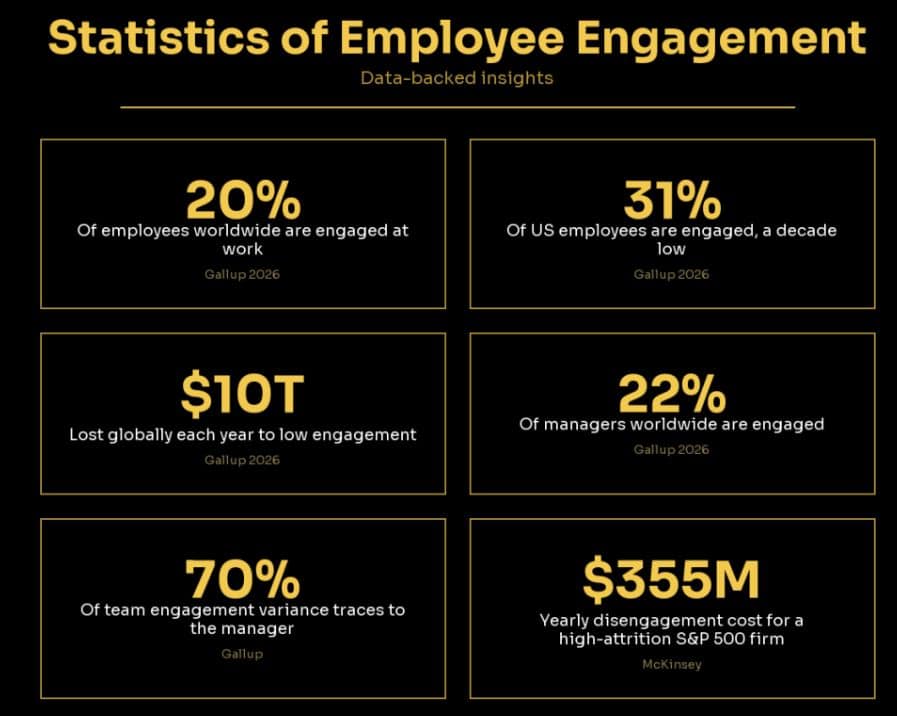
- Only 20% of employees globally are engaged at work.
- In the United States, engagement is 31%, a decade‑low level.
- Low engagement costs the world about USD 10T every year.
- Just 22% of managers worldwide are engaged.
- About 70% of differences in team engagement are linked to the manager.
- A high‑attrition S&P 500 company loses about USD 355 million annually due to disengagement.
Why Employee Engagement Is More Important Than Ever
- The Thirst report further mentioned that the global employee engagement reached 23% in 2025, but growth remains slow.
- Around 82% of employees say learning opportunities improve engagement.
- AI upskilling increases engagement by 37%.
- Managers influence about 70% of team engagement.
- Clear career paths make employees 3.5 times more engaged.
- Weekly feedback improves engagement by 21%.
- Hybrid employees are 24% more engaged than other workers.
- Learning during daily work increases engagement by 34%.
- Purpose-driven employees are 4 times more engaged.
- Regular recognition makes employees 4 times more engaged.
- Well-being support increases engagement by 31%.
- About 42% of employees experience burnout.
- Nearly 49% say poor technology lowers engagement.
- Reskilling programs improve engagement by 24%.
- Highly engaged teams are 18% more productive.
- Around 76% prefer personalized learning.
- AI-powered learning platforms increase engagement by 45%.
- Skills-based organizations achieve 2.4 times higher engagement.
- Innovation opportunities triple engagement.
- A strong sense of belonging increases engagement by 56%.
- Clear communication improves engagement by 47%.
- Engaged employees are 14 times more likely to recommend their organization.
How Career Growth Opportunities Influence Employee Engagement
- Unclear career paths reduce employee engagement, and 1 in 3 employees feel they have limited opportunities for career growth, according to a report from Pumble.
- About 65% of employees believe hiring procedures for new internal roles are fair, but 46% do not expect to receive a promotion.
- The biggest career barriers include lack of opportunity (19%), lack of desire (13%), lack of time (12%), self-motivation (10%), lack of support, confidence, and experience (8% each), lack of visibility and skills (6% each), and fear and education (5% each).
- Organizations can improve engagement by supporting AI upskilling, internal mobility, and continuous learning.
The Disengagement Dilemma:
- Low Morale, High Costs: According to Gallup’s State of the Global Workplace report, 85% of employees worldwide are not actively engaged or are actively disengaged at work. This means a large portion of the workforce feels unmotivated and disconnected, and puts in minimal effort. Disengaged employees can cost companies a whopping USD 450 to USD 500 billion annually in lost productivity and turnover.
The Upside of Engagement:
- Profit Powerhouse: Companies with highly engaged workforces are 21% more profitable than those with low engagement. Engaged employees are more productive and innovative and deliver better customer service, ultimately leading to a healthier bottom line.
- Retention Rocket Fuel: Highly engaged employees are far less likely to leave their jobs. Statistics show that employees who find a purpose and passion at work are more than 3 times as likely to stay with their organization. Reduced employee turnover saves companies significant time and money spent on recruitment and training.
Employee Engagement And Productivity Statistics
- Highly engaged teams are 18% more productive than low-engagement teams.
- Engaged employees solve problems faster, share new ideas, work better with others, and take fewer sick days.
- These teams also achieve better quality by reducing work errors by 41%, lowering safety incidents by 64%, and decreasing shrinkage or theft by 28%.
Employee Engagement In The Modern Workplace
(Source: worktime.com)
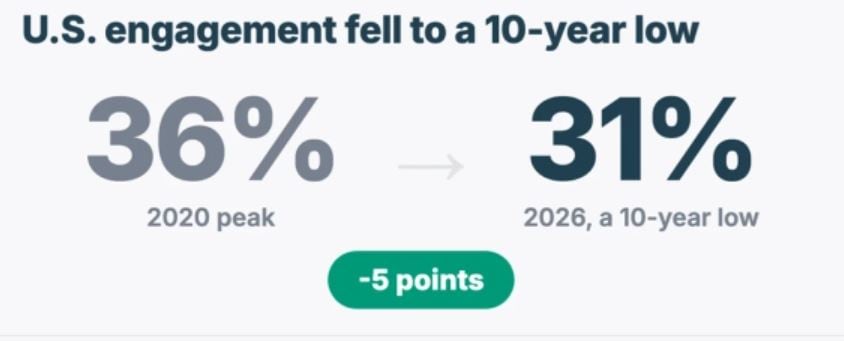
- Employee engagement has reached a 10-year low, with only 31% of U.S. employees engaged in 2026 and 20% worldwide.
- Low engagement costs the global economy around USD 10 trillion every year.
- About 17% of U.S. employees are actively disengaged and may negatively affect their organizations.
- Most employees are not engaged and often do only the minimum required at work.
- U.S. engagement declined by 2% since 2023 and by 5% from its 36% peak in 2020.
- Around 8 million fewer U.S. employees are engaged than in 2020, and 3.2 million fewer than in 2023.
- Global engagement reached 23% in 2022, then fell to 20% in 2026.
- Leading organizations achieve employee engagement levels of up to 70%.
Employee Satisfaction Statistics
(Reference: pewresearch.org)
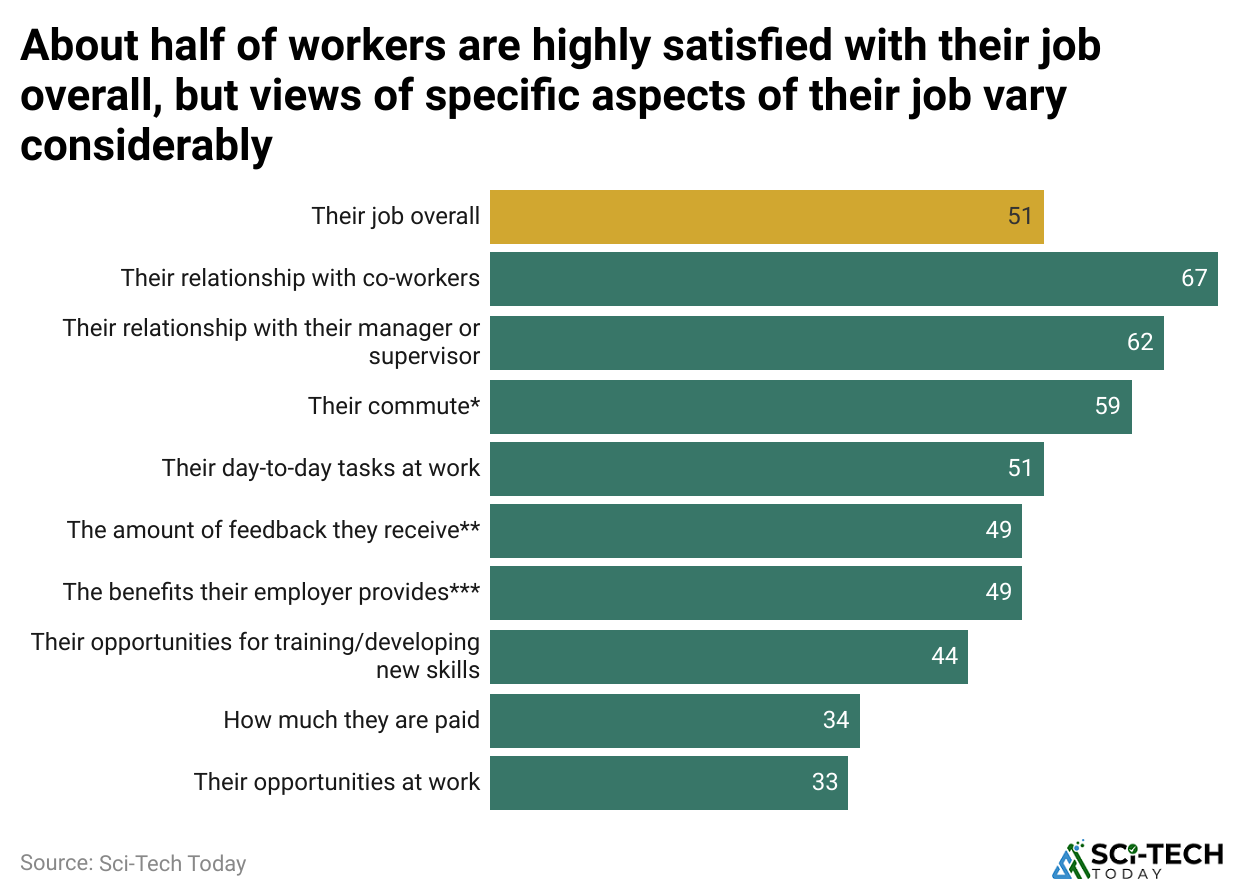
- As of 2023, the overall job satisfaction of 51% of U.S. employees remained highly satisfied.
- In America, 67% of employees remained very satisfied with their relationships with co-workers.
- In Employee Engagement Statistics, other shares of employees felt very satisfied in the following fields due to effective employee engagement are their relationship with managers and supervisors (62%), commute (59%), day-to-day tasks at work (51%), amount of feedback received (49%), benefits provided by employers (49%), training opportunities and new development skills (44%), salary increment (34%), and opportunities for promotion for work (33%).
What Makes Employees Tick?
Understanding what motivates employees is key to fostering engagement. Here’s what the data reveals:
- Leadership Matters: A whopping 58% of employees say a lack of strong, inspiring leadership is the top reason they feel disengaged. Employees crave clear direction, open communication, and appreciation from their leaders.
- Learning and Growth: Employees want to feel like they’re constantly learning and developing new skills. A staggering 80% of employees say that opportunities to learn and grow would make them feel more engaged.
- Feeling Valued: Recognition is a powerful motivator. 37% of employees consider recognition the most important factor for engagement. A simple “thank you,” or public acknowledgment for a job well done, can go a long way in boosting morale.
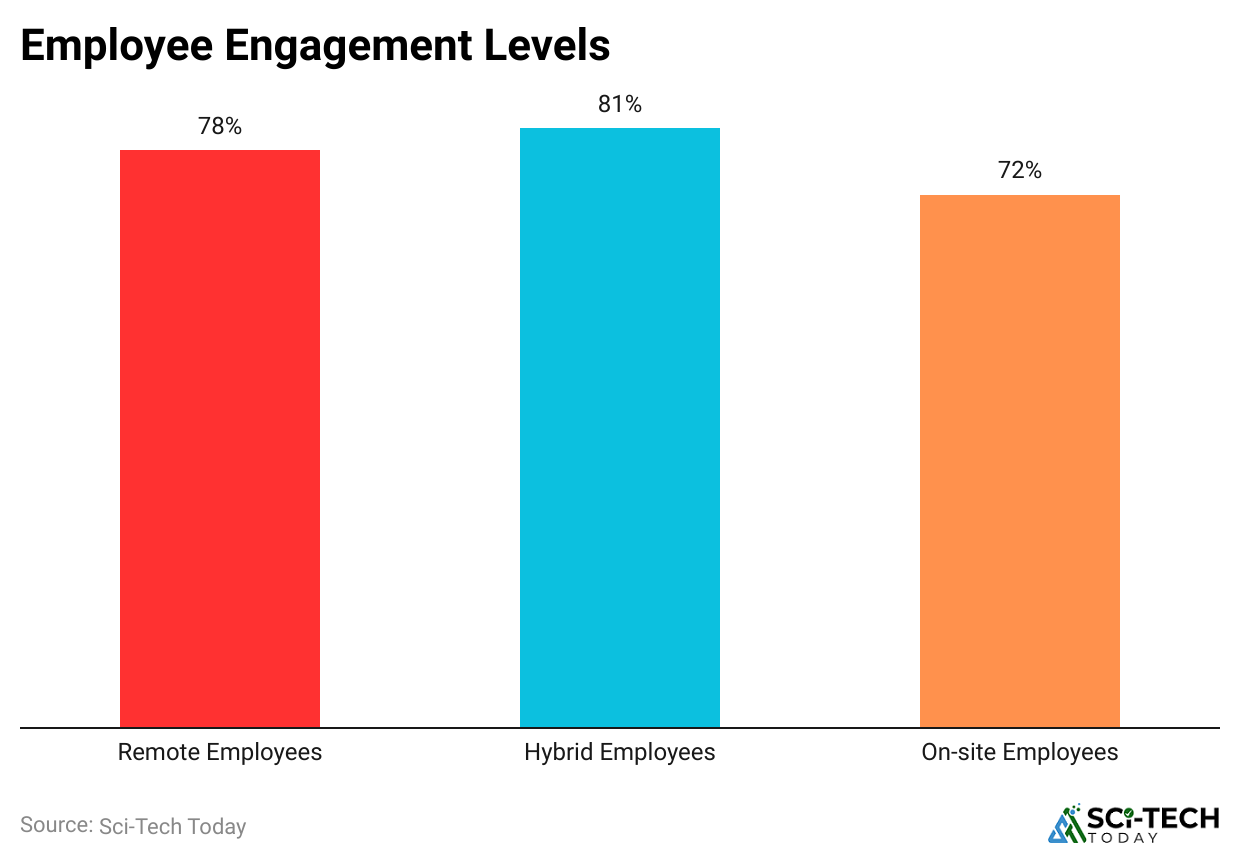
- Work-Life Balance: Feeling burnt out is a major drain on engagement. Hybrid and remote work arrangements are gaining traction, with statistics showing that hybrid (81%) and remote employees (78%) report higher engagement compared to on-site counterparts (72%). Offering flexible work options helps employees achieve a healthy work-life balance, leading to increased engagement.
Key Drivers of Employee Engagement
(Source: happeo.com)
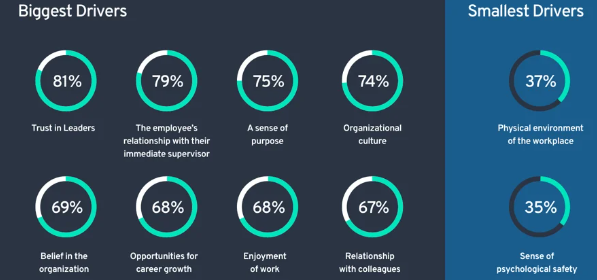
- The most important factors that help in enhancing employee engagement are trust in leaders (81%), Good employee relationships with their immediate supervisor (79%), a sense of purpose (75%), and organizational culture (74%).
- Moreover, the other biggest drivers include belief in the organization (69%), opportunities for career growth (68%), enjoyment of work (68%), and relationships with colleagues (67%).
- Besides, the smallest drivers are the physical environment of the workplace (37%) and the sense of psychological safety (35%).
Contribution To Employee Engagement
(Source: ctfassets.net)
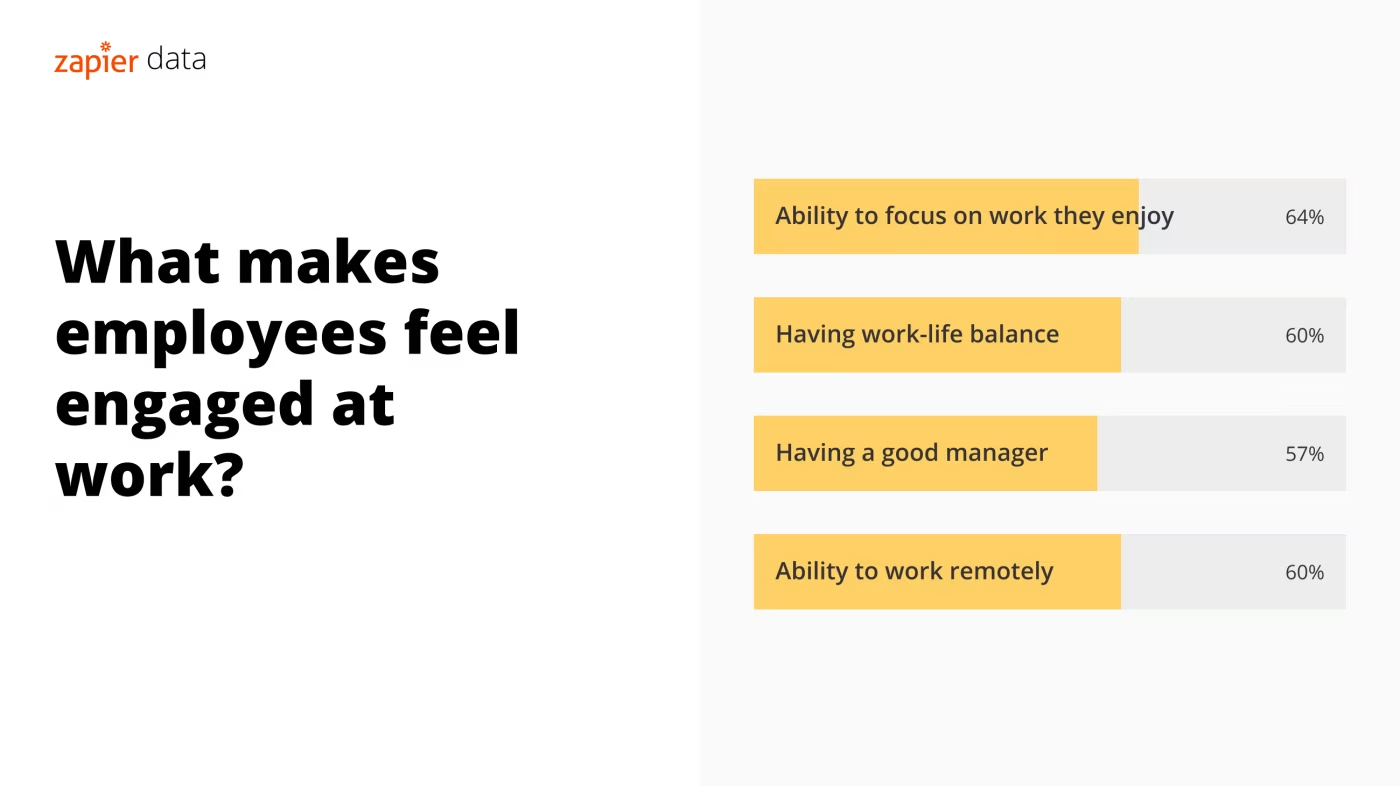
- Employee Engagement Statistics reported that 64% of employees focus on work that they enjoy doing, which makes them more engaged in work.
- 60% of employees felt more engaged in 2023 as they had an effective work-life balance.
- Meanwhile, 57% of employees remained fully engaged as they had good managers, and 60% were satisfied due to their remote working ability.
Employee Engagement Levels
(Reference: allnewbusiness.com)
- As mentioned by Employee Engagement Statistics, the highest engagement rate in 2023 was achieved by hybrid employees at 81%.
- However, remote employees and On-Site employees captured 78% and 72% engagement rates, respectively.
Workplace Engagement Trends, 2026
(Source: pumble.com)
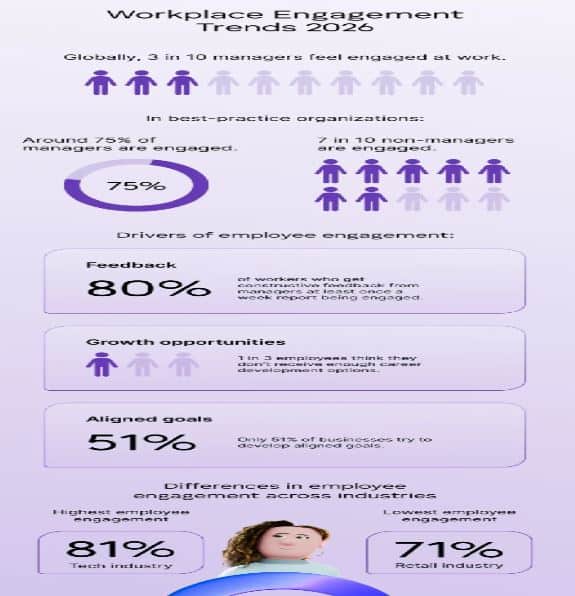
- Globally, only 3 in 10 managers feel engaged at work, highlighting a major leadership risk.
- In best‑practice organizations, about 75% of managers and roughly 7 in 10 non‑managers are engaged, demonstrating what is achievable.
- Around 80% of employees who receive constructive feedback from managers at least once a week say they feel engaged.
- About 1 in 3 employees believe they do not get enough career growth opportunities.
- Only 51% of businesses work on setting aligned goals, leaving nearly half without clear direction.
- Employee engagement varies by sector, with the tech industry at 81% and the retail industry at 71% engagement.
Manager Engagement Statistics
(Source: primeast.com)
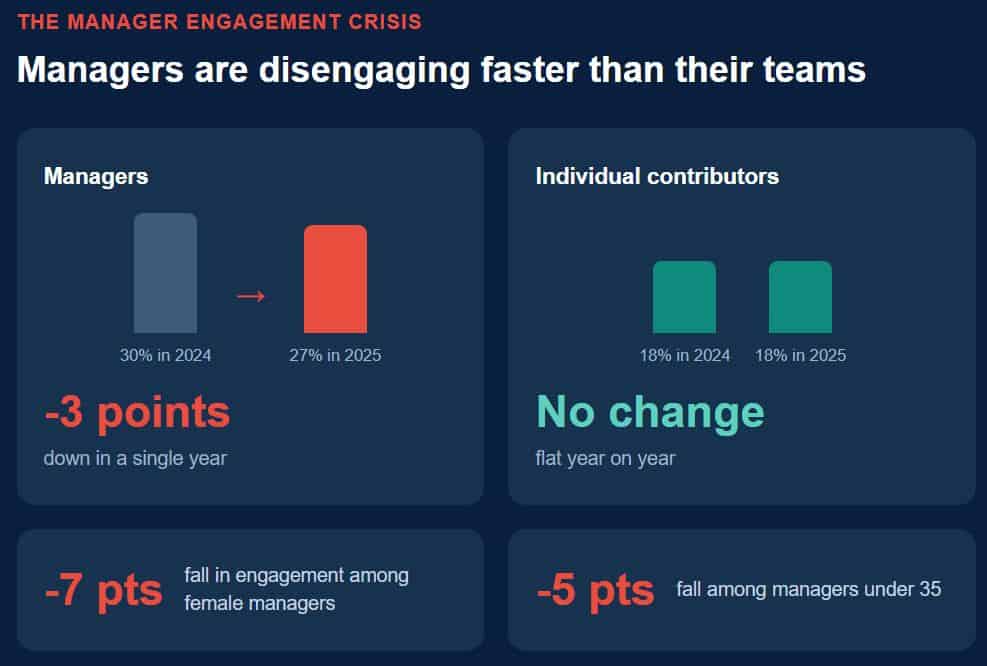
- Global manager engagement dropped from 30% to 27% in one year, while individual contributor engagement remained steady at 18%.
- Engagement among female managers declined by 7 points, and among managers under 35 by 5 points.
- Managers influence about 70% of the differences in team engagement.
- Employees with highly engaged managers are 59% more likely to be engaged than those reporting to managers who are actively disengaged.
Employee Engagement Strategies By Expectation
(Reference: founderjar.com)
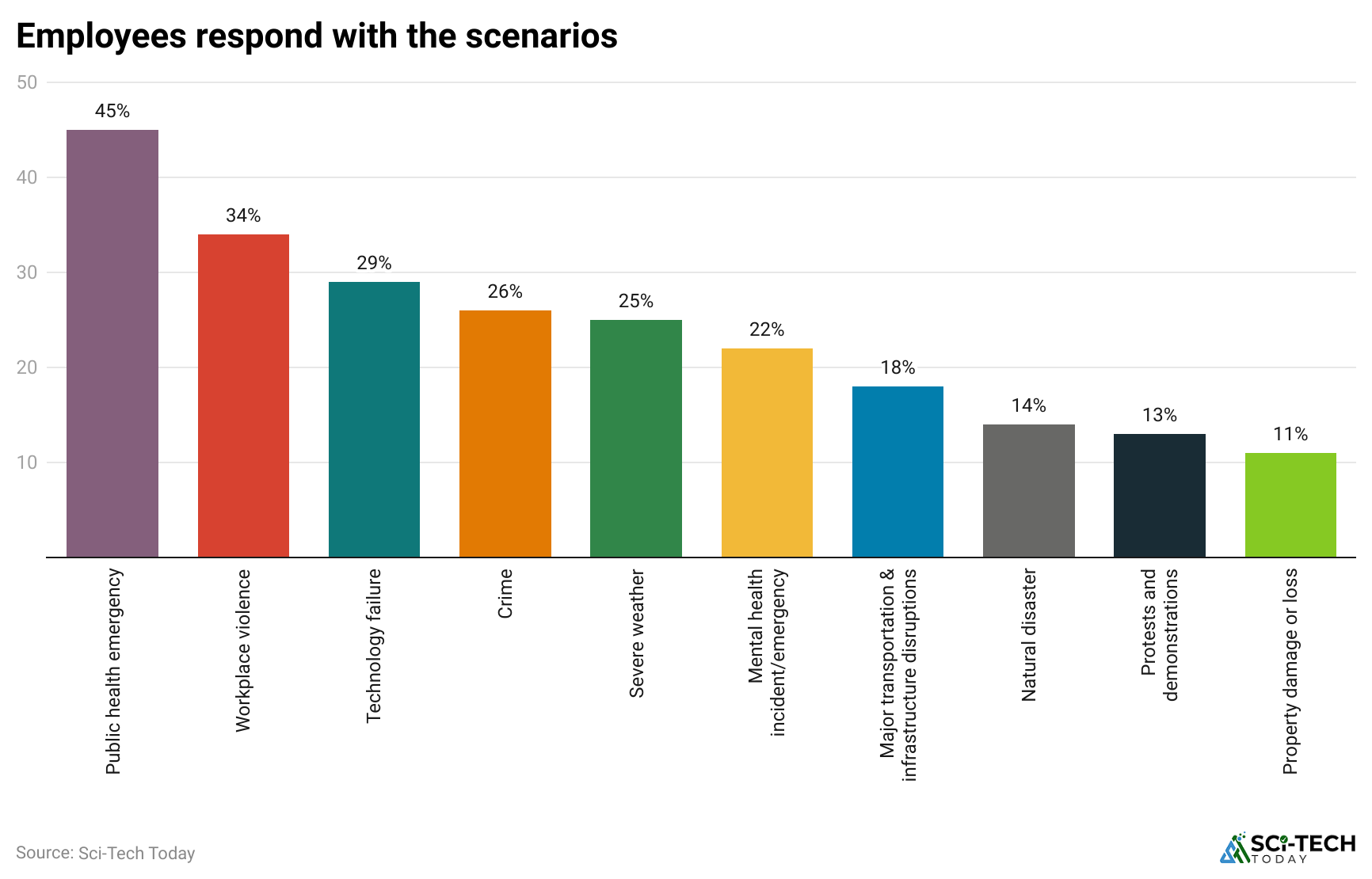
- For almost 81% of employees in the U.S., physical safety is the top priority, but only 58% of employers have achieved it in 2023.
- Some basic requirements of employees about which they are concerned are public health emergencies (45%), workplace violence (34%), Technology failure (29%), Crime (26%), severe weather (25%), mental health or accidents (22%), Major transportation disruption (18%), Natural disaster (14%), and protests (13%).
- American organizations have implemented many safety measures to make employees feel safe, which was agreed by 71% of employees.
By Work Arrangement
(Source: worktime.com)
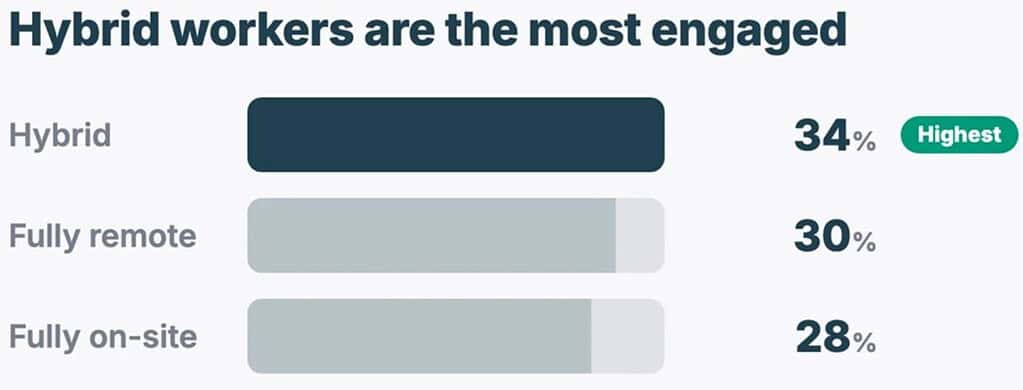
- Hybrid employees have the highest engagement rate at 34%, making them the most engaged work group.
- Fully remote employees report a 30% engagement rate.
- Fully on-site employees have the lowest engagement rate at 28%.
- Hybrid work combines workplace flexibility with in-person collaboration, thereby improving employee engagement.
- A Stanford study also found that fully remote employees were 13% more productive than office-based employees, although this result reflects an earlier period before hybrid work became widely adopted.
By Generation
- Employee engagement has declined the most among younger workers.
- Employees under 35 years experienced a drop in engagement of about 5% in one year, which is greater than that of older age groups.
- Many younger employees feel they receive less recognition, fewer resources, unclear expectations, and limited learning opportunities.
- They also feel less connected to their organization’s mission and purpose.
- Career growth and development remain the strongest factors influencing engagement among younger employees.
By Industries
- Employee engagement differs across industries, with the largest recent declines seen in finance, insurance, transportation, technology, and professional services.
- Leading organizations maintain 70% employee engagement across every industry.
- Moreover, 70% engagement depends more on effective management practices than on the industry or the work itself.
Employee Well-Being, Communication, Absenteeism, And Retention Statistics
- Around 34% of employees worldwide are thriving in overall well-being, while most workers are either struggling or just getting by.
- About 41% of employees reported feeling significant stress the previous day, which can reduce engagement over time.
- Poor workplace communication costs U.S. businesses about USD 1.2 trillion annually, or nearly USD 12,506 per employee.
- Communication effectiveness declined by 12%, while productivity losses increased by 15%.
- Around 88% of organizations focus on employee retention, with learning opportunities as their top strategy.
- According to gifteo.co, organizations with strong employee engagement experience 21%-51% lower staff turnover than those with weak engagement.
- About 96% of employees believe that showing empathy improves employee retention.
- Highly engaged organizations report 78% lower absenteeism.
- Disengaged employees have 37% higher absenteeism
Organizations Focus on Employee Engagement
(Reference: founderjar.com)
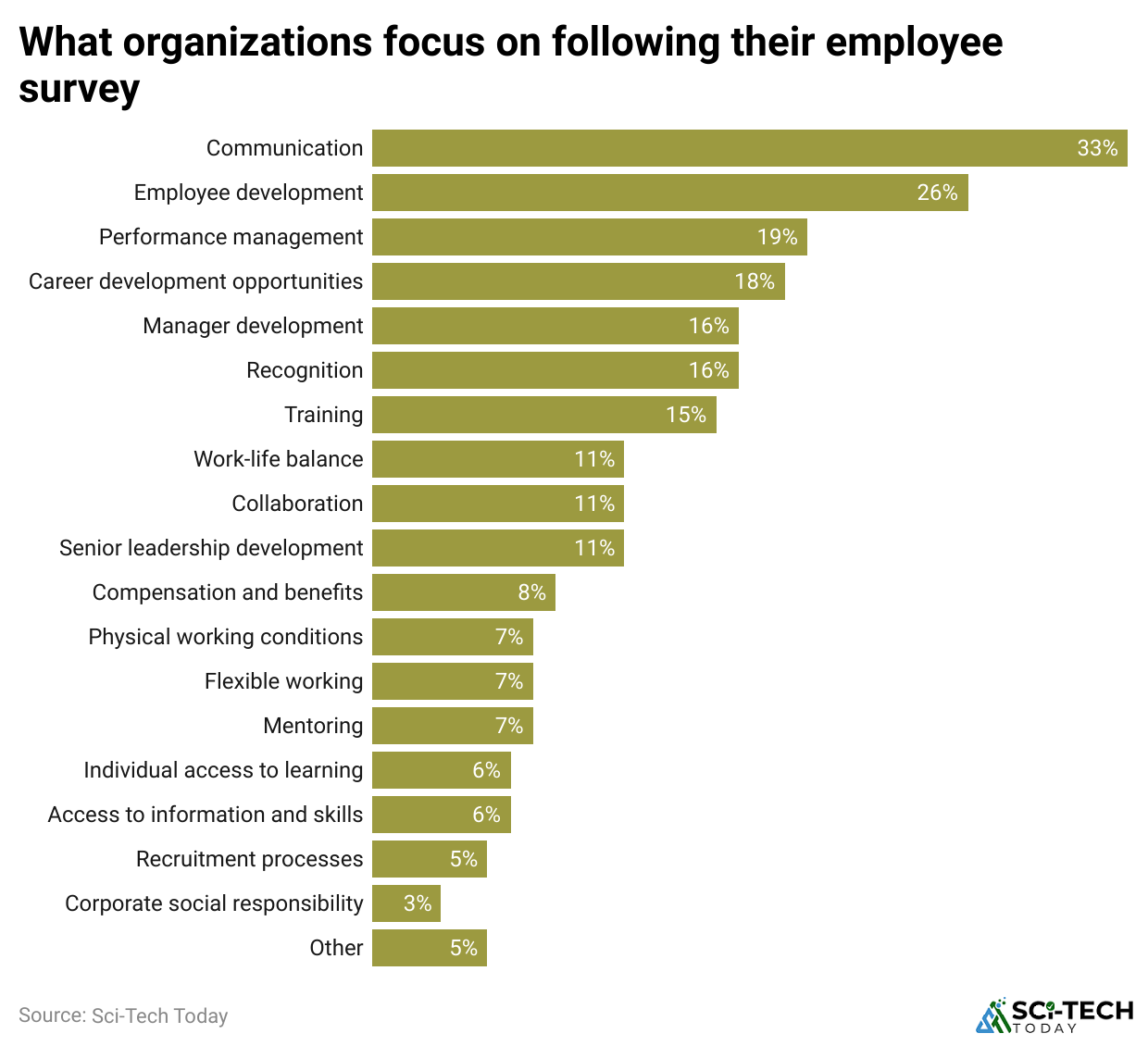
- In 2023, organizations’ main focuses on employee engagement were communication (33%), employee development (26%), performance management (19%), career development opportunities (16%), recognition (16%), and training (15%).
- In addition, other focus areas were work-life balance (11%), collaboration with employees (11%), senior leadership development (11%), compensation and benefits (8%), physical working conditions (7%), individual access to learning (6%), access to information and skills (6%), recruitment processes (5%), corporate social responsibility (3%), and other (3%).
Cost Of Employee Disengagement
- A report published by WorkTime shows that employee disengagement costs the global economy about USD 10 trillion each year, equal to around 9% of global GDP.
- Around 6 in 10 employees worldwide are not engaged and contribute only the minimum effort at work, reducing overall productivity.
- More than 50% of employees globally are looking for or planning to change jobs, reflecting low engagement.
- In the United States, 17% of employees are actively disengaged, which can lower team performance and workplace morale.
- Burnout is a major cause of disengagement and increases voluntary employee turnover, leading to higher hiring and training costs for organizations.
Business Benefits Of High Employee Engagement
- Research across 183,806 business units in 53 industries and 90 countries shows that highly engaged teams deliver stronger business results.
- Highly engaged teams achieve 23% higher profitability and 18% higher sales productivity.
- Production productivity increases by 14%, while customer loyalty improves by 10%.
- Employee well-being is 70% higher, and organizational citizenship improves by 22%.
- Turnover is 21% lower in high-turnover organizations and 51% lower in low-turnover organizations.
- Absenteeism decreases by 78%, and shrinkage or theft falls by 28%.
- Safety incidents are 63% lower, patient safety incidents are 58% lower, and quality defects are 32% lower.
- The engagement-performance correlation is 0.49, with top-performing teams having 2.33 times higher odds of success.
Employee Sentiment Toward AI In The Workplace
- According to EvolveUp, around 52% of U.S. employees are concerned about the future use of AI in the workplace.
- Only 36% feel hopeful about how AI will be used at work in the future.
- About 33% of employees say AI makes them feel overwhelmed at work.
- 32% believe AI could reduce their long-term job opportunities.
Best Employee Engagement Strategies For 2026
- According to Gallup, set clear goals and expectations because only 31% of U.S. employees and 20% of employees worldwide are engaged, making role clarity essential for better engagement.
- Train managers, as they influence about 70% of team engagement, while employees with supportive managers are 2.1 times more likely to use AI regularly.
- Use AI to improve work rather than create stress, as poor engagement costs the global economy about USD 10 trillion each year.
- Invest in career development, upskilling, and mentorship to improve engagement and retention.
- Provide regular recognition, as 82% of employees say it improves engagement, while 57% of HR reports link peer recognition to higher engagement.
- Collect employee feedback regularly and build flexible, well-being-focused workplaces with strong collaboration and a clear sense of purpose.
Building a More Engaged Workforce
So, how can companies create a work environment that fosters employee engagement? Here are some tips:
- Defined Mission and Values: Employees want to feel like their work has a purpose and contributes to a bigger goal. A clear company mission statement and defined values can help them connect with the company’s vision.
- Open Communication: Regular, transparent communication between managers and employees is crucial. Create a space where employees feel comfortable sharing ideas, voicing concerns, and providing feedback.
- Performance Feedback: Employees don’t thrive in the dark. Provide regular, constructive feedback to help them understand their strengths and areas for improvement.
- Opportunities for Growth: Invest in your employees’ professional development. Offer training programs, mentorship opportunities, and support for pursuing relevant certifications or skills.
- A Culture of Recognition: Don’t underestimate the power of a simple “thank you” or public acknowledgment. Regularly recognize and reward employees for their hard work and achievements.
Ending
Employee engagement is the key to building a happy and successful workplace. When employees feel valued, supported, and motivated, they work better and stay committed to their jobs. Simple actions like clear communication, regular appreciation, and learning opportunities can make a big difference. Companies that focus on employee engagement enjoy higher productivity, better teamwork, and lower employee turnover. In the long run, an engaged workforce helps both employees and the business grow and succeed together.
FAQ
Employee engagement matters because it increases productivity, improves teamwork, boosts job satisfaction, and helps businesses achieve long-term success.
Low employee engagement is evident in poor productivity, low motivation, absenteeism, minimal participation, and turnover.
Leaders improve employee engagement by communicating clearly, recognizing achievements, supporting growth, encouraging feedback, building trust, and leading with empathy.

Sources