








Introduction
Data Centers Statistics: In 2025, the data center has pushed its origins as just a server room to become the most vital infrastructure of the 21st-century economy; its industrial-scale footprint is growing exponentially. In an era dominated by cloud computing, Big Data, 5G, and the recent demands of Artificial Intelligence, the global data centers market is experiencing a profound transformation.
So, I’d like to discuss this data center’s statistics, letting the readers know the market’s colossal value, its energy consumption challenges, and the changes deciding its future. Let’s get started.
Editor’s Choice
- The overall market size for global data centers was valued at US$242.72 billion in 2024, setting the benchmark for the sector’s economic scale.
- The market is strategically forecasted to reach US$584.86 billion by 2032, showing a massive 140% growth over the forecast period, driven by persistent digital demand.
- The CAGR is projected at a robust 11.7% from 2024 to 2032, confirming the sector’s aggressive growth.
- North America holds the largest market share, at 38.83% in 2024, reflecting its established technological infrastructure and early adoption of hyperscale computing models.
- The Asia Pacific region is slated to be the fastest-growing market, propelled by rapidly increasing internet penetration and substantial digitalization efforts across emerging economies.
- The total number of operational data centers across the globe currently exceeds 11,800, illustrating the physical magnitude of the internet infrastructure.
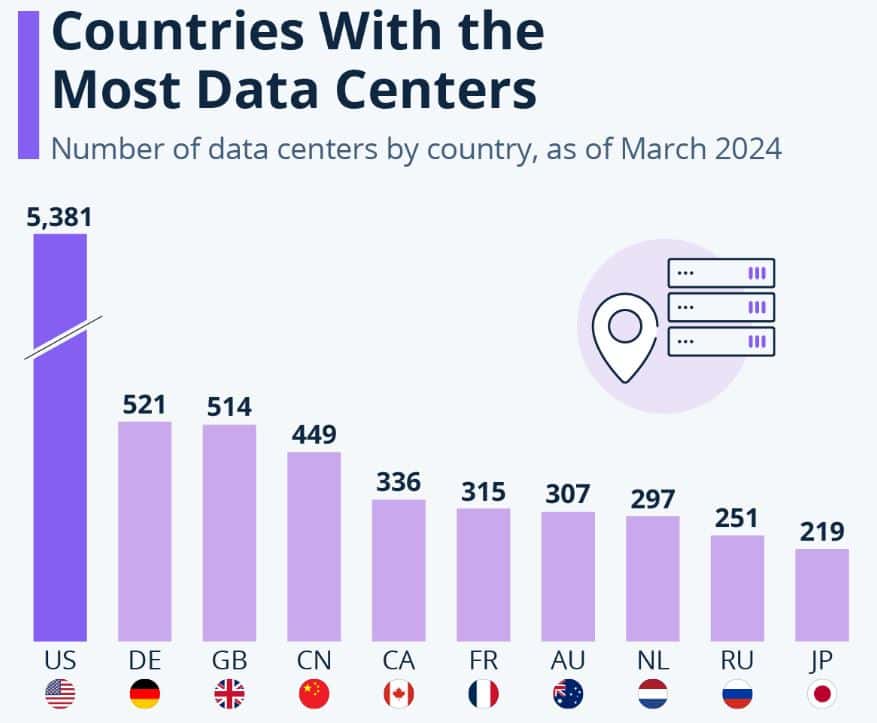
- The United States leads in quantity, hosting an estimated 5,530 data centers in 2023, which accounts for nearly 40% of the world’s total capacity.
- The number of massive Global Hyperscale Sites reached 523 in 2024, marking the ongoing industry change toward centralized cloud facilities.
- Amazon Web Services AWS leads the physical count among hyperscalers with 126 data center sites in 2024, solidifying its dominance in cloud infrastructure.
- The Tier 3 segment, mandating 99.982% uptime with N+1 redundancy, represents the dominant level of infrastructure maturity and high availability standard adopted by the industry in 2024.
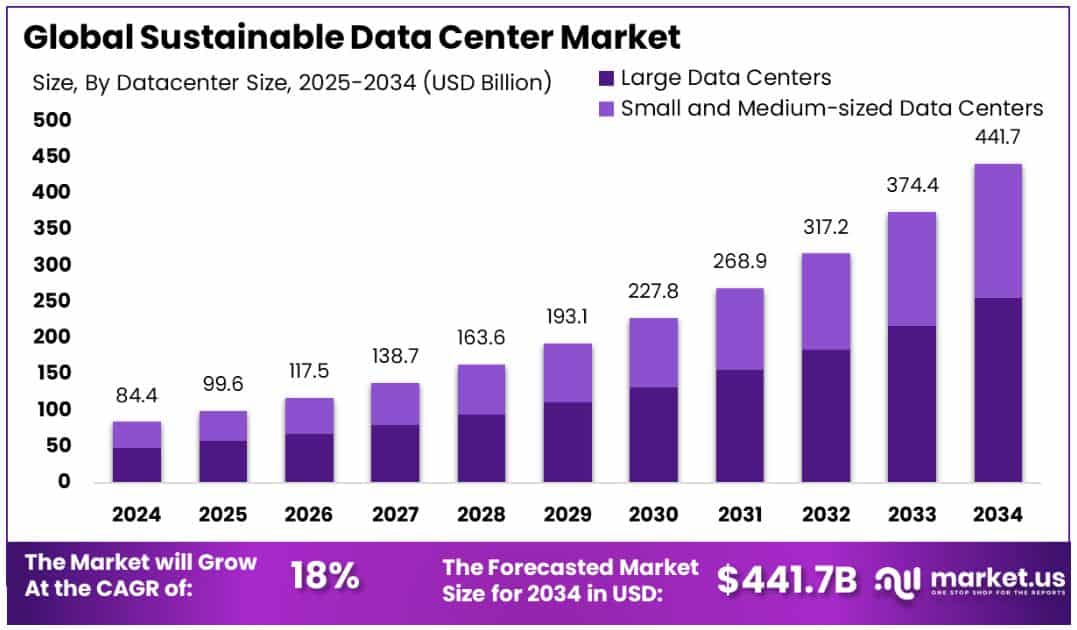
- The market for Sustainable Data Centers is forecast for a five-fold surge, rising from US$99.6 billion in 2025 to US$441.7 billion by 2034.
- The 18% CAGR for this segment is significantly higher than the general data center market.
- The Solution Segment, encompassing hardware, cooling, and power systems, captured a massive over 70% share in 2024.
- Large Data Centers dominate the sustainability segment with over 58% share in 2024, as hyperscale providers lead the massive procurement of renewable energy resources.
- The US sustainable market alone is projected to grow from US$28.1 billion in 2024 to US$127.2 billion by 2034, with a strong 16.3% CAGR.
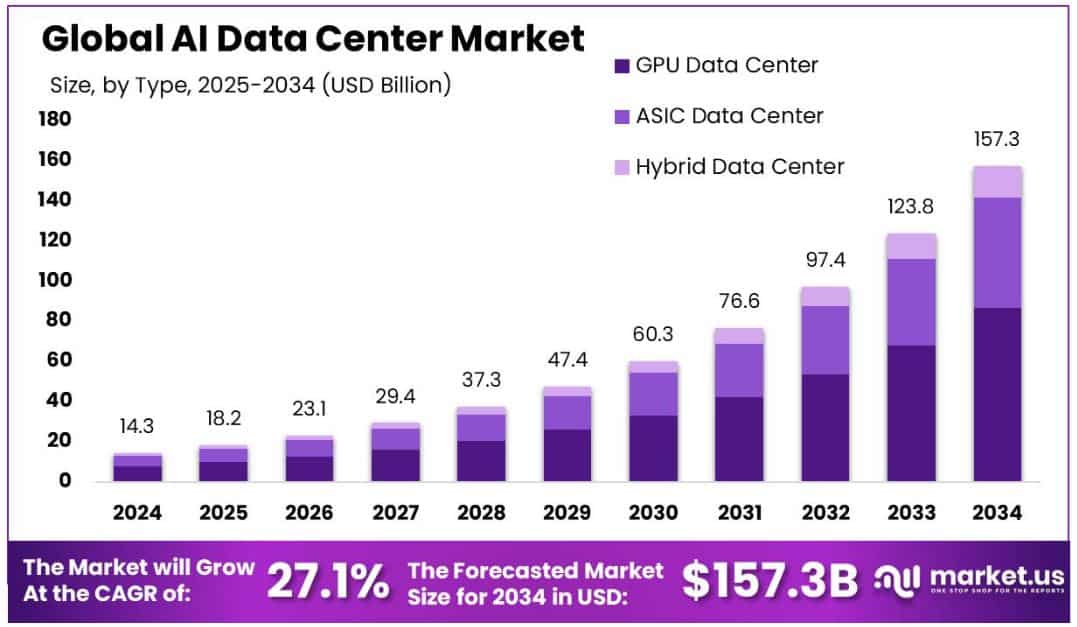
- The AI Data Center market is set for hyper-growth, projected to skyrocket from US$18.2 billion in 2025 to a colossal US$157.3 billion by 2034.
- This segment boasts the highest projected growth rate in the industry, with a massive 27.1% CAGR.
- The GPU Data Center segment holds the hardware lead, commanding over 55% of the market share in 2024.
- The BFSI Banking, Financial Services, and Insurance segment is the largest end-user, capturing more than 20% of the market share due to its critical use of AI for risk assessment and data-intensive operations.
- North America confirms its lead in this crucial sector, generating an estimated US$5.7 billion in revenue and capturing over 40% of the global market share for AI infrastructure in 2024.
- The industry’s energy demand is projected to more than double by 2030, potentially exceeding 945 TWh globally.
- US power market demand for data centers is expected to double from 17 Gigawatts GW in 2022 to 35 GW by 2030, representing a 100% capacity increase in eight years.
- The average industry Power Usage Effectiveness PUE is estimated at 1.56 in 2024, indicating that 56% of total power is still used for non-IT overhead like cooling.
- Best-in-class hyperscale fleets, like Google, have achieved an ultra-efficient PUE of 1.09 in 2024, setting the efficiency gold standard for minimal overhead power use.
- New AI rack density is pushing power needs to 10-50 kW per rack, drastically higher than the traditional 5 to 10 kW.
- Google’s data centers globally consumed nearly 6 Billion Gallons of water in 2024, highlighting the substantial water footprint driven by high-intensity AI cooling requirements.
- A single large data center can consume up to 5 Million Gallons of potable water per day, a consumption rate comparable to a small metropolitan area.
- The industry’s collective carbon emissions stand at approximately 2% of global emissions, which is comparable to the entire global aviation industry’s carbon footprint.
- A projection over 35% of AI-centric data centers will deploy specialized liquid cooling methods by 2025 to manage the extreme heat loads of next-generation hardware.
- Edge computing is rapidly redefining the footprint, with estimates suggesting that more than 50% of data will soon be processed outside traditional.
The Sustainable Data Center Market – The Green Exponential
(Source: market.us)
According to Market.us, the escalating operational costs from rising energy prices and mounting regulatory pressure have transformed green operations from a corporate footnote into a standalone market.
Market Momentum And Valuation
- The global sustainable data center market is currently valued in the tens of billions and is aggressively projected to surge from $99.6 billion in 2025 to a massive $441.7 billion by 2034.
- This colossal expansion changes to a CAGR of 18% from 2025 to 2034, significantly outpacing the growth of the conventional data center market.
- In the United States, the investment thesis is particularly strong: the US sustainable market alone was valued at a significant USD 28.1 billion in 2024 and is forecast to grow to a monumental USD 127.2 billion by 2034, compounding at a vigorous 16.3% CAGR.
Technology And Dominant Segments
- The Solution segment, which includes the tangible hardware and software for efficiency, like power, cooling, and monitoring systems, held a commanding lead in the market, capturing over 70% of the market share in 2024.
- By size, Large Data Centers dominated the sustainability conversation in 2024, accounting for more than 58% of the total market share.
- The IT & Telecom segment maintains its prominence as an end-user, capturing over 25% of the market in 2024.
- Innovation is accelerating, evidenced by industry collaborations such as Fujitsu, Supermicro, and Nidec jointly developing liquid-cooling solutions designed to enhance data center energy efficiency by a remarkable 40% over standard air-cooling methods.
- Additionally, major players like Dell Technologies are aligning their product roadmap, set to launch the PowerProtect All Flash Appliance and PowerStore Advanced Ransomware Detection in 2025.
Regional Leadership In Sustainability
- North America remains the unquestioned global leader in the sustainable segment, capturing a substantial over 36% of the global market share in 2024, generating approximately USD 30.52 billion in revenue.
| Sustainable Data Center Market | Metrics |
| Market Value 2025 | $99.6 Billion |
| Forecasted Value 2034 | $441.7 Billion |
| Growth Rate CAGR 2025 to 2034 | 18% Five-fold growth |
| Dominant Component 2024 | Solution Segment Over 70% share |
| Dominant Size 2024 | Large Data Centers Over 58% share |
| US Market Value 2024 | USD 28.1 Billion |
| US Growth Rate CAGR 2025 to 2034 | 16.30% |
The AI Data Center Market
(Source: market.us)
According to Market.us, if sustainability is the conscience of the industry, AI data centers are the engine of computational demand. Artificial Intelligence and Machine Learning workloads require a fundamentally different type of facility. Here is the complete data.
Explosive Market Growth and Drivers
- The global AI data center market is projected to skyrocket from a foundation of $18.2 billion in 2025 to a colossal $157.3 billion by 2034.
- This monumental expansion is supported by an almost unbelievable CAGR of 27.1% between 2025 and 2034.
- For the American market, the investment is immense: the US AI Data Center Market was already valued at approximately US$5.38 billion in 2024, and with a projected CAGR of 26.4%.
Hardware and Industry Dominance
- The GPU Data Center segment is the undisputed hardware champion of this market, commanding over 55% of the market share in 2024.
- The BFSI Banking, Financial Services, and Insurance segment surprisingly led the end-user market for AI infrastructure in 2024, capturing more than 20% of the market share.
- The requirement for these specialized facilities is purely about scale: AI workloads demand racks with 4 to 10 times the power density of traditional racks.
Regional Concentration of Power
- North America has firmly established itself as the global giant in the AI segment, capturing over 40% of the global market share in 2024 and generating an estimated USD 5.7 billion in revenue.
| AI Data Center Market | Value Metrics |
| Market Value 2025 | $18.2 Billion |
| Forecasted Value 2034 | $157.3 Billion |
| Growth Rate CAGR 2025 to 2034 | 27.1% Hyper-growth |
| Dominant Hardware 2024 | GPU Data Center Over 55% share |
| Dominant End-User 2024 | BFSI Segment More than 20% share |
| North America Market Share 2024 | Over 40% |
| North America Revenue 2024 | USD 5.7 Billion |
Number And Distribution of Data Centers
(Source: statista.com)
- There are estimated to be over 8,000 colocation and enterprise data centers operational worldwide, with the total number of all-inclusive sites, including hyperscale, exceeding 11,800 as per early 2024 estimates.
- The United States stands as the unquestioned leader in numbers, hosting an estimated 5,530 data centers in 2023, a figure representing nearly 40% of the global market capacity.
- North America collectively accounted for 1,357 colocation sites in 2024, though Asia Pacific slightly surpassed this count with 1,811 sites in the same year.
- The critical change is toward hyperscale data centers, with a reported 523 hyperscale sites in operation globally in 2024, and this number is projected to increase to 567 by 2025 alone, a swift 8.4% annual increase.
- AWS currently leads the hyperscale segment, with a total of 126 data center sites in 2024, a count projected to grow to 185 by 2030.
- The segment of Tier 3 data centers, which mandate a minimum of N+1 redundancy and guarantee 99.982% uptime, captured the largest share of the market in 2024.
| Metric | Value | Timeframe |
| Global Colocation Sites | 5,186 | 2024 |
| Global Hyperscale Sites | 523 | 2024 |
| US Data Centers | 5,530 | 2023 |
| Leading Hyperscaler Sites AWS | 126 | 2024 |
| Dominant Tier Level | Tier 3 99.982% Uptime | 2024 |
Energy Consumption And Sustainability Metrics
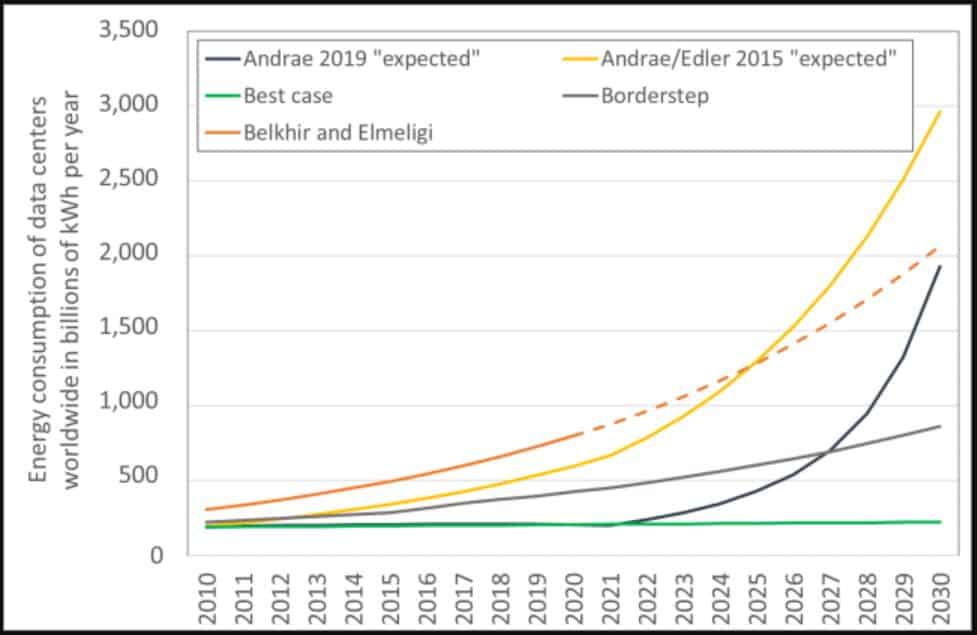
(Source: researchgate.net)
- Global electricity consumption by data centers excluding cryptocurrency mining was estimated to be between 240 and 340 Terawatt-hours TWh in 2022, representing approximately 1% to 1.3% of global electricity demand.
- This figure is set for a dramatic spike, with electricity demand from data centers and AI operations projected to more than double by 2030, potentially exceeding 945 TWh.
- In the United States alone, market demand is expected to double from 17 Gigawatts GW in 2022 to a massive 35 GW by 2030, reflecting a 100% capacity increase in just eight years.
- The adoption of AI is the primary catalyst; one report projects that AI will drive a 165% increase in data center power demand through 2030.
- The average industry Power Usage Effectiveness PUE, the ratio of total facility power to IT equipment power, is estimated to be around 1.56 in 2024, meaning 56% of total power is still used for overhead like cooling and lighting.
- Leading hyperscalers have set the gold standard: Google’s global fleet of data centers reported an average annual PUE of an ultra-efficient 1.09 in 2024, using 84% less overhead energy than the industry average.
- Servers, which are the computational core, account for an average of 60% of electricity demand in modern data centers, though this percentage can be higher in AI-optimized facilities.
| Metric | Value | Timeframe |
| Global Consumption Share | 1% to 1.3% of global electricity | 2022 |
| Projected Global Consumption | 945 TWh | By 2030 |
| US Power Demand Growth | 17 GW to 35 GW | 2022 to 2030 |
| Industry Average PUE | 1.56 | 2024 |
| Best-in-Class PUE Google Fleet | 1.09 | 2024 |
A Key Sustainability Metric
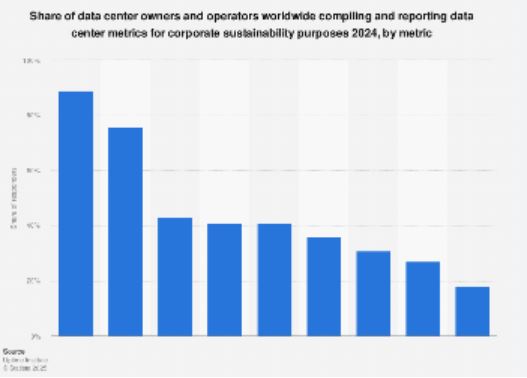
(Source: statista.com)
- A single large data center can consume up to 5 million gallons of potable water per day for its cooling processes.
- Hyperscale giants report colossal consumption figures: Google’s data centers worldwide consumed nearly 6 billion gallons, 22.7 billion liters of water in 2024, marking an 8% increase YOY.
- The sector’s overall carbon emissions stand at approximately 2% of global carbon emissions.
- The rising power density within server racks now exceeds 100 times that of a conventional office building.
- Due to the critical nature of this resource, the industry is increasingly adopting the Water Usage Effectiveness WUE metric to measure efficiency, aiming for a score closer to 0.
- More than 35% of AI-centric data centers are projected to deploy some form of liquid cooling, including direct-to-chip or immersion cooling, in 2025 to manage extreme heat loads.
| Metric | Value | Timeframe |
| Google’s Annual Water Use | 6 Billion Gallons | 2024 |
| Single DC Daily Water Use | Up to 5 Million Gallons | 2024 |
| Global Carbon Footprint | 2% of global emissions | 2024 |
| Projected Liquid Cooling Adoption | 35% of AI Centers | 2025 |
Historical Context And Segmentation
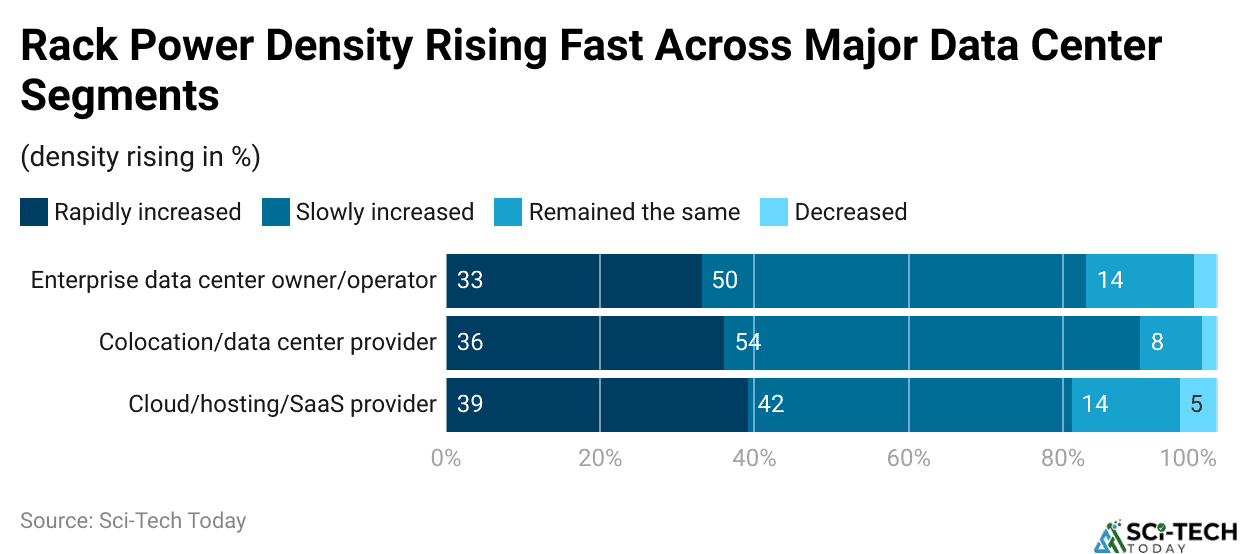
(Reference: scoop.market.us)
- The true precursor to the modern data center was the Electronic Numerical Integrator and Computer ENIAC, completed in 1945, which occupied a massive 300 square feet and weighed over 27 tons.
- The introduction of the transistorized computer by IBM in 1955 dramatically reduced energy needs by 90% and halved the size of comparable systems.
- The dot-com boom of the mid-1990s spurred the construction of the first large-scale facilities, but the subsequent bust led to a focus on virtualization, which ultimately reduced data center power, space, and cooling requirements by an estimated 80%.
- By Component, the Solution segment currently holds the largest revenue share, accounting for a commanding 65.76% of the market in 2024.
- By type, the Colocation segment held the largest market share in 2024, as organizations choose to rent infrastructure rather than bear the huge capital expenditure of building and maintaining their own facilities.
- By End-User, the IT & Telecom sector has historically captured the highest market share in data centers, as they require the most robust and scalable infrastructure for communication and cloud services, leading the market in 2024.
| Segment Type | Metric | Value | Timeframe |
| Component Solution | Revenue Share | 65.76% | 2024 |
| Type Colocation | Market Share | Largest Share | 2024 |
| Type Hyperscale | Growth Rate | Fastest CAGR | Forecast Period |
| End-User IT & Telecom | Market Share | Highest Share | 2024 |
| End-User SMEs | Growth Rate | Fastest CAGR | Forecast Period |
Investment, AI, And Innovation Driving Data Centers
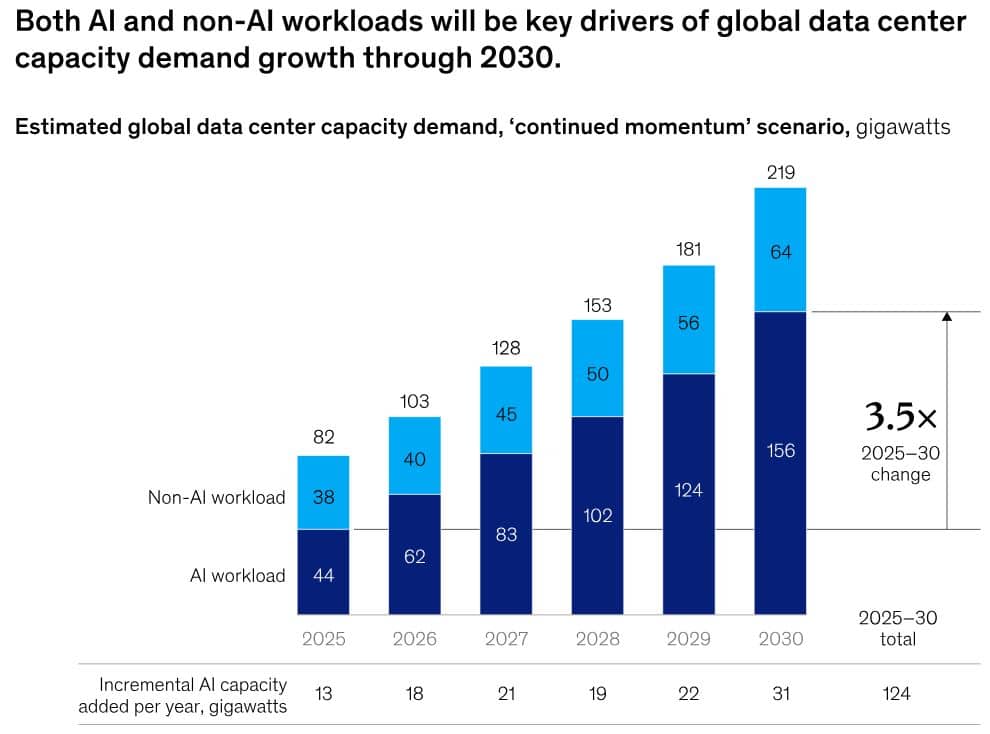
(Source: mckinsey.com)
- Major cloud providers have signaled unimaginable capital expenditure, with investment in data center infrastructure expected to exceed $150 billion in 2025 alone.
- A recent key development is the collaboration between the US and the UAE on building a massive 5 GW AI data center campus.
- The introduction of purpose-built AI processors for data centers is driving the need for racks capable of delivering power densities between 10 to 50 kW per rack, compared to a traditional enterprise rack density of 5 to 10 kW.
- The data center power market itself, encompassing all electrical solutions and systems, is projected to grow from USD 35.14 billion in 2025 to USD 50.51 billion by 2030, a 7.5% CAGR in supporting infrastructure alone.
- The push for sustainability is leading to significant investments in renewable energy, with global purchases of new wind and solar capacity by tech firms exceeding 70 GW in 2024.
- Edge computing is becoming a data reality, with estimates suggesting that more than 50% of data is now processed outside of traditional, centralized data centers.
- The construction of the highest-redundant facilities is accelerating, with the Tier IV segment guaranteeing 99.995% uptime and full fault tolerance expected to see the highest growth in the power market.
| Trend/Metric | Value/Projection | Timeframe |
| Cloud Provider Investment | $150 Billion | 2025 |
| AI Rack Density | 10 to 50 kW per rack | 2024 |
| Renewable Energy Procurement | 70 GW | 2024 |
| Data Processed at the Edge | 50% | Near Future |
| Data Center Power Market CAGR | 7.50% | 2025 to 2030 |
Conclusion
Overall, what these data reveal is a sector in the middle of a digital industrial change. The market valuation is growing toward the trillion-dollar mark, the infrastructure footprint is doubling in power capacity, and the entire design philosophy is being changed to accommodate the demands of Artificial Intelligence. The statistics on energy and water consumption are direct calls to action, forcing a pivot toward hyper-efficient designs like the sub-1.1 PUE targets and massive renewable energy integration.
This kind of data center remains the focus keyword and the core engine of the global marketplace, and its evolution confirms its role as the most dynamic and important asset class of the modern world. I hope you like this piece of the article. If you have any questions, any ideas, or suggestions, kindly let us know. Thanks for reading till the end. I’d be happy if this article helped you.