









Starter
Kakao Talk Usage Statistics: Digital connectivity runs through contemporary society because it enables people to connect through messaging applications, which serve as the main method of communication for both personal and business purposes. KakaoTalk stands as the top communication platform in South Korea, which belongs to the global messaging market that includes WhatsApp Messenger and Telegram as its two major competitors. The 2025 app reaches a near-total user base because it shapes communication methods, transaction processes, shopping experiences, and work activities for millions of people.
The article presents research findings about Kakao Talk usage statistics 2025, user base, and financial performance, which show detailed information about its user reach and engagement metrics, together with its revenue effects and overall impact on its business ecosystem.
Editor’s Top Recommendations
- KakaoTalk reached 48.9 million monthly active users in South Korea in 2025, covering 94.7% of the total population.
- Kakao serves approximately 54 million global monthly active users across its ecosystem.
- Kakao’s total revenue reached its highest point at KRW 1,050 billion during the second quarter of 2024, but it declined to KRW 871 billion in Q1 2025.
- The platform showed consistent revenue performance between KRW 943 billion and KRW 1,047 billion, which demonstrated that the primary business operations remained strong.
- Kakao’s content revenue decreased by almost 16%, which resulted in a drop from KRW 1,033 billion in 1Q24 to KRW 871 billion in 1Q25.
- Kakao experienced a 22% revenue increase during the first quarter of 2024, but this growth stopped at a 6% revenue decline by the first quarter of 2025.
- Kakao holds the 4th position in worldwide rankings because its digital rights score reaches 44%, which shows its business ecosystem and governance systems have reached advanced development stages.
- Kakao Talk usage drives advertising revenue, which accounts for more than 35% of total revenue for Kakao.
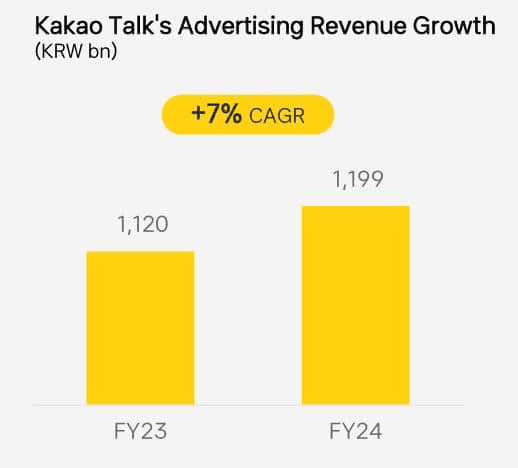
- KakaoTalk’s advertising revenue increased by 7% compared to the previous year, which resulted in a revenue increase from KRW 1,120 billion in FY23 to KRW 1,199 billion in FY24.
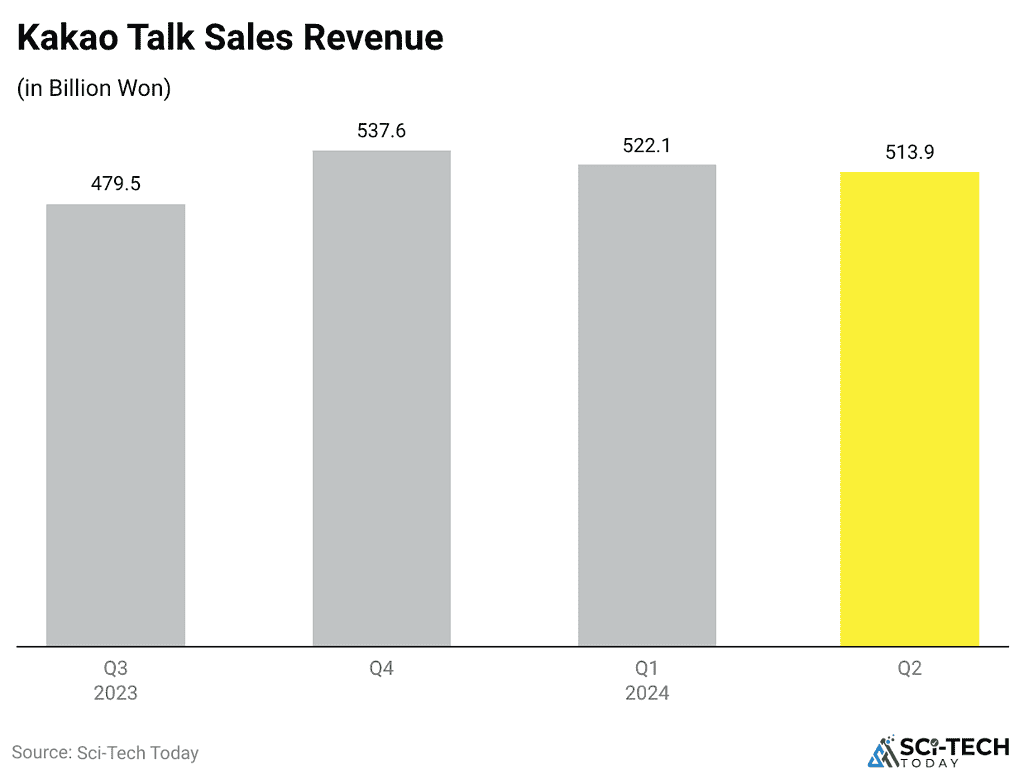
- KakaoTalk business revenue reached its highest point at KRW 537.6 billion during the fourth quarter of 2023 before it returned to regular levels in 2024.
- The users spent 677.85 minutes in October, which showed a 22.32-minute decrease from their 700.17-minute usage in September.
Kakao Website Traffic and Visitor Engagement
(Source: SEMrush)
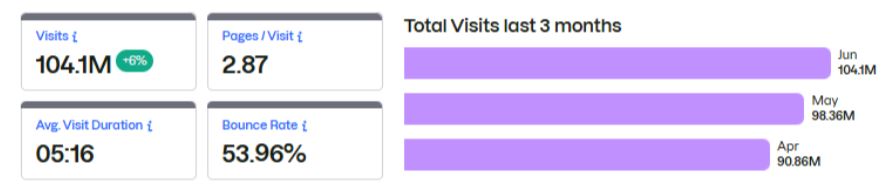
- Kakao.com received 104.1 million visits in June, marking a solid 5.84% increase compared to May, reflecting growing user engagement on the platform.
- The average session duration stands at 5 minutes and 16 seconds.
- Users browse an average of 2.87 pages per visit, showing moderate on-site navigation as visitors explore different sections of the platform.
- The bounce rate is recorded at 53.96%, suggesting that just over half of visitors leave after viewing only one page, indicating room for improved user retention strategies.
- Traffic has shown consistent growth over the past three months, rising from 90.86 million visits in April to 98.36 million in May, and reaching 104.1 million in June.
Kakao Revenue
(Source: kakaocdn.net)
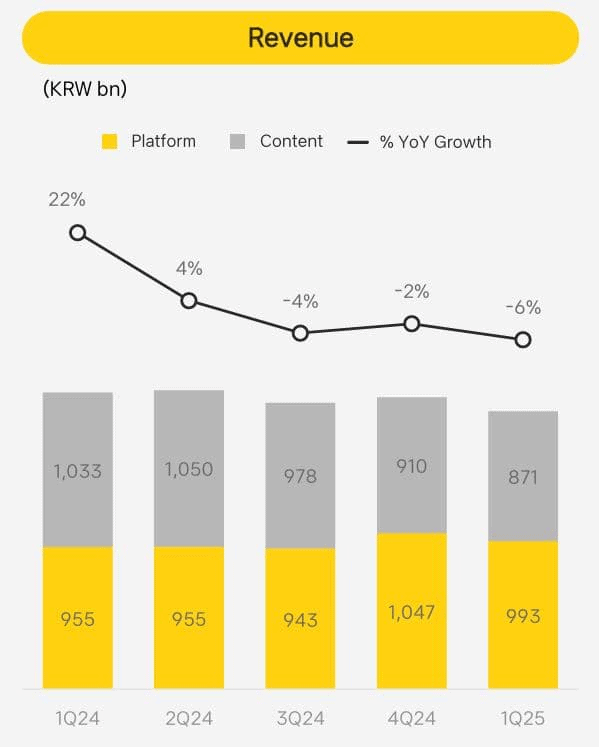
- The chart shows Kakao’s revenue performance through its quarterly financial results, which separate Platform and Content revenue streams while displaying year-on-year growth metrics between 1Q24 and 1Q25.
- Total revenue shows a gradual declining trend over the period, reflecting a moderation in growth momentum despite relative resilience in the platform segment.
- In absolute terms, total revenue peaked at KRW 1,050 billion in 2Q24 before declining to KRW 871 billion by 1Q25, representing a cumulative drop of around 17% from the peak.
- Platform revenue (highlighted in yellow) remained comparatively stable, fluctuating within a narrow range of KRW 943–1,047 billion.
- The consistent source of income for Kakao is derived from its core services, namely, messaging, advertisements, and its financial and transportation services.
- Platform revenue amounts to KRW 1,047 billion in 4Q24, implying seasonality as well as successful revenue generation.
- The content category, which is depicted by a grey-colored line, presents an even more pronounced declining tendency. Revenue from content has fallen from KRW 1,033 billion in 1Q24 to KRW 871 billion in 1Q25, showing a 16% contraction.
- The poor performance of the business is due to competitive pressures and regulations of the market following the earlier period of growth.
- The growth rate decreased from 22%, which was the high growth rate in 1Q24, to low single digits until mid-2024, and became negative from 3Q24.
- The revenue of the company decreased by 6% year over year in 1Q25, which demonstrates that the revenue issues of the firm continue persisting.
- The stable platform revenue of Kakao and the declining content revenue mean that the company primarily depends on its platform ecosystem in terms of revenue, while its content business encounters permanent and temporary problems.
- The current situation needs organizations to manage their expenses effectively while they choose which content projects to invest in that will provide them with better returns.
Kakao Rank
(Source: rankingdigitalrights.org)
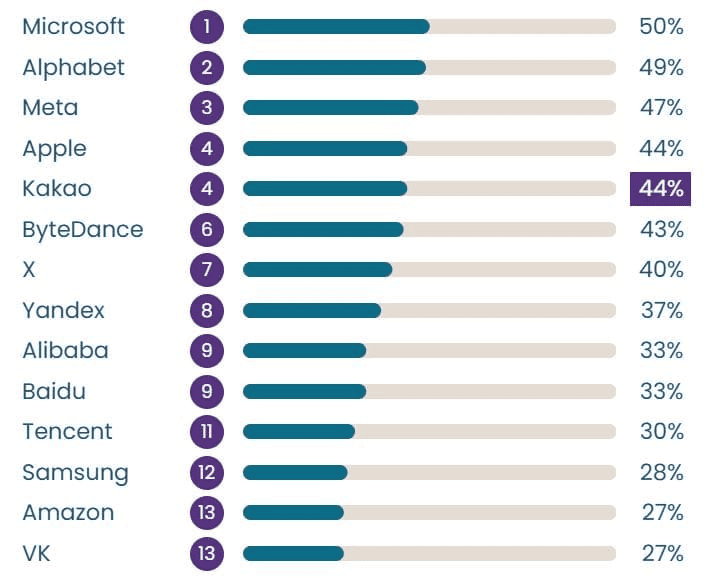
- Kakao shows its digital ecosystem diversity through its 4th place rank and 44% score.
- Kakao usage shows that the platform supports approximately 54 million users who use it every month throughout the world, and its advertising business generates more than 35% of its total revenue, while games and e-commerce produce consistent income and support future development.
Kakao Employees
(Source: kakaocdn.net)
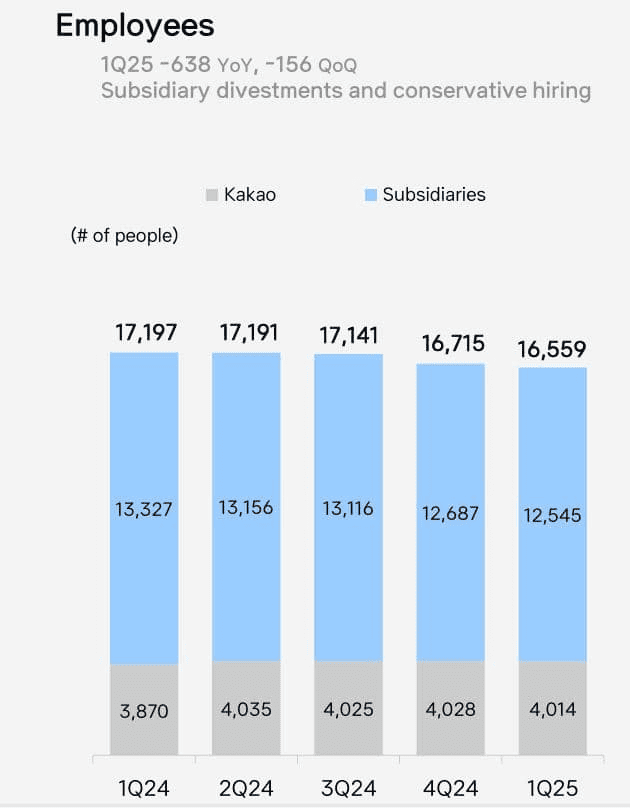
- The chart shows Kakao’s employee count from 1Q24 until 1Q25, which distinguishes between the parent company and its separate business units.
- Total headcount declined from 17,197 employees in 1Q24 to 16,559 in 1Q25, representing a year-on-year reduction of 638 employees, or approximately 3.7%.
- The workforce decreased by 156 employees between 4Q24 and 1Q25, which indicates that the company continues to streamline its operations instead of making temporary workforce changes.
- The organization experiences ongoing decreases because it has implemented permanent operational changes that improve efficiency.
- The subsidiary workforce decreased from 13,327 employees in 1Q24 to 12,545 employees in 1Q25, which represents a decrease of 782 employees and a YoY contraction of 5.9%.
- The trend demonstrates management’s commitment to divesting non-core businesses while optimizing its portfolio for higher-margin projects.
- The parent company of Kakao maintained stable operations since its workforce range stayed between 4,014 employees and 3,870 employees, resulting in a 1Q25 total of 4,014 employees.
- The organization chooses to hire or keep employees who work in essential functions that include platform development and data and AI development.
- The employee distribution in 1Q24 showed that subsidiaries employed approximately 77% of the total workforce, which dropped to roughly 76% in 1Q25.
- The shift seems minor, but it leads to an ongoing process of transforming the organization into a less complex operational framework.
- Workforce control measures enable companies to maintain stable profit margins throughout the years because labor expenses normally make up 30 to 40 % of total operational costs for technology and platform-based businesses.
Kakao Website Traffic by Country
(Source: SEMrush)
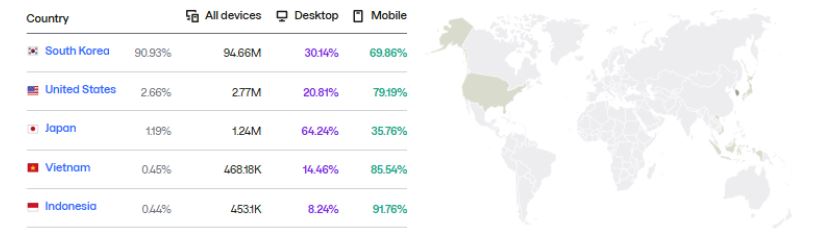
- South Korea overwhelmingly dominates Kakao’s global traffic with a massive 90.93% share, generating 94.66 million visits.
- In South Korea, mobile usage significantly leads over desktop, with 69.86% of visits coming from mobile devices compared to 30.14% from desktop.
- The United States ranks second with just 2.66% of total traffic and 2.77 million visits, showing an even higher mobile preference at 79.19%, compared to 20.81% on desktop.
- Japan holds the third position with 1.19% of traffic and 1.24 million visits, standing out as the only top country where desktop usage (64.24%) surpasses mobile (35.76%).
- Vietnam contributes 0.45% of total traffic with 468.18K visits, showing a strong mobile-first pattern at 85.54.
- Indonesia rounds out the top five with 0.44% of traffic and 453.1K visits, recording the highest mobile usage among all countries at an overwhelming 91.76%.
Kakao Website Traffic Share by Device
- Mobile devices overwhelmingly drive Kakao’s traffic at 69.81%.
- Desktop traffic accounts for just 30.19% of total visits.
Kakao Talk Advertising Revenue
(Source: kakaocdn.net)
- The chart shows that KakaoTalk has experienced continuous growth in its advertising revenue, which increased from KRW 1,120 billion in FY23 to KRW 1,199 billion in FY24.
- Positive growth indicates that the users are getting more skilled at monetizing their efforts.
- Greater performance is provided due to the use of Kakao Talk as it adds up to increased daily user count and time on the application; this makes the ad inventory value increase.
- Kakao Talk usage statistics indicate that advertisers get better performance due to proper targeting, which they can do inside the ecosystem.
Kakao Talk Sales Revenue
(Reference: kedglobal.com)
- The chart shows the revenue trends of Kakao’s KakaoTalk business from Q3 2023 to Q2 2024.
- Sales rose from KRW 479.5 billion in Q3 2023 to a peak of KRW 537.6 billion in Q4 2023, a strong quarter-on-quarter increase of about 12.1%.
- The company reported revenue declined to KRW 522.1 billion in Q1 2024, which represented a drop of 2.9 %, and to KRW 513.9 billion in Q2 2024, which represented a decrease of 1.6 %.
- The pattern shows that seasonal demand peaks are followed by a return to regular business operations.
- Kakao Talk usage remains stable, which enables the company to generate revenue from advertising and business messaging services.
- The company depends on sustained usage of Kakao Talk for its revenue stabilization throughout the coming years.
Kakao User Growth
- KakaoTalk has established itself as an essential digital service in South Korea which people need to use their smartphones to send text messages.
- According to company disclosures, KakaoTalk recorded approximately 48.9 million monthly active users, which equals 94.7 % of the total national population.
- The research shows that 97.2 % of South Korean internet users used the platform as their primary method for daily communication, commercial activities, and content distribution.
- KakaoTalk attracts adult users who represent its complete user base. The GWI data from Q3 2024 shows that 50.9 % of users are male, while 49.1 % are female, which demonstrates that the platform appeals to both genders.
- The balance between male and female users strengthens Kakao’s advertising effectiveness because it provides brands with access to different customer groups.
- Businesses experience growth patterns that show them moving toward maturity instead of facing market saturation.
- KakaoTalk gained 597000 new users between Q3 2023 and Q3 2024, which resulted in a 1.2% growth rate that shows strong performance in a market that has almost reached complete customer adoption.
- The user base experienced minimal growth from the previous quarter, with an increase of 2000 users, which resulted in a 0.004 % growth rate.
- The Kakao Talk usage metrics show that the platform has reached advanced development because users maintain consistent engagement.
- Users in South Korea depend on Kakao Talk as a main digital platform that companies use to develop long-term revenue plans.
Kakao Website Competitors Statistics
- Gmarket.co.kr ranks as a top competitor with 32.61 million visits.
- Coupang.com leads by a significant margin among all competitors with an impressive 235.4 million visits.
- SSG.com rounds out the top three with 10.39 million visits.
Kakao Talk Redesign Shows Mixed Engagement Signals
- The post-revamp performance of KakaoTalk shows that short-term engagement metrics do not match actual monthly user patterns.
- Kakao reported an increase in average daily stay time after its September 2025 “Friends” tab redesign, but third-party data showed that user engagement levels decreased during that period.
- According to IGAWorks’ Mobile Index, which reports an accuracy rate of 95%, the average monthly usage time per user declined by 22.32 minutes, dropping from 700.17 minutes in September to 677.85 minutes in October.
- The data showed session durations at the interface revamp, which resulted in 694.81 minutes of Q3 duration, below the Q3 average. This dataset provides insights into mobile app usage, but it fails to account for PC usage, which creates challenges when comparing with Kakao’s internal data.
- Kakao’s Q3 earnings announcement showed that average daily usage increased from 24 minutes to 26 minutes after the redesign.
- The company withheld information about its measurement period and whether desktop usage contributed to results, which demonstrates how different research methods led to opposing results about Kakao Talk usage.
- The monthly active user count grew from 46.49 million in September 2025 to 46.64 million in October 2025, which shows that the revamp did not affect user reach or their daily activities.
- The way people use Kakao Talk shows strong daily communication ties that continue to grow despite changing interaction patterns.
Kakao Talk User Gender Distribution
| Gender | Share of Users | Number of Users (millions) |
| Male | 50.9% | 24.90 |
| Female | 49.1% | 23.99 |
(Source: theglobalstatistics.com)
- The near-equal gender split in 2025 highlights the maturity and universality of Kakao Talk usage in South Korea.
- South Korea possesses an even user demographic ratio, which displays a 50.9% male and 49.1% female user ratio, leading to around 24.90 million male users and 23.99 million female users out of a total 48.9 million monthly active users.
- This proves that KakaoTalk is used as a vital communication medium by people for their routine needs rather than being a social networking site.
- Even the user ratio for all consumer categories makes the business gain constant user engagement, enhances their marketing campaigns, and increases their business scope.
- Those Koreans who make continuous use of KakaoTalk in their daily activities show the significance of this digital medium as a basic system making their day-to-day activities possible.
Wrapping Up
Kakao Talk Usage Statistics: The digital platform KakaoTalk proves its strong operational capacity throughout South Korea because it operates as a fully developed digital system, which has achieved widespread user adoption. The core platform foundation of KakaoTalk has maintained its strength despite the current revenue growth slowdown and content-based businesses experiencing both cyclical and structural challenges. The ongoing user penetration, together with the mixed user demographic distribution and the uninterrupted user activity and increasing advertising revenues, serve as fundamental elements that support the sustained profitability of Kakao’s business operations.
The company demonstrates its commitment to improving business performance by reorganizing staffing and making targeted investments, which will help it achieve better cost control and sustainable profit margins. KakaoTalk maintains its essential status as a communication platform that people use throughout their daily lives, so it will continue to generate revenue and support its role as a main component of Korea’s digital infrastructure.
FAQ
KakaoTalk has approximately 48.9 million monthly active users in South Korea.
The total revenue of the company decreased from KRW 1,050 billion during the second quarter of 2024 to KRW 871 billion in the first quarter of 2025.
Advertising revenue grew from KRW 1,120 billion in FY23 to KRW 1,199 billion in FY24.
Total employees declined by 3.7% YoY, mainly due to subsidiary divestments.
Users are evenly split: 50.9% male and 49.1% female.


Disclaimer: This press release/article is provided by a third party, which is solely responsible for its content. It is published on Sci-tech Today exactly as received from the issuing organization, without any edits, verification, or endorsement by Sci-tech Today.
Sci-tech Today does not guarantee the accuracy, completeness, or reliability of the information. Readers are advised to independently verify all information and do their research before acting on it or investing any money. Sci-tech Today is not responsible for any financial loss that may result from reliance on this content.

