








Market Overview
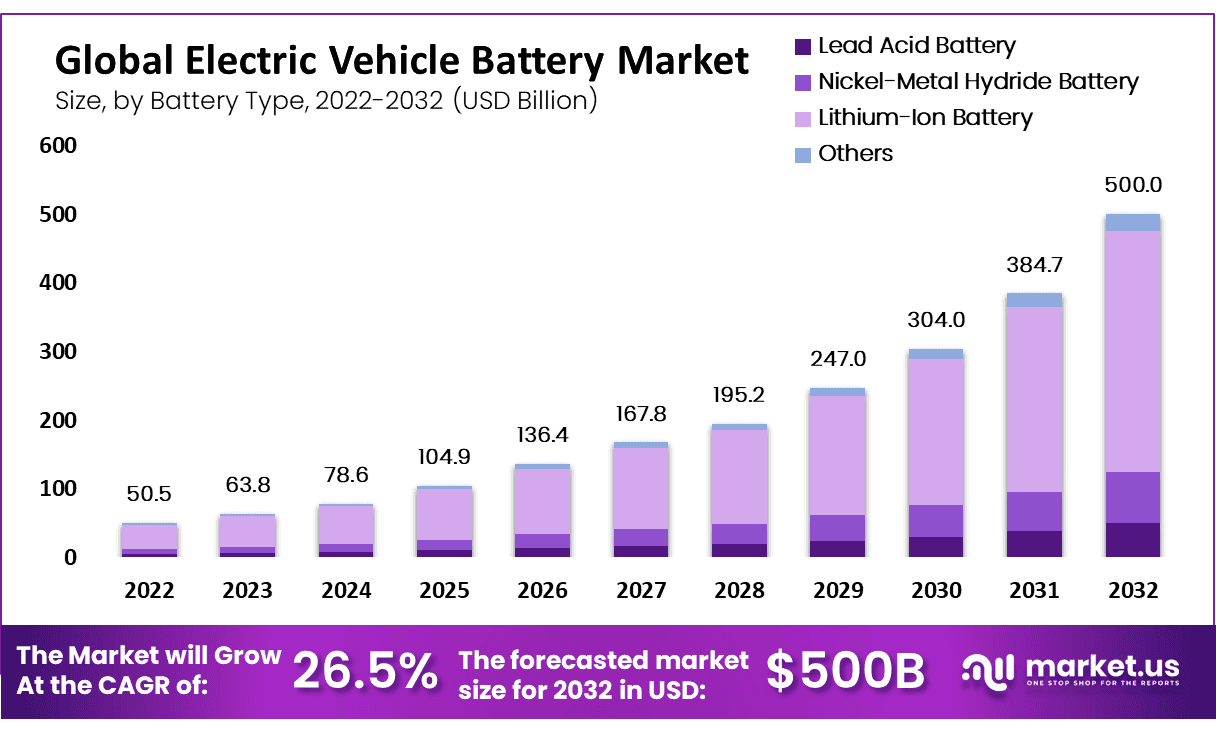
The Electric Vehicle Battery Market is expanding at a high pace as automakers, utilities, and governments accelerate electrification. According to Market.us, the market was valued at USD 50.5 billion in 2022 and is projected to reach USD 500.0 billion by 2032, growing at a 26.5% CAGR from 2023 to 2032. The same source highlights that Asia-Pacific held 38.8% of the global market, while lithium-ion remained the dominant battery chemistry and BEVs led vehicle demand. The growth story is being reinforced by falling battery pack prices, which dropped to a record USD 115/kWh in 2024, and by rising EV battery demand, which crossed 950 GWh in 2024 globally.
Key Takeaways
- The Electric Vehicle Battery Market stood at USD 50.5 billion in 2022 and is forecast to reach USD 500.0 billion by 2032 at 26.5% CAGR.
- Lithium-ion is the leading battery type, and BEVs account for the largest vehicle segment.
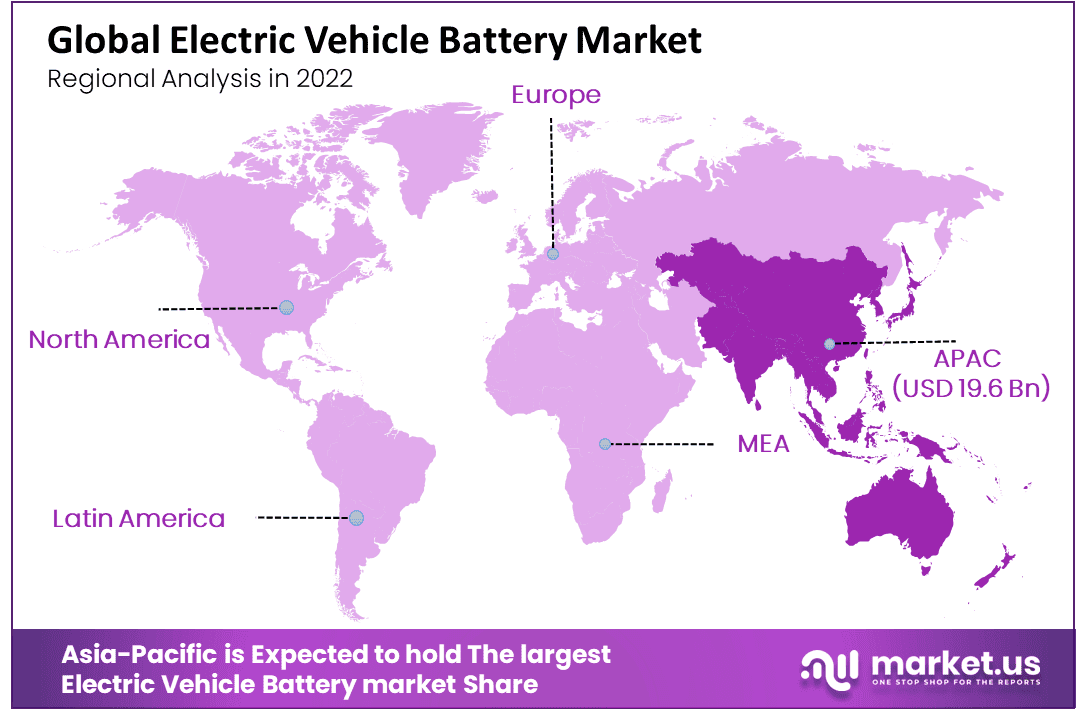
- Asia-Pacific leads the market with 38.8% share.
- Global EV battery demand exceeded 950 GWh in 2024.
- Battery pack prices fell to USD 115/kWh in 2024, improving affordability.
- Charging infrastructure expanded strongly, with 1.3 million public chargers added in 2024.
- Supply chains remain concentrated, with about 85% of cell manufacturing capacity in China.
Request For Sample Report Here: https://market.us/report/electric-vehicle-battery-market/free-sample/
How Growth is Impacting the Economy
The rapid expansion of the Electric Vehicle Battery Market is reshaping the global economy by driving industrial investment, technology commercialization, and employment across mining, refining, cell manufacturing, pack assembly, charging infrastructure, software, and recycling. As EV battery demand surpassed 950 GWh in 2024 and overall battery demand in the energy sector hit 1 TWh, capital is flowing into new factories, grid upgrades, logistics hubs, and local supplier ecosystems. Lower battery prices are also improving EV affordability, supporting consumer adoption and reducing long-term fuel import dependence in oil-importing economies.
Report Scope
| Report Features | Description |
|---|---|
| Market Value (2022) | US$ 50.5 Bn |
| Forecast Revenue (2032) | US$ 500.0 Bn |
| CAGR (2023-2032) | 26.5% |
| Base Year for Estimation | 2022 |
| Historic Period | 2016-2022 |
| Forecast Period | 2023-2032 |
| Report Coverage | Revenue Forecast, Market Dynamics, Competitive Landscape, Recent Developments |
| Segments Covered | By Battery Type: Liquid, Spray, and Wipe; By Vehicle Type: Battery Electric Vehicle (BEV), Plug-In Hybrid Electric Vehicle (PHEV), and Hybrid Electric Vehicle (HEV) |
| Regional Analysis | North America – The US, Canada Europe – Germany, France, The UK, Spain, Italy, Russia & CIS, Rest of Europe APAC- China, Japan, South Korea, India, ASEAN, Rest of APAC Latin America – Brazil, Mexico, Rest of Latin America Middle East & Africa – GCC, South Africa, Rest of MEA |
| Competitive Landscape | ATLASBX Co., Sony, Hitachi, NEC Corporation, Panasonic Corporation, TCL Corporation, Huanyu New Energy Technology, Duracell, NorthStar, Crown Battery Manufacturing, GS Yuasa Corp, East Penn Manufacturing Co., C&D Technologies, Inc., B.B. Battery Co., Ltd., Narada Power Source Co., Ltd., CSB Battery Company Ltd., EnerSys, Inc., Coslight Technology International Group Co., Ltd., Zibo Torch Energy Co., Ltd., and Other Key Players. |
| Customization Scope | Customization for segments, region/country-level will be provided. Moreover, additional customization can be done based on the requirements. |
Feel Free Reach Analyst at – [email protected]
Business Opportunities
The Electric Vehicle Battery Market offers strong business opportunities across the full value chain. Upstream, there is room in critical mineral processing, precursor materials, separators, electrolytes, and anode/cathode technologies. Midstream, battery cell production, module assembly, thermal systems, battery management software, and testing services are attractive growth pockets. Downstream, EV charging, fleet battery analytics, battery swapping, second-life storage, and end-of-life recycling are becoming high-potential segments.
Use Case and Growth Factors
- Battery Electric Passenger Cars: Growth is driven by falling battery prices, stricter emission regulations, rising consumer EV adoption, and the expansion of public charging infrastructure.
- Plug-in Hybrid Vehicles: Demand is supported by their role as a transitional solution in regions with uneven charging infrastructure, along with increasing fuel-efficiency regulations.
- Hybrid Electric Vehicles: Growth is fueled by strong demand in cost-sensitive markets and suitability for regions with slower charging infrastructure rollout.
- Electric Trucks and Commercial Fleets: Growth is supported by fleet decarbonization targets, a focus on total cost of ownership, and rising battery demand from trucks, which increased by over 75% in 2024.
- Battery Swapping / BaaS (Battery-as-a-Service): Adoption is increasing due to faster turnaround times, reduced vehicle downtime, lower charging wait times, and high suitability for commercial fleet operations.
- Battery Recycling: Growth is driven by the need for raw material recovery, rising sustainability mandates, enhanced supply chain security, and increasing emphasis on circular economy initiatives.
- Second-life Energy Storage: Expansion is supported by the utilization of residual battery value, the need for renewable energy integration, and growing demand for stationary energy storage systems.
Regional Analysis
The Electric Vehicle Battery Market remains regionally imbalanced but strategically dynamic. Asia-Pacific leads with 38.8% market share in the Market.us dataset and continues to dominate manufacturing scale, with the IEA noting that about 85% of global battery cell manufacturing capacity was located in China in 2024. Europe remains a major demand and policy-driven region, supported by public funding, charging deployment, and decarbonization targets.
Key Segmentation
The Electric Vehicle Battery Market is segmented primarily by battery type and vehicle type. By battery type, the market includes lead-acid battery, nickel-metal hydride battery, lithium-ion battery, and others. Among these, lithium-ion leads due to its high energy density, charge retention, and suitability for lightweight automotive applications.
By vehicle type, the market is divided into Battery Electric Vehicle (BEV), Plug-In Hybrid Electric Vehicle (PHEV), and Hybrid Electric Vehicle (HEV). BEVs hold the leading share because they rely entirely on battery power and align well with zero-emission transport policies. From a strategic lens, lithium-ion plus BEV remains the core revenue engine of the market today.
Recent Developments
- Global battery demand in the energy sector crossed 1 TWh in 2024, while EV battery demand exceeded 950 GWh, showing continued market acceleration.
- Lithium-ion battery pack prices fell 20% year over year to a record USD 115/kWh in 2024.
- Global battery cell manufacturing capacity grew nearly 30% in 2024 to more than 3 TWh.
- More than 1.3 million public charging points were added globally in 2024, with the worldwide total surpassing 5 million.
Conclusion
The Electric Vehicle Battery Market is becoming a foundational pillar of the global clean mobility economy. Strong demand, declining costs, policy support, and innovation in chemistry and recycling point to sustained long-term expansion, making the market highly attractive for manufacturers, suppliers, investors, and infrastructure providers.

Sources