








Introduction
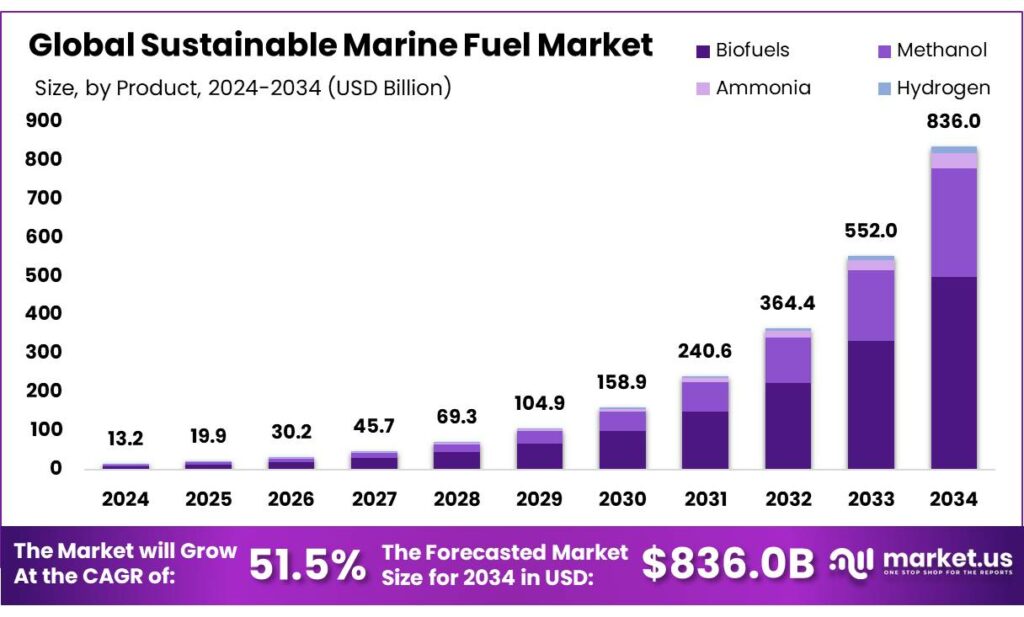
The global sustainable marine fuel (SMF) market is projected to grow exponentially, reaching USD 836.0 billion by 2034, up from USD 13.1 billion in 2024, at a CAGR of 51.5% between 2025 and 2034. In 2024, Europe led the market with over 51% share, generating around USD 6.7 billion in revenue.
As the maritime industry, responsible for about 2.5% of global greenhouse gas emissions, faces rising trade volumes, its emission share could climb to 17% by 2050. To curb this, the International Maritime Organization (IMO) aims for net-zero emissions by 2050, with intermediate targets of 20–30% reduction by 2030 and 70–80% by 2040, compared to 2008 levels.
Get a comprehensive report summary that describes the value and forecast along with methodology. Download the PDF brochure
Sustainable marine fuels are key to achieving these goals. Derived from bio-based feedstocks, recycled carbon, or renewable energy sources such as Power-to-X, hydrogen, and electrofuels, SMFs must ensure at least 50–60% lifecycle GHG reduction, exclude virgin fossil inputs, and maintain independent sustainability certification. While liquid fuels will remain dominant in shipping, electrofuels and advanced biofuels—including methanol—are expected to lead future adoption.
Government support is pivotal in this transition. The U.S. Department of Energy’s Bioenergy Technologies Office (BETO) is advancing research on marine biofuels, addressing the maritime sector’s fuel consumption of 105 billion gallons annually, which could double by 2030. BETO’s programs aim to scale sustainable fuel production in line with decarbonization targets.
In Europe, regulatory measures like Regulation (EU) 2023/1805 and FuelEU Maritime, effective January 2025, mandate the gradual integration of renewable and low-carbon fuels in shipping, requiring a 2% GHG reduction by 2025 and 80% by 2050. In response, companies such as KPI OceanConnect plan to expand biofuel availability across 120 ports worldwide to meet growing compliance-driven demand.
Top Market Takeaways
- The global Sustainable Marine Fuel (SMF) market is projected to grow from USD 13.1 billion in 2024 to approximately USD 836.0 billion by 2034, reflecting a CAGR of 51.5% over the forecast period.
- Between types, biofuels accounted for the largest market share of 64.2%.
- Among application, tankers/carriers accounted for the majority of the market share at 44.6%.
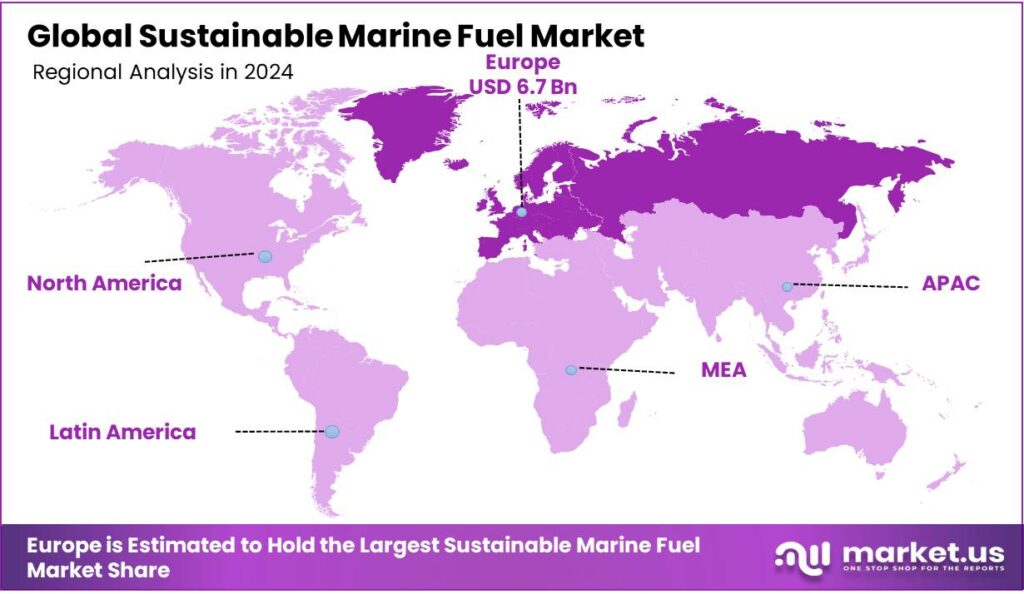
- Europe was the leading regional market in 2024, holding a commanding 51.0% share of the global SMF market, with its value estimated at approximately USD 6.7 billion.
Scope and Research Methodology
The scope of this study covers the global sustainable marine fuel (SMF) market, focusing on current trends, market drivers, challenges, and growth opportunities from 2025 to 2034. It examines different types of sustainable marine fuels such as biofuels, methanol, hydrogen, and electrofuels, and how they are being adopted across regions including Europe, North America, Asia-Pacific, Latin America, and the Middle East & Africa. The report also studies the impact of government policies, technological developments, and investments on market expansion.
The research is based on a combination of primary and secondary data. Primary research involved interviews and discussions with industry experts, manufacturers, fuel suppliers, and policy makers to understand the latest market trends and challenges. Secondary research included reviewing industry reports, government publications, trade journals, and company websites to collect data on production, demand, and pricing. Statistical tools and models were used to estimate market size, growth rate (CAGR), and regional shares. Data triangulation was applied to cross-check information from different sources, ensuring the accuracy and reliability of the findings.
By Type Analysis
In 2024, biofuels led the global sustainable marine fuel market, capturing a 64.2% share. Their dominance is mainly due to technological maturity, well-established supply chains, and compatibility with existing marine engines and infrastructure. Unlike ammonia, hydrogen, or methanol, which often require vessel retrofits and new fueling systems, biofuels can be easily blended with conventional marine fuels and used with minimal modifications.
Biofuels are available at scale and produced from waste oils, residues, and other biogenic feedstocks, ensuring strong supply security and regional adaptability. Their lower cost also makes them an attractive option for operators aiming to reduce emissions without heavy financial burdens.
Global Sustainable Marine Fuel Market by Type (USD Million, 2020–2024)
| Type | 2020 | 2021 | 2022 | 2023 | 2024 |
|---|---|---|---|---|---|
| Biofuels | 1,596.3 | 2,419.7 | 3,671.4 | 5,572.6 | 8,455.7 |
| Methanol | 784.5 | 1,177.2 | 1,771.4 | 2,671.8 | 4,043.0 |
| Ammonia | 88.6 | 135.1 | 206.5 | 316.4 | 486.3 |
| Hydrogen | 30.5 | 47.5 | 74.1 | 116.0 | 182.1 |
By Application Analysis
In 2024, the tankers/carriers segment dominated the sustainable marine fuel market, accounting for 44.6% of total revenue. These vessels transport large quantities of crude oil, petroleum products, LNG, chemicals, coal, and grains across global routes and therefore consume substantial amounts of fuel.
With increasing pressure from international climate policies and rising customer demand for greener transportation, tanker and bulk carrier operators have emerged as early adopters of sustainable marine fuels. Because of their scale and global reach, this segment holds the strongest potential to reduce emissions and shape overall demand trends in the SMF market.
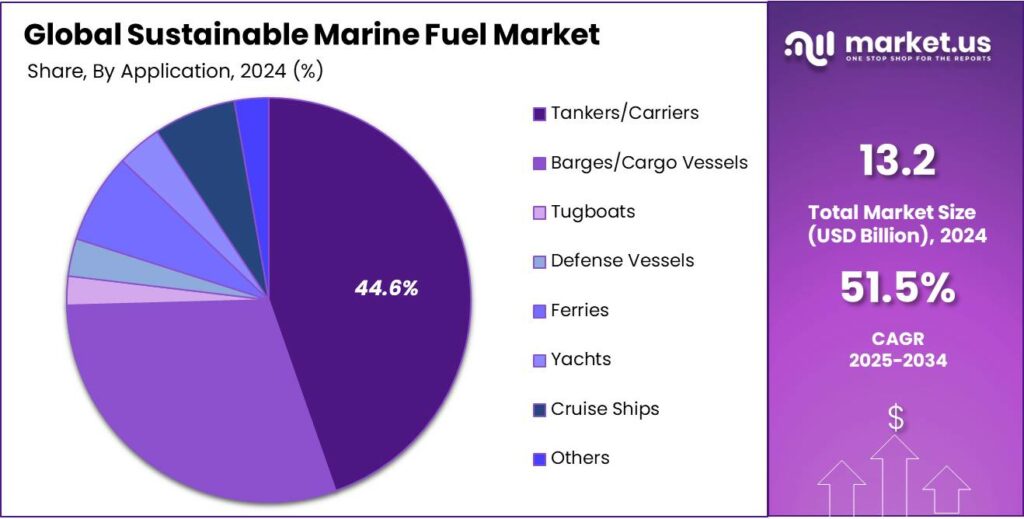
Global Sustainable Marine Fuel Market by Application (USD Million, 2020–2024)
| Application | 2020 | 2021 | 2022 | 2023 | 2024 |
|---|---|---|---|---|---|
| Tankers/Carriers | 1,045.0 | 1,612.1 | 2,485.1 | 3,826.3 | 5,877.1 |
| Barges/Cargo Vessels | 759.8 | 1,142.1 | 1,721.6 | 2,601.1 | 3,942.7 |
| Tugboats | 68.4 | 99.0 | 143.7 | 209.1 | 305.3 |
| Defense Vessels | 82.9 | 122.0 | 180.1 | 266.5 | 395.7 |
| Ferries | 191.3 | 284.1 | 423.3 | 632.1 | 947.0 |
| Yachts | 97.3 | 143.7 | 212.8 | 315.9 | 470.5 |
| Cruise Ships | 177.2 | 262.6 | 390.2 | 581.2 | 868.5 |
| Others | 77.9 | 113.7 | 166.6 | 244.5 | 360.2 |
Regional Analysis: Europe
In 2024, Europe held the largest share of the global sustainable marine fuel (SMF) market with about 51% of total revenue, supported by an estimated market value of around USD 6.7 billion. This leadership is driven by strict climate policies, ambitious decarbonisation goals, and fast rollout of low-carbon fuel infrastructure across key shipping hubs.
The European Union has extended the EU Emissions Trading System (EU ETS) to cover shipping from January 2024, effectively adding a carbon cost to maritime emissions and making traditional fossil marine fuels less attractive. Additional measures such as FuelEU Maritime and the Renewable Energy Directive (RED II/III) require reductions in the carbon intensity of marine fuels, which pushes demand for sustainable options like biofuels, methanol, hydrogen, and ammonia.
Global Sustainable Marine Fuel Market by Region (USD Million, 2020–2024)
| Region | 2020 | 2021 | 2022 | 2023 | 2024 |
|---|---|---|---|---|---|
| North America | 467.5 | 700.4 | 1,050.7 | 1,577.2 | 2,368.9 |
| Europe | 1,207.4 | 1,851.1 | 2,841.9 | 4,366.4 | 6,713.5 |
| Asia Pacific | 602.5 | 902.2 | 1,353.5 | 2,032.9 | 3,056.8 |
| Middle East & Africa | 62.5 | 89.9 | 129.4 | 186.5 | 269.0 |
| Latin America | 160.0 | 235.8 | 347.9 | 513.6 | 758.9 |
Key Regions and Countries
- North America
- The US
- Canada
- Europe
- Germany
- France
- The UK
- Spain
- Italy
- Russia & CIS
- Rest of Europe
- APAC
- China
- India
- Japan
- South Korea
- ASEAN
- Rest of APAC
- Latin America
- Brazil
- Mexico
- Rest of Latin America
- Middle East & Africa
- GCC
- South Africa
- Rest of Middle East & Africa
Key Players Analysis
Product innovation and strong research & development (R&D) remain the core growth strategies adopted by leading players in the sustainable marine fuel (SMF) market. Companies are heavily investing in advanced fuel technologies to develop scalable, cost-effective, and low-carbon alternatives such as bio-methanol, ammonia, hydrogen, and waste-derived biofuels that align with increasingly strict global environmental regulations.
A major focus of R&D is to enhance fuel efficiency, engine compatibility, and lifecycle emission reduction while ensuring these fuels can integrate smoothly with existing vessel engines and bunkering systems. This helps shipping companies transition toward cleaner energy without requiring large-scale infrastructure overhauls.
Innovation strategies also include strategic collaborations with ports, technology providers, and energy companies, allowing faster commercialization of new fuel solutions. Through these partnerships, market leaders are strengthening their competitive position, expanding sustainable fuel adoption, and playing a vital role in the maritime industry’s shift toward decarbonization.
Top Key Players in the Market
- Maersk
- Exxon Mobil Corporation
- Chevron Corporation
- British Petroleum (BP)
- Shell Plc
- TotalEnergies
- FincoEnergies
- Liquid Wind AB
- Methanex Corporation
- Neste Corp.
- Oyj Targray
- Other Key Players
Recent Developments
In November 2024, Hapag-Lloyd marked a major step in sustainable shipping as its vessel Colorado Express successfully bunkered a B25 bio marine fuel blend supplied by ExxonMobil. The blend combines Premium HDME 50™ fuel with 25% waste-based FAME derived from used cooking oil methyl ester (UCOME), demonstrating a significant advancement in the practical adoption of low-carbon marine fuels.
In July 2023, Chevron reached an important milestone by completing more than 50 biofuel deliveries at the Port of Singapore since 2022. Following its acquisition of Renewable Energy Group, Chevron has strengthened its marine biofuel presence through collaborations with global shipowners and patented blending technologies. These waste-based biofuels help reduce lifecycle emissions and can be used without engine modifications, making them an effective near-term decarbonization solution for the shipping sector.
In February 2023, Shell and Hapag-Lloyd signed a multi-year LNG supply agreement for Hapag-Lloyd’s new dual-fuel container vessels, with bunkering operations beginning in Rotterdam in late 2023. The collaboration also includes exploration of alternative fuels such as liquefied biomethane and e-methane. By using LNG, the companies expect to reduce CO₂ emissions by up to 23% while also lowering particulate emissions, reinforcing their commitment to the maritime industry’s low-carbon transition.
Report Scope
| Report Features | Description |
|---|---|
| Market Value (2024) | US$ 13.2 Bn |
| Forecast Revenue (2034) | US$ 836.0 Bn |
| CAGR (2025-2034) | 51.5% |
| Base Year for Estimation | 2024 |
| Historic Period | 2020-2023 |
| Forecast Period | 2025-2034 |
| Report Coverage | Revenue Forecast, Market Dynamics, Competitive Landscape, Recent Developments |
| Segments Covered | Type (Biofuels, Methanol, Ammonia, & Hydrogen), By Application (Tankers/Carriers, Barges/Cargo, Vessels, Tugboats, Defense Vessels, Ferries, Yachts, Cruise Ships & Others) |
| Regional Analysis | North America – The US & Canada; Europe – Germany, France, The UK, Spain, Italy, Russia & CIS, Rest of Europe; APAC– China, Japan, South Korea, India, ASEAN & Rest of APAC; Latin America– Brazil, Mexico & Rest of Latin America; Middle East & Africa– GCC, South Africa, & Rest of MEA |
| Competitive Landscape | Exxon Mobil Corporation, Chevron Corporation, British Petroleum (BP), Shell Plc, TotalEnergies, Maersk, FincoEnergies, Liquid Wind AB, Methanex Corporation, Neste Corp., Oyj Targray & oTHERS |
| Customization Scope | Customization for segments, region/country-level will be provided. Moreover, additional customization can be done based on the requirements. |