









Market Overview
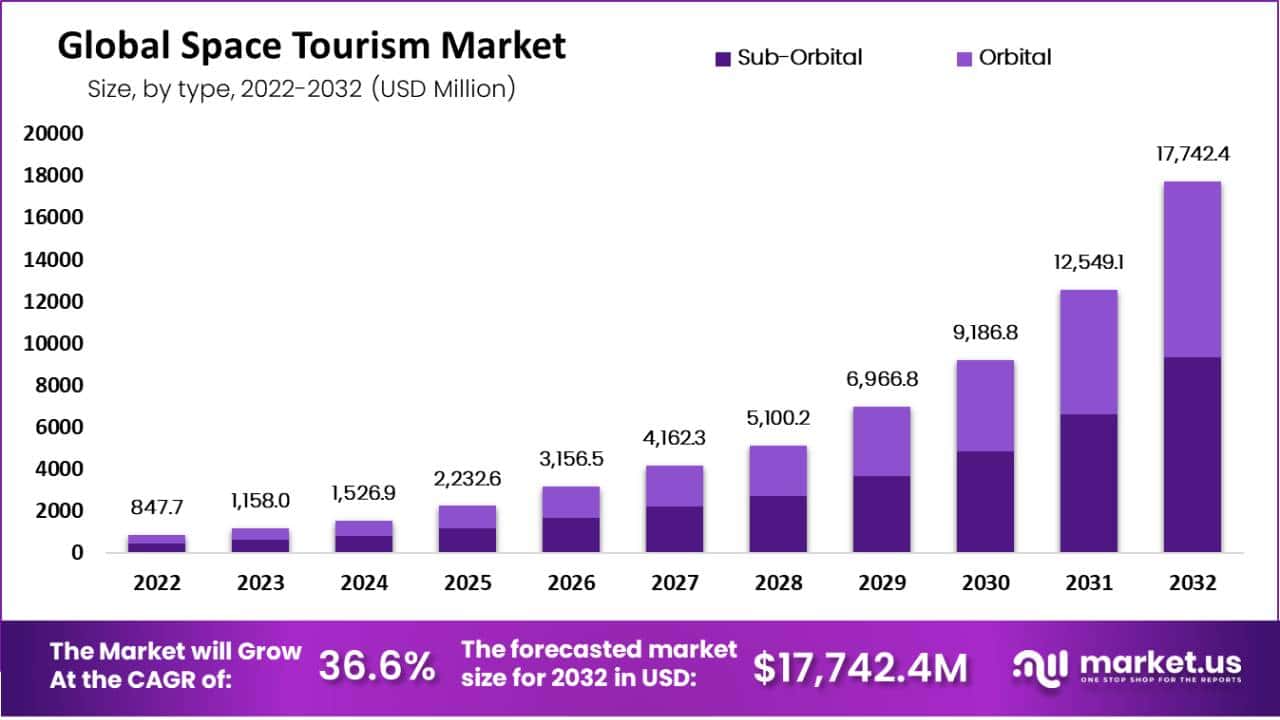
The global space tourism market was valued at USD 1,158.0 million in 2023 and is projected to reach USD 17,742.4 million by 2032. The market grows at a remarkable CAGR of 36.6% during the forecast period from 2023 to 2032. This exceptional growth reflects surging private investment and rapid technology development across the sector.
Space tourism allows private individuals to travel beyond Earth’s atmosphere for recreational or commercial purposes. Passengers experience weightlessness, view Earth from orbit, and participate in missions once reserved for professional astronauts. Companies offer both short sub-orbital flights and longer orbital missions tailored to wealthy adventurers and institutional clients.
Get further insight into the global trends shaping the future of the space tourism industry. Request Sample
Multiple industries accelerate adoption of space tourism. The luxury travel sector targets high-net-worth individuals aged 35 to 60 seeking exclusive experiences. Defense agencies collaborate with private operators on dual-use missions. Technology firms invest in adjacent innovations including spacecraft materials, life support systems, and in-orbit entertainment platforms.
Reusable rocket systems drive the most significant cost reductions in space travel history. SpaceX pioneered this approach, and ISRO followed with its own Reusable Launch Vehicle breakthrough in April 2023. Lower costs per launch increase mission frequency and allow operators to price tickets within reach of a broader affluent audience.
Regulatory bodies such as the FAA have introduced new frameworks to support commercial space operations. Governments worldwide recognize the economic potential of private space ventures and offer licensing pathways that foster innovation. The Space Summit held in Dubai in December 2023 reinforced global commitment to enabling commercial space tourism at scale.
Related market data underscores strong industry momentum. Virgin Galactic raised USD 400 million in October 2023, while Blue Origin secured USD 1 billion led by BlackRock. SpaceX attracted USD 750 million in private funding. Forecasts from industry analysts suggest the global space tourism sector could reach USD 1 trillion by 2040, signaling immense long-term potential.Key Takeaways
- The global space tourism market is projected to reach USD 17,742 million by 2032, up from USD 1,158.0 million in 2023.
- The market expands at a CAGR of 36.6% from 2023 to 2032.
- The Sub-Orbital segment captured more than 52.7% market share in 2022, growing at a CAGR of 37.8%.
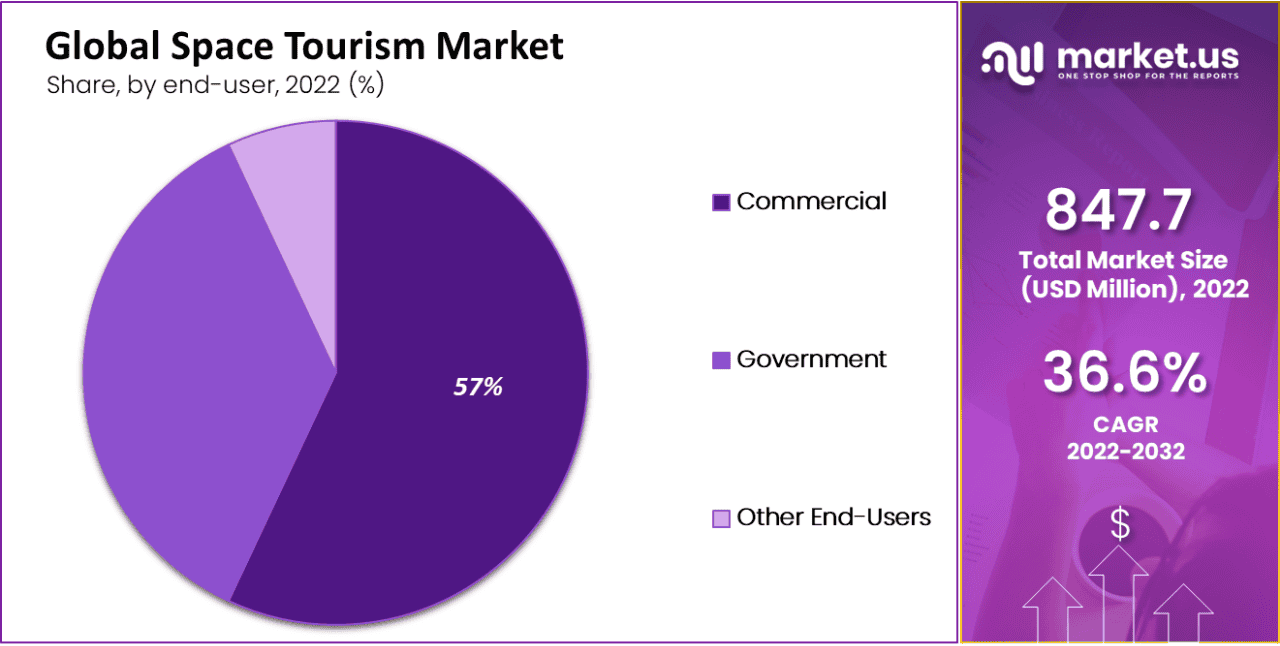
- The Commercial end-user segment held more than 57.3% share in 2022, led by Virgin Galactic and Blue Origin.
- The Government segment is the fastest-growing end-user category, with a CAGR of 38.3% and a share of 36.7%.
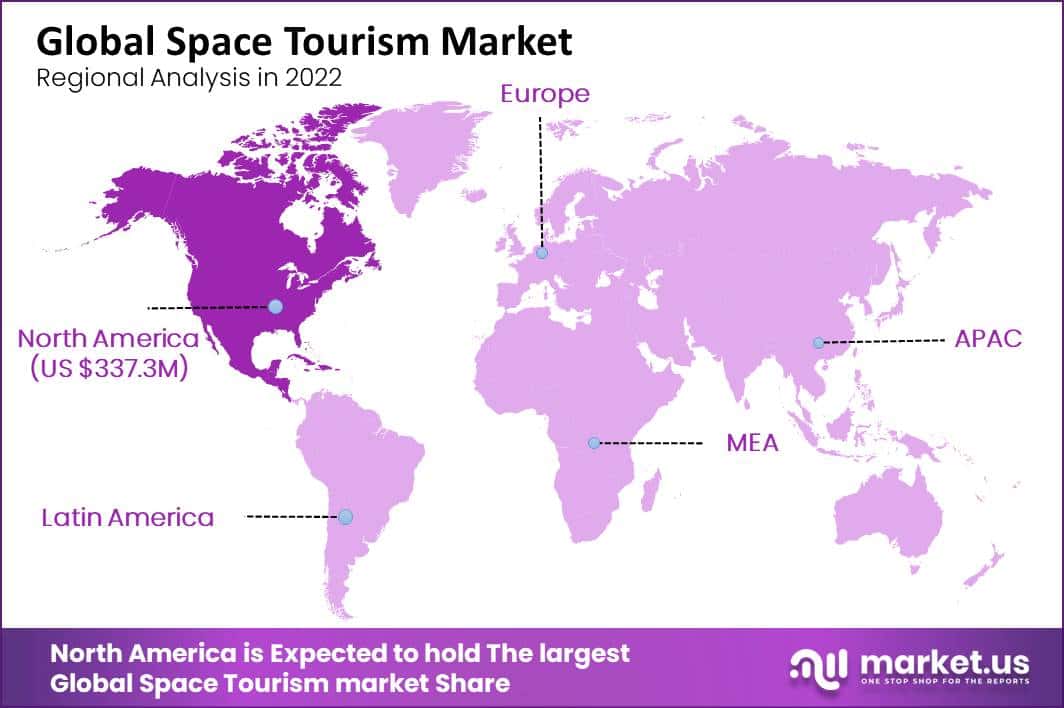
- North America led global market share at 39.8% in 2022, driven by SpaceX, Blue Origin, and Virgin Galactic.
- Asia Pacific is the fastest-growing region with a CAGR of 35.5%, fueled by India and China investments.
Market Segmentation Overview
The Sub-Orbital segment dominated the space tourism market in 2022, capturing more than 52.7% share with a CAGR of 37.8%. Sub-orbital flights appeal to broader audiences because they cost less, require shorter training, and pose fewer technical complexities than full orbital missions. Virgin Galactic and Blue Origin lead commercial sub-orbital operations globally.
Additionally, the Orbital segment represents the premium tier of space travel. Orbital experiences offer extended stays, multiple Earth revolutions, and potential access to future space hotels. Higher price points and complexity limit near-term volume, but strong interest from governments and ultra-high-net-worth individuals sustains development investment.
The Commercial end-user segment held a dominant 57.3% share in 2022. Private companies capitalized on consumer demand for extraordinary experiences, competitive pricing strategies, and favorable government regulation. This segment benefits from aggressive infrastructure investment and the marketing power of high-profile backers and media coverage.
Moreover, the Government segment represents a critical and fast-growing category, posting a CAGR of 38.3% with a 36.7% market share. Governments use commercial space tourism operators for research missions, technology validation, and defense collaboration. The DarkSky-1 mission executed by Blue Origin with the U.S. Defense Innovation Unit illustrates this growing public-private partnership model.
Get further insight into the global trends shaping the future of the space tourism industry. Request Sample
Drivers
Technological advancements in reusable rockets and spacecraft design represent the primary growth engine for space tourism. Reusable launch vehicles cut per-flight costs dramatically, enabling operators to offer more affordable ticket pricing. Improvements in life support, navigation, and materials science further increase passenger safety and comfort, attracting a wider pool of potential travelers.
Additionally, rising global demand for experiential luxury travel accelerates market expansion. High-net-worth individuals increasingly prioritize unique, once-in-a-lifetime experiences over material goods. Space tourism delivers unmatched exclusivity — views of Earth from orbit and weightlessness — which resonates strongly with the affluent 35-to-60 age demographic that drives consumer spending in premium travel categories.
Use Cases
Sub-orbital tourism flights offer the most accessible entry point into commercial space travel. Companies like Virgin Galactic and Blue Origin transport paying passengers to the edge of space for brief experiences lasting several minutes. Passengers achieve weightlessness, view Earth’s curvature, and return safely — all within a single day, requiring minimal prior training.
Consequently, orbital and near-orbital experiences represent the next frontier for space tourism operators. Space Perspective plans luxury stratospheric balloon capsule flights from 2024, offering panoramic Earth views from the upper atmosphere. Orion Span targets the launch of Aurora Station, the first luxury orbital hotel, by 2030, providing multi-day stays with artificial gravity and panoramic windows.
Major Challenges
High costs remain the most significant barrier limiting space tourism growth. Current ticket prices restrict the market to an extremely narrow segment of ultra-wealthy consumers. Research, development, infrastructure, and advanced technology all contribute to elevated operational expenses. While costs are declining, mass-market accessibility remains years away, constraining short-term revenue potential for most operators.
However, safety and regulatory compliance pose equally serious challenges for the industry. Space travel carries inherent physical risks for non-professional passengers. Regulatory bodies require rigorous licensing, safety certifications, and operational protocols before approving commercial missions. Balancing innovation speed with passenger protection demands ongoing collaboration between private operators, governments, and international regulatory agencies.
Business Opportunities
The global surge in experiential travel creates a compelling commercial opportunity for space tourism operators. Approximately 60,000 people have already registered interest in commercial space flights. Social media amplification of space travel moments drives further demand, particularly among affluent millennials and Gen X consumers who prioritize story-worthy experiences over conventional luxury goods.
Furthermore, ancillary services adjacent to core tourism flights offer significant untapped revenue streams. Spaceport development, space travel insurance, in-orbit entertainment platforms, and specialized pre-flight training programs all represent high-margin business categories. Investors who enter these support segments early stand to benefit as the core tourism market scales toward its projected USD 1 trillion valuation by 2040.
Regional Analysis
North America led the global space tourism market in 2022, capturing more than 39.8% share. The region houses SpaceX, Blue Origin, and Virgin Galactic — three companies that define the commercial space tourism industry. Strong private investment, NASA’s legacy infrastructure, a skilled aerospace workforce, and a favorable FAA regulatory environment all reinforce North America’s dominant market position.
Asia Pacific is the fastest-growing region in the forecast period, expanding at a CAGR of 35.5%. India and China are making substantial national investments in space tourism infrastructure and launch capabilities. ISRO’s April 2023 Reusable Launch Vehicle breakthrough signals India’s accelerating technical readiness. Growing wealth among Asian consumers further supports long-term demand for commercial space experiences in the region.
Recent Developments
- March 2024 — Blue Origin successfully demonstrated its Blue Ring spacecraft during the DarkSky-1 mission in collaboration with the U.S. Defense Innovation Unit, validating in-space data processing and maneuverability systems.
- October 2023 — Blue Origin unveiled the Blue Ring in-space platform, designed to operate from medium Earth orbit (MEO) to the Cislunar region, offering payload delivery, refueling, data relay, and cloud-based processing services.
- October 2023 — Virgin Galactic raised USD 400 million to advance commercial spaceflight operations and develop the SpaceShip III vehicle.
- 2023 — Blue Origin secured USD 1 billion in funding led by BlackRock to advance suborbital tourism programs and lunar exploration initiatives.
- 2023 — SpaceX attracted USD 750 million in private investment to support Starship development and expand the Starlink satellite network.
- April 2023 — ISRO achieved a breakthrough with its Reusable Launch Vehicle (RLV) program, developing a fully reusable rocket system to reduce launch costs and support future space tourism missions.
- December 2023 — The Space Summit in Dubai highlighted global interest and investment in space tourism, underscoring the sector’s rapid development and future commercial potential.
Conclusion
The global space tourism market is on an extraordinary growth trajectory, driven by reusable rocket technology, rising experiential travel demand, and surging private investment. These forces combine to compress costs, broaden the potential customer base, and accelerate mission frequency. The sector’s 36.6% CAGR reflects genuine structural transformation rather than speculative enthusiasm.
The Sub-Orbital segment leads with a 52.7% share, making it the primary commercial driver, while the Commercial end-user category commands 57.3% of the market. North America maintains dominance at 39.8% share, supported by the world’s most advanced space companies and a regulatory environment that actively enables private sector growth.
Companies that invest now in spacecraft technology, ancillary services, and emerging market partnerships will secure the strongest competitive positions as the industry scales. Operators must also prioritize safety certification and regulatory alignment to build consumer trust. The market is forecast to reach USD 17,742.4 million by 2032, making early entry a high-stakes strategic priority.
Looking for data tailored to your specific market, region, or business need? Request a custom report or consultation — write to us at [email protected]