








Quick Verdict
The NVIDIA Q2 Fiscal 2027 Earnings report delivered a decisive Q2 FY2027 beat, with GAAP EPS of $2.46 and non-GAAP EPS of $2.22 on record revenue of $96.2 billion. The company’s $108.0 billion Q3 revenue outlook also exceeded prevailing expectations. NVDA initially showed volatile after-hours movement, with reports indicating a modest decline despite the strong release.
About NVIDIA Corporation
NVIDIA Corporation (NASDAQ: NVDA) is a Santa Clara, California-based accelerated-computing and artificial-intelligence company founded in 1993. It designs GPUs, AI systems, networking hardware and software platforms used in hyperscale data centers, enterprise AI, cloud computing, gaming, professional visualization, robotics and autonomous vehicles. Its current growth is overwhelmingly linked to the worldwide buildout of AI infrastructure, including NVIDIA’s Data Center platforms and the expanding production ramp of Vera Rubin systems.
The company reported a substantial cash-and-investment base at the end of Q2 FY2027: $22.4 billion in cash and cash equivalents, $34.1 billion in marketable debt securities, and $42.8 billion in marketable equity securities. NVIDIA also held $99.0 billion remaining under its share-repurchase authorization after returning approximately $26.0 billion to shareholders through repurchases and dividends during the quarter.
Top Financial Highlights
- Total revenue reached $96.2 billion, up 18% quarter over quarter and 106% year over year.
- GAAP net income was $59.7 billion, a 126% increase from Q2 FY2026.
- GAAP diluted EPS rose 128% year over year to $2.46.
- Non-GAAP diluted EPS was $2.22, up 120% year over year.
- GAAP and non-GAAP gross margin each stood at 75.0%, up 2.6 percentage points and 2.5 percentage points, respectively, from a year earlier.
- GAAP operating income was $63.7 billion, increasing 124% year over year.
- GAAP operating expenses reached $8.4 billion, up 55% year over year.
- Data Center revenue was $89.0 billion, up 18% sequentially and 117% year over year.
- Edge Computing revenue was $7.2 billion, up 13% sequentially and 27% year over year.
- Operating cash flow was $24.1 billion, versus $15.4 billion in the prior-year quarter.
- Free cash flow was $21.3 billion, compared with $13.5 billion a year earlier.
- Cash and cash equivalents ended the quarter at $22.4 billion.
- NVIDIA guided Q3 FY2027 revenue to $108.0 billion ±2% and explicitly assumed no Data Center compute revenue from China in that outlook.
- Q3 gross-margin guidance was 74.0% ±50 basis points on both a GAAP and non-GAAP basis.
- NVIDIA declared a quarterly dividend of $0.25 per share, payable October 1, 2026, to shareholders of record on September 10, 2026.
Q2 Fiscal 2027 Summary
(Source: nvidianews.nvidia.com)
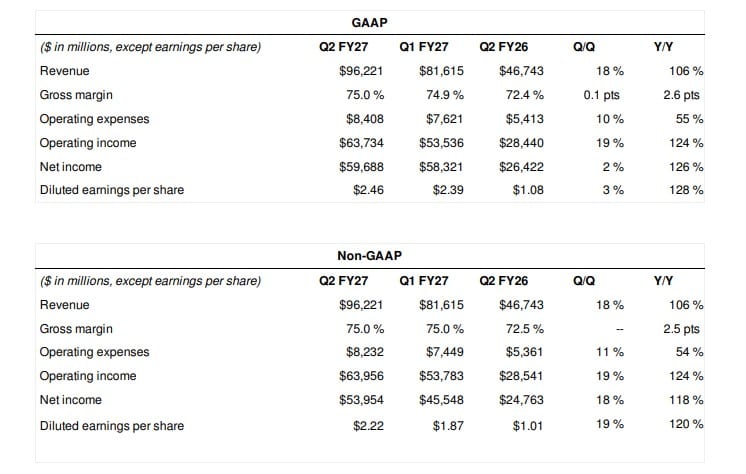
- The image presents a comparison of the company’s GAAP and Non-GAAP financial performance for Q2 FY27, alongside Q1 FY27 and Q2 FY26 results.
- Under GAAP, revenue reached USD 96.22 billion in Q2 FY27, increasing 18% quarter-over-quarter and 106% year-over-year. Gross margin improved to 75.0%, up 2.6 percentage points from Q2 FY26. Operating income rose to USD 63.73 billion, representing growth of 19% Q/Q and 124% Y/Y. Net income increased to USD 59.69 billion, while diluted earnings per share reached USD 2.46, up 128% year-over-year.
- Under Non-GAAP, revenue was also USD 96.22 billion, while gross margin stood at 75.0%, improving by 2.5 percentage points year-over-year. Operating income increased to USD 63.96 billion, up 124% Y/Y, and net income reached USD 53.95 billion, representing 118% year-over-year growth. Diluted earnings per share increased to USD 2.22, compared with USD 1.87 in Q1 FY27 and USD 1.01 in Q2 FY26.
- Overall, the results indicate strong revenue expansion, improved margins, and substantial earnings growth in Q2 FY27.
Beat or Miss?
NVIDIA exceeded the available consensus estimates for both revenue and adjusted EPS. The revenue outperformance was especially notable given the already elevated expectation base following successive quarters of AI-infrastructure demand growth.
| Metric | Reported | Difference/Analysis |
| Revenue | $96.22 billion | Above the approximately $92.07 billion estimate by $4.15 billion, or about 4.5% |
| Non-GAAP diluted EPS | $2.22 | Above the approximately $2.09 estimate by $0.13, or about 6.2% |
| GAAP diluted EPS | $2.46 | Consensus comparison not specified in the source set |
| Q3 FY2027 revenue guidance | $108.0 billion ±2% | Above prevailing Street expectations, according to contemporaneous earnings coverage |
| Q3 gross-margin guidance | 74.0% ±50 bps | Implies modest sequential normalization from Q2’s 75.0% margin |
Consensus comparison figures are based on published market-data reporting; NVIDIA’s release itself does not provide analyst estimates.
What Leadership Is Saying
“AI has reached its inflection point. It’s doing useful work. Its tokens are productive and profitable. Now, compute is revenue.”
— Jensen Huang, founder and CEO, NVIDIA
“We delivered another outstanding quarter with record revenue, operating income, and EPS. Total revenue of $96 billion more than doubled year-over-year as growth accelerated for the fourth consecutive quarter.”
— Colette Kress, executive vice president and CFO, NVIDIA
Historical Performance
| Category | Q2 FY2027 | Q2 FY2026 | Change (%) |
| Revenue | $96.221 billion | $46.743 billion | 106% |
| Net income, GAAP | $59.688 billion | $26.422 billion | 126% |
| Operating expenses, GAAP | $8.408 billion | $5.413 billion | 55% |
| Operating income, GAAP | $63.734 billion | $28.440 billion | 124% |
| GAAP gross margin | 75.00% | 72.40% | +2.6 percentage points |
| Operating cash flow | $24.077 billion | $15.365 billion | 57% |
| Free cash flow | $21.341 billion | $13.450 billion | 59% |
NVIDIA’s revenue growth materially outpaced operating-expense growth, driving a sharp expansion in operating income and net income. However, net income also benefited from substantially higher other income, including gains from equity securities; investors evaluating underlying operating performance should therefore consider operating income, cash generation, and non-GAAP results alongside GAAP net income.
Competitor Comparison
A direct quarterly peer comparison is not appropriate within this earnings report because NVIDIA does not report competitors’ financial results. The most relevant comparison is NVIDIA’s own revenue mix, which shows Data Center as the principal earnings engine.
| Category | Q2 FY2027 | Q2 FY2026 | Change (%) |
| Data Center revenue | $89.0 billion | Approximately $41.0 billion | 117% |
| Edge Computing revenue | $7.2 billion | Approximately $5.7 billion | 27% |
| Total company revenue | $96.2 billion | $46.7 billion | 106% |
| Data Center share of total revenue | Approximately 92.5% | Approximately 87.7% | +4.8 percentage points |
Data Center was responsible for nearly all of NVIDIA’s quarter-on-quarter and year-on-year expansion, reflecting continuing demand for AI accelerators, networking and AI-factory infrastructure. The company also highlighted Vera Rubin entering full production and deployments across named cloud and infrastructure partners
How the Market Reacted?
The earnings release carried a strongly bullish operating message: revenue more than doubled, adjusted EPS exceeded available estimates, and Q3 guidance pointed to another significant sequential step-up. However, reports indicated that NVDA shares were volatile after the announcement, falling more than 2% at one point before narrowing the loss to roughly 1.24% in one contemporaneous update.
That reaction suggests investors were weighing exceptional reported results and guidance against already high expectations and valuation sensitivity around AI-capex durability.

Sources