









Beginning
Digital Art Statistics: The online art market has found its new footing and is thriving like never before. While the COVID-19 pandemic was one of the biggest challenges the traditional art world had faced since the 2008 financial crisis, the online art market told a completely different story. As auction houses and galleries rapidly shifted to digital platforms during lockdowns, online sales of art and antiques surged dramatically and have remained well above pre-pandemic levels ever since.
From AI-generated illustrations and NFT collections to digital paintings and motion graphics, digital art encompasses a vast and rapidly expanding universe of creative expression powered by technology.
In 2025, the global digital art market reached new heights, driven by the explosive growth of AI art tools, the resurgence of NFT platforms, and the increasing integration of digital art into advertising, entertainment, gaming, and virtual reality experiences.
Must Reads in the Editor’s Eye
- The global digital art market was worth about USD 18.3 billion in 2025, and it is growing at a fast rate of 17.3% each year.
- Out of this, online art sales alone made up about USD 11.8 billion in 2025.
- Experts believe this market will keep growing, reaching USD 65.6 billion by 2033.
- Most of this market comes from software, like tools used for drawing, editing, and designing. In 2024, these software tools made up 88.5% of the market because most people use them for their rich features.
- North America leads the world in this market, holding a 38.15% share. This growth is also driven by people’s habits, a survey found that 69.6% of creators prefer drawing digitally instead of using paper.
- AI is also playing a big role in art today. About 27% of Americans have seen AI-generated artwork, though many struggle to tell if it’s real or made by a computer.
- Among AI tools, Midjourney is the most popular, holding 26.8% of the global market, beating out other platforms by more than 2%.
General Digital Art Statistics
- The global digital art market was valued at approximately USD 18.3 billion in 2025, growing at a CAGR of 17.3%, driven by increasing demand for AI-generated content, digital illustrations, and motion graphics across multiple industries.
- Adobe Firefly surpassed 6 billion image generations since its launch, showing the enormous appetite for AI-assisted digital art creation among professional designers and everyday users worldwide.
- Midjourney reported over 20 million registered users in 2025, with users collectively generating more than 200 million AI-generated images per month, making it one of the most widely used AI art platforms globally.
- Procreate surpassed 30 million paid downloads on the Apple App Store in 2025, remaining the most popular professional digital illustration app among artists, concept designers, and graphic creators.
- Digital and AI-generated artworks accounted for 18% of total auction sales at Christie’s in 2025, a significant jump from just 6% in 2022.
- The global NFT market recorded monthly trading volumes of approximately USD 1.2 billion in 2024, showing strong recovery signs driven by renewed interest in digital collectibles, gaming assets, and music NFTs.
- The online art market generated approximately USD 11.8 billion in global sales in 2025, remaining significantly above pre-pandemic levels as auction houses and galleries continued to expand their digital presence.
- Getty Images launched a new AI-generated image licensing platform in 2025, offering over 50 million commercially safe AI art images for licensing.
Global Digital Art Market Share Statistics
(Source: market.us)
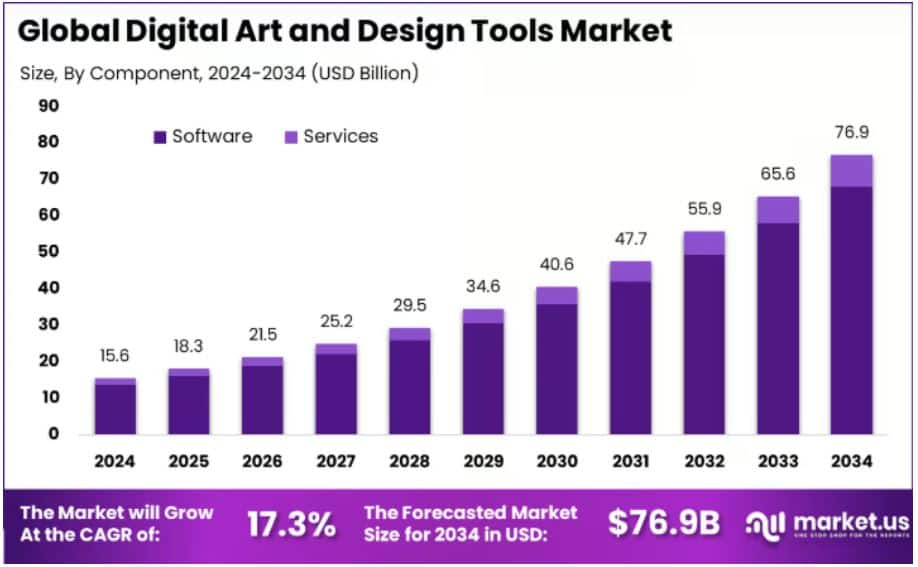
- The Global Digital Art and Design Tools Market size is expected to be worth around USD 76.9 billion by 2034, from USD 15.6 billion in 2024, growing at a CAGR of 17.3% during the forecast period from 2025 to 2034.
- By 2026, the market is projected to reach USD 21.5 billion, showing steady early-stage growth in both the software and services segments.
- By 2033, the market value climbs significantly to USD 65.6 billion, reflecting nearly a decade of consistent expansion.
- Finally, in 2034, the market is expected to hit its forecasted peak of USD 76.9 billion, with the software segment continuing to serve as the primary revenue driver.
Digital Art Market Drivers
- Digital art and design software solutions had the largest market share of 88.5% in 2024 because most users relied on rich-feature software for illustrating, editing, and designing purposes.
- The market leader by category was Raster graphics software at 38.7%. This is due to the fact that the software was widely used in digital painting, photo editing and visual content creation processes.
- Cloud had a leading share of 71.6% as it is preferred by users for flexible access and be able to update their designs anytime.
- Professionals formed 52.4% of all users. This was due to the wide adoption in commercial studios, freelancers and companies.
- The media and entertainment industry accounted for 41.3% due to high demand for products such as video games, films, animations, and digital content.
Digital Art Market in the US
(Source: market.us)
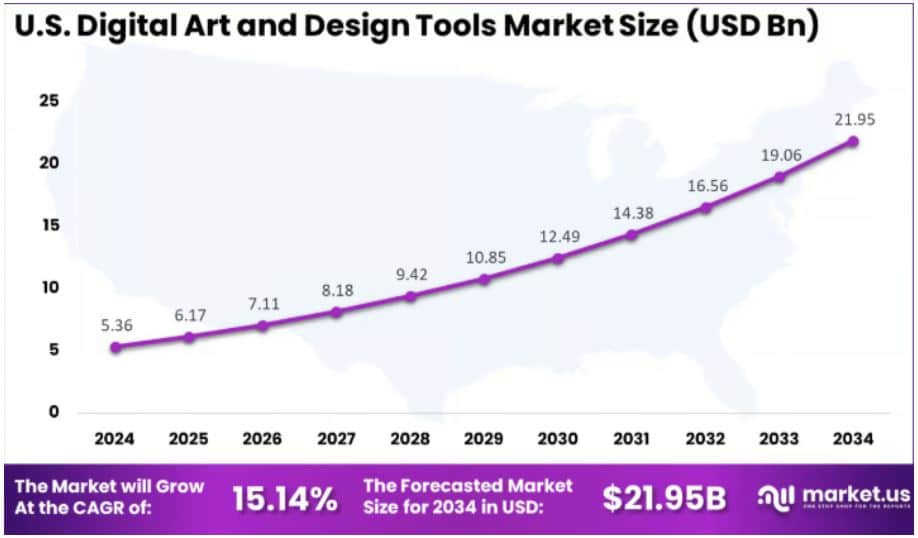
- The U.S. market reached USD 5.36 billion in 2024. It is growing fast, at a rate of 15.14% every year. This growth is happening because more people are becoming online creators, and digital media is expanding quickly.
- For example, in October 2025, Adobe shared exciting new AI tools at an event called Adobe MAX 2025. They added smart AI assistants and new features to popular apps like Photoshop, Lightroom, Premiere, and Illustrator.
- North America is the world leader in this market, holding a 38.15% share. This is because the region has strong creative industries, many people use advanced software, and it has excellent digital technology.
- Companies are investing heavily in AI tools, which helps speed up work in media and entertainment. Because of this, North America continues to be a top region for digital creativity.
- For instance, in September 2025, a company called Autodesk introduced a new tool called “neural CAD” at an event called Autodesk University 2025. This tool uses AI to help design engineers turn their ideas into detailed plans much faster than before.
Demographic Insights of Digital Art
(Reference: Celsys.com)
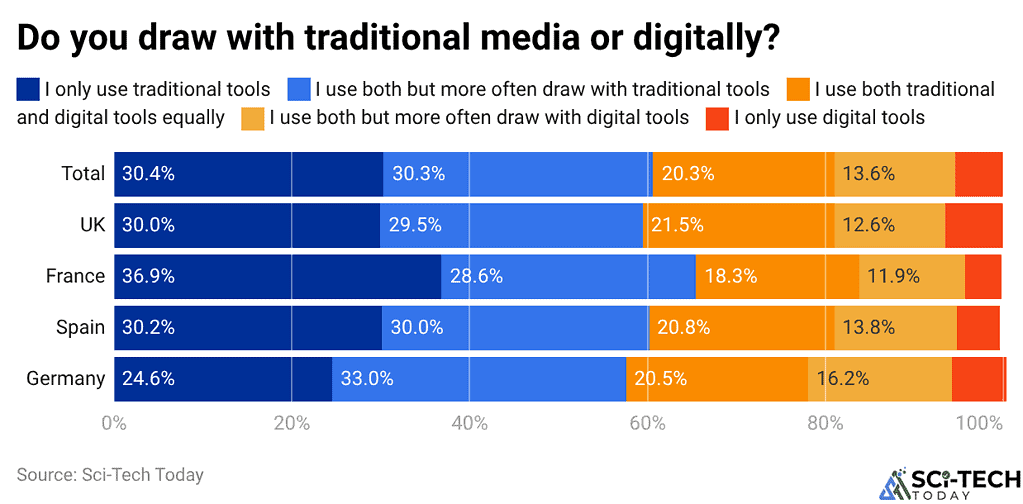
- A survey found that 69.6% of creators like to draw using digital tools instead of paper.
- It also found that a large number of these artists started young: 43.4% began digital art at age 15 or younger, and 13% started even earlier, at age 10 or younger. This shows that many artists grew up being comfortable with digital drawing.
- Digital adoption is different in every country. For most people, their first digital art device was a tablet or smartphone, since these gadgets are easy to get and use.
- When we look at specific countries, Germany has a very high adoption rate, with over 75% of creators using digital tools.
- However, in France, the number is lower, with only 63% of creators using digital tools for their art.
AI in Art Statistics
- 27% of Americans have viewed AI-generated artwork, though not everyone is able to identify it.
- 76% of individuals do not think that AI-generated artwork should be referred to as art.
- 89% of artists are of the opinion that existing copyright laws cannot cope with AI artwork.
- The most expensive piece of AI art ever, Portrait of Edmond Belamy, was auctioned for USD 432,000.
- 55% of artists think that AI will harm their earning capacity.
- Canva emerged as the most popular AI image generator (51.8%) as nominated by influencers across the globe, followed by Photoshop (36.4%).
AI in Art Usage Statistics
- AI art statistics offered by Gartner projected that there would be at least one major blockbuster movie released by 2030, where 90% of the movie would be made by AI (from text to video).
- With such amazing progress in the works, Platform.io conducted a survey among over 500 artists in different fields about text-to-image technology.
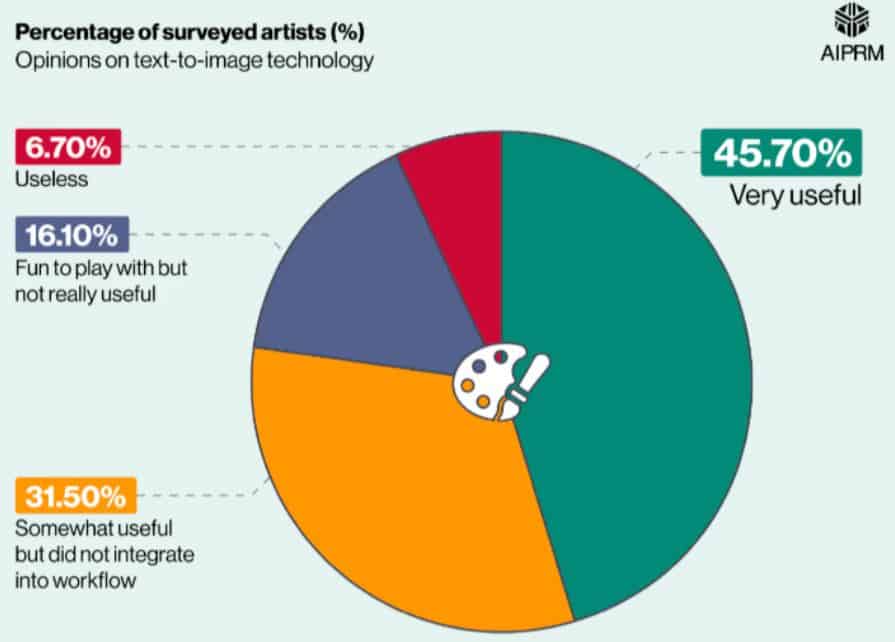
- Over half of them (45.7%) felt that it is extremely helpful in the course of their artwork, with almost one-third (31.5%) thinking that it was useful but not applicable to their working style.
(Source: aiprm)
- Only slightly over a tenth (16.1%) thought that text-to-image technology was fun but useless; this percentage was almost three times lower than the percentage of people who found it extremely helpful.
- Also, slightly over one-twentieth (6.7%) thought that the technology was totally useless; this percentage was approximately five times lower than the percentage of people who found it somewhat useful.
AI in Art Generator Tools Statistics
- Studies show that Midjourney is the most popular AI tool for creating images. It holds 26.8% of the global market, which is more than 2% higher than any other platform.
- DALL-E comes in second place, holding almost a quarter of the market (24.35%). This is slightly higher (0.83%) than Nightcafe, which ranks third.
- Starry AI and Stable Diffusion complete the top five, with market shares of 12.75% and 12.52%. Together, these five platforms make up more than 99% of the entire global market.
- By 2024, Stable Diffusion had created over 12.5 billion images. That is 12 times more than any other platform, making it the only company to pass the 10 billion mark.
- Adobe Firefly was the only other platform to reach 1 billion images created. This total was about 4% higher than Midjourney’s count and 9% higher than DALL-E 2’s count, which ranked third and fourth on the list.
How Artists Use AI
- A survey looked at how artists use AI to make art. It found that just over 1 in 10 artists (11.2%) have used text-to-image tools to create a full digital artwork. This number is almost three times lower than the number of artists who use AI to create image assets for other projects.
- The most common reason artists use these tools is to explore new ideas. Over a third of artists (35.1%) said they use AI for this reason.
- Meanwhile, only 14% said they use it just for fun, which is less than half the number who use it to create assets for projects.
- Even though AI art is becoming popular, most artists aren’t planning to show it in galleries. Only 8.2% plan to display their AI art in art venues, and even fewer, just 6.8% plan to sell their work as NFTs.
- Instead, the most popular choice is sharing art online. More than a third of artists said they plan to share their AI art on social media. This is about four times higher than the number of artists planning to display their work in physical art venues.
Recent Digital Art Developments
- In Q1 2024, Adobe reported that its AI-powered generative art tool, Adobe Firefly, surpassed 6 billion image generations since its launch.
- In Q2 2024, the global NFT market showed signs of recovery, with monthly trading volume reaching USD 1.2 billion, driven by renewed interest in digital collectibles, gaming assets, and music NFTs across platforms like OpenSea, Blur, and Magic Eden.
- In January 2025, Midjourney reported that its AI image generation platform surpassed 20 million registered users worldwide, with users collectively generating over 200 million images per month.
- In March 2025, Getty Images launched a new AI-generated image licensing platform, offering commercially safe AI art for businesses, with over 50 million AI-generated images available for licensing.
- In 2025, the global digital art market was valued at approximately USD 18.3 billion, growing at a CAGR of 14.3%, by increasing demand for digital illustrations, motion graphics, and AI-generated content across advertising, entertainment, and social media industries.
- In August 2025, Procreate reported that its digital illustration app surpassed 30 million paid downloads on the Apple App Store, remaining the most popular professional digital art application among illustrators, concept artists, and graphic designers worldwide.
- In October 2025, Christie’s auction house reported that digital and AI-generated artworks accounted for 18% of total auction sales in 2025, up from just 6% in 2022.
Closure
Digital art isn’t just a trend anymore; it’s basically the new normal, with the vast majority of creators ditching traditional pens and canvases for tablets and styluses. As we head into 2026 and beyond, we’re going to see this space explode even further thanks to AI tools like Midjourney and Stable Diffusion, which are making it easier than ever for anyone to bring their ideas to life.
Expect the lines between “traditional” artist and “digital” creator to blur completely, as AI-assisted workflows become a standard part of every artist’s toolkit rather than just a novelty.
FAQ
Digital art is any artistic work created or presented using digital technology, including AI-generated images, digital paintings, NFTs, motion graphics, and 3D illustrations.
The most popular digital art tools in 2025 include Adobe Firefly, Midjourney, Procreate, DALL-E, and Stable Diffusion, with AI-powered platforms rapidly becoming the preferred choice for both professional and amateur artists.
Yes, NFTs have shown strong signs of recovery in 2026, with monthly trading volumes rebounding and new use cases emerging in gaming, music, and virtual reality, making them a still-relevant part of the digital art ecosystem.
AI is revolutionizing digital art by enabling anyone to generate high-quality images, illustrations, and animations within seconds, democratizing creativity while also sparking important debates around copyright, originality, and artistic authenticity.


