









Introduction
The Global Digital Transformation Market is projected to reach USD 8,567.4 billion by 2033, expanding at a CAGR of 26.3% from 2024 to 2033. This rapid expansion is driven by widespread adoption of AI, cloud computing, and IoT technologies that streamline operations, reduce costs, and enhance productivity. Digital-first strategies are no longer optional, as enterprises shift toward data-driven models to remain competitive and scalable.
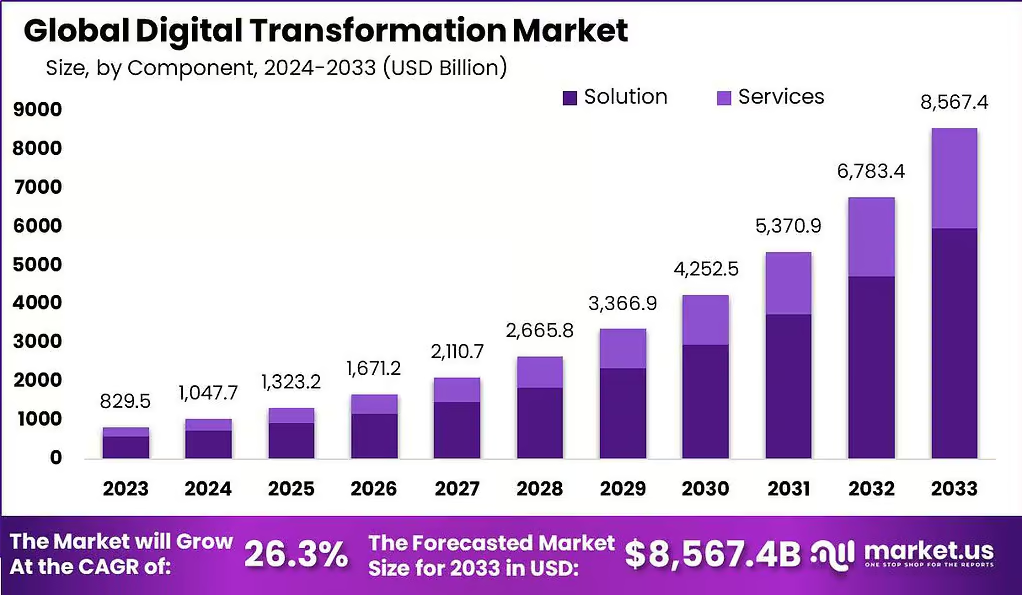
Get lastest insights and updates at @ https://market.us/report/digital-transformation-market/request-sample/
Market Overview
According to Market.us, the digital transformation market is experiencing a structural shift as organizations across industries accelerate their transition toward integrated digital ecosystems.
By 2023, digitally transformed entities are projected to contribute over 50% of global GDP, highlighting the growing dependence of economic systems on digital capabilities. North America led the market with a dominant share of over 41.9%, supported by its advanced infrastructure, strong enterprise adoption, and early integration of emerging technologies.
The market is evolving beyond basic digitization into full-scale transformation, where businesses redesign their processes, culture, and customer engagement models. Enterprises are investing heavily in analytics, automation, and cloud-native architectures to build resilient and agile systems.
This transformation is not limited to operational efficiency but extends to innovation, enabling organizations to unlock new revenue streams and business models. The convergence of technologies such as AI, big data, and IoT is further accelerating this shift, making digital transformation a core strategic priority across sectors.
Key Takeaways
- Market Size by 2033: USD 8,567.4 Billion
- CAGR (2024–2033): 26.3%
- Contribution to Global GDP: 50%+ by 2023
- Dominant Component: Solutions (69.7% share)
- Leading Deployment Mode: On-premise (63.9% share)
- Top Technology Segment: Big Data & Analytics (30.1% share)
- Largest Enterprise Segment: Large Enterprises (61.5% share)
- Leading Industry: BFSI (27.4% share)
- Dominant Region: North America (41.9% share)
Connect with expert @ [email protected]
Report Scope
| Report Features | Description |
|---|---|
| Market Value (2023) | USD 829.5 Bn |
| Forecast Revenue (2033) | USD 8,567.4 Bn |
| CAGR (2024-2033) | 26.3% |
| Base Year for Estimation | 2023 |
| Historic Period | 2018-2022 |
| Forecast Period | 2024-2033 |
| Report Coverage | Revenue Forecast, Market Dynamics, COVID-19 Impact, Competitive Landscape, Recent Developments |
| Segments Covered | By Component (Solution and Services), By Deployment Mode (Cloud-Based and On-Premise), By Technology (Big Data & Analytics, Cloud Computing, Cybersecurity, Artificial Intelligence (AI), Blockchain, Internet of Things (IoT), and Other Technologies), By Enterprise Size (Small and Medium-Sized Enterprises and Large Enterprises), By End-Use Industry (IT & Telecommunications, BFSI, Government & Public Sector, Healthcare, Manufacturing, Retail, Other End-Use Industries) |
| Regional Analysis | North America – The US, Canada, & Mexico; Western Europe – Germany, France, The UK, Spain, Italy, Portugal, Ireland, Austria, Switzerland, Benelux, Nordic, & Rest of Western Europe; Eastern Europe – Russia, Poland, The Czech Republic, Greece, & Rest of Eastern Europe; APAC – China, Japan, South Korea, India, Australia & New Zealand, Indonesia, Malaysia, Philippines, Singapore, Thailand, Vietnam, & Rest of APAC; Latin America – Brazil, Colombia, Chile, Argentina, Costa Rica, & Rest of Latin America; the Middle East & Africa – Algeria, Egypt, Israel, Kuwait, Nigeria, Saudi Arabia, South Africa, Turkey, United Arab Emirates, & Rest of MEA |
| Competitive Landscape | IBM Corporation, Microsoft Corporation, Amazon Web Services Inc., Google LLC, SAP SE, Cisco Systems Inc., Salesforce Inc., Oracle Corporation, Tata Consultancy Services Limited, Accenture Plc, Adobe Inc., Dell Inc., Hewlett Packard Enterprise, Other Key Players |
| Customization Scope | Customization for segments, region/country-level will be provided. Moreover, additional customization can be done based on the requirements. |
| Purchase Options | We have three licenses to opt for: Single User License, Multi-User License (Up to 5 Users), Corporate Use License (Unlimited Users and Printable PDF) |
How AI is Reshaping the Future of the Digital Transformation Market?
Artificial intelligence has become the backbone of digital transformation, enabling organizations to move from reactive operations to predictive and autonomous systems. AI-powered analytics allows businesses to process vast datasets in real time, uncovering patterns that drive better decision-making and operational efficiency.
Leading technology providers are embedding AI into enterprise platforms to enhance automation and intelligence. For instance, according to IBM, AI is used to optimize workflows and improve customer engagement through intelligent automation tools. Similarly, Microsoft integrates AI into its cloud ecosystem to support advanced analytics, cybersecurity, and application development.
AI is also revolutionizing customer experience by enabling hyper-personalization. Businesses use machine learning models to understand consumer behavior and deliver tailored recommendations, improving satisfaction and loyalty. In sectors such as banking and retail, AI-driven chatbots and virtual assistants are handling customer interactions with greater speed and accuracy.
Another critical impact of AI lies in predictive maintenance and risk management. Organizations leverage AI to anticipate system failures, reduce downtime, and enhance operational resilience. This capability is particularly valuable in industries such as manufacturing and energy, where system efficiency directly impacts profitability.
Overall, AI is transforming digital transformation from a technology upgrade into a continuous innovation cycle, where systems learn, adapt, and improve over time.
Segmentation Deep Dive
By Component
The solutions segment dominates the market, capturing more than 69.7% share in 2023. This dominance is driven by the increasing demand for integrated digital platforms that enable automation, analytics, and customer engagement. Organizations prefer comprehensive solutions that combine multiple capabilities into a single ecosystem, reducing complexity and improving efficiency.
Services, including consulting and implementation, are also growing as enterprises require expert guidance to navigate complex transformation journeys. However, solutions remain the core investment area due to their direct impact on business performance and scalability.
By Deployment Mode
On-premise deployment leads the market with over 63.9% share, primarily due to concerns around data security, regulatory compliance, and customization. Large organizations, especially in regulated industries, prefer on-premise solutions to maintain control over sensitive data and critical systems.
Cloud-based deployment is gaining momentum as businesses seek flexibility, scalability, and cost efficiency. Hybrid models are also emerging, allowing organizations to balance control and agility while optimizing infrastructure costs.
By Technology
Big Data and Analytics dominate the technology segment, accounting for more than 30.1% share in 2023. The exponential growth of data across industries has made analytics a critical tool for decision-making and strategy development. Organizations rely on advanced analytics to gain insights into customer behavior, operational performance, and market trends.
Other technologies, including AI, IoT, and blockchain, are complementing analytics by enabling real-time data processing, automation, and secure transactions. The integration of these technologies is creating a unified digital ecosystem that supports end-to-end transformation.
By Enterprise Size
Large enterprises hold the largest share, exceeding 61.5%, as they possess the financial resources and technical capabilities to implement large-scale transformation initiatives. These organizations operate across multiple regions and require advanced systems to manage complex operations.
Small and medium-sized enterprises are gradually increasing their adoption of digital transformation, driven by the availability of cost-effective cloud solutions and digital tools. These businesses are leveraging technology to compete with larger players and improve operational efficiency.
By End-Use Industry
The BFSI sector leads the market with a share of 27.4%, driven by the need to enhance customer experience, ensure regulatory compliance, and manage risks effectively. Financial institutions are investing heavily in digital platforms to offer seamless services, improve security, and optimize operations.
Other industries, including healthcare, retail, manufacturing, and telecommunications, are also adopting digital transformation to improve efficiency and innovation. Each sector is leveraging technology to address specific challenges and capitalize on emerging opportunities.
Regional Analysis
North America stands as the leading region in the digital transformation market, capturing more than 41.9% share in 2023. This dominance is attributed to the region’s advanced technological infrastructure, high adoption of cloud computing, and strong presence of global technology leaders.
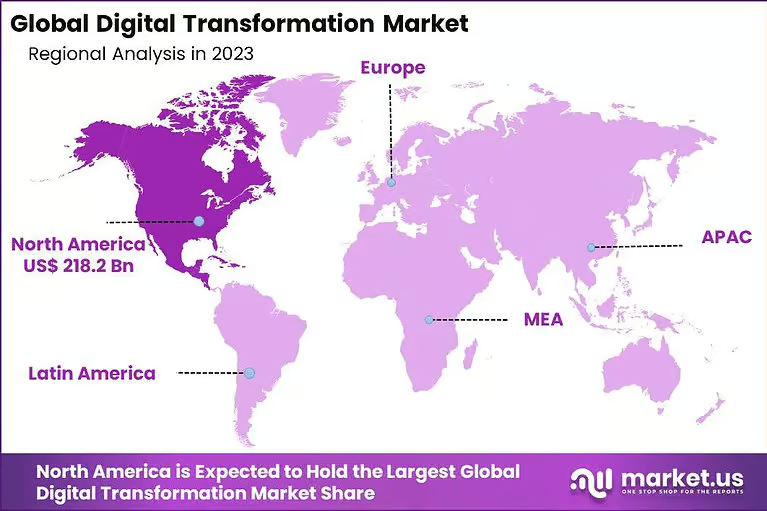
Organizations in North America are early adopters of emerging technologies, enabling them to stay ahead in the competitive landscape. The region also benefits from a highly skilled workforce and supportive regulatory frameworks that encourage innovation and digital adoption.
Additionally, the widespread use of digital platforms across industries, including finance, healthcare, and retail, further strengthens the region’s position. Continuous investment in research and development ensures that North America remains at the forefront of digital transformation initiatives.
Market Leaders
- Microsoft Corporation
- IBM Corporation
- Oracle Corporation
- SAP SE
- Google LLC
- Amazon Web Services Inc.
- Accenture plc
- Capgemini SE
- Cognizant Technology Solutions Corporation
- Tata Consultancy Services Limited
Recent Developments
- In 2024, Microsoft expanded its AI capabilities within its cloud platform to support enterprise digital transformation initiatives.
- IBM enhanced its AI-driven automation solutions in 2023, focusing on improving business process efficiency across industries.
- Oracle introduced new cloud-based applications in 2024 aimed at accelerating digital adoption in enterprise environments.
- SAP strengthened its digital transformation portfolio in 2023 by integrating advanced analytics and automation tools into its platforms.
- Accenture expanded its digital transformation services in 2024 through strategic partnerships and technology investments.
Conclusion
The digital transformation market is entering a phase of sustained and high-impact growth, driven by rapid technological advancements and evolving business needs. Organizations across industries are recognizing the importance of digital capabilities in achieving operational efficiency, innovation, and competitive advantage.
The strong growth trajectory, supported by AI, cloud computing, and data analytics, highlights the market’s long-term potential. As businesses continue to invest in digital transformation, the market is expected to unlock new opportunities for innovation, productivity, and economic growth, making it a critical area for strategic investment.