








Introduction
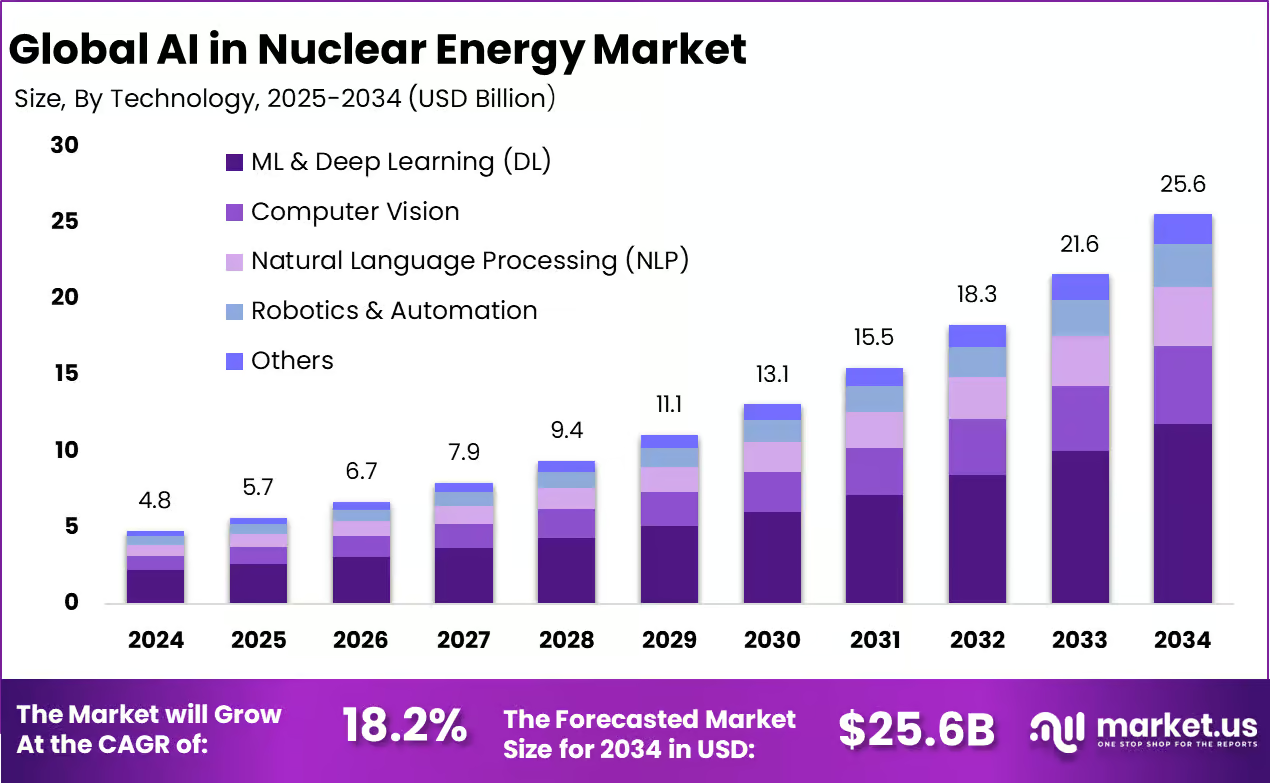
The AI in Nuclear Energy Market is projected to reach USD 25.6 billion by 2034, rising from USD 4.8 billion in 2024, expanding at a CAGR of 18.2%. This rapid growth is driven by increasing demand for predictive maintenance, safety optimization, and intelligent automation across nuclear facilities. The integration of AI into critical infrastructure is accelerating operational efficiency and reducing risk exposure.
To learn more about this report request sample @ https://market.us/report/ai-in-nuclear-energy-market/request-sample/
Market Overview
According to Market.us, the AI in Nuclear Energy Market is experiencing rapid growth as nuclear operators increasingly adopt intelligent systems to modernize aging infrastructure and enhance safety protocols. North America leads the global market with a dominant 36.7% share, generating approximately USD 1.76 billion in revenue. The region’s leadership is supported by advanced research capabilities, regulatory emphasis on safety, and early adoption of AI-driven technologies.
The United States alone reached USD 1.57 billion in 2024, with growth of 16.4%, reflecting strong investment in digital transformation and next-generation nuclear technologies. The market continues to evolve as operators integrate AI for real-time monitoring, anomaly detection, and performance optimization across nuclear power plants.
Key Takeaways
- Global Market Value 2024: USD 4.8 Billion
- Forecast Market Value 2034: USD 25.6 Billion
- CAGR (2025–2034): 18.2%
- North America Share: 36.7%
- North America Revenue: USD 1.76 Billion
- U.S. Market Value: USD 1.57 Billion
- Machine Learning & Deep Learning: 46.3% share
- Asset Management & Predictive Maintenance: 35.1% share
- On-Premises Deployment: 72.8% share
Report Scope
| Report Features | Description |
| Market Value (2024) | USD 4.8 Bn |
| Forecast Revenue (2034) | USD 25.6 Bn |
| CAGR (2025-2034) | 18.20% |
| Base Year for Estimation | 2024 |
| Historic Period | 2020-2023 |
| Forecast Period | 2025-2034 |
| Report Coverage | Revenue forecast, AI impact on market trends, Share Insights, Company ranking, competitive landscape, Recent Developments, Market Dynamics and Emerging Trends |
| Segments Covered | By Technology (Machine Learning (ML) & Deep Learning (DL), Computer Vision, Natural Language Processing (NLP), Robotics & Automation, Others), By Application (Asset Management & Predictive Maintenance, Reactor Operation & Control, Fuel Management & Waste Reduction, Safety & Security Monitoring, Radiation Monitoring & Dose Management, Supply Chain & Project Management, Others), By Deployment Mode (Cloud-based, On-Premises) |
| Regional Analysis | North America – US, Canada; Europe – Germany, France, The UK, Spain, Italy, Russia, Netherlands, Rest of Europe; Asia Pacific – China, Japan, South Korea, India, New Zealand, Singapore, Thailand, Vietnam, Rest of APAC; Latin America – Brazil, Mexico, Rest of Latin America; Middle East & Africa – South Africa, Saudi Arabia, UAE, Rest of MEA |
| Competitive Landscape | ABB, BWX Technologies, Framatome, Hitachi, GE Vernova, Honeywell, Kinectrics, Mitsubishi, NuScale Power Corporation, TerraPower, Siemens Energy AG, Toshiba Corporation, Westinghouse Electric Company, IBM Corporation, Others |
| Customization Scope | Customization for segments, region/country-level will be provided. Moreover, additional customization can be done based on the requirements. |
Connect with Our Expert Team at [email protected]
Segmentation Deep Dive
By Type
Machine Learning (ML) and Deep Learning (DL) dominate the market with a 46.3% share, driven by their ability to process complex datasets and generate actionable insights. These technologies are widely used for fault detection, system optimization, and safety monitoring. Their capability to learn from historical data and improve over time makes them essential for modern nuclear operations.
- Machine Learning (ML) & Deep Learning (DL)
- Computer Vision
- Natural Language Processing (NLP)
- Robotics & Automation
- Others
By Application
Asset Management and Predictive Maintenance account for 35.1% share, reflecting the growing importance of minimizing operational disruptions and extending equipment lifespan. AI-based predictive tools enable operators to forecast equipment failures and optimize maintenance schedules, reducing costs while ensuring continuous plant operation.
- Asset Management & Predictive Maintenance
- Reactor Operation & Control
- Fuel Management & Waste Reduction
- Safety & Security Monitoring
- Radiation Monitoring & Dose Management
- Supply Chain & Project Management
- Others
By Deployment
On-premises deployment leads with a 72.8% share, highlighting the critical importance of data security in nuclear environments. Operators prefer locally managed systems to maintain control over sensitive operational data and comply with stringent regulatory requirements. This approach ensures reliability and minimizes cybersecurity risks.
- Cloud-based
- On-Premises
By End-User
Nuclear power plant operators represent the primary end-user segment, driven by their need to enhance efficiency, safety, and regulatory compliance. The adoption of AI technologies enables operators to optimize reactor performance, reduce downtime, and improve overall operational resilience.
Regional Analysis
North America dominates the AI in Nuclear Energy Market with a 36.7% share, supported by strong technological infrastructure and significant investments in nuclear modernization. The region benefits from well-established regulatory frameworks that encourage innovation while maintaining strict safety standards.
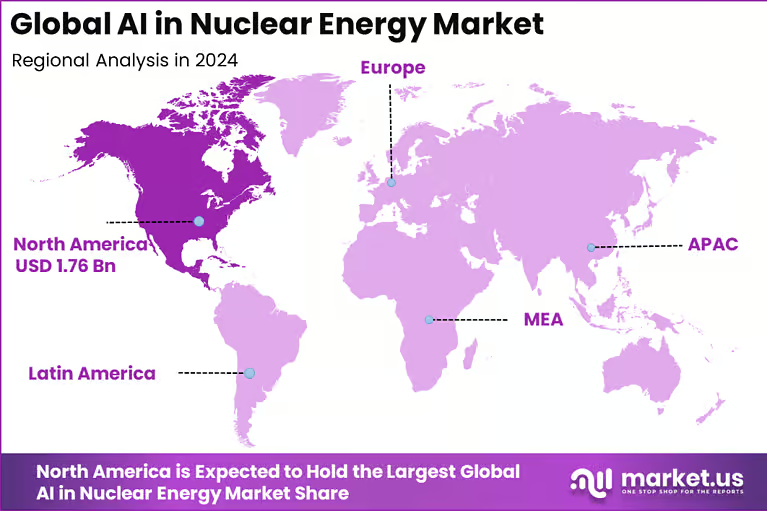
The United States plays a central role, with a market value of USD 1.57 Billion, driven by initiatives to integrate AI into nuclear operations and improve energy efficiency. The presence of leading technology providers and research institutions further accelerates AI adoption, positioning North America as a key hub for innovation in nuclear energy.
Market Leaders
Key players operating in the AI in Nuclear Energy Market include:
- IBM
- Microsoft
- Siemens
- General Electric
- Schneider Electric
- ABB
These companies focus on developing advanced AI solutions tailored for nuclear applications, including predictive analytics, digital twins, and automated monitoring systems.
How AI is Reshaping the Future of AI in the Nuclear Energy Market?
Artificial intelligence is fundamentally transforming nuclear energy operations by enabling predictive, data-driven decision-making. Advanced algorithms process vast volumes of operational data from reactors, sensors, and monitoring systems to detect anomalies and optimize performance. This shift enhances safety while improving plant efficiency and reliability.
Organizations such as IBM and Microsoft deploy AI-powered platforms that analyze real-time data streams from nuclear facilities. These systems identify early signs of equipment degradation, allowing operators to take preventive action before failures occur. Predictive maintenance capabilities significantly reduce downtime and operational costs while maintaining high safety standards.
AI also plays a crucial role in reactor simulation and digital twin technology. By creating virtual models of nuclear plants, operators can simulate various scenarios, assess risk factors, and optimize performance under different operating conditions. This capability supports better planning and decision-making, particularly in complex environments where safety is paramount.
Furthermore, AI enhances regulatory compliance and safety monitoring. Intelligent systems continuously track operational parameters and flag deviations from standard thresholds, enabling faster response times. As nuclear facilities adopt more automated systems, AI is expected to become a central component in ensuring operational integrity and long-term sustainability.
Recent Developments
- In 2024, IBM expanded its AI-driven asset management solutions to support predictive maintenance in nuclear facilities.
- In 2023, Microsoft enhanced its cloud-based AI platforms for energy sector analytics, including nuclear operations.
- In 2024, Siemens introduced AI-enabled digital twin solutions for nuclear plant optimization.
- In 2023, General Electric advanced its predictive analytics tools for reactor performance monitoring.
- In 2024, Schneider Electric strengthened its AI-powered energy management systems to improve operational efficiency in nuclear facilities.
Conclusion
The AI in the Nuclear Energy Market is positioned for substantial growth as operators increasingly prioritize safety, efficiency, and digital transformation. The integration of AI technologies into nuclear operations enables predictive maintenance, real-time monitoring, and enhanced decision-making capabilities.
North America continues to lead the market, supported by strong infrastructure and innovation ecosystems. As investments in AI and nuclear modernization accelerate, the market is expected to unlock significant opportunities for technology providers and energy stakeholders, making it a compelling space for long-term strategic investment.