









Introduction
Kia Statistics: Kia sort of entered the 2026 period as one of the fastest-growing global automotive manufacturers, and it did that by leaning hard into record sales, expanding electrification, and also keeping profitability strong. Since Kia is part of Hyundai Motor Group, it has more or less shifted from a value-minded automaker into a technology-driven mobility company, with hefty funding going to electric vehicles (EVs), hybrids, software-defined vehicles, and purpose-built vehicles (PBVs).
During 2025, the company actually hit its best-ever global sales volume and revenue, even with more rivals around. Models like Sportage, Seltos, Sorento, EV3, EV5, EV6, and EV9 helped Kia hold onto growth while also boosting its global brand value and overall market footprint. The Kia statistics below sort of show performance across sales, financing, electrification, production, and where it’s aiming next during 2025–2026.
Editor’s Choice
- Kia logged record global vehicle sales of 3.136 million units in FY2025, up 1.5% from the year before.
- FY2025 revenue climbed to a record KRW 114.14 trillion (USD 84.55 billion), rising 6.2% compared with FY2024.
- FY2025 operating profit slipped 28.3% to KRW 9.08 trillion (USD 6.72 billion), even though sales stayed higher.
- FY2025 net profit dropped 22.8% to KRW 7.55 trillion (USD 5.59 billion).
- International markets delivered 2.588 million vehicles, meaning more than 82% of total FY2025 sales.
- In Q1 2026, global vehicle sales inched up 0.9% to 779,741 units.
- Q1 2026 revenue grew 5.3% year-over-year to KRW 29.50 trillion (USD 21.38 billion).
- Q1 2026 operating profit fell 26.7% to KRW 2.21 trillion (USD 1.60 billion).
- Q1 2026 net profit was down 23.5% to KRW 1.83 trillion (USD 1.33 billion).
- Kia moved 232,000 electrified vehicles in Q1 2026, and that count represented 33.1% growth year over year.
- In Q1 2026, electrified vehicles made up 29.7% of overall sales, up from 23.1% the year prior, which is kind of a big jump.
- Sales of battery electric vehicles rose 54.1%, reaching 86,000 units, while hybrids went up 32.1% to 138,000 units.
- The U.S. tariff effects, they trimmed Kia’s FY2025 operating profit by around KRW 3.09 trillion (USD 2.29 billion).
- Kia is now aiming for 4.13 million annual vehicle sales, plus 4.5% global market share by 2030.
- The firm plans to put KRW 49 trillion (USD 35.90 billion) into things from 2026 through 2030.
- KRW 21 trillion (USD 15.22 billion) is earmarked for future mobility endeavours, like connected services and related tech.
Kia Financial Performance Q1 2026
(Revenue / Operating Profit / Net Profit unit: Billion KRW)
| 2026Q1 | 2025Q1 | Y/y Change | ||
| Vehicle sales (Units) | 779,741 | 772,648 | 0.9% | |
| Korea | 141,513 | 134,564 | 5.2% | |
| Outside of Korea | 638,228 | 638,084 | 0.0% | |
| Revenue | 29,501.90 | 28,017.5 | 5.3% | |
| Operating profit | 2,205.10 | 3,008.6 | △26.7% | |
| Net profit | 1,830.20 | 2,392.6 | △23.5% | |
(Source: kia.com)
- Kia’s Q1 2026 results kind of sketch a picture of steady sales growth and rising revenue, yet the profitability piece did not; it faced some real pressure versus the same period last year.
- In other words, demand for Kia vehicles stayed strong worldwide, and that helped the company keep a positive top-line rhythm even though earnings looked harder to manage.
- For Q1 2026, Kia sold 779,741 vehicles globally, versus 772,648 units in Q1 2025. That works out to a 0.9% year-over-year uptick, not huge, but still an increase.
- In South Korea, domestic sales reached 141,513 units, up 5.2% from 134,564 units in Q1 2025.
- Outside Korea, international markets stayed the big driver, with 638,228 vehicles, making up nearly 82% of the total.
- The international figure was also basically flat vs 638,084 units in Q1 2025, so it’s more like consistent momentum than a sudden jump.
- Revenue kept climbing, landing at KRW 29.50 trillion in Q1 2026, compared with KRW 28.02 trillion in the prior-year period.
- So revenue was up 5.3% year-over-year, showing Kia brought in more money even with only moderate growth in deliveries.
- Profit, though, went in the reverse direction. Operating profit fell to KRW 2.21 trillion from KRW 3.01 trillion in Q1 2025, which implies a 26.7% decrease.
- Net profit also slid, dropping to KRW 1.83 trillion from KRW 2.39 trillion, a 23.5% decline.
- The operating profit decline was tied to U.S. import tariffs, which amounted to KRW 755 billion in losses for Q1 2026 alone, and also to larger foreign-currency warranty provisions linked to a sharp won-dollar exchange-rate swing.
- The combination of 5.3% revenue growth, 0.9% sales growth, and declines in both operating and net profit highlights a quarter where scale increased, but profitability became more difficult to maintain.
- Overall, the figures point to Kia growing vehicle sales and expanding revenue in the quarter, but earnings progress was held back by margin pressure.
Kia Financial Performance 2025
(Source: kia.com)
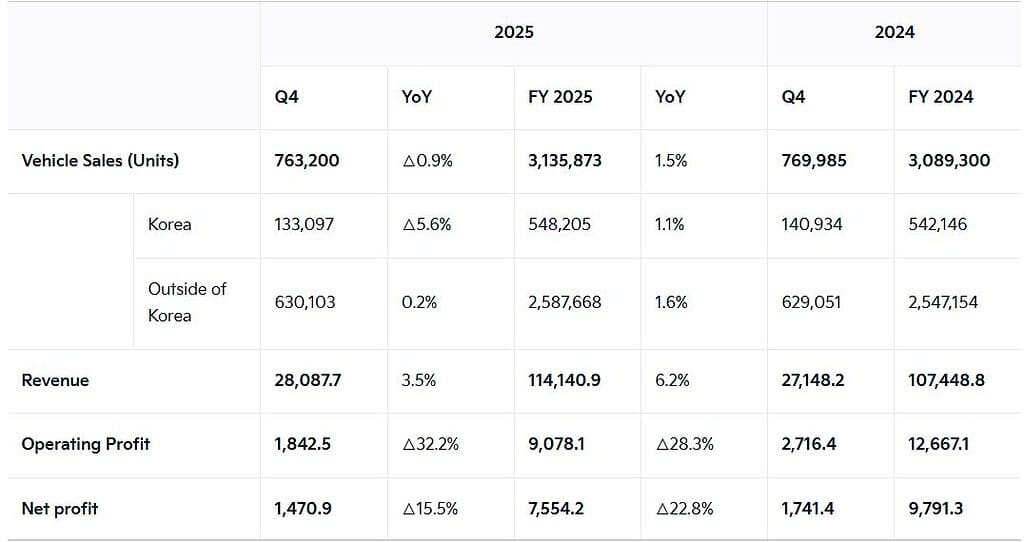
- Kia’s FY2025 results look like one of those stories where the company kept stretching its global footprint and beefing up its revenue base, but at the same time, earnings got squeezed pretty hard.
- For FY2025, Kia delivered 3,135,873 vehicles worldwide, vs 3,089,300 units in FY2024, so that’s about 1.5% year-over-year growth.
- International markets were still the main engine here; they accounted for 2,587,668 vehicles, up 1.6% from 2,547,154 in FY2024.
- Meanwhile, South Korea’s domestic sales came in at 548,205 units, that’s 1.1% higher than 542,146 a year earlier.
- Revenue also climbed to a record KRW 114.14 trillion in FY2025, up 6.2% from KRW 107.45 trillion in FY2024. So in practice, revenue rose much faster than unit volume, hinting at a better product mix plus higher average transaction values, across the portfolio sort of overall.
- Operating profit fell 28.3% to KRW 9.08 trillion, compared with KRW 12.67 trillion in FY2024. Net profit was weaker too, dropping 22.8% to KRW 7.55 trillion, from KRW 9.79 trillion the year before.
- Even though revenue was up by more than KRW 6.69 trillion, earnings tightened quite a bit, showing a tougher operating environment than the sales headline might suggest.
- If you zoom in on Q4 2025, Kia sold 763,200 vehicles, down 0.9% from 769,985 units in Q4 2024.
- Quarterly revenue did manage to increase 3.5% to KRW 28.09 trillion, but operating profit slid 32.2% to KRW 1.84 trillion, and net profit dropped 15.5% to KRW 1.47 trillion.
- Even with 3.14 million vehicle deliveries and KRW 114.14 trillion in revenue, the earnings decline really points to how harder it’s becoming to juggle expansion with profit creation, especially in a more and more competitive worldwide automotive market.
- The above stats show a company that, more or less, managed to push sales and revenue forward during FY2025, but then you also see serious pressure on margins and overall profitability.
Kia Sales Of Electrified Vehicles
- Kia’s electrification plan got a lot more traction in the first quarter of 2026, and their global retail sales for electrified vehicles came in at 232,000 units.
- A solid 33.1% year-over-year lift, kinda showing the brand is moving faster toward hybrid and electric mobility, while also deepening its footprint in major markets.
- Hybrids kept acting like the main growth engine. HEV sales rose to 138,000 units, which is a 32.1% increase versus the same period last year.
- Meanwhile, battery-electric vehicles moved even quicker—EV sales jumped 54.1% to 86,000 units, and that suggests customers are warming up to Kia’s electric range.
- In Q1 2026, electrified models made up 29.7% of Kia’s total global vehicle sales, up from 23.1% a year earlier. So the change is roughly +6.6 ppt.
- In other words, almost three out of every ten Kia vehicles sold globally now come with electrified powertrains.
- Regional demand mattered too. Solid hybrid buying in the United States plus ongoing EV uptake across Europe supported Kia’s “multiple track” strategy.
- The company taps growth chances in different places, at the same time, without relying on just one kind of drivetrain.
Kia 2030 Strategy
- Kia’s 2026 CEO Investor Day kind of laid out one of the more ambitious growth plans you’ll see in the global automotive industry.
- It was, broadly speaking, anchored in aggressive sales moves, electrification, and tech commitments that run through 2030.
- If you look at it like an analyst would, the figures feel like Kia is pushing to grow market share and keep improving profitability, while also speeding up its shift toward electric and software-defined vehicles.
- Kia’s global retail market share actually jumped to a record high 4.1% in Q1 2026, and then it kept climbing, to 4.13 million units by 2030, plus a 4.5% market share target.
- Put another way, that suggests roughly 780,000 more vehicles over the next four years, even if the path isn’t perfectly linear.
- Hybrid vehicles still look like a core engine here. Kia plans to widen its hybrid lineup from where it sits today to 13 models by 2030.
- At the same time, hybrid sales are expected to move from 690,000 units in 2026 up to 1.1 million units by 2030.
- Total electrified hybrid-family sales are then guided to 1.15 million units.
- Now on the EV side, Kia is aiming to sell 1 million electric vehicles every year by 2030, reaching around 3.8% global EV market share.
- Assemble a lineup of 14 EV models, including 2 passenger cars, 9 SUVs, and 3 PBV models.
- In parallel, it’s expanding its mass-market EV coverage, starting with the EV2 launch in 2026, so kind of stepping in earlier than later.
- Kia also wants to lift HEV sales from 690,000 units in 2026 to 1.1 million units per year by 2030.
- Kia plans to lock in another 400,000 units of hybrid production capacity across the mid- to long-term, which should help smooth supply constraints.
- To meet rising demand for ICE and HEV models in emerging markets, Kia intends to lean on production facilities in Korea, China, India, and Mexico as supply hubs, and in doing so, it will further enhance the kind of flexible manufacturing setup it already has globally.
- Purpose-Built Vehicles (PBVs) are expected to morph into some kind of new growth engine, with a 2030 sales target sitting at 232,000 units.
- Kia will run sequential introductions across its commercial lineup, starting from the PV5, which it launched in late 2025, then the PV7, scheduled for 2027, and the PV9 slated for 2029.
- Region-wise, Kia is aiming for 1.02 million annual sales in the United States by 2030, along with a 6.2% market share.
- For Europe, the target is 746,000 units and 4.8% share, and in emerging markets, the plan goes up to 1.48 million units with a 6.6% share.
- India gets singled out too, with a target of 410,000 annual sales and 7.6% market share by 2030, which is pretty central in the whole story.
- On the financial side, Kia targets KRW 170 trillion in revenue, KRW 17 trillion in operating profit, and a 10% operating margin by 2030.
- The company also plans to sink in KRW 49 trillion between 2026 and 2030, including KRW 21 trillion aimed at future ventures.
- At the same time, Kia wants Total Shareholder Return (TSR) to stay above 35% by 2028, so yeah, it’s supposed to be profitable plus dependable.
Geopolitical Pressures – Dissecting The U.S. Tariff Burden
- Kia’s 2025 financial performance shows a noticeable contrast between brisk sales momentum and easing profitability.
- In 2025, the company produced roughly KRW 114–115 trillion in revenue, meaning growth of 6–7% year over year, even though global vehicle sales topped 3.13 million units.
- Yet despite the larger volume, operating profit fell by 28.3% to KRW 9.08 trillion, pointing to the heavy squeeze from outside trade strain rather than a collapse in demand.
- The most obvious tell of this pressure is Kia’s operating margin. The company’s margin slid from an industry-leading 11.8% in 2024 down to 8.0% in 2025, so that’s about a 3.8 percentage point drop.
- At the same time, Kia said, rather plainly, that roughly KRW 3.09 trillion in operating profit was foregone because of U.S. tariff charges.
- Hyundai Motor Group, combined tariff-related costs for Hyundai and Kia came to around KRW 7.2 trillion in 2025. That figure includes KRW 4.11 trillion tied to Hyundai Motor, plus KRW 3.09 trillion tied to Kia. In dollar terms, it’s roughly USD 5.3 billion taken away from operating earnings across the group, in just one year.
- To push back against those costs, Hyundai Motor Group is speeding up localization moves in North America.
- The new HMGMA plant, backed by an investment of USD 7.6 billion, is meant to crank out up to 300,000 EVs each year. Alongside upgrades at existing sites, the group is aiming for 1.0–1.2 million vehicles of U.S. annual production capacity by 2028.
- Hyundai Motor Group will put USD 9 billion toward production expansion in the U.S., and nearly USD 6 billion toward a Louisiana steel mill. The idea, basically, is to lower supply-chain expenses and reduce tariff exposure before it keeps biting.
- Looking ahead, Kia is aiming for 3.35 million global vehicle sales in 2026, with a global market share of 3.8% too.
- Even if tariffs are still expected to be a short-term headache, Kia’s longer plan is mostly about going deeper with local production, pushing more hybrid and EV volumes, and raising profitability via scale plus day-to-day operational efficiency.
Outlook and Plans
- Kia keeps focusing on strengthening margins while it deals with trade uncertainty out there and higher levels of competition. Their approach is basically to tweak the product mix, lift average selling prices, and broaden its electrified range across the board.
- In Korea, Kia wants to fuel growth with new electrified releases, and that means the EV4, EV5, PV5, and the Seltos Hybrid as part of the lineup. In the United States, the company says it will grow sales of the main models while also adding more hybrids to the lineup.
- Europe is still a big deal for Kia’s EV ambitions, too, because the strategy leans on a wide electric range that covers the EV2, EV3, EV4, and EV5.
- At the same time, emerging markets like India and South America are expected to support more momentum with region-focused models, plus better vehicle availability.
- All of the above align with Kia’s long-term 2030 strategy, where the targets are continued expansion in electrified vehicles, stronger standing in each region, and steady growth across both established markets and the emerging ones.
Conclusion
Kia walked into the 2026 window with some pretty solid momentum, hitting record revenue and vehicle sales while, you know, really speeding up its shift toward electrified mobility. Across global markets, the demand looked strong too, and especially as hybrid and EV uptake kept climbing, now these electrified lines make up a meaningful slice of the overall volume. But then profitability got squeezed, mostly from U.S. tariffs, extra warranty provisions, plus operating costs that kept moving upward.
As a result, operating profit and net profit both dropped noticeably, with major declines in each, despite the higher sales numbers. Still, Kia’s 2030 game plan feels pretty big and pretty focused on more EVs, faster hybrid growth, PBV development, and KRW 49 trillion (USD 35.90 billion) earmarked for investment, so the company is basically betting on lasting long-term growth and wider market share.
FAQ
Kia sold 3.136 million vehicles worldwide in FY2025, about 1.5% higher than FY2024.
Kia posted a record KRW 114.14 trillion (USD 84.55 billion) in revenue, up 6.2% year over year.
Kia sold 232,000 electrified vehicles, which is a 33.1% increase versus Q1 2025.
Profitability took a hit due to U.S. tariffs, warranty costs and margin pressure, so operating profit fell 28.3% in FY2025.
Kia plans to sell 1 million EVs each year, reach 4.13 million total vehicle sales, and land at 4.5% of global market share by 2030.


