








Introduction
Chrysler Statistics: Chrysler started 2026 as one of those more unusual automotive names in the worldwide scene. It used to be a cornerstone of Detroit’s “Big Three,” but today the whole thing runs on a really narrow product approach, focused mostly on the Chrysler Pacifica and Voyager minivan lineup. Even with one of the smaller model catalogues around among big automakers, Chrysler still keeps a real footing in North America’s family-vehicle market thanks to strong brand visibility, ongoing leadership when it comes to minivan innovation, and the momentum from its plug-in hybrid tech.
With Stellantis as the parent company, Chrysler is now working through a longer-range reshaping plan, which is mostly about electrification, software-defined vehicles, and the possibility of moving past the minivan lane later on. So yeah, 2026 is being treated like one of those crucial shift years for the old-school American maker. The article below will give the true picture of Chrysler’s statistics and its financial performance.
Editor’s Choice
- Chrysler’s U.S. sales were down 28% in Q1 2026, landing at 25,423 units vs 35,069 units in Q1 2025.
- In 2025, the Chrysler marque sold 126,373 vehicles, a slight 1% uptick year over year.
- Pacifica stayed the top seller for Chrysler, with 110,006 units sold in 2025.
- Pacifica moved up 2% year over year from 107,356 units in 2024.
- Pacifica made up roughly 87% of Chrysler’s overall 2025 volume.
- Voyager sales jumped 31% to 15,792 units in 2025, gaining almost 3,800 extra units.
- Together, Pacifica and Voyager delivered more than 99% of Chrysler’s annual sales.
- Chrysler 300 sales basically collapsed 89% to only 574 units as the model exited the market.
- Stellantis’ revenue rose 6% year over year in Q1 2026 to €38.13 billion (USD 44.12 billion).
- Stellantis swung back to profitability with a €377 million (USD 436.10 million) net profit, compared with a €387 million (USD 447.65 million) loss in Q1 2025.
- Consolidated Stellantis shipments rose 12% to 1.361 million vehicles during Q1 2026.
- Chrysler has sold more than 16.6 million minivans over 43 years, including over 1.15 million Pacifica units.
- More than 5 million Chrysler minivans equipped with Stow ‘n Go seating have been sold since 2005.
- Voyager recorded a remarkable 215% quarter-over-quarter sales increase in Q4 2025, reflecting strong fleet demand.
Chrysler Model Sales
| Model | Sales 2025 | Sales 2024 | % Change |
| 300 | 574 | 5,295 | -89% |
| Voyager | 15,792 | 12,033 | 31% |
| Pacifica | 110,006 | 107,356 | 2% |
| CHRYSLER BRAND | 126,373 | 124,683 | 1% |
(Source: best-selling-cars.com)
- In Q1 2026, Chrysler’s U.S. sales slipped to 25,423 units, down 28% from 35,069 in Q1 2025, which is one of the more severe downturns you see among mainstream brands in the U.S. arena.
- Stellantis, through its own FCA US Q1 release, basically spells out the same thing: Chrysler brand sales fell 33% to 25,423 units, and that lands very close to what the BestSellingCars data shows too, though you have to allow for rounding and the usual reporting cut- offs.
- For context, Stellantis as a whole posted about 4% U.S. sales growth in Q1 2026, so Chrysler didn’t keep pace with its sibling lineups, like Jeep, Ram, and Dodge, all of which either rose or stayed flat.
- Total Chrysler brand sales reached 126,373 units in 2025, versus 124,683 units in 2024, so that’s only a modest 1% year over year climb. Even with the fairly narrow set of offerings, the brand did manage to keep sales broadly stable.
- The volume driver was the Chrysler Pacifica, generating 110,006 sales in 2025, up from 107,356 units in 2024, which works out to around 2% growth.
- The Pacifica made up roughly 87% of all Chrysler brand sales, showing it’s still the company’s mainstay product and the biggest source of revenue.
- Meanwhile, the Chrysler Voyager put up some of the greatest improvements in the lineup.
- Sales moved from 12,033 units in 2024 to 15,792 units in 2025, a jump of about 31% year over year.
- In contrast, the Chrysler 300 saw this sharp decline.
- Sales dropped from 5,295 units in 2024 to just 574 units in 2025, so that’s a dramatic 89% decrease, really signalling the model’s exit from the market and the slow closing down of whatever inventory was left.
- Chrysler runs like a sub-brand under Stellantis N.V., which is the world’s fourth-largest automaker by global registrations as of YTD April 2026.
- As a whole, Stellantis holds roughly 8.5–9% global market share across its multi-brand lineup (Chrysler, Dodge, Jeep, Ram, Fiat, Peugeot, Opel, Maserati, etc.).
- These figures also suggest the brand is getting more and more centered around its minivan line. In fact, the Pacifica and Voyager together account for more than 99% of Chrysler’s 2025 sales volume.
Stellantis Q1 2026 Financial Results
(Source: stellantis.com)
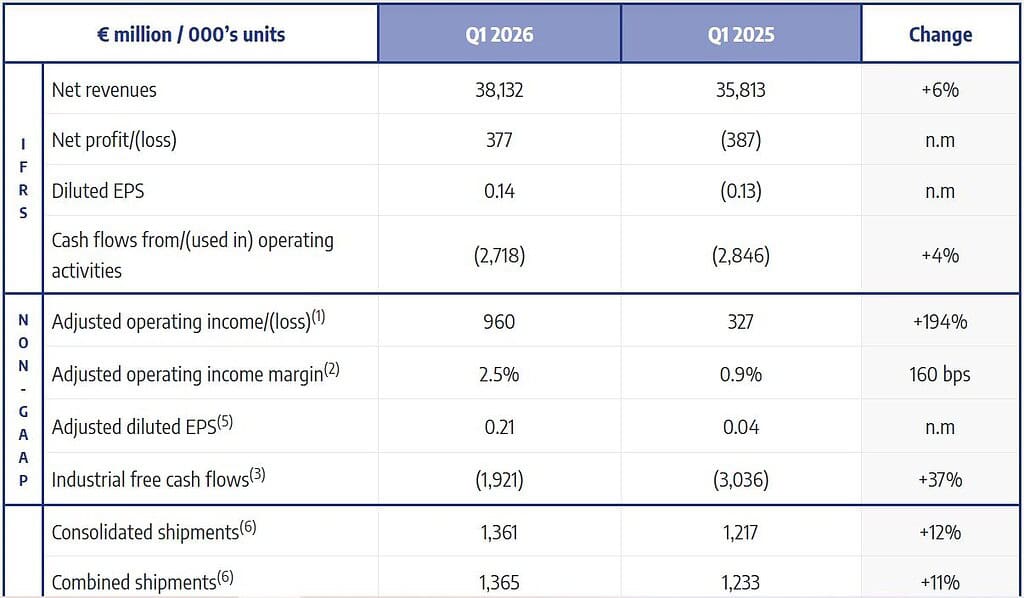
- In Q1 2026, Stellantis put up a pretty solid financial showing, showing quite an obvious rebound after last year.
- During the quarter, the company brought in €38.13 billion (USD 43.5 billion) in net revenue, compared to €35.81 billion (USD 40.8 billion) in Q1 2025, and that translates to about a 6% year-over-year lift.
- Profitability also looked healthier. Stellantis logged a net profit of €377 million, which is a sharp turnaround from the €387 million net loss it reported in Q1 2025.
- Diluted earnings per share similarly improved, moving from –€0.13 to €0.14.
- On the operating side, adjusted operating income jumped to €960 million (USD 1.09 billion), up from €327 million (USD 373 million) a year earlier. That’s a 194% increase, and the adjusted operating income margin widened from 0.9% to 2.5%, gaining 160 basis points along the way.
- Cash flow was mixed but trended less badly. Cash used in operating activities came in at €2.72 billion (USD 3.10 billion), versus €2.85 billion (USD 3.24 billion) in Q1 2025.
- Industrial free cash flow improved by 37%, slipping from €3.04 billion (USD 3.46 billion) to €1.92 billion (USD 2.19 billion).
- Even at the ground level, momentum seemed stronger. Consolidated shipments reached 1.361 million vehicles, up 12% from 1.217 million a year earlier.
- Combined shipments rose 11% to 1.365 million units, from 1.233 million units in Q1 2025, so the overall volume picture feels steadier.
- By May 2026, Stellantis also officially replaced its prior approach with the FaSTLAne 2030 strategic plan, the one that covers a €60 billion investment and 60+ new vehicle launches.
- 29 battery-electric vehicles (BEVs), 15 plug-in hybrids, 24 conventional hybrids, plus 39 internal combustion or mild-hybrid variations across its global brand lineup.
- Overall, the numbers point to a company that’s steadily rebuilding volume, getting margins back in shape, and moving toward real profitability.
2027 Chrysler Pacifica
- The 2027 Chrysler Pacifica launch underlines how Chrysler still leans hard into what it does best, minivans.
- One of the louder signals here is Chrysler’s long-running market leadership, with more than 16.6 million minivans sold across 43 years, plus over 1.15 million Pacifica units since the nameplate first appeared.
- The new Pacifica stays pretty practical, with seven-passenger seating coming standard, and an optional eight-passenger setup too. It also brings over 140 cubic feet of cargo room once the Stow ‘n Go seating system is folded flat.
- Chrysler adds that more than 5 million minivans using the Stow ‘n Go system have been sold since the idea debuted in 2005.
- Under the hood, the Pacifica keeps the 3.6-liter Pentastar V6 engine, making 287 horsepower and 262 lb-ft of torque. It also offers a best-in-class towing rating of 3,600 pounds, which supports that family, work, and weekend utility positioning.
- The redesigned projector headlamps are claimed to improve maximum lighting reach by 17%, so visibility and safety get a lift as well.
- The base Pacifica LX starts at USD 41,495, while the higher-end Pinnacle AWD goes up to USD 57,905. Buyers can pick from seven trim and drivetrain combinations, including both front-wheel-drive and all-wheel-drive options, depending on what they want.
- The above statistics kind of suggest Chrysler is leaning on its proven minivan recipe, instead of really chasing the high-volume push.
- Strong historical sales, over 16.6 million lifetime minivans sold, a workable seven-to eight-passenger layout, and pricing from USD 41,495 to USD 57,905 pretty much frame the 2027 Pacifica as the base layer or cornerstone of Chrysler’s next product direction.
Chrysler’s EV Transition – FaSTLAne 2030 and The Halcyon Concept
- Chrysler is stepping into one of the more critical change phases in its modern timeline.
- By mid 2026, the brand is still the only major mainstream American automaker without a fully battery electric vehicle (BEV) in production.
- A few industry analysts from Edmunds, MotorTrend, Green Car Reports, and Stellantis investor materials don’t really read it as some kind of brand collapse.
- The real centerpiece of Chrysler’s future is the Stellantis FaSTLAne 2030 approach, announced in May 2026. The plan puts €36 billion on the table overall, and 60% of that spend (roughly €21.6 billion) is earmarked for North America.
- In practical terms, this becomes one of the biggest regional investment pledges in Stellantis history. And it basically drops Chrysler right in the middle of the company’s North American recovery play.
- According to a Stellantis official press release, along with the investor day materials from May 2026, they say they’re launching seven new North American vehicles, and yeah, all of them come in priced under 40,000 dollars, plus two of those are set even below 30,000.
- These cars, sometimes described as the Arrow and Arrow Cross, are expected to give Chrysler a kind of doorway into entry-level EV buyers.
- If you compare that to today’s lineup, Chrysler’s cheapest vehicle, the Pacifica, starts at around 42,000, so there’s this pretty big affordability gap that they’re trying to close.
- Now on the tech side, the long-term roadmap is strongly shaped by something called the Halcyon Concept, which is basically a preview showing advanced battery targets and sustainability goals.
- Chrysler claims the concept lithium sulfur battery could lower the battery carbon footprint by roughly 60% compared with regular lithium-ion setups. It also talks about 40 miles of range in one minute, through wireless charging, and about 200 miles of range in five minutes, using an 800-volt fast charging plan.
- In the Halcyon Concept, Chrysler says the cabin materials are 95% recycled or renewable, which kind of signals where future production vehicles are headed, in terms of composition and sourcing.
- Looking further ahead, Chrysler plans to bring out a new EV every single year for the rest of the decade, including an electric crossover, a three row SUV, and a fully electric Pacifica.
- That future electric Pacifica is expected to top out at more than 300 miles of driving range , which they believe puts the brand in position to go toe to toe in the fast growing family EV segment.
Fleet vs. Retail Mix – The Voyager’s Strategic Role
- Chrysler Voyager showed up as one of those unexpected win stories inside the Stellantis lineup, especially during 2025.
- In the U.S, sales climbed 31% year over year, landing at 15,792 units, even though the vehicle got virtually zero big product refreshes , no real advertising push, and not much in the way of meaningful marketing money.
- As per a CNBC account, the Voyager kind of sits in a special spot within Chrysler’s minivan plan.
- The pricier Pacifica usually trades somewhere between USD 42,000 and USD 50,000, while the Voyager leans into the budget-minded crowd with a rough estimated transaction price of about USD 35,400. That puts a noticeable pricing distance there, nearly USD 13,000.
- In practice, this separation lets Chrysler appeal to frugal buyers and also protect the higher-margin retail segment without the two models stepping on each other toes too much.
- Also, data put together by Cox Automotive’s Fleet/Remarketing unit, and cited in Automotive News’s fleet market outlook coverage, points to fleet purchases making up around 15–20% of all total U.S. passenger vehicle sales. But when you zoom into minivans, the fleet share is much more intense, roughly 30–35%.
- One of the clearest signals that fleet activity might be doing the heavy lifting showed up in Q4 2025, with Voyager sales jumping 215% quarter over quarter. That kind of rise is pretty rare in regular retail lanes, and it often means large contracts were getting fulfilled, kinda all at once.
- Voyager and Pacifica kinda share the same 3.6-liter Pentastar V6 engine, plus the chassis architecture, and even the manufacturing line with the Pacifica at Stellantis’ Windsor Assembly Plant, so it’s not just branding it’s the whole deal.
- The kind of shared production strategy is supposed to soak up annual plant overhead costs estimated at about USD 800 million to USD 1.1 billion, and that should end up boosting overall manufacturing efficiency.
- The Kia Carnival logged 101,486 U.S. sales in 2025, and that’s up 35% year over year, which makes it one of the quickest-growing minivan type products out there right now.
- By keeping a lower-priced offering, Chrysler can stay in the entry-level space without really messing with Pacifica’s more premium vibe, or that top-tier positioning.
- Looking ahead, as Chrysler pushes forward with electrification, Voyager’s more affordable pricing structure could become even more important for holding volume and helping keep the long-term minivan market share steady.
Conclusion
Chrysler kicked off 2026 as a very specialized automotive name, kind of built almost entirely on its well-run minivan story. Even with a pretty noticeable Q1 sales dip, the company still kept a steady full-year 2025 look, mostly because the Pacifica held firm and the Voyager started growing fast. In other words, those two models basically made up nearly all of Chrysler’s sales, so you can see both the brand’s narrow focus and how much it relies on one single vehicle segment.
Going forward, Chrysler’s direction will be shaped by Stellantis’ FaSTLAne 2030 plan, big spending in electrification, and the gradual arrival of new EVs. With solid minivan leadership, hybrid tech that already works, plus fairly bold plans for electric vehicles, Chrysler is aiming for a longer-term shift and a renewed run of growth in the changing North American market.
FAQ
Chrysler sold 126,373 vehicles in the United States during 2025, up 1% year over year.
The Chrysler Pacifica was the best-selling model, with 110,006 units sold.
Voyager sales climbed 31% year over year to 15,792 units.
Pacifica and Voyager together were more than 99% of Chrysler’s total 2025 sales.
Under Stellantis’ FaSTLAne 2030 plan, Chrysler plans to bring out new EVs every year,
including an electric crossover, a three-row SUV, and a fully electric Pacifica with over 300 miles of range.