









Introduction
Maserati Statistics: During the first half of 2026, Maserati has had one of those really rough stretches; in fact, it’s arguably among the most difficult periods in the brand’s 112-year story. It used to be seen as one of Italy’s top luxury performance names, but over the last two years, the picture has gone sour fast, with global sales, revenue, and profitability all taking a noticeable hit.
Meanwhile, competitors like Ferrari, Lamborghini, and Porsche keep turning in record deliveries, plus solid financial outcomes. Maserati, however, is in the middle of a big shakeup, as part of parent company Stellantis, and it is basically placing its bet on cars such as the Grecale SUV, the GranTurismo, the MC20, plus upcoming electrification plans to get growth back on track.
Still, even with these setbacks right now, Maserati stays one of the world’s most recognizable luxury automotive marques, backed by real brand strength, capable engineering, and a sharper push toward exclusivity, premium tone, and more selectively positioned products.
The article below will present the main Maserati statistics, including the deliveries, sales, and its competitors’ market performance.
Featured Selection
- Maserati’s global deliveries dropped to roughly 7,900 vehicles in 2025, down about 30% year over year and its smallest volume since 2012.
- The automaker is still way under its 2017 high, when it sold more than 51,000 vehicles in a year.
- In Q1 2026, Maserati’s U.S. sales sank 55%, which is the steepest slide it has shown in its major markets.
- Italy, which is Maserati’s home turf, logged a 42% sales decline during Q1 2026, and that’s not a small drop by any measure.
- Sales were also noticeably weaker in Japan (-31%) and Germany (-28%) through that same first quarter.
- The GranTurismo Folgore puts out 751 hp and sprints from 0–100 km/h in just 2.7 seconds.
- The Grecale Folgore delivers 550 hp and can provide up to 580 km of WLTP driving range.
- Maserati’s electric flagship comes at a premium, with the GranTurismo Folgore listed at around USD 200,295, meaning it costs about USD 40,000 more than the V6.
- The standard Grecale SUV puts out 523 hp and can hit 0–60 mph in 3.6 seconds, pretty quick.
- The exclusive MCXtrema is limited to only 62 units worldwide, and it basically doubles down on Maserati’s shift toward rarity, like exclusivity with teeth.
- Maserati currently runs in more than 70 global markets, still keeping a wide international footprint even with sales that look less confident lately.
Maserati’s 100-Year Trident Celebration
- Maserati used the 2026 1000 Miglia as more than just a historic racing event; it turned into a loud showcase of brand heritage, the product line-up, and long-term positioning, even if it sounds a bit poetic.
- The highlight of the celebration was the Maserati A6 GCS/53, which finished the roughly 2,000-kilometre route and landed in 48th place overall, proving the lasting engineering strength of one of Maserati’s most iconic racing machines.
- The day also marked a big milestone, 100 years of the Trident logo, first introduced in 1926.
- The anniversary also lined up with the centenary of the Tipo 26, Maserati’s first racing car.
- The A6 GCS/53 carries real historical weight too; it competed in five straight editions of the 1000 Miglia from 1953–1957, which is not a small detail.
- One of its standout results came when Emilio Giletti placed 6th overall and 1st in the 2-litre Sport class, a classic moment.
- From a product strategy view, Maserati kinda showed both its past and the new thing, at the same time.
- Along with the historic racer, four current models, GranTurismo, GranTurismo Trofeo, GranCabrio, and GranCabrio Trofeo ended up handling the route as support vehicles, that sort of thing, and it really underlined how Maserati’s racing memory connects to modern luxury performance.
- The whole celebration also leaned hard into Maserati’s customization talent, especially with the Maserati MC20 Cielo Tributo 1926. It was made via the Fuoriserie personalization program, and it came out as a one-off.
- Today, Maserati is present in more than 70 international markets. It keeps extending its lineup, too, using hybrid tech, V6-powered setups, and even fully electric vehicles.
- The brand’s performance-minded approach is shown again through limited-production pieces like the MCXtrema, which is capped at 62 units globally, so very small.
- All in all, the 2026 1000 Miglia functioned as a kind of strategic display: Maserati can blend 100 years of motorsport DNA with a modern luxury roadmap that includes electrification, and in the process, it strengthens the Trident’s global appeal, fairly directly.
Stellantis Q1 2026 Financial Results
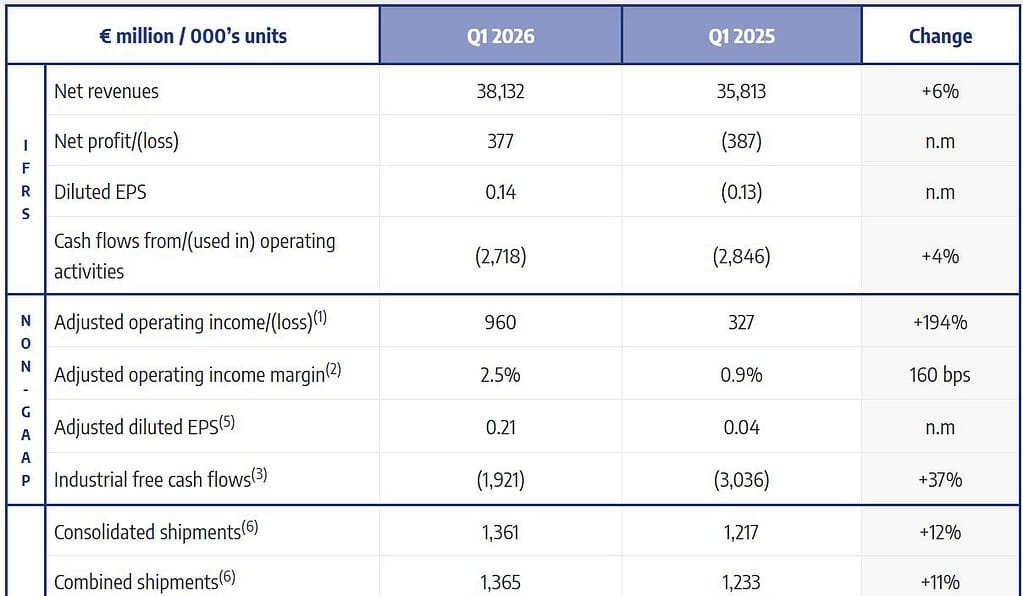
(Source: stellantis.com)
- Stellantis had a pretty strong 2026 kick-off, and most of the important financial and day-to-day operational metrics shifted in a good direction.
- For Q1 2026, it brought in €38.13 billion (USD 43.5 billion) in revenue, which is up 6% versus €35.81 billion (USD 40.8 billion) in the same quarter of 2025, so at least for now, it looks like top-line momentum came back.
- The group posted a net profit of €377 million (USD 430 million), compared with a net loss of €387 million (USD 441 million) a year earlier.
- Diluted earnings per share also turned, moving from -€0.13 to €0.14, essentially pointing to a return to positive results.
- Adjusted operating income jumped 194% to €960 million (USD 1.09 billion), from €327 million (USD 373 million) in Q1 2025.
- At the same time, the adjusted operating margin grew from 0.9% to 2.5%, which is up 160 basis points, and that suggests profitability improved across multiple parts of the business, not just one segment.
- Consolidated shipments rose 12% to 1.361 million vehicles, and combined shipments climbed 11% to 1.365 million units, so overall volume feels steadier worldwide.
- Industrial free cash flow improved 37%, moving from -€3.04 billion to -€1.92 billion, while operating cash consumption eased to €2.72 billion from €2.85 billion.
- Looking forward, Stellantis is planning more than 60 new vehicle launches and about 50 major refreshes as part of the Dare Forward 2030 push. That includes 29 BEVs, 15 plug-in hybrids, 24 hybrids, and 39 ICE or mild hybrid models.
- Taken together, the figures read like the company is rebuilding earnings power, lifting volumes, and setting a firmer base for longer-term growth.
Maserati’s 2026 SUV Strategy – Power, Performance, and Electrification
| Model | Powertrain | Horsepower | 0–60 MPH | Best For |
| Grecale | Twin-Turbo V6 | 385–523 hp | 3.6s | Daily driving |
| GranTurismo | Twin-Turbo V6 | Up to 542 hp | 3.3s | Grand touring |
| GranCabrio | Twin-Turbo V6 | Up to 542 hp | 3.5s | Open-air luxury |
| MCPura | Twin-Turbo V6 | 621 hp | 2.9s | Exotic performance |
| MCPura Cielo | Twin-Turbo V6 | 621 hp | 3.0s | Open-top supercar driving |
(Source: maseratifl.com)
- The standard Maserati Grecale can push out up to 523 horsepower, and it’ll hit 0–60 mph in about 3.6 seconds, so it really sits up there among the quickest luxury SUVs in its little corner while still trying to stay practical for everyday life.
- Switch over to the electric side, and the Grecale Folgore is rated at 550 horsepower thanks to a dual-motor setup, reaching 0–60 mph in roughly 4.1 seconds, which is basically Maserati signaling that it wants luxury plus zero-emission punch, not one or the other.
- Since the Levante wrapped up production in early 2024, it’s not something you can pick as a 2026 option anymore. That said, its absence leaves a big, noticeable hole in the higher-margin large SUV space while Maserati works on what comes next, basically a next-gen electrified swap.
- Looking beyond the SUV lineup, the wider Maserati 2026 plan also talks about the Maserati MC20 Cielo supercar and further growth for its Folgore electric series.
- On that electric front, the lineup is now described as offering outputs as high as 751 horsepower, while the Nettuno twin-turbo V6 continues to be a central piece of the brand’s performance image, like an anchor point.
- So, when you add it all up, the figures suggest Maserati is juggling three main themes for 2026: electrification, big horsepower energy, and luxury customization, all aimed at building a lineup that fits both traditional performance fans and newer EV buyers.
Maserati vs. Competitors – The Luxury Performance Gap
| Metric | Maserati | Ferrari | Lamborghini | Porsche Macan (model only) |
| FY 2025 Global Deliveries | 7,900 | 13,640 | 10,747 | 84,328 |
| FY 2025 Revenue | €726M | €7.1B | €3.20B | Part of the €17.9B Porsche group |
| Operating Income / Loss | –€198M | €2.1B | €768M | N/A (model level) |
| Operating Margin | Negative | 29.50% | 24% | N/A |
| Revenue per Car (approx.) | €92,000 | €521,000 | €298,000 | N/A |
| YoY Delivery Change | –30% | Stable (–112 units) | #ERROR! | 0.02 |
| Order Book Visibility | Limited | Through end-2027 | Through end-2026 | N/A |
| U.S. Deliveries (2025) | 3,100 (est.) | Slight decline | 3,347 | 27,139 |
- In 2025, it became clearer that Maserati is starting to fall behind its luxury performance rivals, in a way that is widening not just a little.
- Maserati moved roughly 7,900 vehicles worldwide, and sure, on its own, that number doesn’t look tiny, but when you set it next to the key competitors, it feels a lot weaker, kind of like a quiet gap that keeps growing.
- Ferrari, meanwhile, delivered 13,640 vehicles in 2025 and pulled in about €7.1 billion in revenue, which is a 7% year over year climb.
- Ferrari’s operating profit landed at €2.1 billion, meaning around €154,000 EBIT per vehicle, so the profitability picture is still one of the strongest you can see in the auto business.
- Then there’s Audi Group’s official financial reporting tied to Lamborghini’s record run, where Lamborghini delivered 10,747 vehicles and cleared more than €3.2 billion in revenue.
- Operating income came in at €768 million, and the operating margin sits at an impressive 24%, so the business is not only selling, it’s keeping control of costs too.
- In simple volume terms, Ferrari outsold Maserati by 73%, and Lamborghini topped Maserati’s deliveries by 36%; basically, both are stretching ahead.
- On the product side, Maserati’s Grecale goes up against the Porsche Macan. The Macan posted 84,328 global deliveries in 2025, with 27,139 units sold in the United States alone.
- Even more striking is that Macan sales in the U.S. surpassed Maserati’s total worldwide sales across all models, and that’s a bit of a reality check.
- Lamborghini reported a 94% personalization rate among buyers in 2025, while the Macan’s electric variant added 45,367 units to overall sales.
- At the same time, Ferrari’s order backlog reaches into 2027, and Lamborghini is fully booked through 2026, which usually means demand is staying solid and not fading.
- The Ferrari, Lamborghini, and Porsche continue expanding revenue, profitability, and customer demand.
- Maserati faces the challenge of rebuilding scale, strengthening product competitiveness, and restoring financial performance in an increasingly demanding luxury market.
Maserati’s “Folgore” Electrification Roadmap & Strategic Pivot
- Maserati’s electrification strategy has had one of those very major pivots in the luxury automotive world.
- The GranTurismo Folgore puts out 751 horsepower, 994 lb-ft of torque, and it gets from 0–100 km/h in 2.7 seconds, while also running past 320 km/h at the top end, all thanks to an 83 kWh battery pack.
- The GranCabrio Folgore is built on the same tri-motor setup, and the Grecale Folgore, meanwhile, comes in at 550 horsepower, with a 105 kWh battery, and up to 580 km on the WLTP cycle.
- For 2026, the GranTurismo Folgore begins at roughly USD 200,295, which is about USD 40,000 more than the V6 GranTurismo that’s priced at USD 160,695. The Grecale Folgore starts at USD 84,500.
- Reuters also noted that North American EV registrations dropped 39% in December 2025, after the federal tax incentives expired.
- In the luxury segment, demand didn’t really hold up either; for example, Mercedes-Benz apparently moved only 1,450 electric G-Class models in Europe, compared with 9,700 gasoline versions in the same stretch.
- Maserati’s original plan was aiming for a fully electric range by 2028, and that once beat an even earlier 2030 timeline. Now, that expectation seems to have been pushed aside, kind of quietly abandoned.
- Instead, Maserati is working on a diversified lineup plan, mixing electric, hybrid, and combustion power, rather than betting on one route only.
- What comes next includes a hybridized 3.0-liter Nettuno V6, currently making as much as 530 CV in the performance versions, plus a new 324-hp Hurricane Turbo four cylinder.
- Maserati isn’t really betting only on battery-electric anymore. Instead of pushing electrification at all costs, the brand seems to be sliding into a more flexible approach, where hybrid technology, and well, customer choice, looks more and more useful.
Maserati 2026 High-Stakes Reset For A Brand
- 2026 looks like a defining reset year for Maserati after this longer stretch of weakening global results. The numbers are pretty blunt. In the first quarter of 2026, multiple key markets for Maserati showed steep falls.
- The United States dropped (-55%), Italy (-42%), Japan (-31%), and Germany (-28%), all at once.
- Those declines dragged the brand’s sales volumes toward the kind of levels that were last seen around 2010, which makes the contraction feel even bigger.
- Maserati’s global sales fell about 30% in 2025 to just 7,900 units, which is its lowest volume since 2012, and that is a huge reversal from the peak of more than 51,000 units in 2017.
- Leadership changes are also showing up as a core piece of the recovery plan. Bringing in Jean-Philippe Imparato adds experience from turnarounds and product launches inside Stellantis, but the job ahead is honestly far more complex.
- At the same time, the company is reassessing what comes next product-wise. Some signs that “100% electric” is no longer the only direction being chased.
- Most major markets are weakening at the same time, which points toward a wider, structural issue, not just a short-term slowdown.
- A couple of places did manage to post gains, like the United Kingdom (+2%) and Switzerland (+128%), but those improvements are relatively small next to the losses in the bigger markets.
- For investors and industry observers, the key statistic is not really one single sales number but the general direction, like which way things are leaning.
- Maserati now has a critical strategic fork in the road about how it wants to place itself long term, inside the luxury automotive arena.
- Whether the 2026 transformation works out, in a real, measurable way, will likely decide if the brand can flip that downward curve and reestablish stable growth in the following years.
Conclusion
Maserati arrives in 2026 at a moment that feels like a pivotal crossroads; it’s trying to balance its motorsport legacy with pretty significant commercial headwinds. Even with global sales falling sharply, and with pressure from Ferrari, Lamborghini, and Porsche still getting louder, the marque still holds meaningful strengths: thoughtful design, solid engineering, a sense of exclusivity, and strong brand recognition.
The rollout of the Folgore lineup, plus ongoing investment in high-performance models, and a shift toward a flexible blend of electric, hybrid, and combustion powertrains, points to a pragmatic way of handling current market realities. The real test will be whether demand comes back, margins improve, and the products stay competitive, while Maserati attempts to reclaim its footing in luxury performance automotive circles.
FAQ
Maserati delivered roughly 7,900 vehicles worldwide in 2025, down around 30% year-over-year.
The GranTurismo Folgore is Maserati’s top EV, delivering 751 horsepower.
The Grecale Folgore makes 550 hp and reaches 0–60 mph in 4.1 seconds.
No. Maserati changed course to a multi-powertrain plan, with EVs, hybrids, and combustion engines included.
In 2025, Maserati sold 7,900 vehicles, compared with 13,640 for Ferrari and 10,747 for Lamborghini, while also reporting weaker profitability.

Sources