








Introduction
Volkswagen Statistics: Volkswagen stepped into 2025–2026 with one of the more convoluted situations in its whole history. Competition keeps getting sharper, especially from Chinese automakers. The global EV demand feels like it is cooling down, and there is geopolitical uncertainty and tariff pressure, plus restructuring expenses that never really seem to fully go away. All of that put pressure on margins across the auto sector, not just one brand. Still, Volkswagen Group stayed among the biggest vehicle makers worldwide: in 2025, it moved nearly 9 million vehicles globally and pulled in more than €321 billion (USD 348 billion) in annual revenue.
Meanwhile, it kept putting money toward electrification, software platforms, battery know-how, and digital mobility services, while also holding firm positions in Europe, China, and North America.
This article will present the Volkswagen statistics, which will reflect figures showing Volkswagen’s size, its financial standing, how it is growing EVs, where production is efficient, and how the firm is trying to reshape itself through 2025–2026
Editor’s Choice
- In the first quarter, Volkswagen Group posted a small market share increase, even though deliveries fell 14.8%
- Even with the lower volume, VW basically kept its global passenger car share flat at 10.1% since the entire global market shrank too.
- Q1 2026 revenue came in at €75.7 billion (USD 88.6 billion) and operating margin improved to 3.3% from 2.8% in FY2025.
- Automotive net liquidity also looked solid, sitting at €34.2 billion (USD 39–40 billion) in Q1 2026.
- For deliveries, Volkswagen shipped 2.049 million vehicles worldwide in Q1 2026, down 4.0% year over year.
- Volkswagen Passenger Cars deliveries slid 7.6% to 1.048 million units in Q1 2026.
- Global BEV deliveries dropped 7.7% to 200,000 units in Q1 2026.
- Europe represented 88.2% of Volkswagen’s global BEV deliveries, and EV sales rose 11.5% to 176,400 units.
- U.S. BEV deliveries kinda plunged 79.9% down to 4,000 units, while in China, BEV deliveries fell 63.7% to 9,400 units.
- Volkswagen’s order intake nudged up 3.0% to 1.114 million vehicles, like, showing steadier customer appetite.
- Volkswagen also cut its global workforce by 29,000 employees, down 4%, so total headcount slid to 625,100 as part of efficiency and restructuring work.
Volkswagen Financial Overview
(Source: vw-mms.de)
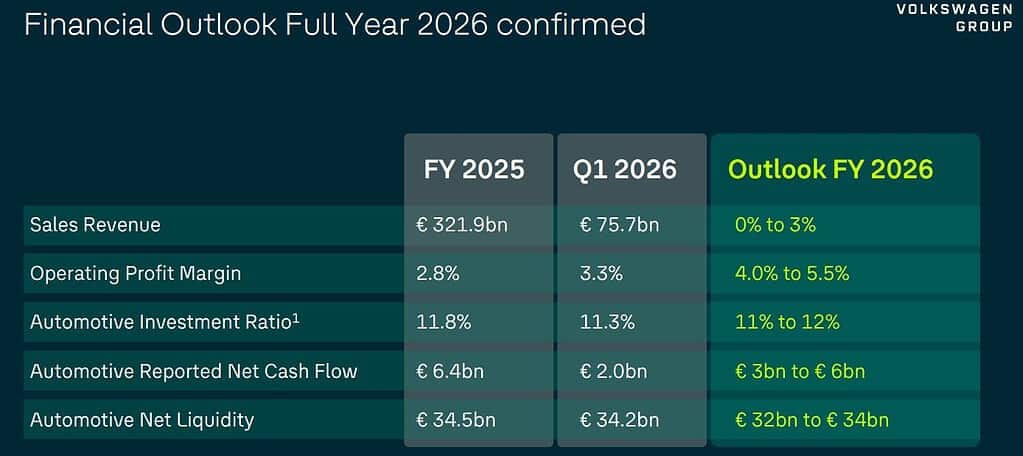
- Looking back at Full Year (FY) 2025, the company pulled in a huge €321.9 billion in sales revenue, but it ran pretty lean with an operating profit margin of 2.8%.
- Then, forward to Q1 2026, and things are getting tuned up, efficiency-wise. Revenue landed at €75.7 billion, yet the operating margin rose to 3.3%, which suggests better profitability per car sold.
- Meanwhile, management keeps its foot on the gas with an automotive investment ratio of 11.3%, so it does not appear to be cutting back on future technology.
- From a financial standpoint, the engine room looks steadier than you might expect. After generating €6.4 billion in net cash flow during FY 2025, it managed to bank €2.0 billion in only the first quarter of 2026. That leaves the total automotive net liquidity at a kind of fortress, €34.2 billion.
- If you look into the FY 2026 Outlook, the company expects conservative revenue growth in the range of 0% to 3%, but it wants to fine-tune internal processes to move profit margins upward, targeting 4.0% to 5.5%.
Volkswagen Deliveries By Brand
| Deliveries to customers by brand | Jan. – Mar. 2026 | Jan. – Mar. 2025 | Delta (%) |
| Brand Group Core | 1,554,400 | 1,600,300 | -2.9 |
| Volkswagen Passenger Cars | 1,048,300 | 1,134,200 | -7.6 |
| Škoda | 271,900 | 238,600 | +14.0 |
| SEAT/CUPRA | 145,300 | 146,700 | -1.0 |
| Volkswagen Commercial Vehicles | 88,900 | 80,800 | +10.1 |
| Brand Group Progressive | 364,900 | 388,800 | -6.1 |
| Audi | 360,100 | 383,400 | -6.1 |
| Bentley | 2,200 | 2,400 | -9.9 |
| Lamborghini | 2,600 | 3,000 | -11.7 |
| Brand Group Sport Luxury | 61,000 | 71,500 | -14.7 |
| Porsche | 61,000 | 71,500 | -14.7 |
| Brand Group Trucks / TRATON | 68,600 | 73,100 | -6.1 |
| Scania | 20,900 | 22,200 | -5.7 |
| MAN | 23,600 | 20,600 | +14.5 |
| International | 13,300 | 16,900 | -21.1 |
| Volkswagen Truck & Bus | 10,800 | 13,400 | -19.6 |
| Volkswagen Group (total) | 2,048,900 | 2,133,600 | -4.0 |
(Source: volkswagen-group.com)
- Volkswagen Group’s first quarter 2026 delivery numbers show a sort of mixed figures across the brand lineup, and it looks like not everyone is moving in the same direction.
- Total group deliveries hit 2.049 million vehicles, down from 2.134 million in Q1 2025, so that’s a 4.0% decline and roughly 84,700 units less than last year.
- Inside the Core Brand Group, deliveries came in at 1.554 million vehicles, which is a 2.9% drop year over year.
- Now the biggest name here is Volkswagen Passenger Cars, with 1.048 million vehicles, down 7.6%, and basically the bulk of the group’s decline. But Škoda kind of flipped the script; it rose 14.0% to 271,900 vehicles.
- Further, Volkswagen Commercial Vehicles also grew 10.1% to 88,900 units, so at least some parts are clearly gaining traction.
- The Progressive Brand Group recorded 364,900 deliveries, down 6.1%. Audi delivered 360,100 vehicles, which is also down 6.1%, and the luxury end felt pressure too.
- Bentley and Lamborghini saw declines of 9.9% and 11.7%, respectively, not exactly small moves either.
- If we look for the weakest point, it comes from the Sport Luxury Group. Porsche deliveries fell 14.7% to 61,000 vehicles, and that means more than a 10,000-unit drop compared with Q1 2025.
- On the commercial vehicle side, TRATON deliveries declined 6.1% to 68,600 units. Still, MAN did not follow the same downward pattern; it grew 14.5% to 23,600 vehicles.
- Meanwhile, International and Volkswagen Truck & Bus moved the other way, dropping 21.1% and 19.6% respectively.
- The above figures show that the growth from Škoda, MAN, and Volkswagen Commercial Vehicles helped cushion the problems from Volkswagen Passenger Cars, Audi, Porsche, and several truck-related operations, though apparently it was not enough to stop an overall decrease in group deliveries.
Volkswagen Customer Deliveries By Market (BEV)
(Source: volkswagen-group.com)
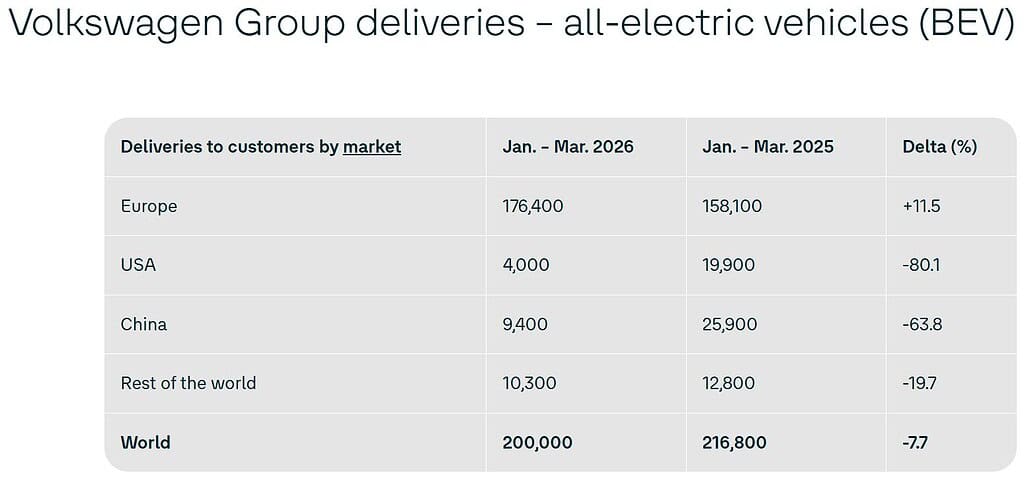
- Volkswagen Group’s first-quarter 2026 battery electric vehicle (BEV) delivery numbers show this kind of uneven, messy global picture.
- On one hand, Europe kept getting stronger as the company’s main EV market. But the United States and China both slipped a lot, and that really pulled the overall result down.
- Worldwide, Volkswagen delivered about 200,000 all-electric vehicles in January to March 2026, compared with 216,800 units in the same quarter of 2025. So yeah, that’s a drop of 7.7%, which is roughly 16,800 fewer BEVs shipped globally.
- Europe, though, stayed the clear momentum driver. Deliveries went from 158,100 units in Q1 2025 up to 176,400 units in Q1 2026. That means +18,300 cars, or 11.5% growth.
- Europe made up around 88.2% of Volkswagen’s global BEV deliveries in the quarter, so it basically underlines why the region still matters a lot for their electrification push.
- Meanwhile, the United States had the toughest percentage slide. BEV deliveries dropped from 19,900 units to just 4,000. That’s down by 15,900 vehicles, or 79.9% year over year.
- China also looked weak, with deliveries falling from 25,900 to 9,400. In other words, a decline of 63.7%, meaning about 16,500 fewer units.
- The “Rest of the World” bucket still managed 10,300 BEVs, but it was down from 12,800 in Q1 2025. So that works out to a 19.7% contraction.
- The figures suggest strong European demand could not really balance out the big decreases in the United States and China, and that’s why Volkswagen’s all-electric vehicle deliveries ended up lower during the first quarter of 2026.
Volkswagen Customer Deliveries By Market (All Types Of Vehicles)
| Deliveries to customers by market | Jan. – Mar. 2026 | Jan. – Mar. 2025 | Delta (%) |
| Western Europe | 848,500 | 814,000 | +4.2 |
| Central and Eastern Europe | 135,300 | 125,800 | +7.6 |
| North America | 205,500 | 237,200 | -13.3 |
| South America | 147,900 | 138,200 | +7.0 |
| China | 548,700 | 644,100 | -14.8 |
| Rest of Asia-Pacific | 70,200 | 76,300 | -8.0 |
| Middle East/Africa | 92,800 | 98,000 | -5.3 |
| World | 2,048,900 | 2,133,600 | -4.0 |
(Source: volkswagen-group.com)
- Volkswagen Group’s first quarter 2026 delivery results show a business that is getting more and more into regional diversification, less centered on one place.
- Even though a few markets posted solid momentum, major slides in China and North America pulled the global total down, quite notably in the aggregate.
- Globally, deliveries landed at 2.049 million vehicles for January to March 2026. That compares to 2.134 million vehicles in Q1 2025. So overall, this is down 4.0%, which is roughly 84,700 fewer vehicles delivered worldwide.
- Western Europe remained Volkswagen’s biggest engine for growth, with deliveries moving up from 814,000 to 848,500 vehicles. That’s an increase of 34,500 units or 4.2%.
- Central and Eastern Europe was also steady, rising 7.6% to 135,300 vehicles, about 9,500 units more year over year.
- South America kept going in the right direction, with deliveries increasing from 138,200 to 147,900 vehicles. That’s up 7.0% or close to 9,700 additional units.
- China was the most difficult part, and it remains Volkswagen’s single largest market. Deliveries dropped from 644,100 to 548,700 vehicles.
- The shortfall was around 95,400 units, meaning a 14.8% decline. In fact, this market alone explains more than the total global decline by itself.
- North America also weakened, deliveries slipping 13.3% from 237,200 to 205,500 vehicles, a reduction of about 31,700 units.
- More softness showed up in Rest of Asia-Pacific (-8.0%) and also Middle East/Africa (- 5.3%).
- In the end, the steadier performance in Europe, plus the better showing in South America, helped, but it still had to wrestle with those steep double-digit setbacks across the Pacific.
Volkswagen Order Book
(Source: vw-mms.de)
- The recent delivery numbers seem to hint at a global slowdown, but Volkswagen’s back-end engine is still kind of humming, like there’s hidden demand under the surface.
- In the newest metrics, you can see a healthy pipeline of what’s next for sales, so yeah, consumer appetite still looks pretty resilient, despite the noise.
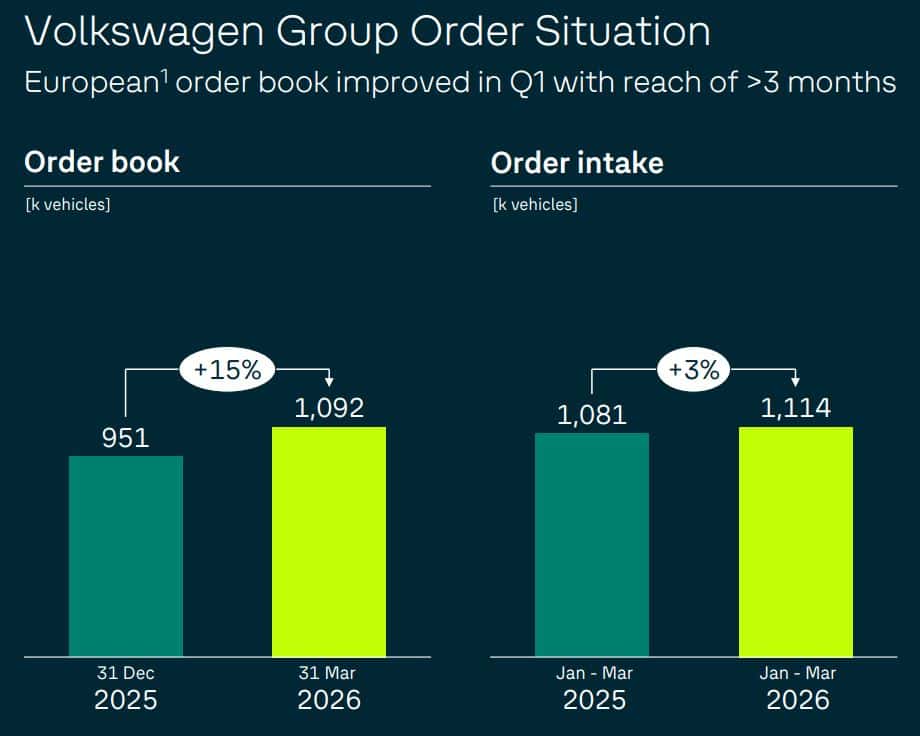
- If you look straight away at Order Intake for the first quarter, that’s (Jan – Mar), the company pulled in 1,114,000 new vehicle orders in 2026.
- A fairly steady 3% climb compared with the 1,081,000 orders captured in the very same stretch of 2025. New business keeps rolling right through the door, no real hesitation.
- The backlog rose from 951,000 vehicles as of December 31, 2025, to a bigger figure of 1,092,000 vehicles by March 31, 2026. That’s roughly a fast 15% accumulation in just these three months, which is not a small jump.
- The growing reservoir of over a million backlogged vehicles works like a financial cushion, a kind of buffer you don’t usually notice until things get choppy. It means that even with localized market speed bumps, production lines stay active, and revenue streams are anchored pretty firmly into the quarters ahead.
Volkswagen Workforce
(Source: vw-mms.de)
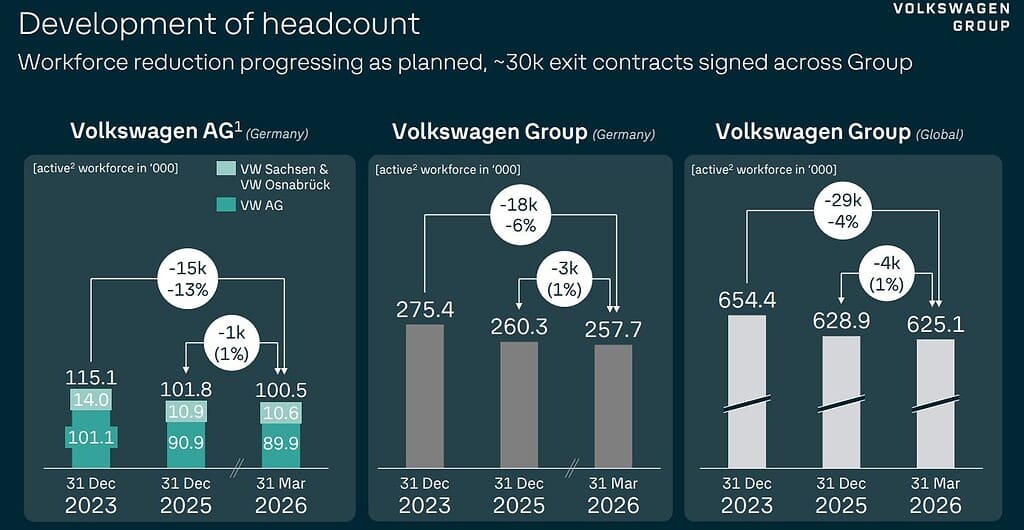
- Volkswagen is kinda aggressively streamlining its engine room to boost day-to-day operational efficiency.
- At the central level, Volkswagen AG (Germany), the active workforce shrank noticeably, by 13%: from 101,800 employees as of December 31, 2025, down to 100,500 by March 31, 2026, with a net reduction of 1,300 people.
- The pullback involved a 1,000-person drop right in the first quarter of 2026, which pushed the VW AG segment to 89,900 and its subsidiaries (Sachsen & Osnabrück) to 10,600.
- If you zoom out a bit to the wider Volkswagen Group (Germany), the staffing totals moved down by 6% across the same window, eliminating 18,000 jobs, so the group went from 275,400 to 257,700.
- On a global level, the Group reduced its large payroll by 4%, releasing 29,000 workers, bringing total headcount from 654,400 to 625,100.
- Looking specifically at the latest quarter (Jan Mar 2026), departures were 3,000 in Germany and 4,000 worldwide.
- The above consolidation suggests a company that is very committed to lean manufacturing and cost-cutting, ahead of a highly competitive future that is basically coming fast.
Software and Technology Investments (CARIAD & Partnerships)
- Volkswagen’s software transformation is one of the largest kinds of industrial technology investments that are happening right now in the automotive sector.
- The numbers the company shares kinda show both the size of the opening and the real financial headwinds the company has had while moving toward software-defined vehicles (SDVs).
- Volkswagen’s Automotive Division said the investment ratio was 11.3% in Q1 2026, while full-year guidance is sitting at about 11–12%.
- According to Statista, the company’s push for innovation also shows up when you look at its research spend. Statista reports that Volkswagen put nearly €21 billion (USD 23 billion) into automotive R&D during 2024, which placed it among the top corporate research spenders globally.
- Still, the software subsidiary CARIAD has been expensive. During its heaviest development stretch between 2023 and 2025, the division was using about €2 billion (USD 2.2 billion) in cash every year.
- In 2025, CARIAD posted €1.8 billion (USD 2.0 billion) in revenue, that’s 34% growth year over year, and the operating loss improved by €251 million to -€2.2 billion (-USD 2.4 billion).
- Even net cash flow improved by around €1 billion (USD 1.1 billion) compared with the year before, suggesting there’s some tangible momentum from the restructuring efforts.
- Workforce reductions sort of formed a major part of that whole restructuring. Volkswagen said it plans to cut 1,600 jobs by the end of 2025, and it’ll touch nearly 30% of CARIAD’s 5,900 employees.
- Since there was that earlier plan to remove 2,000 roles back in 2023, the overall workforce shrinkage is basically getting close to one-third across two years.
- Volkswagen promised as much as USD 5.8 billion for the joint venture, with an initial USD 1 billion convertible note, USD 1 billion in equity investments in 2025, and again in 2026, then a further USD 1 billion loan that’s planned for 2026, plus a final USD 1 billion joint venture equity contribution.
- Volkswagen licensed its autonomous-driving technology for future electric vehicles, and the first models tied to that collaboration are scheduled to launch in 2026, so it should be an early reality check on Volkswagen’s pivot away from internal software development and more toward strategic technology partnerships.
Conclusion
Volkswagen’s 2025–2026 performance kind of shows the company trying to juggle global scale, but also these big transformation issues that keep piling up. Even with annual revenue hitting €321.9 billion, and liquidity staying solid at €34.2 billion, things still weren’t fully smooth. Deliveries slipped, EV performance was weaker in China plus the United States, and restructuring pressures are still there, like quietly knocking in the background.
The good part, though: profitability improved in Q1 2026, and order intake plus backlog growth suggest customers are still showing up with interest. Also, some bright spots helped dilute the negatives, like strong results from Škoda and Volkswagen Commercial Vehicles, plus the European EV markets doing better than expected.
On top of that, Volkswagen is spending heavily on software, electrification, and strategic partnerships, so the group remains, sort of, set to strengthen long-term competitiveness even if the near-term market winds keep feeling unfriendly.
FAQ
From January to March 2026, the Volkswagen Group delivered 2.05 million vehicles worldwide, down 4% year on year, while keeping its global market share steady.
Global BEV deliveries slipped 8% to 200,000 vehicles, but the company stayed a clear BEV market leader in Europe, where deliveries grew 12%.
Sales rose in Europe (+4.7%) and South America (+7%), while China (–15%) and North America (–13%) saw noticeable drops.
Škoda had the strongest momentum, with deliveries increasing 14.0%.
The company said its order backlog was 1.092 million vehicles, up 15% from December 2025.

Sources