








Introduction
Customer Churn Statistics: Customer churn remains one of the most important business metrics in 2026, and it significantly affects profitability, customer lifetime value, and long-term growth. At the same time, acquisition costs keep rising across most industries, so companies are leaning more heavily into retention strategies that leverage AI, predictive analytics, customer success efforts, and more tailored experiences.
Most studies agree that retaining current customers is much cheaper than acquiring new ones, which means reducing churn is a top concern for executives everywhere. Subscription models, SaaS platforms, telecom providers, banks and other financial institutions, and e-commerce brands are now investing large sums in customer experience tools, all to reduce churn and maintain strong recurring revenue.
This statistical article shows the customer churn cost, customer retention rate, and referral programs.
Editor’s Choice
- Customer churn costs U.S. businesses USD 136.8 billion each year, so keeping people is a major lever for profit.
- Getting a new customer costs 5-25× more than retaining someone already onboard, so loyalty has real financial weight.
- Energy & Utilities stands out with an impressive 89% retention rate, while IT Services is not far behind at 88%.
- Good onboarding- that kind of structured start- can cut early-stage churn by about 50%, which helps customers reach value sooner.
- When companies conduct proactive outreach and engagement, churn drops by 15-25%, showing that prevention often beats “fixing it later”.
- Roughly 20-40% of subscription churn is involuntary, mostly tied to failed payments.
- AI-based payment recovery systems can reclaim 55-80% of failed transactions and typically outperform standard retry approaches.
- Predictive AI can also forecast churn 3-6 months before renewal with more than 85% accuracy, enabling teams to act before problems surface.
- Customer success teams can reduce B2B SaaS churn by about 20-30%, underscoring how much continuous customer engagement matters.
- Referral-driven customers churn 18% less often, and if someone actually makes a referral, they’re 3× less likely to leave, so long-term retention gets stronger kinda automatically.
Customer Churn – High Cost Of Losing Customers
- Customer churn is still one of the biggest dangers to long-term business profitability, because retaining current customers delivers stronger financial returns than chasing new ones.
- Accenture says U.S. companies lose USD 136.8 billion every year due to avoidable switching, underscoring just how significant the financial impact is.
- Harvard Business Review reports that acquiring a new customer costs roughly 5 to 25 times as much as retaining an existing customer. So in practice, customer retention is a much more economical growth approach.
- Bain & Company reports that raising customer retention by 5%. In the SaaS world, David Skok from Entrepreneurs found that companies typically spend around 92% of their first-year revenue on customer acquisition, which makes every single lost account especially painful.
- ProfitWell also notes that if a business has USD 10 million in ARR with 10% churn, then cutting churn by only 2 percentage points can create roughly USD 1.3 million more revenue over five years.
- Meanwhile, Gartner estimates that reactivating or winning back churned customers costs 3 to 7 times more than acquiring new ones.
- OpenView Partners reports that just 30% of SaaS companies achieve negative churn, meaning expansion revenue outweighs the loss from customer cancellations.
Customer Retention Rate By Industry
(Reference: vibetrace.com)
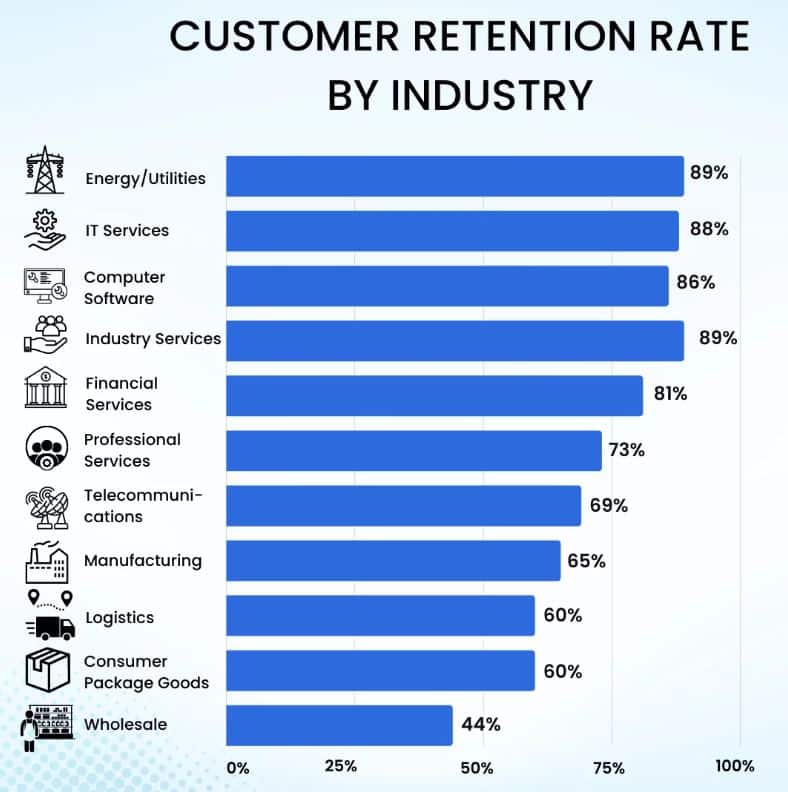
- Customer retention varies widely from one industry to another, showing how customer ties and the service setup really shape long-term loyalty.
- Looking at the chart, Energy/Utilities and Industry Services seem to lead the pack with a strong 89% customer retention rate. After that, IT Services sits at 88%, and Computer Software lands around 86%. When you see rates that high, it usually means the companies selling essential services, or working under longer commitments, or supporting mission-critical software tend to keep relationships for longer.
- On the other hand, Financial Services comes in at 81%, which pretty clearly points to how trust plus switching costs matter a lot in banking and other financial products.
- Professional Services shows 73% retention, while Telecommunications reaches 69%, so loyalty is there, but it does not look fully locked in, especially with competition getting sharper.
- Retention then weakens in Manufacturing at 65%, while Logistics and Consumer Packaged Goods (CPG) are both at 60%.
- In many of these areas, firms compete on pricing, availability, and day-to-day operational speed, making it harder to keep customers loyal.
- Finally, Wholesale has the lowest customer retention at 44%. That number suggests customers move around more often, and competitive pressure is stronger than you typically see in other sectors.
- The stats show a fairly clear trend: industries that provide essential subscription services or deeply integrated support usually land retention numbers above 80%.
- In contrast, the areas that run on price battles, or customers who buy things as one-time transactions, end up with way worse customer loyalty.
- Overall, the figures underscore that strong retention comes from ongoing customer value, long-term engagement, and switching barriers that are hard to overcome.
Churn Prevention Moves and Referral Programs
- Actually, reducing churn is not only about handling cancellations after they happen; it should also be about proactive engagement throughout the customer journey.
- Studies indicate that proactive customer outreach can reduce churn by 15-25%, and structured onboarding can cut early-stage churn by around 50%, helping customers realize real value more quickly (Gartner; Wyzowl).
- For subscription companies, dunning handling plus payment retry sequences can claw back about 20-30% of involuntary churn. That step matters because it stops revenue leakage from failed payments, not from real customer choice to leave.
- Exit surveys end up collecting practical feedback from roughly 30-40% of people who cancel, and that gives businesses concrete ways to improve offerings (Qualtrics).
- At the same time, win-back efforts often bring back 10-15% of churned customers within six months, while customer success specialists reduce churn by 20-30% in B2B SaaS, underscoring the value of ongoing support (Recurly Research; Gainsight).
- Some firms manage to retain 15-20% of customers simply by allowing them to pause their subscriptions rather than forcing immediate cancellation.
- On the billing side, annual payment plans reduce churn roughly 40-50% compared to monthly setups.
- Referred customers tend to churn about 18% less often than non-referred users, and people who actively refer others are 3× less likely to churn too. That outcome typically indicates stronger brand loyalty (Harvard Business Review; Wharton School of the University of Pennsylvania).
- Also, businesses running referral initiatives often report around 92% customer retention after 12 months, and when organizations pair churn prevention efforts with referral incentives, they can see roughly 25% better retention results, which makes this approach feel like a real engine for sustainable growth (Bond Brand Loyalty; McKinsey & Company).
Voluntary Vs. Involuntary Churn – The Silent Revenue Killer
- One of the more common misconceptions in subscription businesses is believing that every customer who disappears has consciously chosen to leave. But actually, around 20-40% of total SaaS and subscription churn is involuntary.
- In other words, customers get lost because of payment problems, like expired cards, insufficient funds, stale billing info, or decline events driven by fraud, rather than because they’re unhappy with the product (Chargebee, Redux Payments, Paddle, FlyCode).
- TrueLayer estimates average churn of about 4.1%, with 3% voluntary churn and 1% involuntary churn, while Shno says companies that do not manage payment declines could lose as much as 7.2% of subscribers every month.
- The same body of research further suggests that SaaS companies lose USD 1.6 billion each year due to involuntary churn, and that failed subscription payments are projected to cost businesses USD 129 billion in lost revenue globally in 2025.
- Recurflux and Finsi.ai indicate that companies running default smart-retry systems claw back only about 20-30% of failed payments, but once they implement structured recovery workflows, the recovery rate rises to roughly 30-45%.
- Recurly’s tuned recovery programs recover around 53% of eligible failed transactions, with achievable goals of 50-65% when rule-based retries, account updater steps, and more personalized customer messaging are all in place.
- Churnkey says they can recover 70% of detected involuntary churn, and about 42% of that comes from dunning email and SMS campaigns alone.
- Finsi.ai also notes that when organizations deploy AI-assisted, multi-channel dunning, recovery rates for failed payments sit around 55-80%, while teams that don’t dunning at all are basically in the 0-10% zone.
- For comparison, basic retry logic gets around 15-25%, and email-only recovery programs land at around 30-50% (Finsi.ai).
- Shno and Recurly estimate that proactive payment recovery can cut involuntary churn by 25-40%, while supporting a 95.6% Renewal Invoice Paid Rate (RIPR).
- So overall, it looks like putting together automated dunning, intelligent payment routing, more than one payment method, and proactive customer communication shifts involuntary churn from a quiet revenue leak into one of the better high-return retention chances on the market.
The Role Of Predictive AI In Churn Prevention
- Predictive AI has become one of the most valuable tools for reducing customer churn, mainly because it detects warning signs long before someone actually cancels.
- Nowadays, AI models pull together lots of customer signals into a single customer health score. This can include product usage, engagement levels, support interactions, billing history, payment behavior, and customer sentiment.
- EverAfter.ai claims that AI-boosted customer health scoring can forecast churn 3-6 months ahead of renewal, with more than 85% accuracy, so companies can sort out which accounts are highest risk while there is still a chance to improve customer outcomes.
- Userpilot, Gainsight, and LinkedIn Marketing Analytics indicate predictive systems watch for shifts like login frequency dropping off, reduced feature adoption, lower workflow completion, fewer active sessions, more support tickets, negative communication sentiment, and billing problems. These are treated as early cues that churn might be coming later.
- A commonly referenced customer health score framework suggests you assign weighted importance to key business metrics, where value realization makes up 40% of the overall score and engagement momentum accounts for 25%. This creates a shifting 0-100 health score that can flag customer risk about 60-90 days before renewal.
- CDP.com also says it’s worth validating these predictive models with 6-12 months of prior customer data to improve forecasting accuracy.
- Overall, the research points to predictive AI shifting churn management away from reactive dashboards and toward proactive intervention.
- With lead time, 3-6 months of advance prediction, 85%+ forecasting accuracy, a 0-100 customer health scale, and 60-90 day early risk detection, organizations can concentrate on leading indicators rather than waiting on lagging outcomes.
- In practice, this tends to boost customer retention and supports steadier long-term subscription growth.
Conclusion
Customer churn is becoming one of those metrics that really leans into business performance, especially in 2026. Since acquisition costs keep climbing, many teams are moving away from reactive retention tactics and toward proactive approaches that run on predictive AI, customer success workflows, intelligent billing, plus personalized engagement. A lot of research shows, pretty consistently, that reducing churn tends to deliver more value than just bringing in new customers.
Organizations that invest in structured onboarding, referral programs, payment recovery, and AI-driven “health scoring” are seeing higher retention, stronger customer lifetime value, and more reliable recurring income. And honestly, companies that double down on customer experience and early risk detection tend to be better positioned to protect margins and sustain long-term growth.
FAQ
Customer churn has a direct effect on revenue, profitability, and customer lifetime value, so retention becomes a core business focus.
Getting a new customer usually costs about 5-25 times more than retaining an existing one.
Roughly 20-40% of subscription churn comes from payment failures, not customers actively canceling.
Current predictive AI can flag churn risk around 3-6 months early, with better than 85% accuracy.
Using proactive onboarding, AI-based customer health monitoring, customer success programs, and smart payment recovery together is where you usually get the best retention outcomes.