








Introduction
Cookie-Less Marketing Statistics: Cookie-less marketing has kind of become the whole thing defining digital advertising in 2026, with companies slowly moving away from third-party cookies toward privacy-first targeting, first-party data, contextual advertising, AI-powered audience modeling, and server-side measurement.
This shift is happening because people expect more privacy, there are stricter regulations worldwide, browser tracking limits are tightening, and ad tech keeps changing. So, organizations are putting billions of dollars into customer data platforms (CDPs), consent management platforms (CMPs), identity resolution, and privacy-enhancing technologies to keep marketing performance steady without leaning on third-party cookies.
The article below is meant to show the most recent research, market outcomes, consumer patterns, and the attribution that is shaping Cookie-less marketing in 2026.
Editor’s Selection
- Global cookie acceptance rates dropped under 40%, and that suggests we’re already in a de facto Cookie-less advertising environment.
- Chrome’s 65% browser share makes its Privacy Sandbox approach the single biggest push shaping the Cookie-less advertising era.
- Safari (19%), Edge (5%), and Firefox (4%) together nudge most web traffic into privacy-constrained modes.
- 61% of advertisers now have an active first-party data plan, up a lot from 37% in 2023.
- 48% of global web traffic is already Cookie-less, which speeds up the fading of old-school tracking methods.
- Unified ID 2.0 has reached 420 million profiles, and it’s backed by 78% of the world’s top 100 publishers.
- Contextual advertising budgets jumped 32% year over year to USD 18.2 billion, turning into a real growth driver.
- CRM based programmatic activation returns 3.1× higher ROAS, so it kinda proves how much owned customer data really matters.
- 67% of CPG advertisers use retail media first-party data, achieving an average 2.8× higher conversion rate.
- Server-side tracking captures 25–35% more conversions than browser-pixel measurement.
Browser Privacy Reshapes the Cookie-less Advertising
(Source: digitalapplied.com)
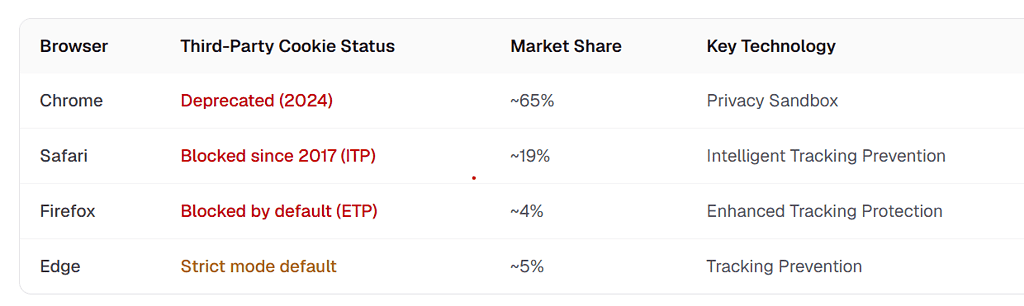
- The browser ecosystem has really kind of shifted toward privacy-first advertising, with most big browsers now limiting or straight up blocking third-party cookies.
- Google Chrome, which holds roughly 65% of the global browser market, has moved into a Privacy Sandbox-style approach, and this looks like the industry’s largest privacy shift because Chrome is so dominant in usage.
- At the same time, Safari, around 19% of the market, has been blocking third-party cookies since 2017 via Intelligent Tracking Prevention (ITP), so that part is not new.
- Firefox, about 4% market share, blocks third-party cookies by default with Enhanced Tracking Protection (ETP).
- Then Microsoft Edge, with almost 5% of the market, turns on Tracking Prevention through its default privacy settings.
- The browser shares suggest that most web users now navigate in environments where cross-site tracking is pretty restricted, or at least much harder than before.
- The stats show that browser privacy isn’t some tiny niche thing anymore; it’s basically the industry standard now.
- In particular, Chrome (65%), Safari (19%), Edge (5%), and Firefox (4%) together cover almost all the browser market, so advertisers really can’t rely on the old third-party cookies for targeting or attribution like they used to.
- So, from a market angle, those browser-level privacy guardrails are starting to change digital ad strategies everywhere, and in practice the big winners are going to be privacy-compliant data gathering plus direct first-party customer ties for better campaign performance going forward.
First-Party Data Becomes the Foundation of Cookie-less Programmatic Advertising
(Source: searchlab.nl)
- Cookie-less advertising is kinda speeding up the shift toward first-party data, where advertisers are rapidly rebuilding their targeting and measurement setups around privacy-friendlier approaches.
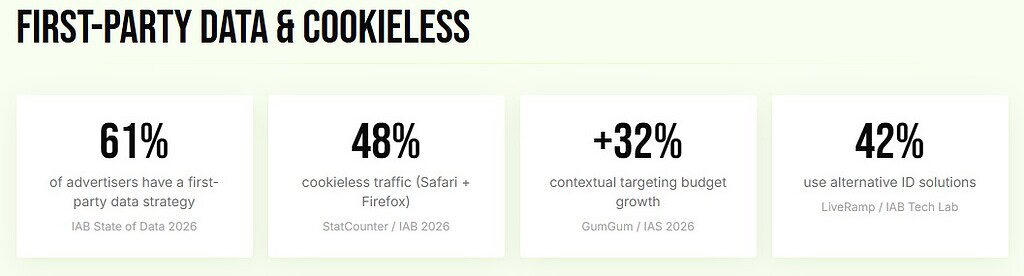
- In 2026, 61% of advertisers say they now have an active first-party data plan, which is way up from 37% in 2023, and it shows how fast the industry adapted.
- At the same time, 48% of global web traffic is already cookie-less, largely because browser privacy protections are pushing it along in Safari and Firefox.
- Also, 38% of large advertisers are running tests in Google’s Privacy Sandbox, but only 14% see it as a total end to third-party cookies.
- Then there are alternative identity solutions: 42% of advertisers have taken some form of that path, and Unified ID 2.0 is now at 420 million unique profiles, with 78% of the world’s top 100 publishers backing it.
- In parallel, contextual and first-party targeting are showing up as the most noticeable growth lanes in programmatic advertising.
- Contextual targeting budgets rose 32% year over year, hitting USD 18.2 billion, which is about 2.5 times higher than what was spent back in 2022.
- Even so, cookie-less CPMs are still 22% lower than cookie-based inventory, but the pricing gap has shrunk a lot from 34% in 2023, suggesting better contextual targeting plus stronger first-party data quality.
- Attention-based metrics also feel like they’ve gained momentum, with 28% of enterprise advertisers using attention measurement as a main KPI.
- Enterprise investment in customer data infrastructure keeps getting stronger for campaign performance, like it’s kinda obvious.
- Data Clean Rooms are now in use by 44% of the top 500 advertisers, with AWS Clean Rooms at 31% leading the way, then Google Ads Data Hub at 28%, and Snowflake at 22%.
- Meanwhile, CRM based programmatic activation shows a 3.1 × higher return on ad spend (ROAS), but only 34% of small and medium-sized businesses are actually using it.
- On top of that, 67% of CPG advertisers rely on retail media first-party data, and they report an average 2.8 × higher conversion rate.
- Customer Data Platform (CDP), for short, adoption is up to 58% among enterprise firms, which yields an average 2.5:1 ROI during the first year.
- Taken together, these numbers suggest that first-party data is now the main engine behind targeting precision, campaign effectiveness, and durable growth in the cookie-less advertising world.
Cookie-less Attribution Becomes the New Standard for Marketing Measurement
- The shift away from third-party cookies has sort of changed how marketers count and measure campaign results in general.
- As per Improvado’s 2026 Cookie-less Attribution Guide, the old cookie-based way of attributing usually hit around 85–90% accuracy, yet newer cookie-less approaches are closer to 50–85% accuracy, depending a lot on what tech is being used.
- Identity graphs seem to be the strongest option, giving roughly 70–85% match rates; after that, device fingerprinting sits around 60–75%, and probabilistic modeling lands near 50–65%.
- At the same time, browser privacy limits are now touching 60–75% of global web traffic, so cookie-less attribution is turning into a business requirement instead of a nice optional step.
- Also, about 30–40% of desktop users use ad blockers, and another 15–25% of users clear cookies each month, which keeps making classic tracking less and less effective.
- On mobile, Apple’s App Tracking Transparency (ATT) ends up showing only about 25–35% opt-in rates, so yeah, there’s yet another hurdle for advertisers.
- Server-side tracking can pull in something like 25–35% more conversions than browser pixel setups, mainly because it sidesteps ad blockers and browser-level restrictions in a more steady way.
- Meta Conversion API (CAPI) is reporting roughly 92–96% match rates, and Google Enhanced Conversions can reach 88–93% match rates when first-party customer data is available.
- If a business sees identity graph match rates below 70%, they’re basically running into the same measurement trouble that more than 60% of marketing teams have already been reporting, which really emphasizes first-party data strategies.
- Improvado Cookie-less Attribution Guide (2026) report also points out, kind of quietly, the bigger part that authenticated identity solutions are playing for cross-channel measurement.
- Most Universal ID approaches can land around 60–80% match rates, while UTM session attribution can get beyond 95% for those single-session conversions, but then it drops to something like 40–50% for longer customer journeys.
- AI-powered attribution models are positioned better to keep campaign measurement reliable in the whole Cookie-less era.
Google’s Shift Toward User Choice – The Chrome Situation in 2026
- Google’s April 2025 call to swap mandatory third-party cookie removal for a user-choice model means cookies can still be available in Chrome
- However, industry studies report that global cookie acceptance has fallen under 40%, since more users are turning down tracking.
- Organizations putting money into Customer Data Platforms (CDPs), CRM integration, authenticated user experiences, and server-side event tracking are better set up to keep reliable customer insights while still following privacy rules.
- The market is also edging toward hybrid measurement models, where you mix first-party deterministic data with aggregated reporting and do incrementality testing, rather than depending only on user-level attribution.
- At the same time, marketers are upping investments in contextual advertising, owned media, authenticated programmatic buying, and Privacy Sandbox APIs to counter the drop in third-party data.
- Companies that offer premium authenticated audiences, plus publisher-managed identity solutions, are expected to do well, because advertisers are starting to value privacy-compliant, high-quality audience data more and more.
- The above statistics indicate the industry is already in something like a de facto Cookie-less environment, even if there isn’t a full browser ban yet.
- With cookie acceptance sitting below 40%, the competitive edge now goes to organizations that tighten up first-party data, keep consent management transparent, and use privacy-safe measurement frameworks, instead of leaning on traditional third-party tracking.
The Rise of Retail Media Networks (RMNs) as a Safe Haven
- Retail media has turned into one of the most powerful growth engines in digital advertising, kinda because it fuses first-party purchase data with closed-loop measurement, and you can see the impact pretty fast.
- Most industry forecasts say global retail media spending will pass USD 160 billion in 2026, and that number kinda mirrors how ad budgets are shifting toward retailer-owned environments, where the purchase linkage is more precise than the old cookie-based ways of targeting.
- Big marketplace and retailer platforms, like Amazon and Walmart, keep showing (in their studies) that lots of CPG brands can hit an average Return on Ad Spend, around 4x, on major retail channels. The main point seems to be that they aim at shoppers using confirmed transaction history and actual buying patterns, instead of relying on guessed third-party signals.
- Meanwhile, ongoing forecasts keep pointing to double-digit annual growth for retail media, so it stays one of the quickest-growing areas inside digital ads.
- Retailer advertising ecosystems are also stretching beyond sponsored product placements, into off-site programmatic ads, Connected TV, CTV, in-store digital screens, plus stronger first-party identity solutions. So advertisers get more ways to meet consumers across different touchpoints.
- As global investment is now over USD 160 billion and 4x ROAS targets keep pulling in advertisers, brands are kinda changing how they judge “success”, more towards revenue-driven indicators like profitable ROAS, sales lift, and customer lifetime value.
- In general, companies that stitch together retailer partnerships with solid first-party data programs are expected to get the best edge, especially in this privacy-first advertising world
Conclusion
Cookie-less marketing isn’t just something to watch later anymore; it has basically become a current competitive reality. Browser privacy changes, lower cookie consent levels, and tougher regulations are pushing advertisers to rebuild targeting and measurement using first-party data, contextual intelligence, retail media, and server-side infrastructure.
The numbers show that organizations that put effort into Customer Data Platforms, identity resolution, clean rooms, and authenticated customer experiences are getting stronger ROAS, better conversion performance, and attribution that holds up even when the environment shifts. With global retail media spending now over USD 160 billion and almost half of web traffic operating without cookies, the winners are the brands that balance privacy compliance with real, high-quality customer relationships and outcomes you can measure
FAQ
Cookie-less marketing is a privacy-first method that leans on first-party data, contextual targeting, and AI-based measurement instead of relying on third-party cookies.
Roughly 48% of global web traffic is already Cookie-less.
Because 61% of advertisers now lean on first party data strategies, to keep targeting and attribution working even inside privacy restricted environments.
Server-side tracking captures 25–35% more conversions than traditional browser-pixel tracking.
Global retail media spending is projected to exceed USD 160 billion in 2026.

Sources


