








Opening section
Online Recruitment Statistics: Hiring has changed significantly in the digital age, and online recruitment is now one of the most popular ways to find the right talent. Instead of relying on traditional hiring methods, companies post job openings on websites, job portals, and social media to reach more candidates in less time. Job seekers can easily search, apply, and connect with employers from anywhere.
This makes the hiring process faster, simpler, and more convenient for everyone. Whether you are a business looking for skilled employees or a professional searching for a new opportunity, online recruitment offers an efficient way to connect the right people with the right jobs. It has become an important part of modern hiring across industries.
Best Overall
- The global online recruitment market reached USD 39 billion in 2025 and grew to USD 41 billion in 2026.
- North America leads the global online recruitment market with a 43% share.
- The World Economic Forum estimates 170 million new jobs and 92 million displaced jobs by 2030, resulting in a net gain of 78 million jobs.
- 84% of organizations actively use social media platforms such as LinkedIn, Instagram, and Facebook for primary talent recruitment and sourcing.
- Airing 97.4% of Fortune 500 companies, which is 487 out of 500, rely on an Applicant Tracking System ATS to manage their hiring workflow.
- Around 70% of U.S. job seekers use online job platforms as their primary method for finding employment opportunities.
- In 2026, around 73% of job seekers aged 18-34 found their latest job through social media.
- In 2026, 52% of U.S. employees with remote-capable jobs worked in a hybrid model, making it the most common work arrangement.
- 64% of organizations that use AI apply it to recruiting, interviewing, and hiring.
- Seek.com.au records 7.9 pages per visit with a 33.59% bounce rate.
- Companies receive about 180 job applications for every successful hire, with an applicant-to-hire conversion rate of around 0.5%-1%.
Latest Recruitment Statistics For 2026
- The World Economic Forum estimates 170 million new jobs and 92 million displaced jobs by 2030, resulting in a net gain of 78 million jobs.
- Around 63% of employers say skills shortages are their biggest hiring barrier.
- By 2030, 22% of jobs are expected to change, while 39% of core job skills will be different.
- 66% of recruiters report that finding qualified talent has become more difficult.
- Around 80% of job seekers feel unprepared to search for jobs in 2026.
- AI adoption in HR and recruitment increased from 26% in 2024 to 43% in 2025.
- About 56% of recruitment firms reported revenue growth in 2025, while graduate hiring is expected to increase by 1.6% for the 2026 class.
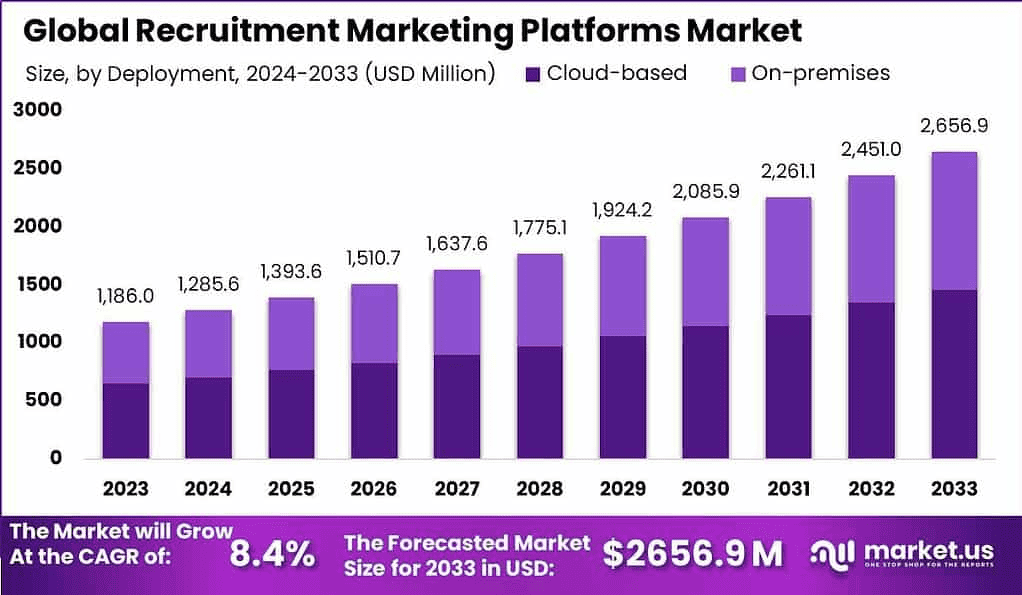
Global Online Recruitment Market Overview
(Source: market.us)
- The global online recruitment market reached USD 39 billion in 2025 and grew to USD 41 billion in 2026.
- The market is projected to reach USD 58 billion by 2032, driven by the adoption of digital hiring.
- The industry is expected to expand at a CAGR of 6.4% from 2022 to 2032.
- The average cost to hire one employee in the U.S. is around USD 4,700.
- The global average time to fill a job role is 44 days, while executive positions typically take 120+ days.
- Around 56% of employers say that talent shortages are their biggest recruitment challenge.
Regional Analysis
- North America leads the global online recruitment market with a 43% share, supported by strong digital infrastructure and a mature economy.
- Europe follows with 24%, driven by high internet usage and a skilled workforce.
- Asia-Pacific accounts for 22.5%, supported by rapid economic growth and rising internet access.
- Latin America and the Middle East & Africa hold 5.3% and 5.2%, respectively.
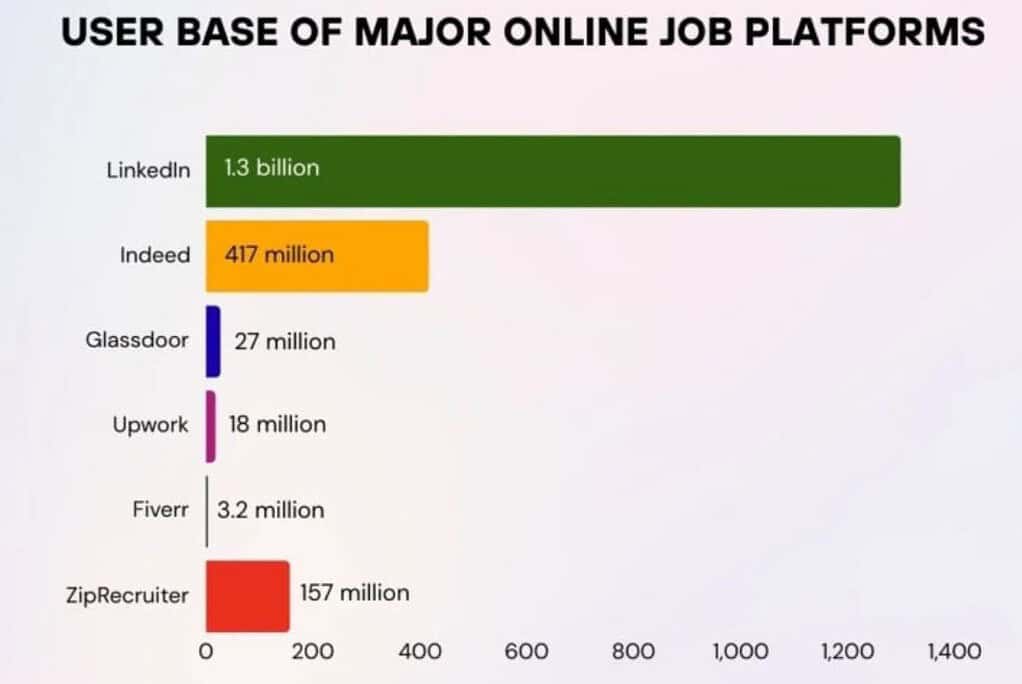
Users Of Leading Online Job Platforms
(Source: sqmagazine.co.uk)
- LinkedIn has surpassed 1.3 billion members worldwide, making it one of the largest professional networking platforms.
- Indeed receives more than 417 million monthly visitors, while Glassdoor attracts around 27 million monthly users.
- Upwork has over 18 million registered freelancers.
- Fiverr serves more than 3.2 million active buyers, and ZipRecruiter has over 157 million job seeker profiles.
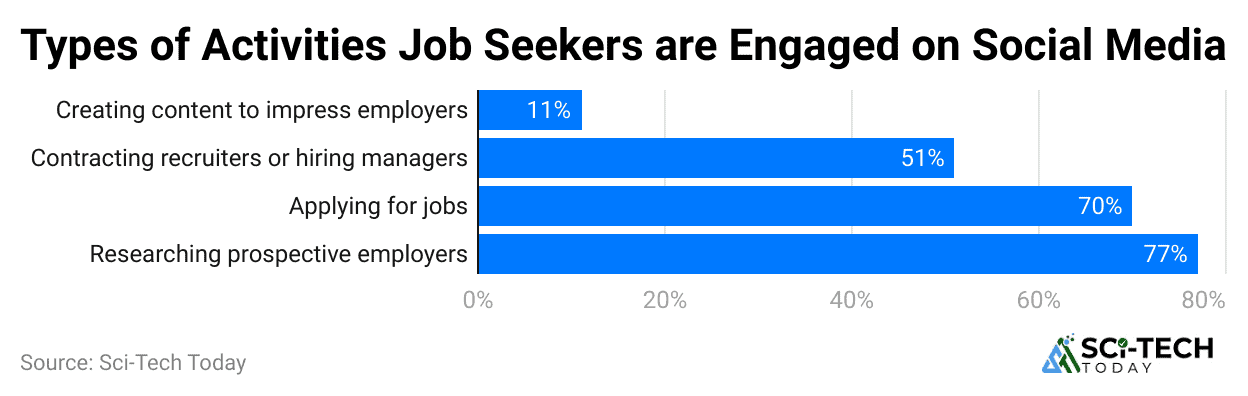
- Around 77% of job seekers use social media platforms to research employers and job opportunities.
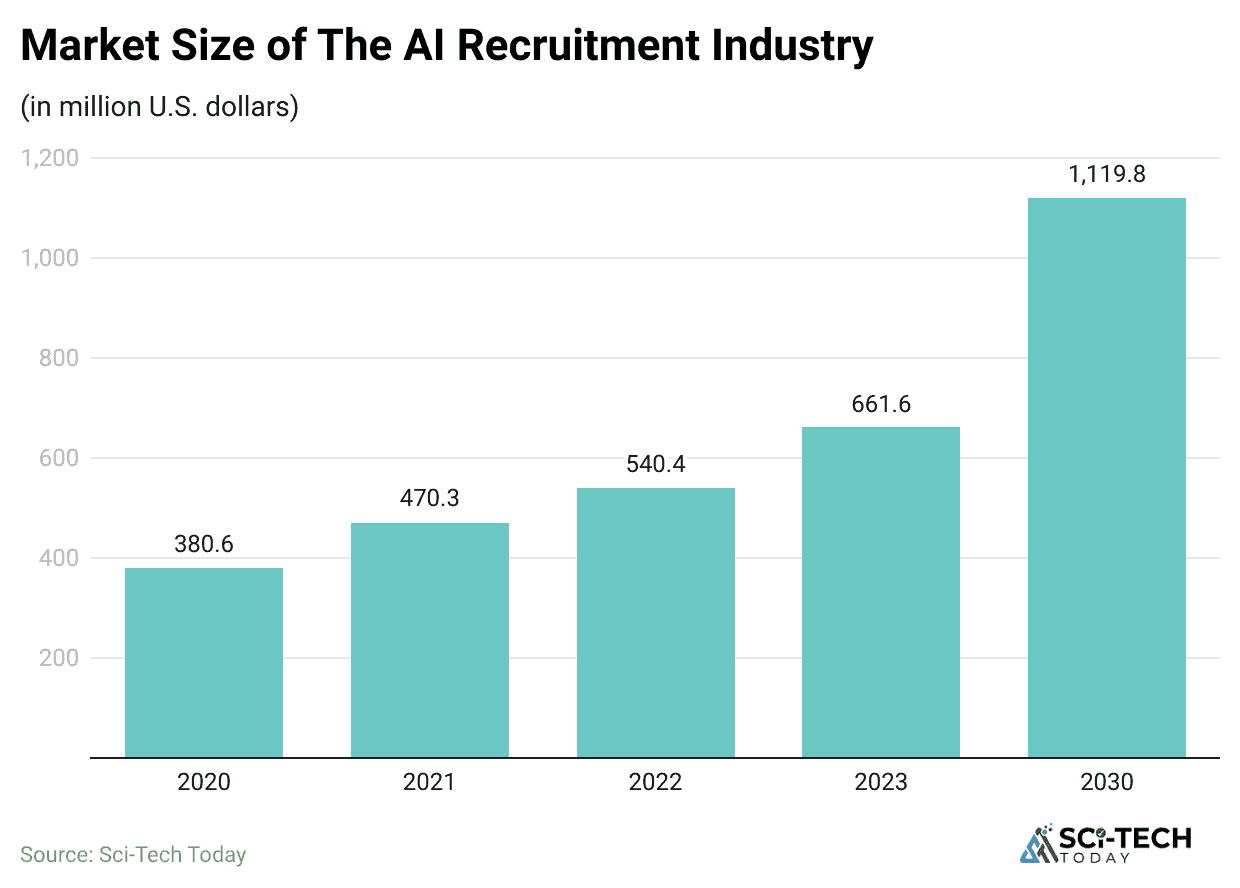
The Automation Imperative By ATS and AI in Sourcing
(Reference: demandsage.com)
- Airing 97.4% of Fortune 500 companies, which is 487 out of 500, rely on an Applicant Tracking System ATS to manage their hiring workflow.
- 79% of organizations have already integrated AI or automation directly into their existing ATS platform, moving beyond basic filtering.
- The primary goal of this integration is efficiency, with 64% of survey respondents using AI to automatically filter out unqualified candidates.
- Recruiters who implement an ATS report a remarkable 86% reduction in their overall time-to-hire metric, a huge boost to efficiency.
- This speed is crucial, as 69% of applicants will reject a job offer if the company takes too long to respond after the final interview.
- AI adoption in Human Resources tasks has climbed to 43% in 2025, a substantial increase from just 26% reported in 2024.
- Recruiters are optimistic, with 85% viewing AI as a valuable tool, but 60% also expressing concern that AI could eventually replace their jobs.
- This shift helps address the fact that 65% of candidates say they rarely or never receive an update on their application status.
- Only 15% of business leaders feel 100% confident in their hiring decisions at the time of hire, signaling a systemic issue with traditional candidate evaluation methods.
Online Job Search And Job Platform Statistics
- The SQ Magazine report further noted that around 70% of U.S. job seekers use online job platforms as their primary method for finding employment opportunities.
- Nearly 56% of candidates apply for jobs through mobile apps or online job boards rather than traditional methods.
- More than 9,000 job applications are submitted every minute through LinkedIn.
- Around 45% of workers found their most recent job through an online platform.
- Nearly 80% of millennials use digital job marketplaces to research employers and apply for jobs.
- Job platforms connected with social networks achieve up to 40% higher candidate engagement than traditional job boards.
Online Recruitment Demographics Statistics
- According to Recruiter Flow, in 2026, around 73% of job seekers aged 18-34 found their latest job through social media.
- Overall, 81% use social media, while 60% rely on online job boards, as per Novo Resume.
- Among unemployed people aged 16-24, about 67% visit online recruitment websites, compared with 61% of employed people in the same age group.
- The online recruitment platform market is expected to grow from USD 57.70 billion in 2025 to USD 64.66 billion in 2026, supported by rising adoption across the Asia-Pacific.
- Around 84% of organizations use social media for hiring. Applicant tracking systems are used by 97.4% of Fortune 500 companies, 67% of large businesses, and 35% of small businesses.
- About 44% of Baby Boomers rely on personal networks, while only 28% of Gen Z do. Nearly 20% of Gen Z applicants secured interviews through TikTok.
Social Media, Mobile, and Passive Candidate Engagement
(Reference: scoop.market.us)
- 84% of organizations actively utilize social media platforms like LinkedIn, Instagram, and Facebook for primary talent recruitment and sourcing.
- This is a significant shift: 78% of recruiters expect their activity to increase outside of LinkedIn this year, specifically targeting platforms like TikTok and niche forums.
- 75% of potential candidates meticulously investigate a company’s values and culture on social media before they even apply.
- More than 65% of all job applications are now submitted via mobile devices, reinforcing that an unoptimized, non-mobile application process is a guaranteed filter for drop-offs.
- In fact, 60% of candidates have abandoned an application midway because the process was too long or complex, often due to poor mobile design.
- 70% of passive job seekers, those not actively looking but open to a new offer, make up the largest available talent pool globally.
- 73% of job seekers between the ages of 18 to 34 report that they found their most recent job through social media channels.
- Only 55% of organizations currently use social media as their primary recruitment strategy, despite its high effectiveness for sourcing and branding.
- This gap indicates a massive missed opportunity, as employee referrals, often driven by social sharing, generate 4x more high-quality candidates than job boards.
Remote Work And Virtual Hiring Statistics
(Source: gallup.com)
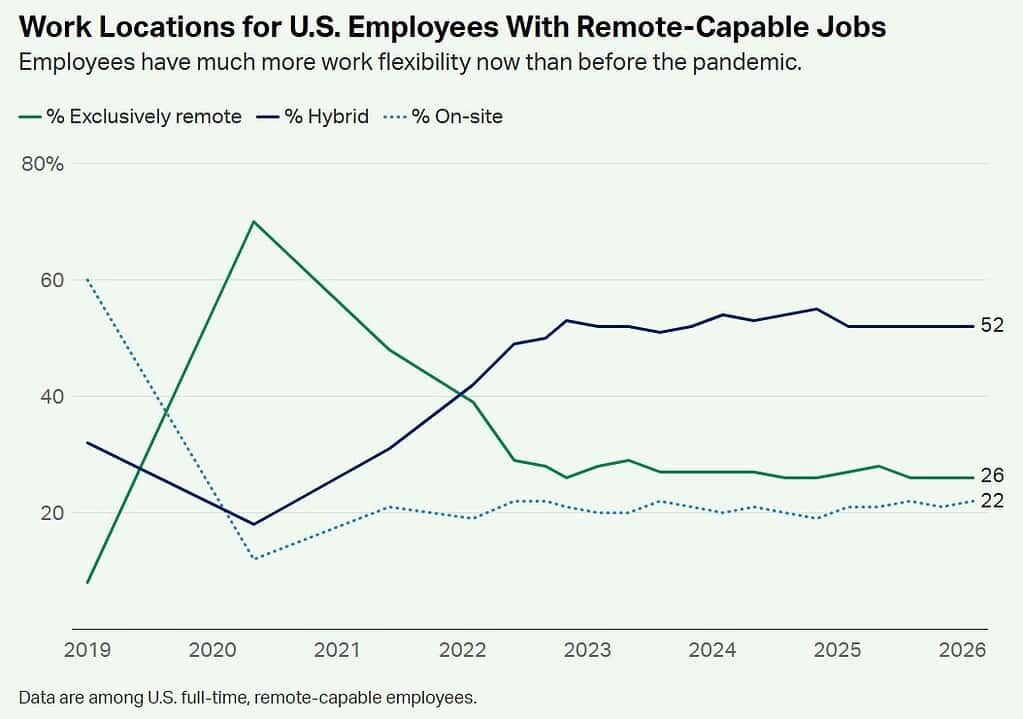
- In 2026, 52% of U.S. employees with remote-capable jobs worked in a hybrid model, making it the most common work arrangement.
- Around 26% worked fully remotely, while 22% worked entirely on-site. About 60% preferred hybrid work, and fewer than 10% preferred working full-time from the office.
- Nearly 54% of hiring managers said candidates declined interviews or job offers due to limited remote work options.
- Around 83% of companies using remote work reported benefits such as greater flexibility, lower costs, and improved access to talent.
- Remote work helped 73% of companies expand international hiring, while 95% of employers reported no decline in productivity, and 51% reported improved productivity.
- About 93% of employers plan to continue virtual interviews, and 86% expect video interviews to remain a standard part of the hiring process.
Diversity, Equity, and Skills-Based Hiring

(Reference: fitsmallbusiness.com)
- Companies that boast racial and ethnic diversity are 35% more likely to financially outperform their racially homogenous competitors in profitability.
- Similarly, those with gender-diverse executive teams are 15% more likely to achieve above-average profits, proving diversity directly impacts the bottom line.
- 75% of US job seekers now consider a diverse workforce to be a key, essential factor when they are evaluating job offers.
- The desire for an inclusive environment is a major differentiator, with 60% of workers prioritizing diversity when choosing a new employer.
- The gender pay gap in the US averages around 17%, a persistent disparity that severely impacts the recruitment and retention of top female talent.
- Furthermore, for every 100 men promoted from entry-level to manager, only 81 women are promoted, indicating a systemic leakage at key career stages.
- 94% of employers believe that skills-based hiring is a significantly better predictor of a candidate’s actual job performance than a traditional resume.
- This shift is active, with 81% of companies now utilizing skills-based hiring practices, up from just 56% two years prior.
- Candidates from Historically Underrepresented Groups are 67% more likely to experience ghosting, sudden, unexplained communication cessation after an interview, than white candidates.
- More than 50% of employers now state that attracting diverse talent is their primary DEI obstacle, a challenge that has risen sharply from just over 40% last year.
Most Visited Job And Employment Websites Analysis
- According to Market.us Scoop, Seek.com.au records 7.9 pages per visit with a 33.59% bounce rate, indicating strong user engagement.
- Gupy.io shows 5.71 pages per visit and a higher bounce rate of 41.64%, reflecting moderate retention.
- Jooble.org and HH.ru report 4.73 and 7.1 pages per visit, with bounce rates of 32.55% and 32.65%, showing balanced performance.
- Computrabajo.com leads with 15.18 pages per visit and a 33.83% bounce rate, highlighting deep user interaction.
- Indeed.com achieves 8.65 pages per visit with a 34.87% bounce rate, indicating consistent traffic quality.
- ZipRecruiter.com and Glassdoor.com show higher bounce rates of 50.01% and 47.32%, suggesting lower session retention despite steady traffic.
Candidate Experience by The New Standard for Online Recruitment Success

(Source: selectsoftwarereviews.com)
- A massive 58% of candidates have made the decision to turn down a job offer that was otherwise acceptable due to a poor candidate experience during recruitment.
- Half of all workers 50% have rejected a job offer at some point because of a negative recruitment experience, showing this is a widespread, systemic issue.
- 72% of candidates who have a bad experience will tell friends and family about it, actively damaging the company’s reputation.
- Only a tiny fraction, 5% of job seekers, prefer to apply via a complex online application form, while the vast majority, 48%, prefer to simply submit a CV to an online system.
- This preference highlights the need to drastically simplify the application funnel to prevent the 60% application drop-off rate.
- A positive candidate experience makes a candidate 38% more likely to accept a job offer from the organization when one is extended.
- 52% of candidates report that they had to wait three months or even longer to receive a definitive response from an employer after submitting their initial application.
- This extended silence is the main source of frustration, with 63% of candidates unhappy with the lack of communication following an application.
- Only 25% of employers actively follow up by asking candidates for feedback on their experience via candidate surveys.
AI Recruiting Statistics
(Source: cvviz.com)
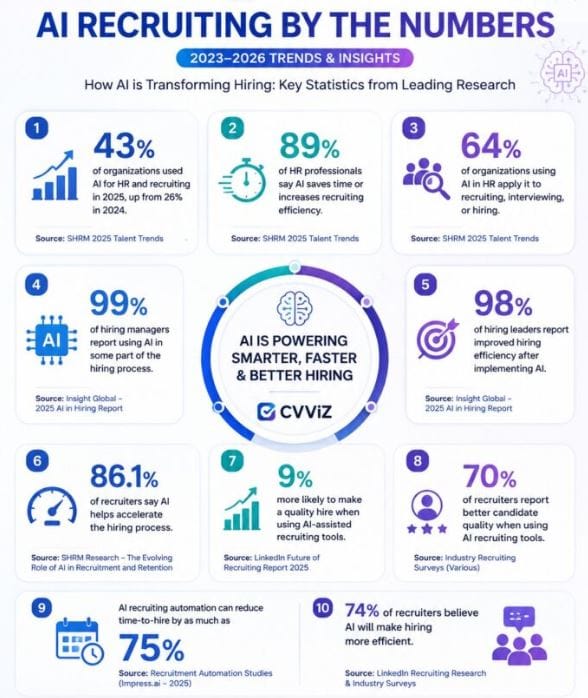
- AI use in HR and recruitment increased from 26% in 2024 to 43% in 2025, showing rapid adoption.
- Around 89% of HR professionals said AI saves time and improves recruitment efficiency.
- 64% of organizations that use AI apply it to recruiting, interviewing, and hiring.
- 99% of hiring managers use AI at least one stage of the hiring process, and 98% report improved hiring efficiency.
- Around 86.1% of recruiters said AI helps speed up the recruitment process.
- Companies using AI-assisted recruiting tools are 9% more likely to make quality hires.
- 70% of recruiters reported better candidate quality with AI-powered hiring tools.
- AI recruitment automation can reduce time-to-hire by up to 75%.
- Around 74% of recruiters believe AI will continue to make hiring more efficient.
Recruitment Funnel And Hiring Benchmark Statistics
- According to CVIZ, companies receive about 180 job applications for every successful hire, with an applicant-to-hire conversion rate of around 0.5%-1%.
- Only about 3% of applicants reach the interview stage, while the average applicant-to-interview conversion rate is 12%-15%. Top-performing companies achieve over 18%.
- Around 17% of interviewed candidates receive a job offer, and 84%- 87% accept those offers.
- The global median time-to-hire is 38 days, while the average time-to-fill ranges from 36 to 45 days.
- Mobile job applications continue to grow, although many employers still lack mobile-friendly application systems.
- Candidate drop-off rates range from 30% to 50% during the hiring process.
- Companies using data-driven hiring funnels achieve 37% higher offer acceptance rates.
- Organizations using AI-powered recruitment hire candidates 26% faster, reducing hiring time by an average of 11 days.
Final Thoughts
Overall, thank you for diving into these core online recruitment statistics. The data tells a story: the future of hiring is driven by efficiency, by technology, and centered on the candidate.
From the necessity of an ATS for corporate scale to the overwhelming candidate preference for hybrid work, these data points are actionable insights for your recruitment needs. The organizations that thrive in the coming years will be the ones that treat their candidates with the speed and respect demanded by the market, leverage AI to free up their teams for engagement, and actively pursue the proven financial benefits of a truly diverse workforce.
I hope this article will help in any of your hiring processes. If so, I would be the happiest person on the planet. Thanks for staying up till the end. If you find this one useful, kindly share it with your friends who are looking for the right recruitment. Thanks.
FAQ
Regularly search trusted job websites, company career pages, and professional networks for suitable openings.
A virtual interview is a job interview conducted online, in which employers and candidates communicate via video or audio calls.
The biggest benefit of online recruitment is reaching more qualified candidates quickly, reducing hiring time, lowering costs, and improving recruitment efficiency.

Sources