









Introduction
AI in Video Editing Statistics: AI in video editing uses machine learning to automate tasks that used to be done manually, like trimming clips, correcting color, adding captions, creating background sounds, and even making short clips from text or images. Big platforms are now working to build these AI tools right into the editing software people already use, instead of keeping them as separate apps. Adobe has added strong AI features to Premiere and Firefly, teamed up with Runway for early access to newer video-generation technology, and partnered with YouTube to bring mobile editing to Shorts.
Google’s Veo and Flow, along with companies like Runway and Hedra, are also getting a lot of investment as more companies compete in this space. News organizations are exploring these tools too, with Reuters trying out browser-based AI editing to help speed up its coverage. Most editors and creators seem to be using AI mainly to speed up repetitive tasks, while still relying on their own creative judgment for the bigger decisions.
Hand Picked by the Editor
- 71% of video content creators have used AI tools for editing.
- LinkedIn creators report the highest weekly AI video tool usage, at 58%.
- AI-assisted editing and cutting is the top use case, used by 58%.
- 26% of creators save 16 to 30 minutes per video using AI.
- Facial-recognition tools are expected to reach over 97% accuracy by 2028.
- AI video editing can cut overall production costs by 58%.
- 72% of YouTubers using AI thumbnails saw a 38% click-through increase.
- 75% of entertainment executives say generative AI has eliminated or reduced jobs.
Recent AI in Video Editing Developments
- On September 8, 2026, Reuters partnered with CuttingRoom to provide browser-based AI editing, captioning, mixing, color correction, and reframing.
- On September 8, 2026, Adobe added Generative Media to Premiere, including soundscapes created by analyzing up to 15 seconds of video.
- On April 15, 2026, Adobe launched Firefly AI Assistant with more than 30 AI models and access to 800 million assets.
- On December 18, 2025, Adobe signed a multiyear Runway partnership, giving Firefly early access to the Gen-4.5 video model.
- On October 28, 2025, Adobe and YouTube partnered to bring AI-assisted Premiere mobile editing directly into YouTube Shorts.
- On October 28, 2025, Adobe introduced Firefly’s timeline-based AI editor for generating, trimming, sequencing, and transcript-editing video clips.
- On October 15, 2025, Google released Veo 3.1 after users generated more than 275 million videos through Flow within 5 months.
- On May 15, 2025, Hedra raised USD 32 million at a reported USD 200 million valuation, lifting total funding to USD 43 million.
- On April 3, 2025, Runway raised USD 308 million at a valuation exceeding USD 3 billion to expand AI filmmaking research.
Global AI in Video Editing Market Growth
(Source: market.us)
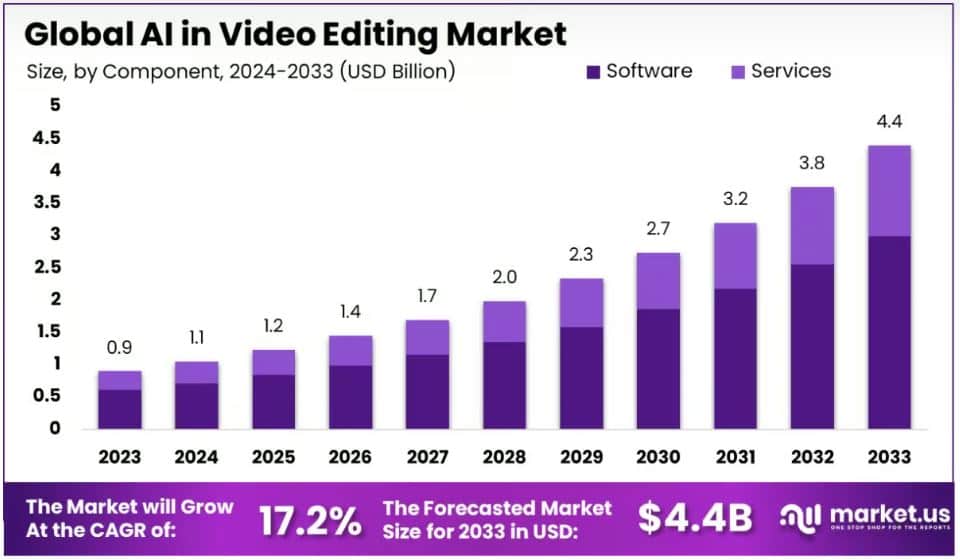
- The global AI in video editing market was valued at USD 1.1 billion in 2024, USD 1.2 billion in 2025, and USD 1.4 billion in 2026.
- Market value is projected to reach USD 1.7 billion in 2027, USD 2.0 billion in 2028, and USD 2.3 billion in 2029.
- By 2033, the global AI in video editing market is expected to reach USD 4.4 billion.
- The market is projected to grow at a compound annual growth rate of 17.2% between 2024 and 2033.
Global AI Video Market
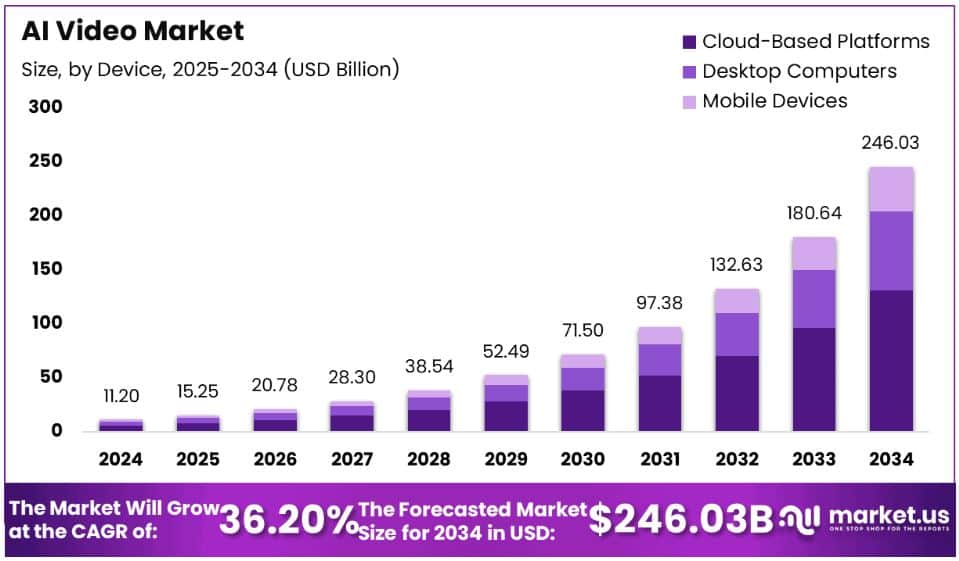
- The global AI video market was valued at USD 15.25 billion in 2025, USD 20.78 billion in 2026, and USD 28.30 billion in 2027.
- Market value is expected to increase to USD 38.54 billion in 2028, USD 52.49 billion in 2029, and USD 71.50 billion in 2030.
- By 2034, the global AI video market is expected to reach USD 246.03 billion.
- The market is anticipated to grow at a compound annual growth rate of 36.20% from 2025 to 2034.
(Source: market.us)
AI Video Tool Adoption by Content Creators
- 71% of video content creators have used AI tools for video generation or editing.
- 41% of creators who use AI video tools do so every week.
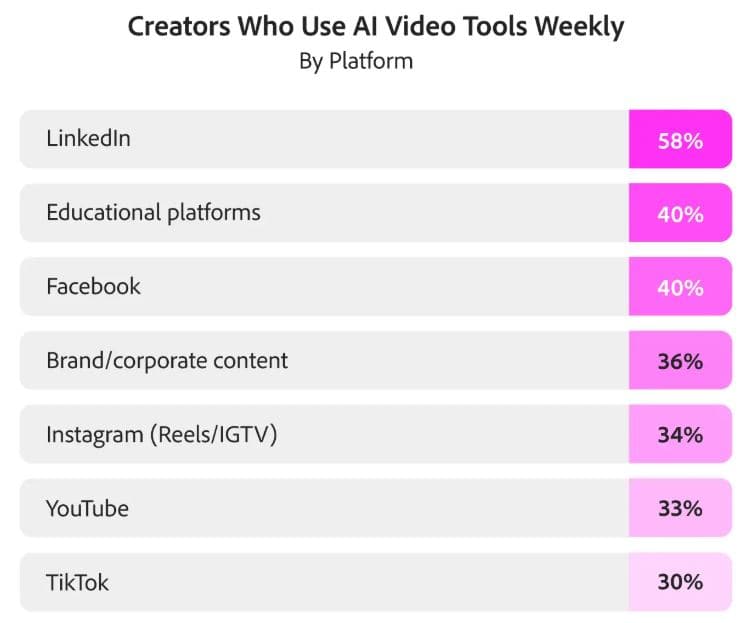
- LinkedIn has the highest weekly use of AI video tools, with 58% of creators using them regularly.
- Educational platforms and Facebook each report 40% weekly AI video tool usage among creators.
- 36% of creators use AI video tools weekly for brand and corporate content.
- Instagram, including Reels and IGTV, records 34% weekly usage of AI video tools.
- YouTube creators report 33% weekly use of AI video generation or editing tools.
- TikTok records 30% weekly AI video tool usage among creators.
(Source: adobe.com)
Leading AI Applications in Video Creation
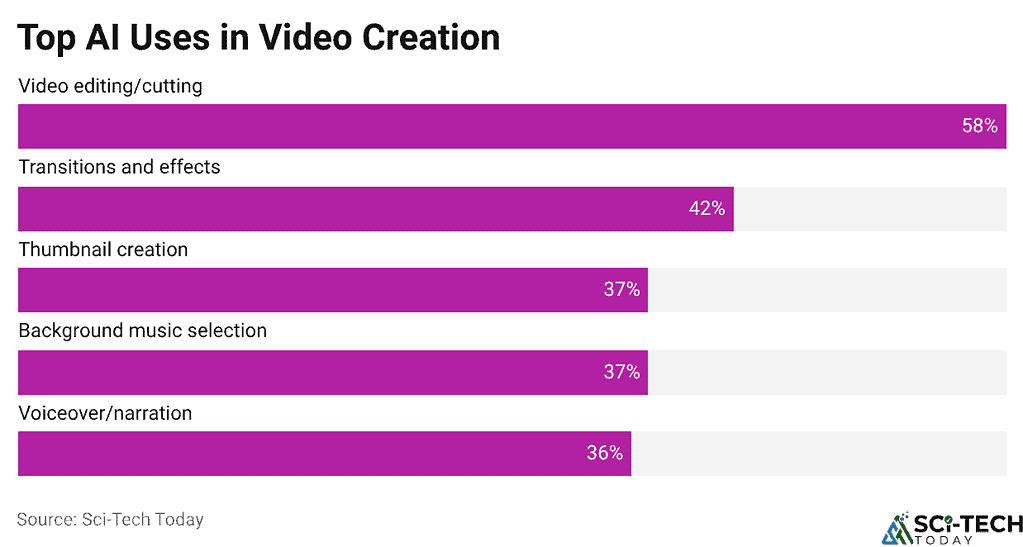
- AI-assisted video editing and cutting is the most common use case, with 58% of creators using these tools to speed up editing workflows.
- 42% of creators use AI to add transitions and visual effects, helping produce smoother and more engaging videos.
- AI supports thumbnail creation for 37% of creators, enabling faster development of visuals designed to attract viewers.
- 37% of creators use AI to select background music that matches the tone and pace of their videos.
- AI-generated voiceovers and narration are used by 36% of creators, supporting faster audio production and multilingual content development.
(Reference: adobe.com)
Time Savings from AI Video Tools
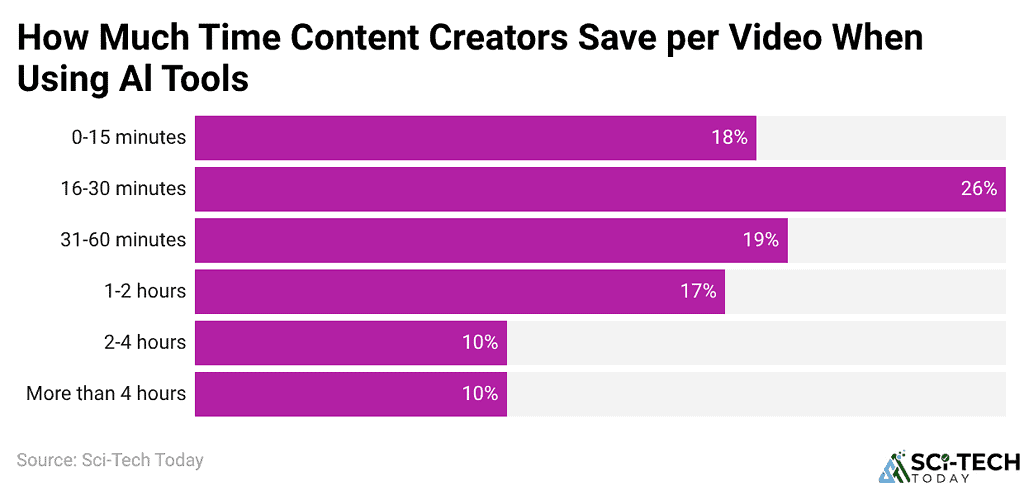
- AI video tools help content creators save time and publish content more efficiently.
- 18% of creators save between 0 and 15 minutes per video when using AI tools.
- 26% of creators save between 16 and 30 minutes per video, making this the most common time-saving range.
- 19% of creators save between 31 and 60 minutes per video.
- 17% of creators save between 1 and 2 hours per video.
- 10% of creators save between 2 and 4 hours per video.
- Another 10% of creators save more than 4 hours per video.
- 50% of larger creator teams with four or more members save at least 2 hours per video through AI use.
- Larger teams are twice as likely as smaller teams (25%) and nearly three times as likely as solo creators (18%) to save at least 2 hours per video.
(Reference: adobe.com)
AI Video Editing Tools and Technology Statistics
- 58% of AI-enabled marketing videos use AI-generated voiceovers, helping creators produce clearer audio more quickly than traditional recorded voiceovers.
- 36% of brands use AI avatars or digital actors in video production to improve viewer engagement and scale content creation.
- By 2028, facial-recognition tools in video-editing software are expected to identify and tag individuals with more than 97% accuracy.
- 77% of video-editing tools include AI-driven automation features that reduce editing and production time.
Cost Savings from AI Video Editing
- AI video-editing tools can reduce overall production costs by 58%, helping creators and businesses produce videos more efficiently.
- Talent-hiring costs can decline by 68% when AI supports tasks such as voiceovers, avatars, scripting, and editing.
- AI-enabled video workflows can increase team productivity by 47%, allowing teams to create more content within the same time period.
- Organizations can reduce marketing budgets by 43% by using AI to automate parts of video creation and campaign production.
- AI-powered captioning tools can lower caption-production costs by 77%, reducing the need for manual transcription and subtitle creation.
- AI can shorten pre-production time by 53% by assisting with planning, scripting, concept development, and content preparation.
| Area of Impact | Benefit | Percentage |
| Overall Production Costs | Reduction in total video production costs | 58% |
| Talent-Hiring Costs | Decline in hiring costs for voiceovers, avatars, scripting, and editing | 68% |
| Team Productivity | Increase in content output within the same timeframe | 47% |
| Marketing Budgets | Reduction in marketing budgets through automated video creation | 43% |
| Caption Production Costs | Decrease in costs for captioning and subtitle creation | 77% |
| Pre-Production Time | Reduction in time spent on planning, scripting, and concept development | 53% |
AI Video Editing in Content Creation and Streaming
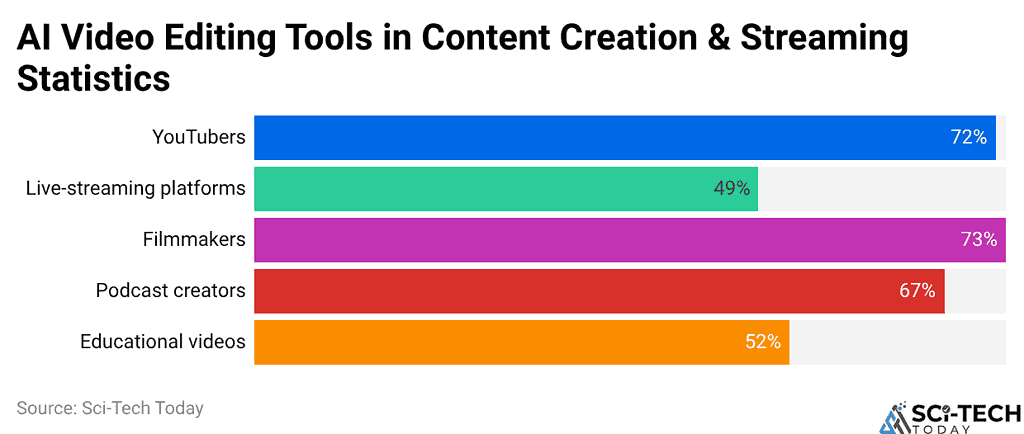
- 72% of YouTubers reportedly use AI-edited thumbnails, which are associated with a 38% increase in click-through rates.
- 49% of live-streaming platforms reportedly offer AI video-customization tools to enhance viewing experiences.
- By 2035, 73% of filmmakers are expected to use AI video-editing tools for advanced production workflows.
- AI video editors could reduce filmmakers’ post-production costs by 48% by automating editing, visual effects, and other repetitive tasks.
- Up to 67% of podcast creators use AI-generated video formats to make content more engaging and reach wider audiences.
- 52% of educational videos on streaming platforms use interactive AI-generated avatars to save production time and improve learner engagement.
(Reference: Gudsho.com)
Impact of AI on Video Editing Jobs
- U.S. Bureau of Labor Statistics projections show video-editor employment is expected to grow by 3% between 2023 and 2033.
- The U.S. Bureau of Labor Statistics reported 39,400 film and video editor jobs in 2025, including self-employed professionals and project-based workers.
- Self-employed editors completed approximately 31,500 editing projects, showing continued demand for independent creative talent.
- The average salary for film and video editors was USD 75,420 in 2025, equivalent to a median hourly wage of USD 36.26.
- Around 13,280 film and video editors, or 51.9% of the occupation, worked in the motion-picture and video industry.
- A survey of 300 U.S. entertainment-industry executives and managers found that 75% believe generative AI has supported job elimination, reduction, or consolidation in their businesses.
Top AI Video Editing Tools
- Adobe Premiere Pro led a 2026 survey, with 83 of 245 respondents using its AI features.
- Premiere Pro’s AI Object Mask helps redesigned shape masks track moving subjects up to 20 times faster.
- Premiere Pro can translate captions into 27 languages and create transcripts in more than 18 languages.
- CapCut ranked second in the 2026 survey, with 81 of 245 respondents using its AI tools.
- CapCut offers more than 100 digital avatars, over 30 templates, and more than 30 visual styles.
- CapCut processes videos lasting up to 3 hours and sized up to 10GB, with subtitles in over 20 languages.
- In October 2026, CapCut reached 7% organizational adoption, rising 4 percentage points from the previous year.
- CapCut adoption reached 9% among enterprises, 9% among mid-market companies, 7% among SMBs, and 6% among microbusinesses.
- Descript recorded 23 users in the 2026 survey, supporting transcript-based editing, AI captions, audio cleanup, and filler-word removal.
- Descript can dub videos in more than 20 languages, while workflow improvements reduced AI-credit consumption by approximately 20%.
Wrap Up
AI has become a big part of video editing. It helps cut costs, speed up the work, and change how creators, marketers, and newsrooms make content. People on LinkedIn and those making educational videos use AI the most, while tools like Premiere Pro and CapCut are the most popular choices. AI saves a lot of time and money on editing, captions, and planning videos.
Even so, jobs for video editors are still growing, even though many people worry AI could take away editing jobs. As the market keeps growing fast through 2033, video editing is turning from a hands-on skill into a process that relies more and more on AI.
FAQ
AI uses computer vision to detect and separate a subject from its background in real time, allowing creators to remove or replace backgrounds without a green screen in many cases.
Yes, AI tools can stabilize shaky footage, upscale low-resolution video, reduce noise, and enhance lighting and color, improving overall video quality with minimal manual adjustment.
AI can generate realistic voiceovers from text, clone a speaker’s voice, and even translate and dub videos into other languages while attempting to match lip movements and tone.
Yes, many AI video editing tools are designed with simple interfaces and automated features that allow beginners to create polished videos without extensive editing experience or technical skills.
AI tools may struggle with highly creative or nuanced edits, can produce inconsistent results in complex scenes, and often still require human review for storytelling, pacing, and overall artistic direction.