









Opening
Video Marketing Statistics: Video marketing has emerged as a cornerstone of digital strategies, leveraging the power of visual content to engage audiences and drive business growth. As video consumption continues to rise, companies across various industries increasingly adopt video as a critical component of their marketing efforts. The statistics surrounding video marketing reflect its growing influence, with metrics highlighting the effectiveness of different video formats, audience preferences, and the impact on consumer behaviour.
From how-to guides to thought leadership pieces, video marketing is an essential tool for brands looking to connect more dynamically and impactfully with their target audiences.
Highest-Rated Selections
- A significant 70% of marketers needing to incorporate video into their strategies intend to begin utilizing this medium in 2025.
- Video marketing continues to be a cornerstone of the digital sphere, adopted by around 89% of enterprises in 2025.
- In the same year, adoption is poised for significant growth, with about 67% of current non-users intending to incorporate video into their strategies.
- Around 89% of video marketers are poised to either sustain or escalate their investment in video content throughout 2025, with over half planning to increase budgets and only a small minority cutting spend.
- 69% of marketers have allocated a budget towards video advertising, while the remaining 31% have opted to depend solely on organic reach.
- Nearly half of marketers (49%) perceive an upward trend in video marketing costs, contrasted with 29% who observe a decline in expenses.
- General Video Marketing Statistics: 21% of marketers perceive that the expenses associated with video marketing remain relatively stable.
- 90% of marketers report that video marketing has yielded a substantial return on investment, underscoring its effectiveness as a strategic tool in their campaigns.
- A substantial 88% of marketers utilizing video content report that it has significantly enhanced user comprehension of their offerings.
- In the current year, approximately 86% of video marketers report that utilizing video content has significantly boosted their website traffic.
General Video Marketing Statistics
- A majority of video marketers, around 87%, attribute video content to enhancing their lead-generation efforts.
- Meanwhile, 87% of marketers report a direct boost in sales attributable to the strategic use of video content.
- 82% of digital marketers report that utilizing video content has effectively prolonged visitor engagement on their websites.
- On the other hand, 66% of marketers specializing in video reported that utilizing this medium has significantly decreased support inquiries, marking an all-time high and reflecting a notable 13% increase from the previous year.
- As per Video Marketing Statistics 2025, around 96% of individuals have engaged with an explainer video to gain a deeper understanding of a product or service
- After watching a video, almost 82% of people were convinced to buy a service or product.
- 77% of individuals have made a purchase or downloaded an application following exposure to a video showcasing it.
- In 2025, an overwhelming 83% of consumers expressed a strong desire for brands to increase their presence in video content, reflecting still‑rising appetite for video.
- 87% of consumers indicate that the caliber of video content directly influences their confidence in a brand.
- Global search advertising expenditures are anticipated to reach around USD 226.2 billion by the close of 2025, as search (including AI‑driven and retail search) continues to expand within the digital ad mix.
Video Marketing Usage Statistics
(Reference: wyzowl.com)
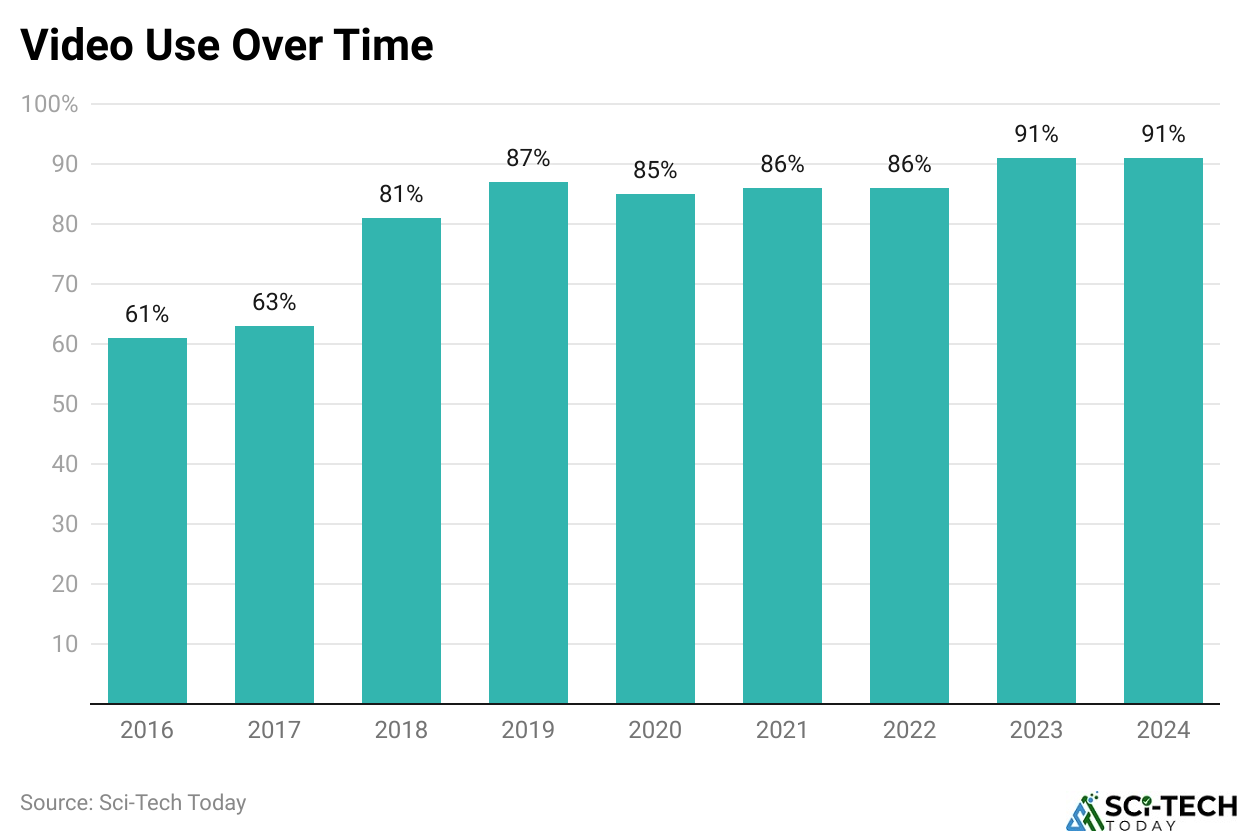
- As of 2025, approximately 89% of businesses leverage video as a marketing tool, keeping adoption near record highs even after a slight dip from 2024.
- In the same fiscal year, around 95% of video marketers regard video as a crucial component of their overall strategy, up from 88% in 2024 and underscoring video’s central role in modern marketing.
Video Viewership Statistics
Digital Video
(Reference: statista.com)
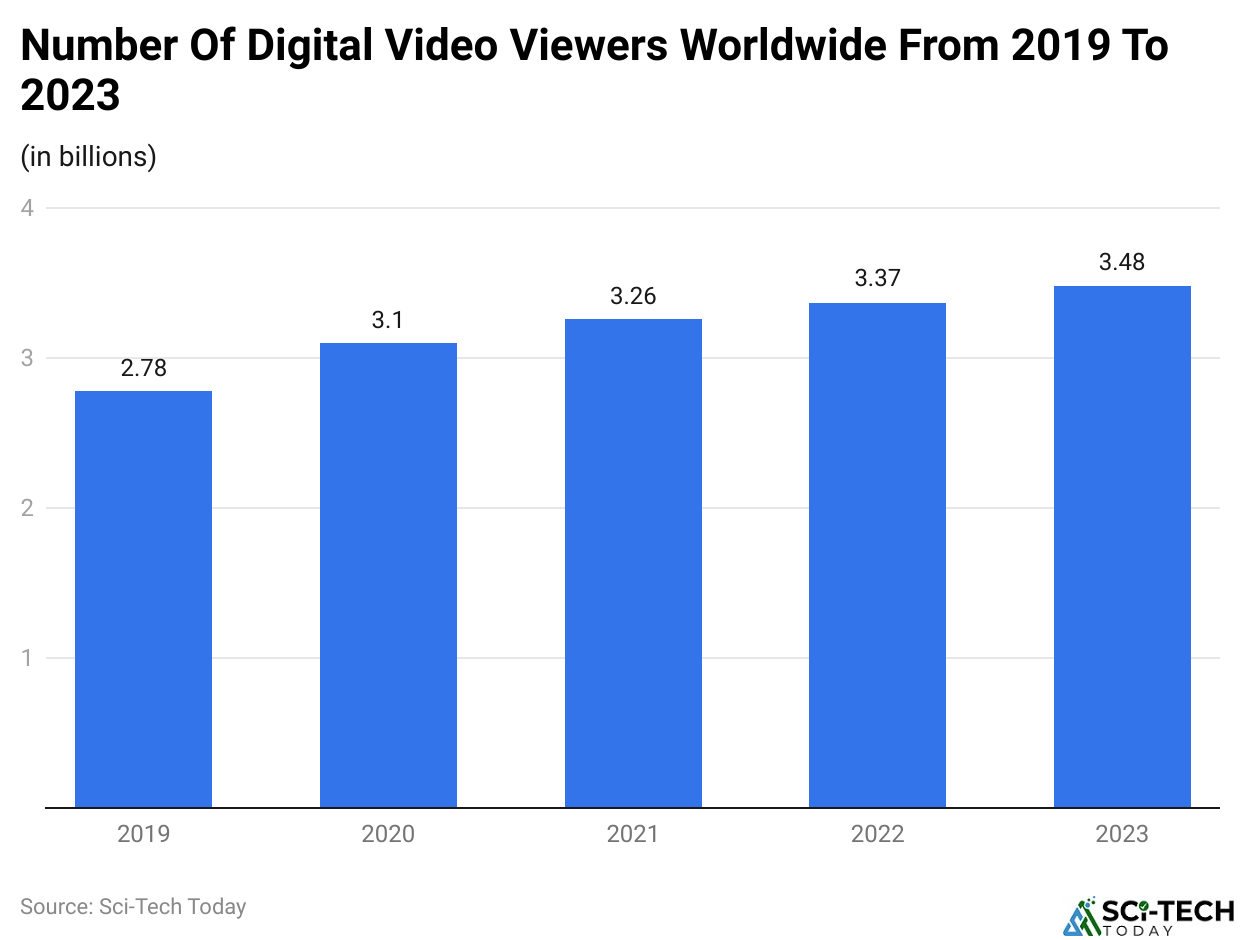
- A report published by Statista states that in 2020, over 3.1 billion internet users of all ages streamed or downloaded video content across various devices at least once per month.
- This number is expected to rise consistently each year, reaching 3.26 billion in 2021, 3.37 billion in 2022, 3.48 billion in 2023, and approximately 3.60 billion in 2025 as online video viewing keeps pace with global internet user growth.
Live Video
(Reference: optimise2.assets-servd.host)
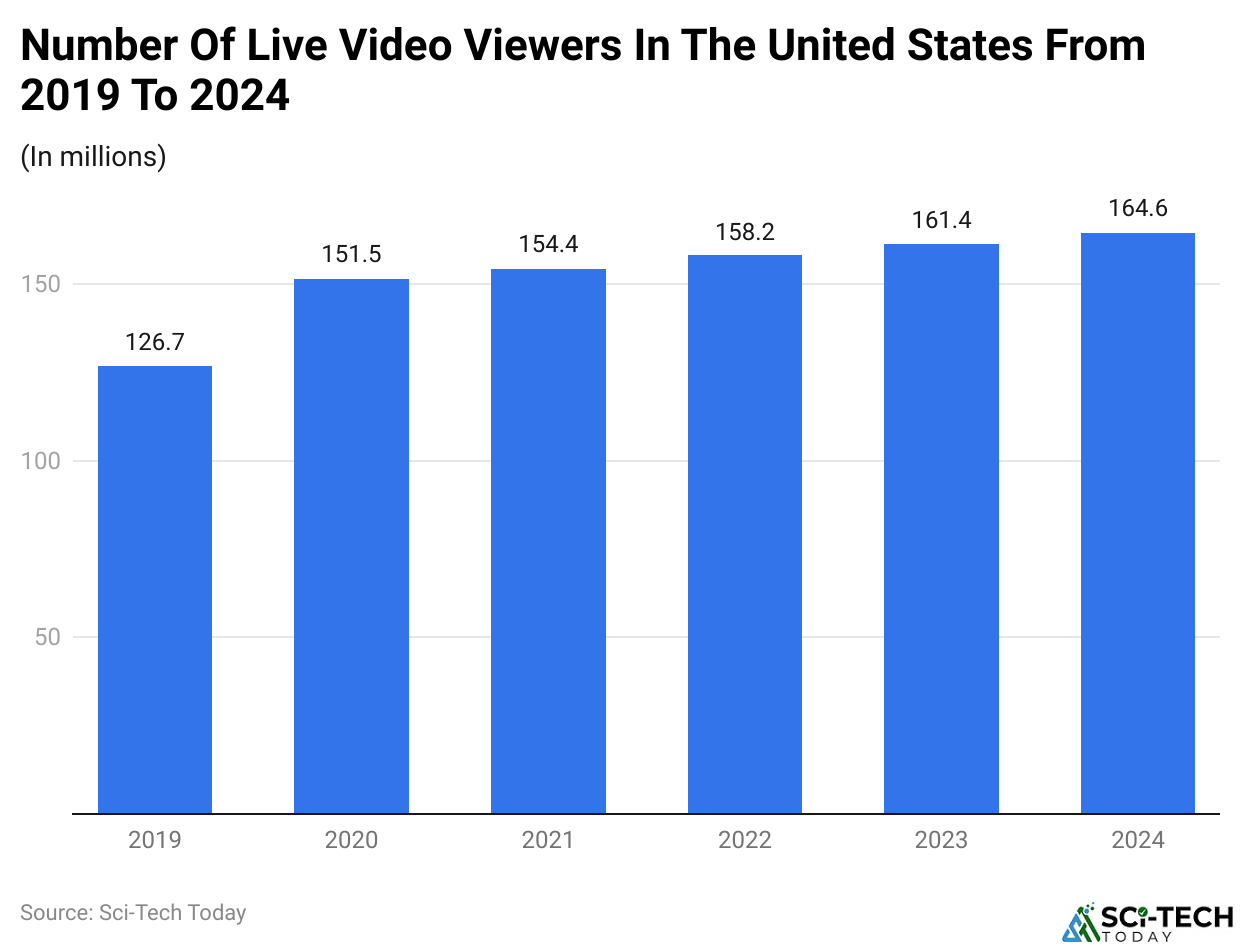
- Video Marketing Statistics show that in 2023, an estimated 161.4 million individuals actively engaged in live video streaming in the United States.
- By the end of 2024, around 164.6 million Americans will be using video for marketing purposes, and this figure is projected to rise to about 167.8 million in 2025 as streaming and video usage continue to grow.
Leading Video Content Type by Usage Reach
(Reference: statista.com)
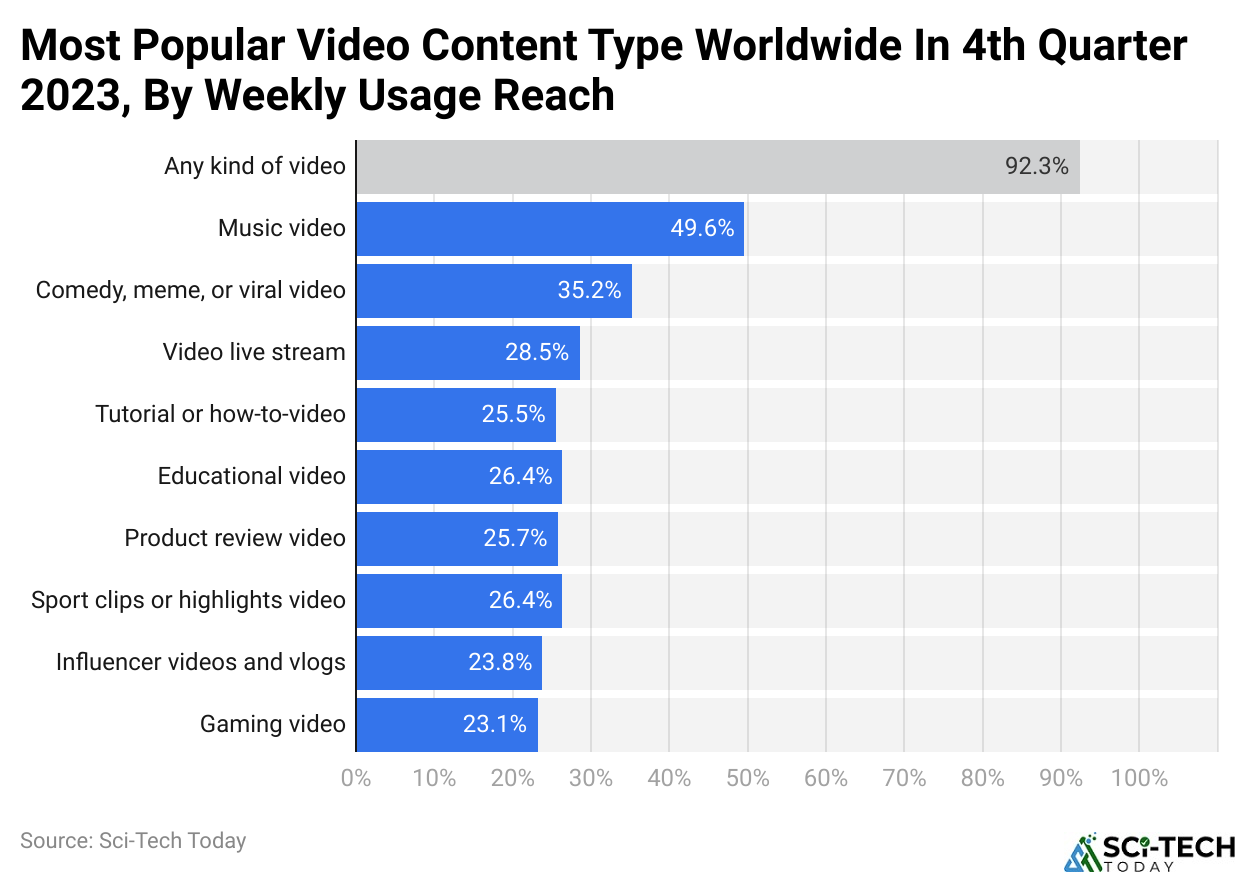
- In the fourth quarter of 2025, online videos reached a substantial audience of approximately 94.6% of global internet users on a monthly basis, with around 91% watching online video weekly.
- The most popular video content type worldwide in the 4th quarter of 2025, by weekly usage reach, is music video (about 50%), followed by comedy, meme, or viral video (around 36%), video live stream (about 29%), educational video (around 27%), sport clips or highlights video (around 27%), product review video (about 26%), tutorial or how-to video (about 26%), influencer videos and vlogs (around 23%), and gaming video (around 24%).
Leading Types of Videos Used in Marketing
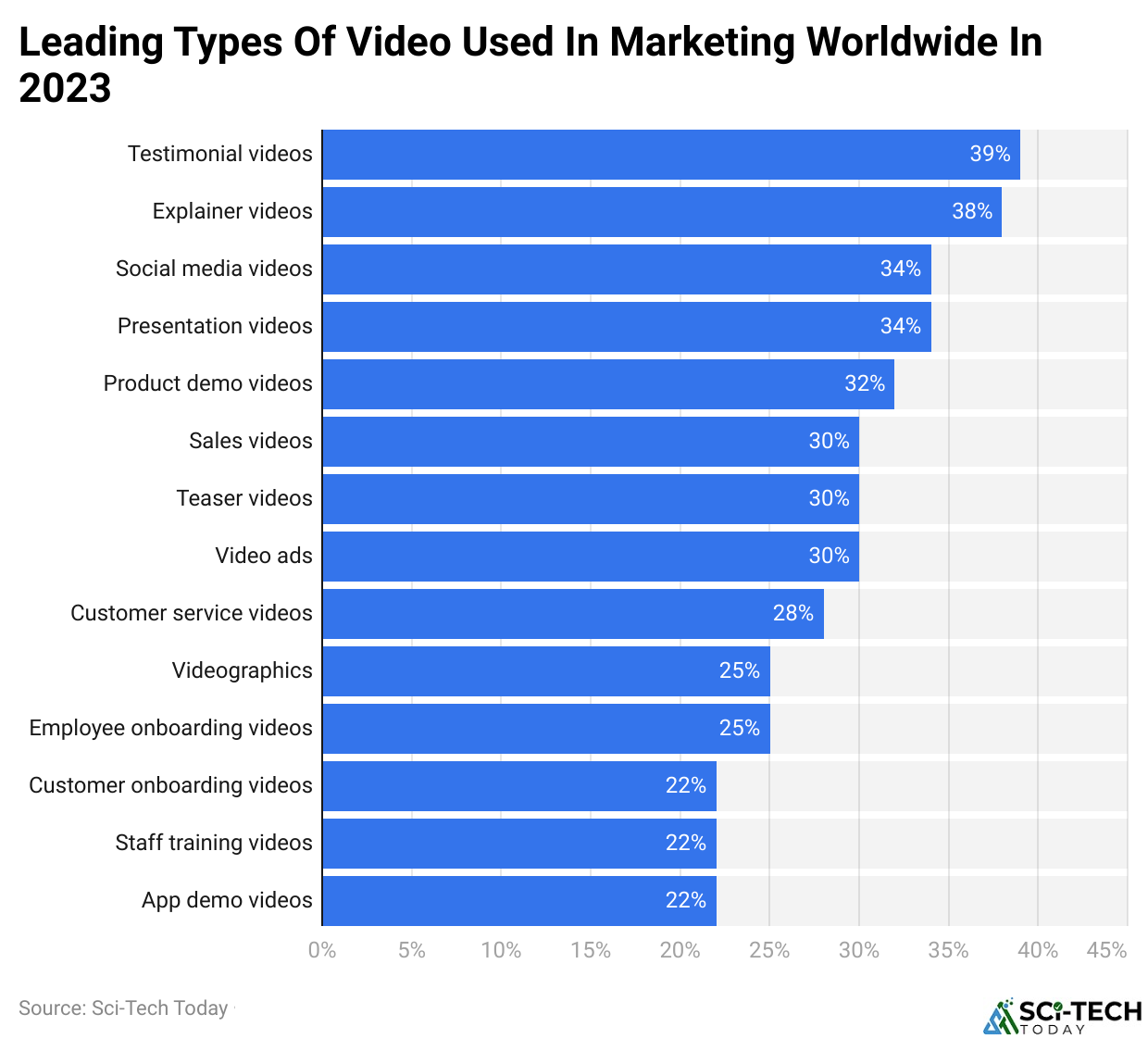
(Reference: statista.com)
- In 2025, testimonial videos remain one of the leading formats in global marketing, with about 58% of video marketers integrating them into their strategies, up from 39% in 2023.
- Around 73% of video marketers globally now closely follow and utilize explainer videos, while about 69% highlight the adoption of social media videos in their campaigns, making these the most commonly produced and used formats in 2025.
- As mentioned in Video Marketing Statistics, other leading types of video used in marketing worldwide in 2025 include product demo videos (about 48%), sales or promotional videos (around 41%), video ads (widely used across short-form and social formats), customer service and support videos (around 32%), video graphics or animated explainers (around 30%), customer onboarding videos (mid‑20% range), staff training videos (around 29%), and app or software demo videos (around 30%), reflecting a broad mix of formats across the funnel.
By Types of Videos Created
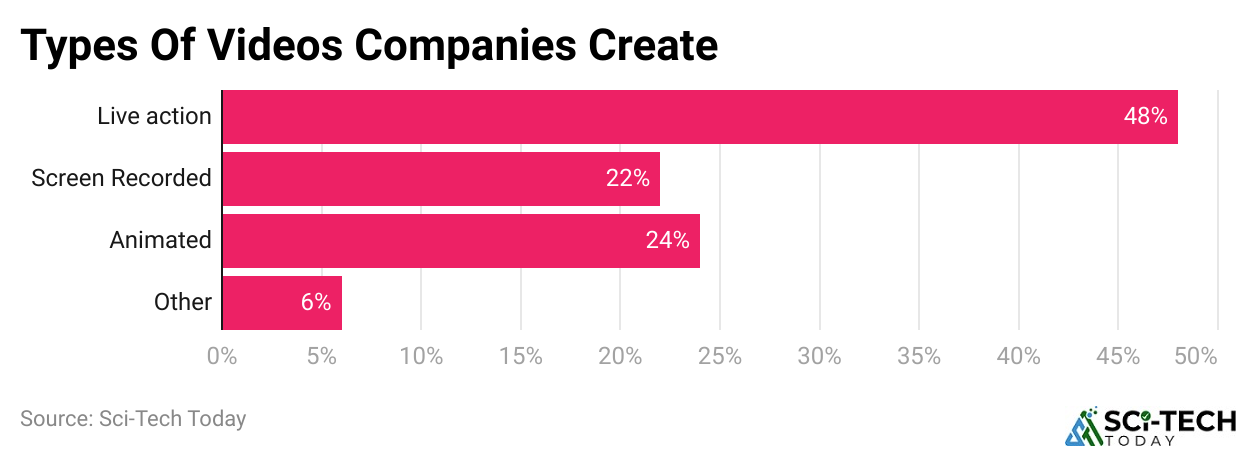
(Reference: wyzowl.com)
- Live-action video remains the predominant format in video marketing, with 48% of video marketers primarily focusing on this type.
- Following closely, animated videos account for 24%, while screen-recorded content constitutes 22% of the videos produced.
- A substantial 40% of content generated by customer experience teams takes the form of instructional videos.
- Types of videos followed by other organizations are leadership material (20%), visual content comprises presentations (65%), explainer videos (40%), product demos (32%), testimonials (50%), synchronous video content via live webinars (53%), and short-form video content (95%).
By Use Cases For Videos
- As per Video Marketing Statistics, in 2025, video testimonials remain a major application for video marketing, with about 58% of marketers incorporating them into their strategies up from 39% in 2024.
- Close behind are explainer videos, utilized by around 73% of video marketers, followed by social media videos (about 69%), presentation videos (around 53%), product demos (about 48%), and other key formats such as video ads, sales videos, and teaser videos, each widely used within modern campaigns.
- Additionally, 28% of marketers used customer service videos, while 25% employed video graphics and employee onboarding videos.
- Training, customer onboarding, and app demo videos, each adopted by 22% of marketers, round out the list.
By Video Length Works Best
- Video Marketing Statistics further state that the majority of marketers indicate that short-form videos yield significant success.
- According to 39% of these professionals, the optimal video length is between 30 and 60 seconds, followed by 1-2 minutes, preferred by 28%, and videos of 30 seconds or shorter, preferred by 18%.
- 10% of videos lasting 2-3 minutes are deemed effective, while only 5% consider videos exceeding 3 minutes to be impactful.
Ways To Create Videos in Businesses
- Video Marketing Statistics further states that a significant shift continued in the video marketing landscape in 2025, with around 59% of video marketers now producing content in‑house, a rebound from the 38% reported in 2024 but still below the 2023 level.
- The proportion of video marketers who exclusively rely on external vendors for content creation stands at about 10% in 2025, while around 32% strategically combine in‑house resources with external teams, meaning roughly 42% rely on external creators in some capacity.
Watch Time of Online Videos Statistics
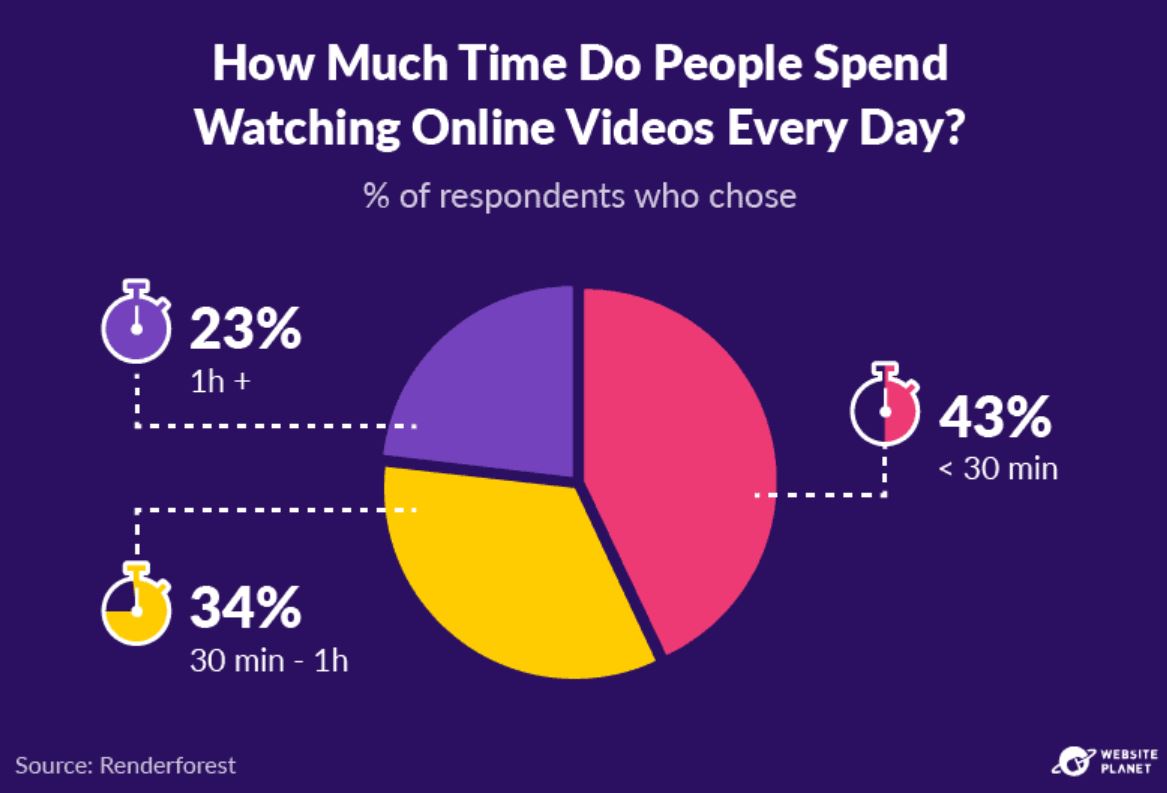
(Source:cloudfront.net)
- About 23% of people watch a lot of videos on a daily basis.
- According to Video Marketing Statistics, about 34% of the total population watches online videos for 30-60 minutes each day.
- While the majority of internet users watch videos for less than 30 minutes daily.
Impacts of AI On Video Marketing
- Around 75% of video marketers report leveraging AI tools to assist in the creation or editing of marketing videos.
- On the other hand, 25% of them have yet to use any AI tools for video marketing in 2024.
- By 2030, approximately 35% of user-generated content is expected to be produced using AI tools.
By Financial Analyses
- In recent years, almost 16% of marketers have allocated marketing budgets to video content, varying significantly between 21% and 30% of their overall expenditure to this medium.
- Similarly, the other percentages of the marketing budget allocated to videos are 11-20% (14%), 31-40% (14%), 41-50% (15%), 51-60% (11%), 61-70% (8%), 71-80% (6%), 81- 90% (3%), 91-100% (2%), and 0-10% (7%).
By ROI
- Notably, 60% of video marketers measure their ROI using video engagement metrics such as likes, shares, and reposts.
- Similarly, 42% calculate their ROI using metrics associated with customer engagement and loyalty.
- 40% of marketers use views of videos as the measure of their ROI, whereas 39% measure ROI in terms of brand awareness and public relations.
- Moreover, 32% of marketers use sales impact as the measure of ROI, whereas 28% consider clicks or leads as their ROI measure.
Countries With The Most YouTube Users
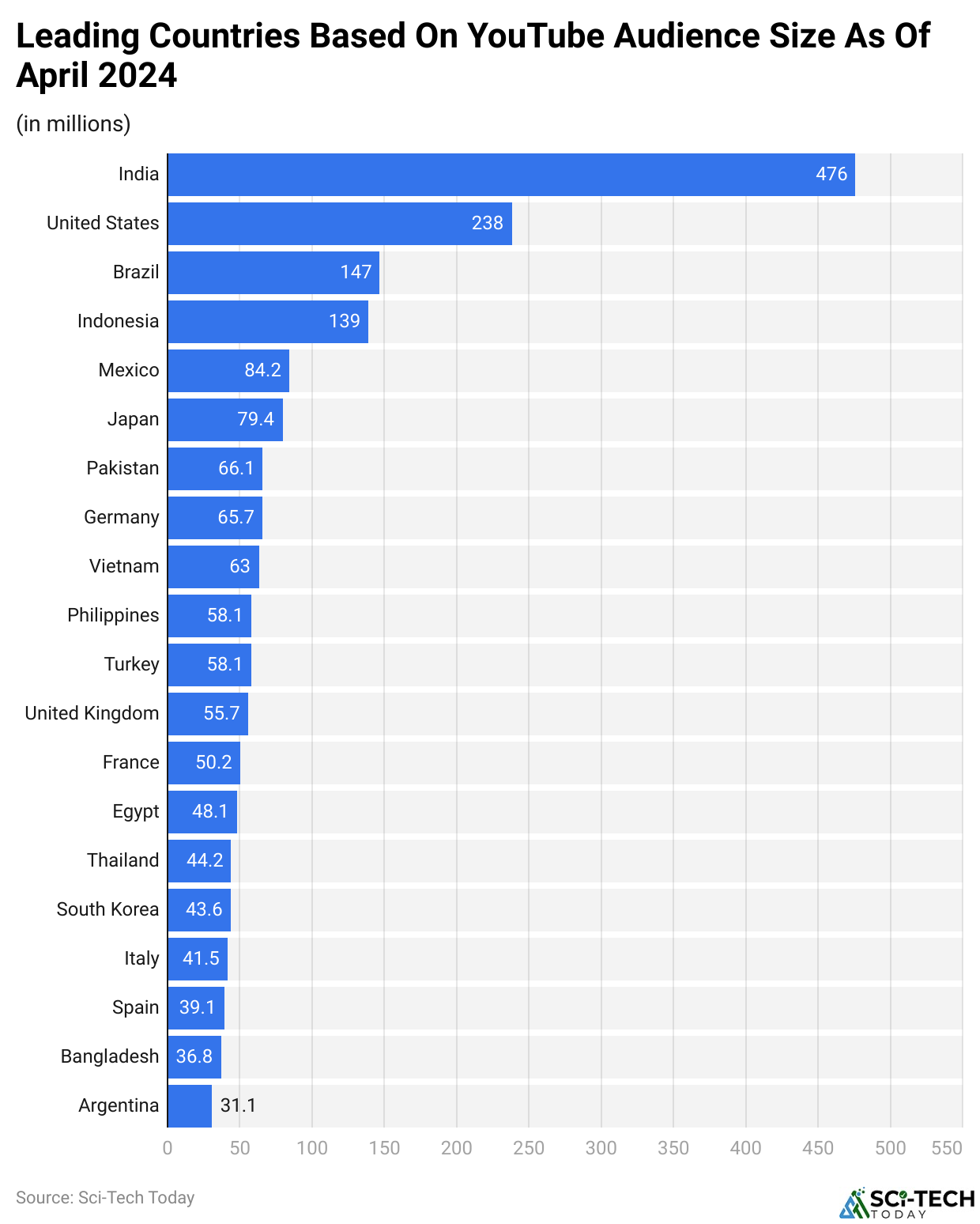
(Reference: statista.com)
- As of April 2025, India stood as the leading nation in terms of YouTube viewership, boasting an impressive around 491 million active users on the platform.
- The United States trailed behind with a substantial 238 million viewers, while Brazil secured the third position with 147 million engaged users.
- During the same period, leading countries based on YouTube audience size were followed by Indonesia (139 million), Mexico (84.2 million), Japan (79.4 million), Pakistan (66.1 million), Germany (65.7 million), Vietnam (63 million), Philippines (58.1 million), Turkey (58.1 million), United Kingdom (55.7 million), France (50.2 million), Egypt (48.1 million), Thailand (44.2 million), South Korea (43.6 million), Italy (41.5 million), Spain (39.1 million), Bangladesh (36.8 million), and Argentina (31.1 million).
Leading Social Video Platforms and Features by Video Views
- In the first quarter of 2025, TikTok content garnered an average of about 18,500 views per video, solidifying its status as the premier platform for social and brief video content, up slightly from 18,173 in 2024 as average views continue to climb.
- Instagram followed closely, with its Reels amassing around 16,500 average views in the same period, maintaining their strong performance as a leading short‑form format.
- Facebook’s short-form videos, also known as Reels, secured the third position.
- In contrast, YouTube Shorts exhibited the least engagement, averaging around 650 views during the period under review.
Social Video Platforms Engagement Rate
- In Q1 2025, YouTube Shorts again achieved the highest engagement rate among all analyzed short video platforms and in‑app features.
- Short content on YouTube garnered an impressive 5.91% engagement, surpassing TikTok’s rate of approximately 5.75%.
- Facebook Reels, by contrast, still lagged with an engagement level of around 2.07%, positioning it at the bottom in terms of short‑format user interaction.
Video Marketing for Social Media
- Social media platforms experience a 48% higher viewership for videos compared to other channels.
- A notable 17% of businesses integrate live streaming into their social media marketing plans.
- YouTube emerges as the top choice for 88% of marketers when it comes to video uploads.
- Additionally, 16% of users on these platforms favor vlogs as a means to explore products.
- Video Marketing Statistics further show that over 500 hours of video content are uploaded daily.
- 62% of Google’s search outcomes feature video content.
- A remarkable 90% of individuals on Instagram are connected to at least one business account.
- Video Marketing Statistics also states that on Facebook, daily video views exceed 8 billion.
- Over 73% of marketers leverage Facebook video ads to boost their products or services.
- Notably, the most effective conversion rates are achieved with ads lasting between 16 to 20 seconds.
- Furthermore, 58% of Instagram users report a stronger connection to a brand after viewing its story.
- On LinkedIn, 38% of marketers produce video content, with 75% of them reporting successful outcomes.
By Facebook
- Video Marketing Statistics also elaborates that Facebook users engage with over 8 billion video views each day.
- Facebook users, on average, dedicate 26 minutes daily to viewing video content on the platform.
- Socialinsider observed that a significant 71% of posts from Facebook profiles boasting over 100K followers consist of video content.
- Socialinsider observed that a significant 71% of posts from Facebook profiles boasting over 100K followers consist of video content.
- Over 73% of marketers utilize Facebook video advertisements to promote their offerings effectively.
- The recall rate for Facebook video advertisements by companies increases by 23% when the brand name is displayed within the initial 3 seconds, as per Video Marketing Statistics.
- Mobile-optimized vertical videos have demonstrated the highest levels of engagement on Facebook.
- In Facebook video advertisements, the optimal conversion rate is observed to be between 16 and 20 seconds.
By Instagram
- Research conducted by YetPo disclosed that 30% of Instagram users purchased after encountering the product on the platform.
- For IGTV, nearly 77% of marketers create video content.
- Research indicates that 79% of newly acquired clientele for brands or businesses was gained via Instagram.
- Incorporating stickers into Instagram stories can elevate engagement levels by an impressive 83%.
- Approximately 70% of individuals engage with Instagram stories by swiping up to access the links provided by brands.
By LinkedIn
- In recent years, on LinkedIn, the most shared posts are video content.
- Research done by Wyzowl reveals that 38% of marketers produce visual content specifically for LinkedIn, with 75% of them reporting it as highly successful.
- Approximately 80% of LinkedIn members favor viewing videos with the audio muted.
- In 2024, as per video marketing statistics, LinkedIn videos ranging from 30 to 90 seconds have demonstrated optimal outcomes for enterprises.
- Live broadcasts on LinkedIn have the potential to drive higher engagement levels than pre-recorded videos.
By X
- Tweets that include video content can generate ten times more engagement compared to those without videos.
- Video Marketing Statistics state that in 2025, approximately 8.3 billion videos are viewed daily on X, surpassing the earlier estimate of 2 million daily views.
- The third most common reason for social media users to engage with X is to consume video content.
- Videos in promoted tweets lead to a reduction of over 50% in cost-per-engagement.
- TikToks filmed in vertical format (9:16) achieve a 25% greater average 6-second watch-through rate compared to those shot horizontally.
By TikTok
- Videos that achieve the highest click-through rates typically start emphasizing the product or main message within the first 3 seconds, accounting for 63% of such content.
- TikTok remains largely untapped, with only about 10% of video marketers experimenting with the platform.
- Of those who have ventured into it, 66% have reported positive outcomes.
By Snapchat
- In the fiscal year 2025, on Snapchat, around 66% of advertisements are watched with sound enabled, reflecting a slight increase as sound-on viewing remains the norm on the platform.
- Vertical videos on Snapchat performed nine times better than their horizontal counterparts.
- Snapchat amasses over 10 billion views daily.
Video Marketing by Ad Spending
- By the end of 2025, video ad expenditures are projected to soar to USD 456 billion.
- Each year, marketers are boosting their allocations for video marketing by 25%.
- Incorporating video into marketing strategies has resulted in a remarkable 34% uptick in conversion rates.
- Video Marketing Statistics also state that utilizing video within full-page advertisements can enhance engagement by 22%.
- Conversely, in fiscal year 2024, almost 35% of companies now employ sophisticated video analytics tools to assess the effectiveness of their visual content.
Video Marketing Platforms Statistics
(Reference: wyzowl.com)
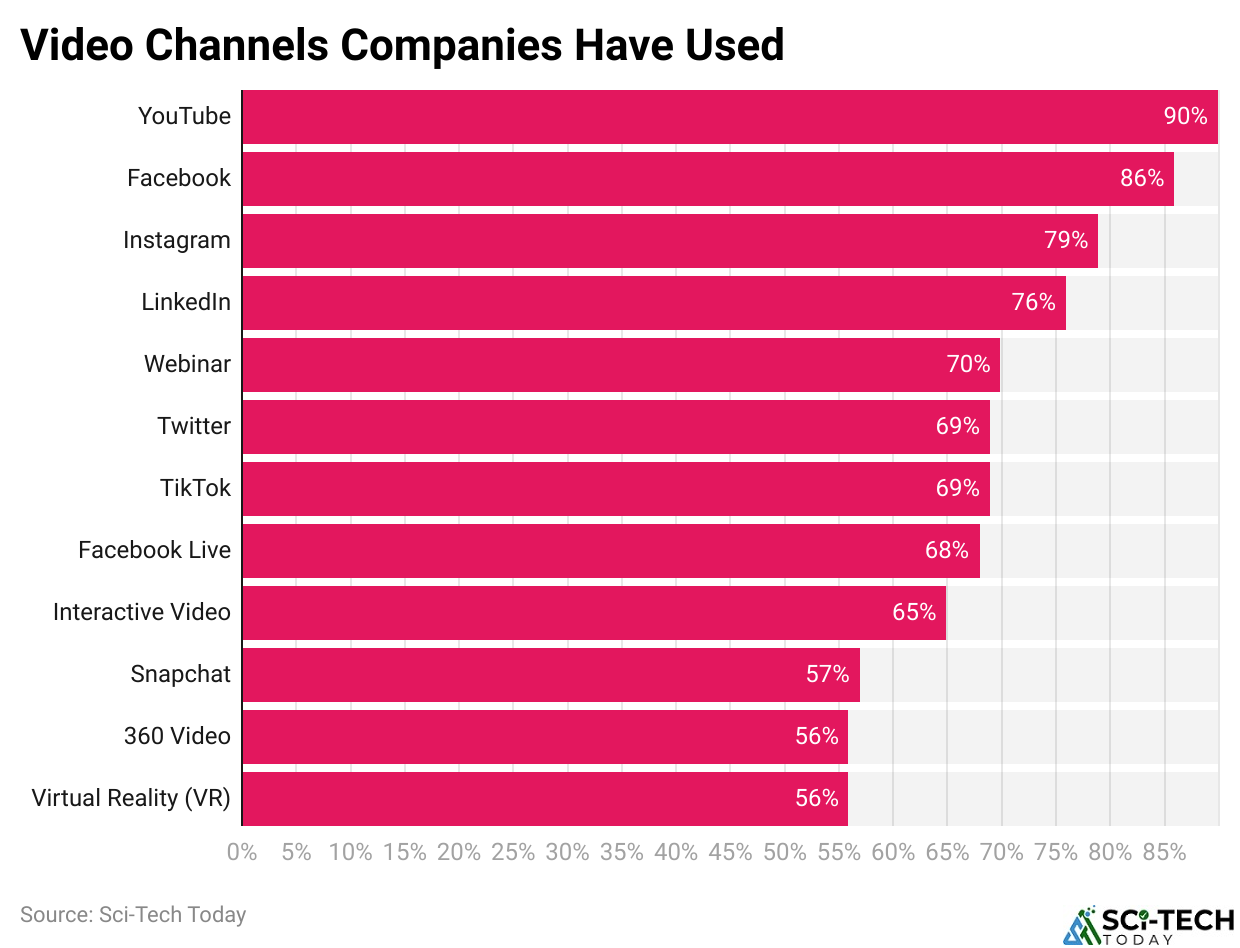
- In 2025, video marketing statistics further report that YouTube remains the premier video marketing platform, with about 88% of companies placing their confidence in the leading global video site.
- This is followed by LinkedIn (around 70% of video marketers using it), Instagram (about 69%), Facebook (around 66%), webinars (mid‑50% range), Twitter/X and TikTok (each used by a growing share of video marketers, often in the 44% range), Facebook Live, and interactive video formats, all of which continue to feature prominently in modern video strategies
- Moreover, the other least-used video marketing platforms by companies are Snapchat (57%), 360 Video (56%), and Virtual Reality (56%).
- On the other hand, YouTube continues to dominate as the premier video marketing platform, with 78% of marketers affirming its effectiveness. It is followed by Facebook videos (71%), Instagram videos (64%), webinars (61%), interactive videos (60%), and Twitter videos (60%).
- The least effective video marketing platforms are Facebook videos (71%), Instagram videos (64%), webinars (61%), interactive videos (60%), and Twitter/X videos (60%).
Video Marketing by Consumption
- In 2025, video marketing statistics report that video consumption continues to dominate online activity, with the average person spending around 115 minutes daily watching videos across platforms.
- Mobile devices now account for around 75% of all video views, and short-form content keeps gaining traction, with about 57% of viewers preferring videos under 5 minutes.
- Around 85% of internet users use video streaming services, and YouTube remains a key platform, attracting about 2.7 billion monthly users in 2025.
- Additionally, video content is projected to account for 82% of all internet traffic in 2025, making it the single largest category of online data.
- Roughly one‑third of total online engagement continues to be dedicated to video consumption, in line with estimates that 78% of people watch online videos weekly and 55% watch daily.
- Every week, individuals allocate around 18-20 hours to viewing online videos, as daily viewing time approaches two hours.
- Moreover, well over 90% often cited as near 97% of the audience engages with videos that explain products or services, underscoring the continued power of explainer content in 2025.
By Production
- A significant 35% of video marketing material is crafted entirely from the ground up.
- However, 48% of professionals rely on a blend of pre-designed templates.
- Notably, Video Marketing Statistics further elaborate that 81% of marketers emphasize that incorporating music boosts viewer interaction, and 66% utilize voiceovers to enrich their videos.
- 39% of marketers are responsible for producing videos internally.
- Additionally, 38% of these visual assets are developed through smartphone applications.
- Companies allocate budgets ranging from USD 100 to USD 1,000 for video creation.
- Similarly, 64% of videos are enhanced with captions.
Benefits of Video Marketing in 2025
- Studies reveal that video content now drives roughly 77% higher customer engagement compared to traditional media formats, and businesses report an average around 60% increase in brand awareness attributed directly to video campaigns.
- Furthermore, platforms like YouTube and TikTok have seen a continued surge in user activity, contributing to global video ad spending growth in the low‑double digits around 11% year‑over‑year in 2025.
- A remarkable 88% regard it as an integral component of their online video consumption strategy.
- Even more compelling, 30% of marketers regard video marketing as more critical to their overall marketing strategy than their website.
- A significant 68% of marketers who have yet to adopt video strategies intend to integrate this medium into their efforts in 2024, signaling a substantial pivot toward dynamic content delivery.
- Adopting a robust video marketing strategy has gained significant traction among small businesses, with 55% now leveraging this potent tool.
- Approximately 38% of businesses leverage in-house video production teams to craft their video content, ensuring a seamless alignment between their marketing videos, brand identity, and overarching company objectives.
Video Marketing Statistics By Businesses
- 91% of companies have integrated videos into their marketing strategies.
- Around 71% of B2B companies and 66% of B2C companies are leveraging video marketing in their strategies.
- Meanwhile, 69% of companies have allocated resources to paid video advertising, while 88% of marketers consider video marketing a cornerstone of their digital strategy.
- 30% of marketers assert that video marketing now holds a more pivotal role in their overall marketing strategy than their website presence.
- Additionally, 36% of marketers identify boosting brand awareness as the primary objective of their video marketing efforts.
- Nearly half (48%) of content marketers believe that their organizations must fully capitalize on video marketing’s potential.
- Meanwhile, 39% of companies need more time as the primary challenge in executing effective video marketing campaigns.
- Video Marketing Statistics also show that among businesses that have yet to adopt video marketing, 15% cite a lack of knowledge on how to begin as their primary deterrent.
- On the other side, 68% of these companies express plans to integrate video marketing into their strategies in 2024.
By Online Users
- As mentioned in Video Marketing Statistics, internet users are three times more inclined to choose a video tutorial on YouTube over a traditional text-based instruction manual.
- Almost 54% of email subscribers demonstrate a preference for emails that incorporate video content.
- 91% of consumers express a strong preference for increased video marketing content from businesses.
- In contrast, 47% of users are particularly interested in experiencing more live video content on social media platforms.
- Approximately 87% of business video content is largely watched using desktops.
- A larger percentage, 70% of people, are open to learning new products from businesses through YouTube.
- Also, more than 55% of buyers use the platform to make decisions.
- More specifically, more than 40% of people have purchased products discovered first on YouTube.
- In Video Marketing Statistics, 80% switch between using search engines and watching videos in their research process.
- Moreover, 82% of customers have been convinced to buy a product or service through a marketing video.
- Three-quarters of Millennials, which is 75%, watch videos every day on social media sites.
Reasons For Not Using Video Marketing
(Reference: wyzowl.com)
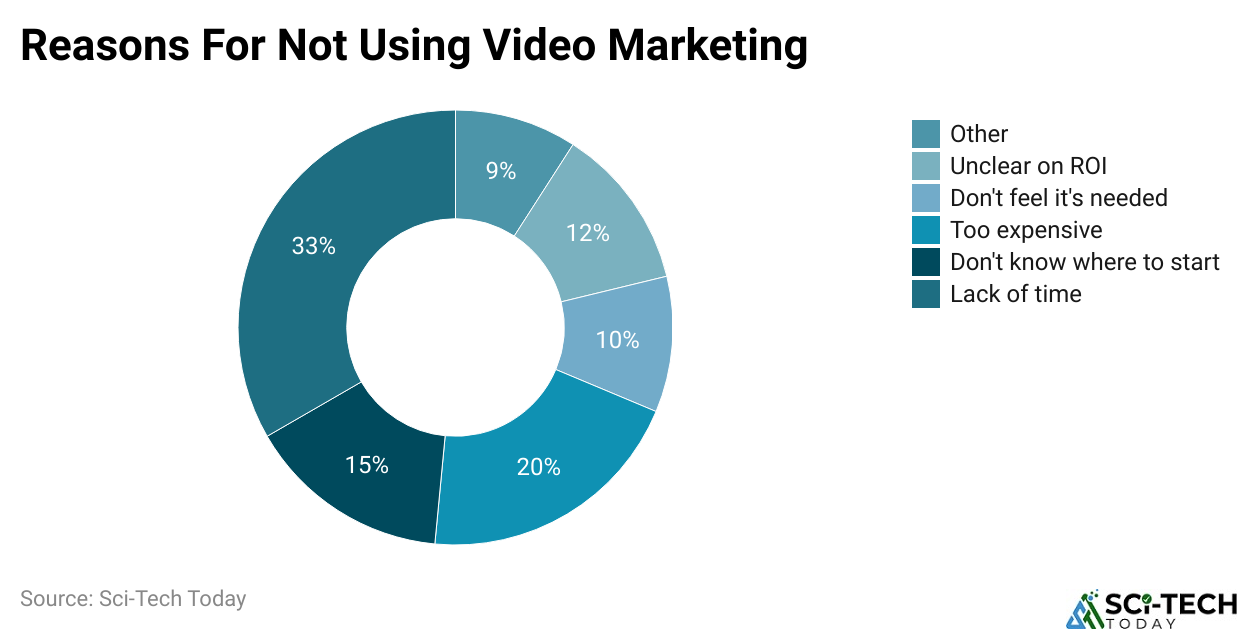
- The Video Marketing Statistics reveal that time limitations continue to be the key barrier to employing video marketing, as 33% of marketers use lack of time as an excuse for avoiding it.
- Besides, 20% of marketers avoid using video because of its expensive nature.
- While 15% are still figuring out how to get started.
- In addition, 12% need to understand the return on investment of video marketing.
- 10% think that video marketing is unnecessary for their approach.
Closure
Video marketing has become an indispensable tool for businesses, offering diverse formats to engage audiences effectively. The growing prevalence of instructional thought leadership and explainer videos highlights the versatility and strategic importance of video content in modern marketing efforts.
As companies continue to innovate and refine their video strategies, the impact of well-crafted video content on customer engagement and brand awareness is poised to grow even further, solidifying its role as a cornerstone of digital marketing.
FAQ
Video marketing is the use of video content to promote a brand, product, or service, increase audience engagement, and achieve specific business goals. It uses visual and audio elements to tell stories and build trust.
Promoting a video typically costs USD 0.01 to USD 0.30 per view on major platforms like YouTube and TikTok. Because digital advertising operates on an auction system, you have complete control over your budget and can spend as little as USD 5 to USD 10 per day to start testing your content.
A professional 2-minute video generally costs between USD 2,000 and USD 20,000, depending heavily on the complexity, style, and whether you require full-scale live production or just post-production editing.